

Ann and Hilary outside the Parents Centre
“I feel I was born to do the job of Education Social Worker at Manchester Parents Centre. It was an extension of everything I believed in my life. It was about addressing justice, giving back to people some control over what happened in their lives and to empower them to change things for themselves. It was not about me being their saviour – because they were capable of making those changes themselves – it was that they needed someone to show them how to and give them the opportunity to do so.”
So says Hilary Jones, who was the longest serving worker at the Manchester Parents Centre, which had opened in November 1981 in the Moss Side Centre, four months after the Moss Side riots.
Moss Side was a deprived area where many poor communities lived, including over 100 ethnic minorities. The riots of 1981 reflected a bitter divide between the young black people in the area (although some white people also took part in the disturbances) and the establishment represented by the police. Issues of poverty, deprivation and racism were highlighted, and the Parents Centre would be at the heart of the changes that would take place in the area. It was a radical initiative, one of only two such centres in the country.
Hilary grew up in Moss Side and comes from a Communist family, a household where ideas of internationalism and anti-fascism were seen as issues that everyone should be concerned with and everyone should be involved with. Hilary set up a Tenants Group on her estate, as well as being a shop steward at work.
A single parent with three children , she had returned to education and became a nursery nurse working in schools. When she saw Bangladeshi women and their children struggling with accessing the school system she set up a pre-school project – half day a week – to bring them together with other parents and children in the school.
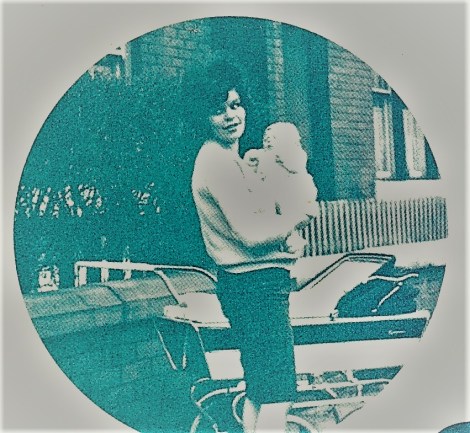
Hilary in 1961
The aim was to address their and their children’s needs so that they could take full advantage of the school system. This was the embryo of a parental involvement movement that would grow over the years.
In 1983 Hilary met Ann Hurst through her trade union, the National Union of Public Employees. Ann encouraged her to apply for the vacancy at the Parents Centre in Moss Side. Up to this point the two posts at the Centre had had teachers appointed to them.
The Parents Centre was a in a shop, originally a bookies, on the first floor of the Moss Side Centre. Walking in the atmosphere was not one of a traditional council office, but a brightly coloured space, decorated with posters created by the workers and parents that told the story of the work done in the Centre.
They had a wide brief : “home, school, community”. Everyone and anyone could walk through the door and be listened to, and people came by word of mouth as little formal publicity was produced about the Centre.
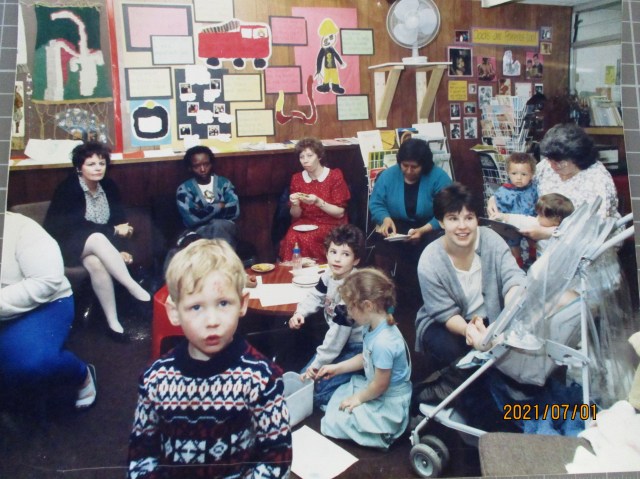
Event at the Centre.
Hilary says: “We were a bridge to schools and other agencies. People would turn up with an issue around benefits and we would listen, give them information, and help them to deal with the issue. Their being able to get to use the phone was crucial in those pre-mobile days.”
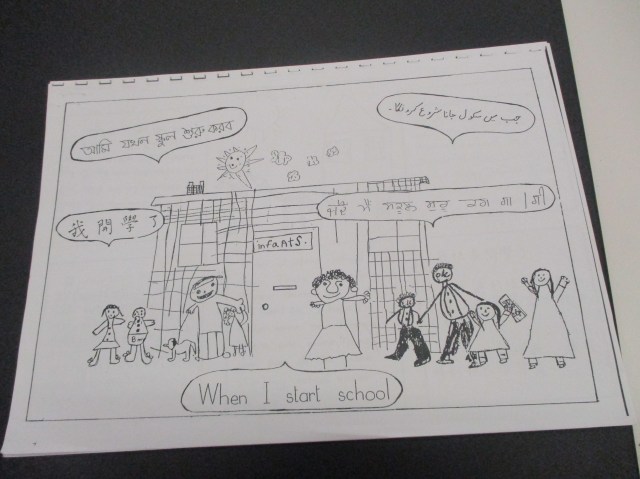
Booklet produced by parents and children about starting school.
Through the Centre parents met and worked together, and eventually a core group of parents got together who would take the initiative in setting up community lunches, getting involved with working groups, and even fundraising for they and their children to go on holidays together.

A holday for children and parents from the Parents Centre
Following the riots in 1981 there was a lot of suspicion between the community and the police. Militant groups were set up by black people locally and one of the big issues (and still is today) was about the underachievement of black boys and a school system that was seen as institutionally racist.
The Centre was part of this activity. “We were part of a network of local groups that shared ideas and gave each other support. A panel was set up and the Education Department came and answered questions from parents.” Ann and Hilary decided to produce their own anti-racist policy and, running alongside it, parents were brought onto the Centre’s Management Committee.
The Centre offered a neutral place to parents, breaking down barriers between the council and other agencies, offering a non-judgemental environment to people who were often seen as “problems” to council and government agencies.
A local doctor summed this up: “When I called there I realised I knew some of the people attending. They happened to be some of the parents who for years I had felt to be amongst the most vulnerable in the community. Often I had been amazed at how very well children of such parents often appear to cope – I suspect the answer may often have been that the hitherto unrecognised contribution of the Parents Centre has sustained and empowered such parents and has in fact saved many inner city children from faring as badly as could have been predicted.”

Parents Centre Leaflet
The motto was “You are Your Child’s First Teacher” a radical approach to working with parents that offered them the opportunity to explore their own issues around bringing up their children and encouraged them to take part in collaborative work with other parents.
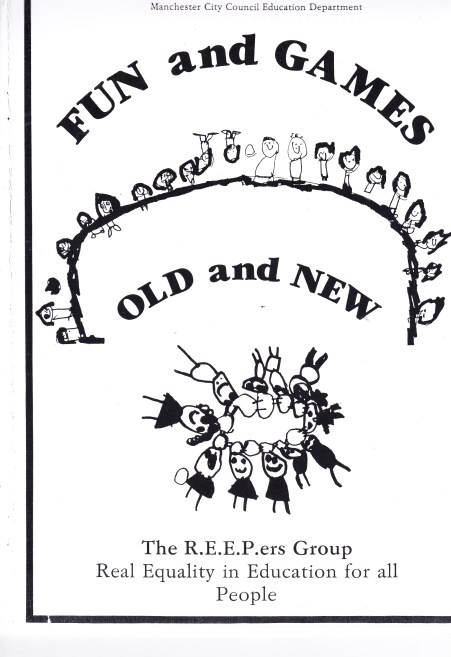
“The Real Equality in Education for all People” was a group set up by Doreen Kirven with parents which met twice a week at the Centre to discuss and exchange ideas. They produced a booklet, Fun and Games Old and New, which promoted play for children, showing how important it was, both physically and mentally. It brought together children’s games from all different cultures and showed that children are learning even when they are playing.
 Looking at the pictures of the Centre it does not look like a council run service. Hilary agrees: “We had a benign management who allowed us to make our own policies and decide how we wanted to implement them.”
It was about bringing all kinds of people together from different backgrounds with different languages and cultures. “We wanted to encourage parents to do better – for themselves and their children”.

Event at the Parents Centre
The Centre was next door to the 8411 Project which was a community education project which offered the parents courses to return to education and, most importantly, a crèche for their children to be cared for whilst they were learning. Parents were encouraged to become school governors – at that time few black people were represented on school management committees.
Other workers such as Pauline Richards brought different skills. Tony Atta, an Afro Caribbean father, joined the parents’ group and later became a youth worker who taught Information Technology skills to the parents. Doreen Kirven set up a creative writing group with the parents from which books were published. She also liaised with local theatres (including the Royal Exchange) and obtained tickets for the parents to go to their performances for free.
In 1993 the Moss Side Centre was demolished and the Parents Centre was relocated to a local school. It never had its own separate space again, but many of its practices and policies were incorporated into Children’s Services across the city.
The Parents Centre was a unique project offering parents and children the opportunity to take part in activities to improve themselves and their children’s lives. The parents had a level of power and influence that was rare (and rarer today) in becoming their child’s first teacher. In terms of numbers of enquiries it started at 30 per month and by the time it closed its doors the number was 900 per month.
After 14 years at the Parents Centre Hilary left to take up another role in the Early Years Service. She continued to work with children and parents and was able to take part in promoting issues around parental involvement in other parts of Children’s Services.
Hilary reflects on her time at the Centrre . “It gave me a validation both personally and politically about how I saw the world and how I could bring that into my working life. I was proud to do the job and it gave me a level of respect that carried into my personal life. “
The archive of the Parents Centre is in the Ahmed Iqbal Ullah Education Trust in Central Library, Manchester see https://www.racearchive.org.uk/

 lipstick socialist
Reblogged this on Anarchy in the Sticks!.