
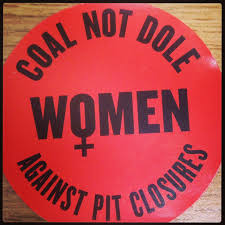
This is the inspiring story of a group of working class women who decided to fight to stop further pit closures seven years after the momentous Miner’s Strike of 1984-5. They set up seven women’s pit camps outside the most threatened colleries. This new and fascinating history book concentrates on the Houghton Main Colliery in the Dearne Valley in the South Yorkshire Coalfields.
The women’s aim was: “To challenge a government that, as a matter of policy, was bent on destroying the publicly owned mining industry, with little regard for the economic and social consequences on local mining communities.”
By 1992 there were only 50 remaining deep mines. Michael Heseltine, the President of the Board of Trade, announced on 13 October 1992, following the election of another Tory government, that 31 of these would be closed. Not reckoning on the public outcry Heseltine ordered a government review of the industry, but this review only included 21 pits and not the 10 earmarked for immediate closure.
This sparked the setting up in January 1993 of the women’s pit camps at seven of the ten most threatened pits. These were Grimethorpe, Houghton Main and Markham Main in South Yorkshire, Parkside in Lancashire, Rufford in Nottinghamshire, Trentham Colliery in Stoke and Vane Tempest in Durham.
In an interview Lynne, one of the women, summed up their determination: “The attempt to walk all over us, wipe us, our families, and our villages out has had the opposite effect…we are not bowed, not depressed, not about to admit defeat because we have got everything that is dear to us to fight for and absolutely nothing to lose.”
The women’s camps were set up outside the collieries and had the support of the miners as they went into work each day; the National Union of Mineworkers; local people; and the children, who were included in all the activities – because it was for them the women were fighting for, for their future and for that of their communities.

Many of the women involved in setting up the pit camps were veterans of the 1984-5 Miners Strike and had made links with other justice campaigns, including the Greenham Women’s peace camp.
The pit camps were organised around principles influenced by the women’s peace movement including non-violent protest, creativity and encouraging sharing skills, information and decision making.
After Heseltine’s announcement the National Women Against Pit Closures called for women and their communities to get ready to fight the closures. A lobby of parliament and a national demonstration showed that people were outraged by the threat of more pit closures.

Sheffield WAPC issued its first Bulletin in October 1992, pledging their support to the fight to keep the pits open and, most importantly, making the links with other industries, showing that closing mines meant the decimation of other industries from rail, power and engineering to factories, retail and service industries.
This book is a manual for how to organise political activity. Not just a written history, but one that interweaves individual women’s stories through their words, diaries, photos and news clippings.
It shows the importance of grassroots organising: involving the local community, involving children, making links with other groups fighting injustice, and, most importantly, keeping the solidarity work going even after the demise of the camp.
One aspect of organising a campaign has changed from 1992-3 is that activists today can use social media – which is direct and can straight away speak to thousands of people. But in 1992 the women organised using “snail mail” and telephone trees. “Each telephone tree started with one woman, who rang the next two and so on.” But they also talked to each other, and used a camp diary and messages to keep the activists involved with what was happening.

In the book there are pictures of the telephone trees, the camp diary and the message book. But they also wanted to inform as many people as possible. “We wanted control over our message: the campaign was not about pay, but about people’s livelihoods and communities, and our children’s future, just as it was in the 1984-5 strike.”
You Can’t Kill the Spirit is a brilliant book on many levels. It is interesting, accessible, and gives a crucial account of a significant period of working class history. It is an example of how to set down and record working class history. Most importantly it shows you how to run a campaign .
There are modern day parallels, particularly the Durham Teaching Assistants campaign in 2016-2017, which again was about a group of mainly women workers fighting injustice at work but aware of the bigger issues about “women’s work”, the importance of education and community.
There are big questions to be asked about organising in 2019 and why so many people feel alienated from trade unions and political parties and why ideas of community and solidarity are often seen as speaking in a different language.
But Socialist Tony Benn is quoted and his comments sum up the story of the women’s pit camps and why some people, often the poorest and most disadvantaged, are still fighting . “You cannot obliterate from the human spirit two things – the flame of anger at injustice and the flame of hope for a better world.”
You Can’t Kill the Spirit can be ordered by emailing SWAPCPitCamp1993@gmail.com or by writing to SWAPC, c/o 6 Burnside Avenue Sheffield S8 9FR. The book costs £12 including post and packaging, though a solidarity price of £20 is suggested. Cheques should be made out to SWAPC Pit Camp Project.

 lipstick socialist
Reblogged this on Wessex Solidarity.
Reblogged this on Anarchy by the Sea!.
Reblogged this on Industrial Workers of the World Dorset.