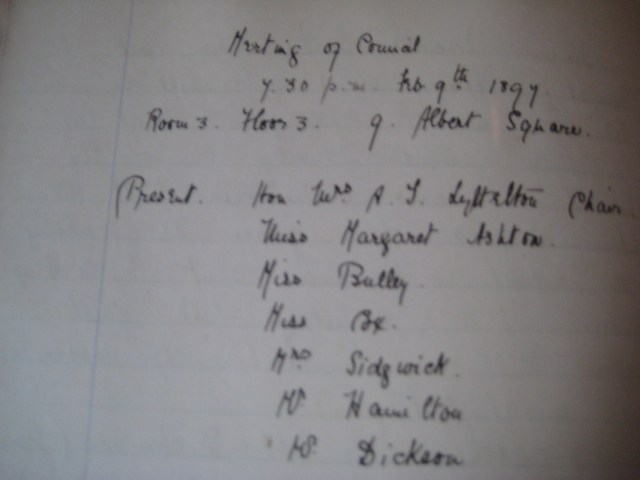
During the years 1897, 1898 and 1899 the Manchester and Salford Women’s Trade Union Council continued their work of organising women into trade unions, researching the experiences of women at work, and lobbying for better work conditions for women workers.
The make-up of the Council started to change as the number of women’s trade unions increased, so the MSWTUC invited their representatives onto the Council. In Oct 1898 the Secretary of the Pipe Finishers Trade Union became a member of the Council.
They also became recognised as a key organisation in organising low paid women into unions with national trade unions addressing their meetings. A special General Meeting was held in Oct 1898 when the General Secretary of the National Union of Shop Assistants spoke about the lives of shop workers and proposed legislation.
The MSWTUC worked with other organisations to encourage women to organise themselves into unions. The benefits of being in a trade union meant the women could get strike pay, out-of-work pay and funeral benefits; and, most importantly, women in trade unions were able to agitate to get their wages increased. Organising women was not easy as the MSWTUC found out when they conducted an investigation into laundries. In order to talk to the women they had to visit them at home on a Monday –the only day they had off work-when they were busy doing their housework.
Cigar Makers
The MSWTUC worked with the London-based Cigar Makers Mutual Association because of an incident at a workplace in Manchester. One of the union members was collecting dues, and was instantly sacked by the owner who did not want union members working in his factory. The other women workers stopped working, Mr Cooper of the national CMMA came down, and together with the MSWTUC, advised the women. When the employer saw the women removing their tools, so serious were they about the strike, he relented and they went back to work. In Manchester 200 women were involved in the trade and the number of women in the CMMA numbered 90.
Jewish Labour
In the Manchester and Salford area there was a large Jewish community, with new immigrants of whom some only spoke German and Yiddish, and therefore could be easily exploited by factory owners. In November 1897 a report is made about an employer who tried to use Jewish immigrants in one his factories, no doubt to undercut wages, the women workers responded and the Minutes noted that they ”…Had been successful in their attempt to secure the abolition of Jewish labour in the factory”. The women called in the MSWTUC who invited them to join the Federation of Women Workers. The MSWTUC suggested that the Jewish unions should produce recruitment leaflets in German and Yiddish.
The Jewish Tailors Machiners and Pressers proceeded to organise Jewish Tailoresses and arranged meetings at the Jewish Labour Hall and the MSWTUC took part. The women were organised as a branch of the JTMP, agreeing to work with the men over wages, but were organised in their own branch.
Upholsteresses
They obtained a wage increase without any difficulty because they were now organised into a trade union.
Lobbying
In these years MSTUC
- Supported the petition circulated by the Manchester and Salford TUC (male workers) for increased railway facilities and cheap trains for workers.
- Supported Bill sponsored by National Union of Teachers to raise age of children in employment from 11-12 years.
- Responded to Select Committee on proposals for Old Age Pensions. They said it would not be just or expedient to expect to demand contributions from women who received low wages.
- Issued a leaflet with the Womens Trade Union League on Compensation for Injuries at work.
- Produced a Fair List of Laundries that they sent to the Home Secretary.
- Passed a resolution protesting against the curtailment of the powers of the new Chief Lady Inspector. At this time there were separate Inspectors for male and female industries.
Funding
The MSWTUC was funded originally by subscribers: wealthy people who wanted to help create the organisation and support its activities. Holding meetings in the drawing rooms of the wealthy elite is a recurring activity in the Minutes, but as the organisation established itself then other like-minded groups gave it grants. This included the Federation of Women Workers, the Shirt Makers Union, and the Upholsteresses Society.
Read about the MSWTUC Transcription Project here
Donations are welcome to continue this project – there are 23 years of Minutes- please contact maryquaileclub@gmail.com

 lipstick socialist
Fascinating. Where do I send donation to? sandy
On 19 October 2016 at 08:55, lipstick socialist wrote:
> lipstick socialist posted: ” During the years 1897, 1898 and 1899 the > Manchester and Salford Women’s Trade Union Council continued their work of > organising women into trade unions, researching the experiences of women at > work, and lobbying for better work conditions for women wor” >