History of the Irish in Britain Representation Group by Patrick Reynolds.Part 5; 1985

Patrick Reynolds was one of the founders of IBRG and played a key role in its history. He is now writing up that history and putting it into the context of radical history in Britain and Ireland in the C20th.

New mailCopy

maire 2

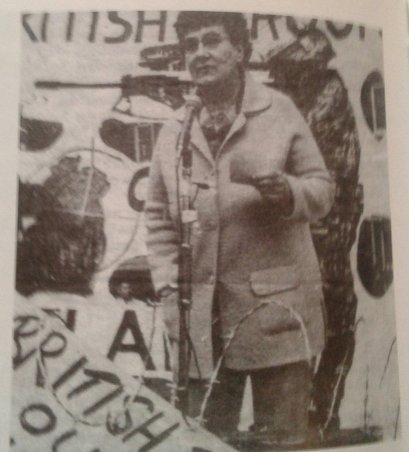
Maire O’Shea Defence Campaign Leaflet

This year started early for the IBRG when Peter Jordan was arrested in Liverpool on Christmas Eve 1984, while IBRG member Peter Lynch was  arrested on New Year’s Day 1985,  along with others following  joint Gardai raids in Dublin.

On New Year’s Day an Irish Press editorial in Dublin covered the case. It reported a Dublin man had been arrested in Liverpool on Christmas Eve at the same time as the Gardai had raided the family home in Dublin the same evening, without informing the family where the missing man was.

The Editorial stated: ‘this is not the first time that the Prevention of Terrorism Act has been used in Britain to humiliate and degrade innocent Irish visitors. Indeed, so common has it become that Irish people feel justifiably nervous when arriving at British ports or airports. There seems to be an attitude among the British Special Branch to Irish people visiting Britain, which owes more to the old caricatures of the dangerous Paddy in Punch than to any real information. The incidence of detention under this particularly oppressive law would indicate that the British police seem to think of all Irish people as terrorists or potential terrorists…. The whole Liverpool episode highlights the almost racist nature of the way in which the Prevention of Terrorism Act is implemented’.

On 5 January 1985 the Irish Times covered a major IBRG statement condemning the recent arrests of six people including three IBRG members under the PTA under the heading ‘Group Condemns Arrests’.

The  Birmingham home of IBRG member, Dr Maire O’Shea, who was Ireland at the time,  had been searched on Christmas Eve. The IBRG noted that the arrests followed a week after the IBRG announced the start of a public campaign in Britain and Ireland against the racist PTA laws, which had created a suspect community of the Irish in Britain.

After Maire O’Shea was arrested Joe Mullarkey of Bolton IBRG remembers: “ Following Maire O’Shea detention in Liverpool,  myself, Jim King, Arthur Devlin, Kathleen and David Wright went to Liverpool and picketed the police station. Cannot remember the date only it was a Sunday night. Arthur Devlin visited Peter Lynch on a few occasions when he was moved to Manchester. I also visited Peter.”

The Irish Times covered in full our long and detailed statement setting out our demands in relation to the PTA. IBRG called on the Irish government to end their subservient role they had with Britain over the PTA, and stand up and defend their citizens abroad and their citizens travelling to and from Britain. They reiterated  our call to the Irish government to publicly condemn the PTA and call for its repeal, to monitor each and every arrest under the PTA and to provide a solicitor in Britain to assist those arrested under the Act.

During the week, while Pat Reynolds was working on the case with Maire O’Shea’s daughter who lived in St Albans, and Irish journalists, his phone was cut off by the Special Branch and he had to leave his house to go to a safe place to continue his work. Ten hours later the phone was restored after the house in St Albans had been raided.

On 8 January 1985 the Guardian covered the arrests. Pat Reynolds was quoted: ‘the PTA is a political breathalyser. If an Irish person expresses political views, he is considered above the limit’.

Clive Soley, Shadow Home Office spokesperson, stated: ‘I regard it as one of the most serious infringements of the democratic rights of British people’. The Guardian article was headed “Opponents of anti-terrorist act renew campaign”.

In a letter to the paper Christine Crawley MEP wrote: ‘It is particularly used to intimidate those people who are active in voicing their anger and frustration at the troubles in Northern Ireland, and it creates an invisible line over which Irish people dare not step in the articulation of their concern. The problem for Irish people is that the position of the invisible line continually changes…The Act should be torn to shreds.’

On 10 January 1985  Gearoid McGearailt  and Pat Reynolds met with the Irish Ambassador in London. They  expressed  IBRG concerns over the arrests and the fact that the Embassy  would not provide any kind of legal support for those arrested under the Act, and  would not even ask that the British government to  inform them of every arrest under the Act.

Watch two films about the Maire O’Shea campaign here

and here

After the meeting they put out a statement  expressing the concern of the IBRG  at the inability of the Irish government ‘to recognise the PTA as a racist weapon of repression used unjustly and indiscriminately against Irish citizens living in or visiting Britain’.  The IBRG called on the Irish Government  to demand that international practice be adhered to, and that the Irish Embassy be informed every time an Irish citizen is arrested under the Act. The IBRG asked Ambassador Dorr to attend a public meeting in the Irish community to hear the views of the Irish community on the use of the Act against them.

On 12 January 1985 the Irish Post ran an Editorial entitled “PTA Victims”. It started by stating that ‘The PTA is a despicable piece of legislation.” It ended by stating ‘Irish community organisation should in no way curtail their activities. Indeed, they should accelerate them.  When this business has passed, the IBRG will emerge strengthened by recent events and from its mature and effective reaction to them’. Our community is beyond reproach, and in a law-abiding fashion throughout the past 15 years of violence emanating from N.Ireland, but it has suffered, both by ways of intimidation and at times harassment.’

On 12 January 1985, PRO Pat Reynolds went to the BBC studio in London to do an interview with RTE over the PTA. When he found that Seamus McGarry, of the Federation of Irish Societies,  was on directly after him, hewaited in the studio to have a chat with McGarry after his interview. Pat was shocked to hear the interviewer from Dublin state over the line before the interview  that the Irish Ambassador had asked RTE to put on Mr McGarry. Seamus went on to do the interview but sadly took the Irish Government line on the PTA, that they were faults with it and how it was used, but failed to call for its abolition.

Just as during the Hunger strikes, the Federation had again let down the Irish community, and betrayed them when a show of unity was required against the PTA. It also showed how the Irish Embassy was interfering with the lawful rights of the Irish community in Britain and supporting British oppression of the Irish community

On 13 January 1985 the Sunday Tribune in Dublin carried a full-page story on the operations of the PTA with headline “London Embassy is attacked for inaction over PTA arrests.” The Department of Foreign Affairs in Dublin had been forced for the first time to brief Irish journalists on the role of the Irish Embassy in London. The response was very defensive and did not address any of the concerns raised by  IBRG.

The Embassy stated that their primary function was to safeguard the welfare of Irish citizens abroad, but failed to mention that the highest welfare is for a person wrongly arrested under racist laws. The paper reported that three of the arrested people were IBRG members: Peter Jordan, Peter Lynch and Dr Maire O’Shea, who were all member of the IBRG Prisoner Subcommittee, who had recently announced that they were setting up a public inquiry into the Birmingham Six case. The Ambassador stated that the recent PTA bill was better than the previous one. This was a most shocking statement for the Ambassador to make of such a racist piece of legislation which targeted the Irish community in Britain.

On 13 January 1985 (1)   the IBRG Ard Choiste met at St Finbarr’s Club, Coventry where 20 members attended, as delegates or officers. This included: Jim King Chair, Judy Peddle Runai,  John Martin,  Joe Mullarkey, Alan Wallace,  Pat Reynolds,  Gearoid McGearailt, Fionbarra Cuillin, Nessan Danaher, Caitlin Wright, John Stanley, Seamus O Coileain,  Denis Casey, Vincent Johnson, Pat Keane, Sean Cross, Martin Collins, Arthur Devlin and JP McCabe, Maurice Moore and Mick Burke from Coventry were observers and  Mary Ann and Angela Lynch, daughters of the arrested man, Peter Lynch, attended part of the meeting.

The first part of the meeting was held as an emergency Ard Choiste on the PTA and  the arrests with the main Ard Choiste held after lunch. The PRO outlined the situation to the meeting, with six arrests on Christmas Eve, of these two men were from Dublin, and Peter Jordan from Bristol were charged.

Peter Lynch and Pat Daly (Bristol) (later identified  in the press as an  MI5 agent) were arrested on New Year’s Eve with Peter Lynch charged and Pat Daly released.  Maire O’Shea’s house was   searched.  She returned from Ireland on 9 January and was later arrested and charged. There were problems with the situation as it involved Christmas and the New Year.

Pat Reynolds, PRO,  had completed a number of interviews with the Irish Times, Irish Independent, Irish Press, BBC World Service and a Radio station in New York where he had argued against the PTA and called for its repeal. The meeting heard back from the meeting on  the previous day where the Ambassador would only say the Irish government were concerned.


The Ard Choiste heard of IBRG plans to launch the campaign  against the PTA at the Commons with Clare Short MP and Christine Crawley MEP on 22 January 1985. Caitlin Wright and her partner Rev David Wright had been to see Peter Lynch on remand.  A defence campaign had been set up for Dr Maire O’Shea in Birmingham made up of IBRG, Troops Out, Trades Council and ASTMS, and there had been a picket of Birmingham police station. Pat Daly had been questioned over a firearms offense but had been released on police bail.

Gearoid  brought a new PTA leaflet to the meeting which could be circulated widely and be used as a campaign leaflet.  The meeting heard from the two daughters of Peter Lynch about the arrest and house search that went on.  A fund was set up to help out the families of those arrested.

The Ard Choise agreed to arrange a delegation to Dublin within the month to raise the issue in Ireland. The Chair, PRO, Leas Runai, Caitlin and David Wright would go on the delegation.

The Ard Choiste main meeting heard from Nessan Danaher, Education Officer, who told the meeting he was planning a bigger and better Education Conference in February this year and that he had printed over 700 copies of the Conference report from last year which had all gone out.  He had an article in the Times Educational Supplement last Friday on the conference.

The PRO informed the meeting that the new branch in Camden looked very promising and that new branches were planned for Hackney, Stratford and Brent. He informed the meeting that the CRE believed John Junor’s article in the Sunday Express to be a possible breach of the Race Relations Act, but they had no power to prosecute, and that the police or Attorney General would have to consider that.

He informed the meeting that a broad-based Irish community organisation had been set up in London to combat racism in the media and that branches should work with it. He had prepared a Media Monitoring leaflet which was going out to branches outlining actions to take over any offending article.

The Ard Choiste decided to hold at the Ard Fheis on 30th March 1985 in London.

On 14 January 1985 Maurice Hearne in the Irish Independent wrote a piece defending the Irish Ambassador who had been forced on the defensive. The piece was extremely one sided and unbalanced. It included a paragraph which stated ‘while the Act may have been operated unfairly in some cases against members of legitimate Irish organisations in Britain, it is fair to point out that the supporters of violence have been able to infiltrate those organisations and shelter behind their legitimacy’. It was very clear that the IBRG had the Irish Embassy and the Irish Government rattled and had put them on the defensive. The IBRG would challenge the Irish Ambassador on this dangerous false story.

Christine Crawley MEP, and IBRG member, took the PTA Campaign into the European Parliament with her motion which stated that ‘the European Parliament condemns the continued use of the PTA by the UK, expresses its deep concern at the erosion of civil liberties under the arbitrary use of the powers of the PTA, calls on the British Government to stop the renewal of the Act, and instructs its President to forward this resolution to the British Government, the Council of Ministers, the European Commission and the Secretary General of the United Nations”.

The preamble stated ‘having regard to the abuse of the UK PTA during the months of December 1984 and January 1985 in which several people have detained in Britain without access to any of the rights afforded to detainees under normal criminal law. The motion lost by only 11 votes. Mary Bonetti of Fine Gael representing the ruling class in Ireland presented her counter motion which stated “The European Parliament  calls for an investigation of the recent assertions of harassment and infringement of human rights of Irish nationals resident in Great Britain under the PTA, and instructs its President to forward this resolution to the Commission and to the governments of the Members sates.” This was passed.

Here you get the Dublin government coming to the rescue of their colonial masters and acting like a provincial government of a colony. Shame on them, and their support for the racist targeting of their own citizens by a colonial government.

The Labour and Ireland magazine in January 1985 covered the story with “New Terror Act Row Government uses law against Irish”. It stated:  ‘The IBRG is active in supporting Irish prisoners in British jails, campaigning against anti-Irish racism in the media and in defence of the democratic rights of Irish people. The promotion of national pride by the IBRG runs directly against the silencing of the community engendered by the use of repressive legislation like the PTA, so it is no wonder that the use of the Act should come to be directed against organisations like the IBRG’. It quoted Roy Hattersley  ‘Irish visitors feel threatened and harassed at the ports, and the whole community feels under constant suspicion’.  Niall Andrews, Irish politician, stated ‘Nothing surprises me about the British police and Special branch and the paranoia they have about Irish people. They have the general feeling that every Irish person is a terrorist’.

City Limits in London stated: ‘this recent spate of arrest was targeted at the IBRG. This was formed four years ago and had attracted over 2,000 members. It aims to act as a social, cultural and welfare organisation for Irish people living here, but its members are not averse to speaking out and campaigning on political issues’.

On 19 January 1985 the Irish Post ran a headline “IBRG Campaign to Repeal PTA” which set out our planned House of Commons launch of the Campaign planned for 22 January 1985.  On 19 January IBRG took part in an Irish day in Hackney east London which drew a huge crowd.

On 21 January 1985 the IBRG attended a meeting at Conway Hall on the case of Giuseppe Conlon’s case,  one of the framed Irish prisoners.

On 21 January 1985 Manchester IBRG held a joint meeting with Labour and Ireland at Manchester Town Hall on the PTA at which Christine Crawley spoke.

On 23 January 1985 the Irish Times ran its headline “Terrorism Act repeal campaign launched” which reported on the launch of the campaign at the House of Commons. Jim King, Chair of  IBRG, spoke and described the PTA as an iniquitous piece of legislation, and said the Irish community in Britain was overshadowed by fear because of it. Christine Crawley MEP said the campaign would be a disciplined nationally co-ordinated campaign in Britain designed to tear the Act to shreds. She mentioned her Resolution to the European Parliament had only failed by 11 votes but the Parliament had still voted for an inquiry into the PTA with a second Resolution by Mary Banotti of Fine Gael:  Ms Crawley hoped the investigation by the European Parliament would be a very hard hitting one.

Clare Short MP stated that the PTA is seen as a measure ‘used to harass and intimidate Irish people and in a particular any Irish person who has the gall to become politically active”. Joan Maynard MP stated that the PTA had nothing absolutely to do with terrorism and everything to do with collecting information and intimidating the Irish community in Britain.

In January 1985 Richard Greenwood, English Rugby coach, had come out with a racist comment about the Irish rugby team needing a brain transplant. The Irish Press stated that the ‘remark betrays a state of mind which lies at the root of the anti-Irish joke, so offensive to our emigrants in Britain. That attitude is a throwback to the old days when Irishmen were depicted  in Punch cartoons as ape like  creatures, treats all Irish people a being of less intelligence than those of other races’, and  ‘Anti Irish jokes  are a  different matter  for the Irish living in post Brighton Britain, where the PTA and scribes like John Junor combine to create a hostile environment’, and   ‘the prospects of Irish youngsters chasing scarce jobs in Britain are unlikely to be enhanced  by this continued portrayal of the race of being less than bright, and Irish children at school in Britain face a similar ordeal’.

On 4 February 1985 Pat Reynolds gave a talk on the Irish community in Britain to sociology students at Goldsmiths College in south east London.

On 5 February 1985 a public meeting was held at County Hall London on strip searching where Ken Livingstone spoke and  focussed on the cases of Martina Anderson and Ella O’ Dwyer in Brixton Prison. IBRG also had   a speaker on the platform which was organised by Irish Prisoners Appeal who used the Lambeth IBRG office as their mailing address.

The debate on the PTA in Dail Eireann took place on 6 February 1985 with Fianna Fail putting a motion which  condemned the  PTA as a racist piece of legislation.  Fianna Fail had spoken about the work of the IBRG during the debate. The motion was defeated by only 7 votes, as Fine Gael and shamefully Labour, brought forward their motion criticising some of the uses of the PTA, same as in the European parliament.

Within   a month the IBRG had forced both the European Parliament and the Dail to consider the racist PTA and how it was being used to abuse the rights of Irish citizens living in or visiting Britain. It was a remarkable performance by an Irish community organisation in Britain to stand up and call out the PTA for what it was.  It was the beginning of serious fight back by the community which would in the end force the British government to release the Birmingham Six, the Guildford Four, and the Maguire Seven.

Without this PTA fight none of this would have happened. It was the cutting sword of the IBRG that paved the way for future progress in the community by creating a safer environment for Irish people to come out and speak about these injustices.

On 8 February 1985 IBRG attended a Greater London Council  meeting on Penal Institutions to ensure material on the rights of Irish prisoners was included e.g. strip searching and transfer of prisoners.

On 13 February 1985 the first meeting of Hackney IBRG took place at Centreprise Bookshop, it followed on from the successful one-day event which 80 people attended.

On 14 February 1985 an IBRG delegation went to Dublin to launch their PTA campaign directly to the Irish people.  On the delegation were Jim King Chair, Gearoid  McGearailt Leas Runai, Pat Reynolds PRO, along with David and Caitlin Wright.

Charlie Haughey was very impressed when he found what he thought was a Catholic priest on our delegation, but when Rev David Wright mentioned “my wife Caitlin here”,  Haughey eyes rolled up to heaven. Haughey seemed to think that the IBRG were ahead of their time with a married catholic priest, but Martin Manseragh, his advisor, realised that David Wright was an Anglican priest.

The meeting with Haughey raised the question of the PTA and anti-Irish racism in Britain and the fact that semi-state bodies were still sponsoring these racist papers with advertising. Haughey agreed with us and promised help, apparently, he would be playing a round of golf with the top Aer Lingus man, and would raise the issue with him.

When Pat Reynolds raised with Haughey the cases of the Birmingham Six, Guildford Four and Maguire Seven, Haughey asked if IBRG thought they were all innocent, meaning all the republican prisoners, as well. The framed prisoners were not volunteers but innocent members of the Irish community who had been taken hostage by the British government as a warning to the Irish community.

The IBRG stated there was a difference between the framed prisoners and political prisoners who were volunteers, who got huge sentences and were not allowed to transfer nearer to home. Haughey promised to continue his opposition to the PTA should he get back into power. This did not fact happen as Fianna Fail failed to oppose the PTA when they came to power. The IBRG met Matt Merrigan , President of the Irish Congress of Trade Unions, Tom Hartley Sinn Fein, and many others.

IBRG held a Press Conference at Buswells Hotel opposite the Dail which was well attended and got two interviews with RTE, and  one with Caitlin Wright on Women’s Hour.  The IBRG also met the National Union of Journalists  in Dublin who were supportive on both the PTA  and anti-Irish racism in the media.

In Manchester the IBRG announced that the Irish Line radio programme  would be going weekly from 1 March 1985. It had started as a monthly show.  The programme  had recently interviewed Tony Lloyd M.P. who was also an IBRG member. The show had over 25,000 listeners each time and had being broadcast since December 1983.

On 15 February 1985 the Irish Times headline said  ‘Emigrant group to meet Haughey on PTA’, and on 16  February a follow up “Fianna Fail  talks to Group over Terror Act”.

On 16  February 1985 Nessan Danaher held his Second National Conference on Irish Dimensions in British Education at Soar Valley Leicester  which over 200 people attended from all over Britain. This included  Coventry, Liverpool, Hounslow, Northampton, Milton Keynes, Birmingham, Manchester, Stafford, Humberside, Nottingham, Burton On Trent, Loughborough, Leeds, Worchester,  Sheffield, Bolton, Bradford, Rugby, York, London and  many more places, from Universities, adult education, convents, colleges, secondary and primary schools, community organisations, cultural and youth groups.

Among the Universities  present were Leicester, Nottingham, Manchester, London, Sheffield, Birmingham and other institutes and Polytechnics. Among the speakers were Dr Philip Ullah , Dr Ita O’Donovan from Birmingham,  Brid Keenan IBRG, Mary Hickman IBRG and Nessan Danaher IBRG. It was a huge success, and probably the largest gathering on Irish Education in Britain since the days of St Columba.

Mary Hickman  looked at issues around identity and racism in education, Dr Philip Ullah talked of the psychological aspects of identity among second generation Irish, Brid Keenan on the areas of cultural production and reproduction in terms of the multi-cultural and anti-racist debate and the relevance of  culture to the Irish in Britain and in Ireland. Dr Ita O’Donovan spoke  of the concepts of ethnic identity and patterns of adjustments that immigrants will adopt in the host society, with reference to the first and second generation Irish, while Nessan Danaher  looked at why the Irish community only lately  sought official recognition within the education system and  looked at some of these in Local Education Authorities and the Catholic Church system.

The Irish Post in writing up the conference with two double spreads of photos over two weeks stated ‘our community is moving onto a new level of discernment and professionalism.  There is a cutting edge to it and much of it is being provided by the second generation.  Five or ten years hence, we are going to be a very effective community.’ The paper also included a big spread on Nessan Danahers’s ten-week Irish studies course which had just finished in Leicester over 60 people attending.

On 21 February 1985 both the Irish Times and  the Irish Independent carried a report of the IBRG press conference in Dublin listing our demands and included a list of the people we had met in Dublin.

On 22nd February 1985 Gearoid McGearailt and Pat Reynolds met with Peter Barry at the Irish Embassy over the issue of the PTA.  The IBRG rejected Barry’s stated position that the Irish government had a  ‘a gentleman’s agreement’ with the British government over  an acceptable level of PTA arrests, and informed him that the Irish government had an international duty to protect their own citizens abroad  and those visiting British,  and to protect them from the racist and discriminatory PTA harassment. Seamus McGarry and John Fahey of the Federation of Irish Societies met Barry also at the Embassy and never even mentioned the PTA during their discussions with Barry.  Barry in his Dail speech referred to 600,000 Irish citizens living in Britain,  thus ignoring those from Northern  Ireland who claimed the right to Irish citizenship, and the second generation Irish in Britain who also had the same rights.

On 23  February 1985 the Irish Post ran a major story entitled “Phantom interview with Ambassador” after the IBRG had raised their concerns about the story which stated that Irish organisations in Britain had been infiltrated by supporters of violence. The Irish Ambassador had denied ever giving Maurice Hearne of the Irish Independent any interview, after Hearne had stated in his article that the Ambassador ‘had assured him’ clearly giving the impression that he had talked directly with the Ambassador in the article of 14 January 1985.

While the IBRG after writing to the Ambassador for clarification on the matter, noted his response, it further noted that the Ambassador did not ask Mr Hearne son of a former Ambassador,  or the Independent to withdraw the remarks, or indeed even write to the Irish Independent to correct the falsehood. It was the second time Dorr had come under fire over his alleged remarks. Earlier he was quoted as stating that ‘there will always be a British dimension in Ireland’ which Charlie Haughey took up in the Dail when he asked Dr Fitzgerald if this was now government policy. The Department of Foreign Affairs then claimed Dorr had been misquoted.

The IBRG drew attention in this case that the Ambassador was not asking the Irish Independent to withdraw their dangerous allegation about Irish community organisations in Britain. The Department of Foreign Affairs failed to act in this matter and Hearne never withdrew the remarks. The community was left with a view that he could have been briefed by the Embassy on the matter before he wrote the article, given the failure of Foreign Affairs to challenge him.

In the same issue of the Irish Post in the Letters page there were letters from the USA and Ireland saluting the Irish community in Britain for standing up to the racism of the British media and particularly to  John Junor. From the USA ‘I applaud the  young Irish in Britain standing up so proudly, not alone against invective but in articulating the shortcomings of eth Irish government and its agencies’ and ‘we here  will stand and respond to the brave Irish in Britain on this issue and any other issue of its kind which may come up’. From Dublin the top letter stated ‘To the Irish in Britain, I say keep right on. An extraordinary number of people here are following with interest and pride your stand against the John Junior insult’ and so hold firm. The rapidly wising up Irish in Ireland are with you too’.

In an Irish Post Editorial of the same day under reassurance. It stated that: ‘The Irish in Britain are not for misinterpreting by the Donnybrook set’ and ‘Meanwhile it would seem essential that Irish organisations in Britain with the assistance of the Department of Foreign Affairs insist on Maurice Hearne withdrawing his scandalous allegation of 14th January 1985.

On 23 February 1985 the Irish Post headline “IBRG and Haughey in fruitful talks” gave a report of the successful IBRG delegation to Dublin. Haughey had promised IBRG that when returned to office Fianna Fail will take whatever steps can be considered reasonable in support of the Irish community in Britain, and also promised that when back in government they would maintain their opposition to the PTA

On 23 February 1985(2) The IBRG Ard Choiste met at the Irish Club in Liverpool  when 18 officers and branch delegates attended including Jim King Chair, Judy Peddle Runai, John Martin, Joe Mullarkey, Pat Reynolds, Caitlin Wright, Gearoid McGearailt, Finonbarra O Cuillin, Michael O Cnaimhsi, Seamus O Coileain, Maurice Moore, Arthur Devlin,  and Maire O’Shea.

Two daughters of Peter Lynch attended part of the meeting to talk about their father in prison. Dr Maire O’Shea, who was  now out on bail, attended the meeting and talked about the campaign, and spoke about a national meeting in Birmingham on the cases on 16 March 1985.

The meeting heard a report back on the launch of the PTA campaign in the House of Commons which had been successful, and had been covered in the Irish and British national press along with Irish weeklies like the Irish Post.

It was agreed to hold a one-day conference on the PTA in the autumn of 1985. It was noted  that the Federation were now contrary to their own policy going along with Fine Gael and the Irish government, by claiming the PTA was not that bad and splitting the community voice.

IBRG agreed to lobby the House of Commons before the PTA renewal debate on 6 March 1985.

The meeting got  feedback from the meeting the day before with Peter Barry at the Irish Embassy by Gearoid McGearailt and Pat Reynolds.  All Barry would say on the PTA was that the Irish government had “a gentleman’s agreement” with the British government over the PTA, while  the IBRG made it very clear to him that this was worthless and not acceptable. The meeting heard that members of the Irish Campaign against Racism in the Media (ICARM) had visited John Junor at his home address on a Sunday morning to protest at his violent racism towards the Irish, and it seemed to shake up him up a bit.

The meeting heard of the huge success of Nessan Danaher’s  Education Conference in Leicester from members who attended. The meeting congratulated Nessan for both his hard work and his successful conference.

The Ard Choiste set the 23 March 1985 for the Ard Fheis in London.

The meeting heard of the delegation to Dublin which had met Charlie Haughey, Brian Lenihan, Michael D Higgins (future President), Tomas MacGiolla, Fine Gael TD’s, Enda Kenny (future Taoiseach) Sinn Fein, Ruari Quinn, Neil Blaney, Tony Gregory, Dean Griffin, the Bishops Commission, Sean Redmond, Mary Harney and others.  They had 17 meetings and held a press conference.

On 26 February 1985 IBRG members attended a large meeting at the Camden Irish Centre on the PTA where Gareth Pierce spoke. Pat Daly spoke to the meeting from the floor  about his recent experiences under the PTA. (Daly was later to be found out as a MI5 agent within the IBRG and later the IRSP/INLA.) It was noted that Daly left the meeting early on his own.

On 26 February 1985 the Irish Press covered the IBRG condemnation of British MP Joe Ashton in ‘Condom remarks Racist”. Writing in the Daily Star the Labour Party MP made great a fun of the Irish whom he called “thick Micks and Paddies” in the article.

IBRG PRO Pat Reynolds stated: ‘The time has come for this type of stereotyping and propaganda and abuse to stop. Instead of these stupid and ignorant insults Mr Aston should be trying to help his constituents understand what Britain is doing in N. Ireland. The offending articlewas  entitled “French Letters They’re all Greek to Paddy” in response to a Family Planning bill in Dail Eireann.

Liz Curtis from the Campaign for Free Speech on Ireland described the right-wing MP as “horrible macho imperialist pig, his remarks were nasty unpleasant and supercilious This piece of work illustrates the ignorance and condescending attitude of right-wing Labour MP’s. They can’t do anything positive about the situation in Ireland’.

 On 2 March 1985 the Irish Post headline “IBRG strengthens Fianna Fail links” which described the meeting with Fianna Fail and other political parties in Dublin. The article quoted the IBRG statement issued after the IBRG London meeting with Peter Barry ‘We registered a strong protest on the Irish government’s stance of the PTA and its unwillingness to condemn and call for the repeal of this un reformable piece of legislation. We expressed our disapproval of the inference of an acceptable level of PTA arrests in Peter Barry’s recent Dail statement on the act, and we criticised the restrictive parameters placed by the Irish government, on the Irish Embassy’s ability to represent adequately the needs of PTA detainees. It was conveyed to the Minister that the IBRG considers as inadequate the Dublin’s reliance on the goodwill of the British government or a gentleman’s agreement on the PTA and we urged that, according to international practise the Irish Embassy should be informed every time an Irish citizen is arrested under the act. Our organisation is gravely concerned that the vast majority of these arrested under the Act receive no help because the Embassy is never informed of their arrest, and that they are prevented from contacting their Embassy. Peter Barry was asked that the Department of Foreign Affairs issues a statement on the dangerous allegations made by the Irish Independent writer Hearne on Irish community organisations in Britain.”

On 15 March Pat Reynolds was one of the main organisers of a very successful Irish Bookfair held at the Royal Festival Hall on the South Bank with the help of the GLC. Neil Kinnock turned up at the Bookfair as Leader of the Labour Party. The Fair sold over £10k worth of Irish books and Green Ink got a further order from Haringey libraries for £3k..

On 16 March 1985 Lambeth IBRG held a successful St Patrick’s night event in Norwood, South London. Lambeth IBRG also announced the opening of an IBRG welfare project with two workers in Brixton following funding from the GLC.

On 16 March 1985 the Irish  Post headline was “Islington IBRG put pressure on.” The story was about a meeting of Islington Social Services on 19 March 1985 which was due to hear a commissioned report on the Irish community in Islington. The report showed that the  Irish were seriously under represented among social services staff.

IBRG wanted the needs of Irish elders in the borough taken on and wanted a drop-in centre and a luncheon club for them. It was wrongly assumed that the Catholic Church looked after the Irish when in fact the Catholic Church did nothing for the Irish, and in any case many Irish people had moved away from the church or were not members.

On 23 March 1985(3) the IBRG held their Ard Fheis at Brent Town Hall, Wembley. With the following officers present Jim King, Seamus Carey, John Martin, Pat Reynolds, Judy Peddle, Gearoid MacGearailt, Caitlin Wright, Fionbarra O Cuillin Nessan Danaher, Alan Wallace and Michael Cnaimhsi.  Delegates were present from Coventry, Cardiff, Leeds, Bolton, Haringey, Islington, Harrow, Lambeth, Waltham Forest, Southwark, NE Lancs, Wigan, Birmingham Brent and Lewisham some 16 branches.

The following Officers were elected

Chair Jim King Manchester

Vice Chair Geraroid  MacGearailt Lambeth

President Maire O Shea Birmingham

Vice Presidents Joe Mullarkey Bolton and Peter Lynch Birmingham

Runai Judy Peddle Cardiff

Leas runai  Colm O Floinn Lambeth

PRO Pat Reynolds Islington

Internal Co-ordinal Caitlin Wright Bolton

Cisteoir Alan Wallace Leeds

Education officer Nessan Danaher Leicester

Membership Marie Wynee Haringey

Youth Officer John Doyle Haringey.

The following motions were passed by the Ard Fheis.

To set up a Women’s Committee

To elect a Trade Union liaison officer

To create a PTA bust card

An end to strip searching in Armagh and affiliate to the Stop the Strip Search campaign

Condemn Section 31 and called  for its Repeal.

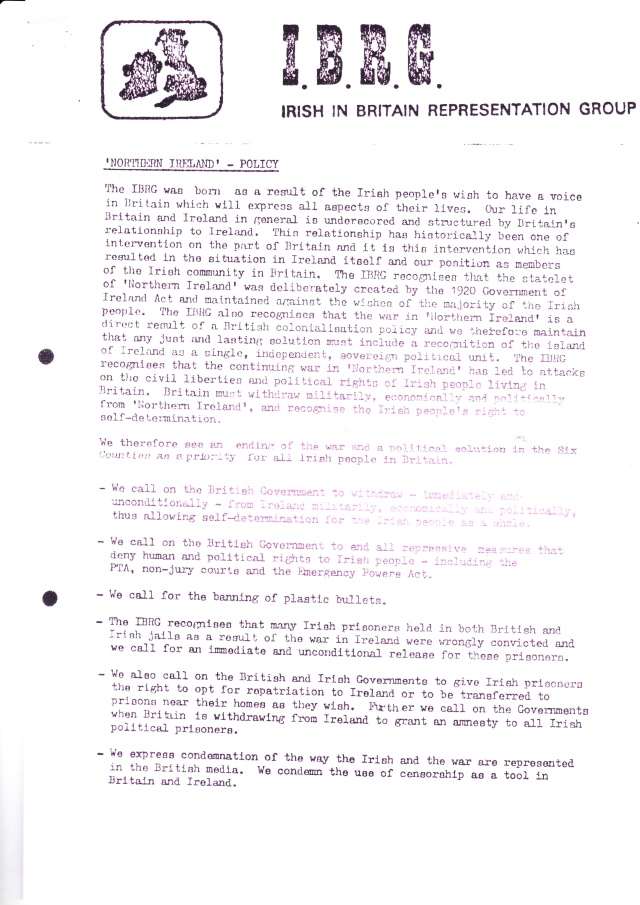
That the RUC and UDR be disbanded as a part of a prerequisite to withdrawal and add to Northern  Ireland Policy

That the Prisoner’s Sub-Committee Campaign for the release of the Birmingham Six, Guildford Four, and Maguire Seven

That  IBRG work with other groups to oppose the new British police bill

Condemned the recent arrest of IBRG members and called for the charges to be dropped and for an inquiry into their arrest.

Condemn David Owen for rescinding the SDP conference decision to ban plastic bullets.

To congratulate workers at Dunnes Stores in Dublin for their actions against selling South African produce.

Calls for a sustained campaign against the PTA in all branches, including holding public meetings collecting petitions, leaflets, posters, conferences etc

Support the creation of preschool language nurseries

Jim King, elected as Chair for his third term, criticised Irish Foreign Minister Peter Barry for ignoring that part of Ireland which was occupied against the wishes of the majority of the Irish people. He said there was a renewed sense of national pride among the Irish in Britain and that the IBRG had contributed greatly to this.  He deplored the recent arrests under the PTA and the attitude of the Dublin government and said that our work on the PTA and for a united sovereign Ireland must continue unabated.

On 30 March 1985 the Irish Post reported that IBRG acted as catalyst in its report of the IBRG Ard  Fheis at Brent Town Hall.  Jim King was reported saying: ’There is a new mood of assertiveness and the IBRG has acted as a catalyst demonstrating that the heads down approach is unproductive and unnecessary. The IBRG has made an immense contribution to the renaissance of all things Irish in Britain which we are now enjoying’

In 28 March 1985 Pat Reynolds spoke with Jo Richardson MP at a public meeting on Strip Searching in Newham.

A conference in Newham entitled Racism and the Irish Community was organised by the Stratford Irish Community Association in East London in early April at which Gearoid McGearailt  IBRG and Brid Ni Chainin  IBRG spoke at.

The Conference passed a resolution condemning Bord Failte and Aer Lingus for refusing to give assurances that they would discontinue advertising in the Express newspapers including the Evening Standard, because of these paper’s anti- Irishness. The GLC exhibition the Invisible Irish was on show at the Conference.

On 20 April 1985 the Irish Post reported on “Significant victory in Wigan” where the chair of the Wigan  IBRG branch, Michael Gallagher, standing as a Labour candidate,  had beaten the Tories in a Council by election. In the campaign the Tory leaflet suggested that voters should ask Michael Gallagher if he were a supporter of the IRA. He immediately issued a writ for libel claiming damages and was granted an injunction in the High Court in Manchester restraining the Tories from such slanders. The Tories were also required to publish and distribute to every household an apology to Michael Gallagher and withdraw the inferences made against him.

On 13  April 1985 IBRG along with ICARM (Irish Campaign against Racism in the Media) picketed the offices of Bord Failte and Aer Lingus in central London.

On 20 April 1985 IBRG members attended a GLC Conference on the PTA at the Camden Centre. Over 100 people attended the Conference.

Dr Maire O’Shea, IBRG, spoke on her arrest and detention and on the other prisoners arrested. Dr O’Shea stated:  ‘The PTA is a kind of terrorism in itself, it hasn’t stopped terrorism in this country. It has separated families and friends and has caused anguish to people closest to those arrested’.

Gearoid MacGearailt gave a wide-ranging speech setting out the background to the Irish community in Britain in housing, health and employment, and stated:  ‘the PTA is institutional racism. Its purpose is to intimidate and to stifle lawful and legitimate political activity. He also led one of the workshops.

Both of these detailed speeches and others are available in the GLC document Consultative Conference on the effect of the workings of the PTA upon London’s Irish community published later in 1986.

On 21  April 1985(4) the IBRG Ard Choiste met at the Crown Pub in Bristol at which the following attended Gearoid MacGearailt Chair for the day, Maire O’Shea, Judy Peddle, Colm O Floinn, Marie Wynne, John Doyle, Denis Casey, Pat Keane, Seamus O’Colileain, Enda McCarthy,  Mairin Higgins and Jim McCarthy.

The Ard Choiste heard that Haringey IBRG had set up a Prisoners support group to work with non-political prisoners and had recently a meeting with Sister Sarah Clarke who worked with Irish prisoners in Britain.

On 24 April 1985 Pat Reynolds was the speaker on the PTA motion at Brent Nalgo AGM at Brent Town Hall which carried the motion condemning the PTA.

On 25 April 1985 Pat Reynolds was speaking at an Irish Awareness day for staff in Islington Council.

A support group for Maire O’Shea was set up in Manchester and on 27 April a meeting was held in the Town Hall basement to launch the campaign.

In May 1985 the Press council ruled against John Junor and the  Sunday Express over his anti-Irish racist remarks. The complaint was brought by Luke Kearns of Bradford IBRG and Damien Price of Green Ink with Pat Reynolds assisting him.  The Irish Post would claim that this was its greatest victory in some 15 years history while ignoring the role IBRG had played in it.

On 11 May 1985 the Irish Post reported that Michael O’Cnaimhsi and IBRG in Blackburn  had got a local store not to sell Punch magazine as it had contained anti Irish material. John Stanley, from Leeds IBRG,  in the same issue drew attention to  W.H. Smith’s who  were selling the Official Irish Joke Book which was full of racist jokes and stereotypes.

The complaint was sent to Smiths in London who replied; ‘Were we to withdraw the Irish joke book the effect would be to draw a lot more attention to them with the result that more would be bought’.

One IBRG member in London also protested by filling a trolley full of books, which after they had put them through the till, just happened to come across this Irish joke book, and was so offended, that he cancelled his entire large order and walked out.

Donal Kennedy in the same issue remarked on Joe Ashton’s claim that it was an Irishman’s ability to take a joke that stopped  the English from automatically thinking him connected with the IRA. Amazingly Ashton seemed never to have heard of Brendan Behan, Frank O’Connor and Sean O Faoilean.

bernard manning

On 12 May 1985 Jim King, Gearoid MacGearailt and Pat Reynolds met Jim Delaney of the Irish American Unity Conference at London airport to discuss join community interests. IBRG got invited to come to America late that year for their conference in Washington DC.

On 14 May 1985 IBRG members picketed the George Robey Pub  in Finsbury Park North London over Frank Carson’s  appearance there. Ironically the Gaelic football team South and O’Hanlon’s used to use that pub as their HQ in the 1970’s.

On 15 May 1985 IBRG met with Alf Lomas MEP and  Father Bobby Gilmore,  head of the Irish Chaplaincy,  over anti Irish racism and Sean Sexton’s amazing media campaign which called for more Irish representation in the media.

In May 1985 Green Ink were awarded £33,000 to set up an Irish bookshop in North London including  subsidising  the difference between sales and salaries.

In May the Federation withdrew from the NCCL research on the PTA which led to a huge storm. The Federation wanted total control of the project while the NCCL wanted to keep the research independent. The Federation were caught out over their position on the PTA where they sided with Fine Gael  against their own community in Britain to their great shame, following on from their eternal shame of their stance during the Hunger Strikes.

On 23 May 1985 Clare Short and  IBRG were honoured by the Massachusetts House of Representatives for her works on Irish self-determination for the Irish in Britain. The citation mentioned the work of the IBRG to quote:  “Whereas the committed Ms Short has participated in meetings and conferences  with members of the Labour Party , which would put forth a platform for British withdrawal and unity and independence, and has discussed with  the Irish in Britain Representation Group, which works on behalf of Irish people living in England, who are subjected to continuous detention and imprisonment, and denial of human and civil rights by the British government’.

Here we see IBRG making an impact from the European parliament to the Dail to the USA and to the British House of Commons within a few months, raising the question of the civil liberties of the Irish community in Britain. The document was signed by Marie Howe and signed by the Speaker in Boston where Clare Short MP was given a special reception along with a Press conference to highlight her visit her campaign on Ireland and the Irish in Britain.

On May 1985 the radical Dublin Magazine Phoenix outlined the growth of the IBRG and the Embassy attempts to curb the new militancy of the IBRG and the Irish in Britain. It  praised Brendan MacLua, editor of the Irish Post, who refused to play ball with the Embassy.   It seemed that  being on the Embassy guest list meant nothing to IBRG who boycotted these events, given the failure of the Embassy to protect Irish citizens in Britain. The Irish in Britain were no longer for sale for the sake for cheap wine at the Irish Embassy.

In 18 May 1985 the Irish Post covered the story where the London Irish Festival at Roundwood Park had refused IBRG a stall at the park because the IBRG would display political materials.

Pat Reynolds IBRG stated: ‘the conditions they wish to place upon us having stand would require us to deny our nationality, and betray those who are being killed by plastic bullets, humiliated by strip-searching and harassed under the PTA.  The organisers blamed the GLA and Brent Council for their stance. IBRG finds it incredible that either body would indulge in such political censorship as a prerequisite to allowing a charity day’.

The organisers tried to blame the GLC and Brent Council for this imaginary ban, yet could produce no evidence of any such condition. Ironically Pat Reynolds worked for Brent Council and knew this claim by the organiser to be nonsense as his colleagues at the Council provided the facilities for the festival.  Later they would even ban the Birmingham Six from having a stall,  clearly not even recognising welfare issues and supporting British extreme censorship on their own community.

On 1 June 1985 IBRG members in London attended the GLC conference on Policing the Black and Irish Communities.

On 9 June 1985 (5) the IBRG Ard Choiste met at the Unemployed Centre in Birmingham with 19 officers and  delegates attended including Jim King Chair, Judy Peddle Runai, Maire O‘Shea, Gearoid MacGearailt, Joe Mullarkey, Pat Reynolds, Alan Wallace, Marie Wynee, Caitlin Wright, Nessan Danagher, Maurice Moore,  Seamus O Coileain, Mairin Higgins Arthur Delvin and David Wright.

The meeting heard that a new IBRG branch had been set up in Strathclyde. Gearoid McGearailt was working on  setting up a new branch in Lewisham. The meeting agreed to give £150 towards Nessan Danaher producing 1,000 copies of his 1985 Education Conference report.

On 15 June 1985 the Irish Post covered Islington IBRG story “No to Islington deplorable” where the Department  of the Environment had turned down Islington council application to fund a local Irish centre.

The Department  stated; ‘It is considered that there is no justification for treating the Irish as an ethnic minority, and therefore no reason why they should not use facilities provided for the population generally’. The IBRG stated that this decision was discriminatory, political, and racist as the Irish were clearly  a racial group under the terms of the Race Relations Act, and the House of Lords judgement on this matter.

The decision would effectively block the Irish community from any central government funding. Brent Irish Advisory Service had also been refused funding and John Ryan, Labour councillor in Brent, stated: ‘the Tories are opposed to the funding of any Irish project. I would go further and say that they are opposed to the very concept of there being an organised Irish community in Britain which endeavours to promote its own culture and sense of identity’.

On 22 June 1985 IBRG members in London attended a GLC Homelessness Conference to ensure an Irish dimension was included as the Irish suffered much from being homeless.

On 26th June 1985 Dr Maire O’Shea spoke at the Red Rose club Islington at a public meeting with Jeremy Corbyn MP and Chris Smith MP.

There was a row in June 1985 when the letters pages of the Irish Post were filled with criticism of the Federation and their manner of withdrawing from the NCCL research into the PTA, because the Federation wanted total control of the project despite their own confused position on the PTA, which was aligned to the Fine Gael position on the PTA.  The GLC responded in the Post to say they had every faith in the NCCL,  despite the criticism of John Fahy, PRO of the Federation, who had attacked both the GLC and the IBRG for no reason.

On 28 June 1985 Pat Reynolds PRO issued a press release in response to several arrest of Irish workers in seaside towns in Britain. It stated: ‘The IBRG condemns the continuing harassment of the Irish community under the racist PTA laws, and the abuse of the civil and legal rights of Irish citizens in Britain. A coach and horses has been driven through the sub judice laws in Britain by the police media and politicians on the last week, what chance has any Irish person getting a fair trial in Britain with the current whipped up hysteria, if you are Irish, it sems  you are guilty once you are arrested, and that you have no rights under the law, to be afforded ordinary civil liberties, and the right to a fair hearing. The IBRG condemn the racist selective targeting of Irish workers in sea side towns, and demand that this racist witch-hunt is called off, and condemn the use of conspiracy charges against member of our community. The PTA main objective is the political policing of the legitimate political activity of the Irish community in Britain’.

On 1 July 1985 Dr. Maire O’Shea addressed a large public meeting at the Cricklewood Hotel in West London along with Ken Livingstone on the PTA.

On 6 July 1985 PRO Pat Reynolds had a letter in the Irish Post ‘Independent research vital in bid to repeal PTA’ in which he took John Fahy PRO of the Federation to task for his attack on the IBRG, NCCL and the GLC over the PTA research project, from which they had withdrawn.

He stated: ‘the position of the IBRG in this matter is quite clear. We had urged the GLC to provide funding for such a project and when the NCCL began their research we offered them our full support. Last year we met with the NCCl to convey our particular concerns about the PTA, and how it affects the Irish community. As an independent organisation ourselves, we respect the independence of the NCCL and regard independent research to be vital to accompany any campaign seeking the repeat of the PTA We have no reason to change our support for the NCCL’s research, nor have we found any sustainable evidence to indicate that this research is not in the interest of our community.  For John Fahy to refer cynically to ‘platforms’ is insulting to any organisation which campaign on the PTA issue. It is also insulting to the thousands of Irish people held under that vile legislation. The Irish in Britain are a politically aware people and from its founding, the IBRG has been open and honest in its work in education, research, politics, culture, media and welfare. We urge the Irish community throughout Britain and especially the young to join with the IBRG in its fight to have the PTA abolished, and also to participate with us in our various activities which give expression to Irish life in Britain’.

The Federation were closely aligned with the Irish Embassy, being used as their mouth piece in the PTA debate, and were closely aligned with the Fine Gael government’s stance on the PTA, and failed to call for its abolition.

On 14 July 1985 (6) the IBRG Ard Choiste met at the Unemployed Centre in Birmingham. 16 officers and delegates attended with Doris Daly from Islington attending part of the meeting. The following were present Jim King Chair, Judy Peddle Runai, Maire O’Shea, Gearoid McGearailit, Joe Mullarkey, Colm O’Floinn, Marie Wynee, Nessan Danagher, Caitlin Wright, John Doyle, Sean Cross, Maurice Moore, Eddie Whyte, Michael O Cnaimhsi and David Wright along with Elizabeth and Maura Cassidy from Coventry.

The Ard Choiste decided that the Comhcomhairle should be held in Birmingham on 26 October 1985. Haringey IBRG were planning a local public meeting on the PTA in September. The meeting had a long discussion on the PTA campaign.

On 23 July 1985 a meeting was held at Peckham Town Hall to restart Southwark IBRG and on 24 July a similar meeting took place in Brent to restart Brent IBRG. On 28 July 1985 there was a GLC Race Awareness day where Pat Reynolds chaired the Irish workshop.

In Leeds over 100 people turned up to launch the Anti PTA campaign which Alan Wallace chaired. Dr Maire O’Shea was unable to make it as her car broke down. Councillor  Sheena Clarke gave the meeting a graphic description of her recent detention under the PTA at Manchester Airport on her return from a housing conference in Belfast where she was questioned for 55 minutes.  She stated ‘I got the impression that if you favour a united Ireland, you risk being labelled a terrorist subversive and somebody, whom they are entitled to pick up and harass.’ She describes it as being one of the most terrifying experiences I have ever had. And ‘what happened to me happens to thousands of people travelling backwards and forwards between Britain and Ireland’.

In July 1985 Manchester City Council recognised the Irish community, the first local authority outside of the GLC and Islington to do so. The IBRG had made a major submission to Manchester City Council and lobbied for the recognition. The report had dealt with housing, social services, culture and education. The report also dealt with anti-Irish racism, the effects of the PTA and N. Ireland upon the local Irish community.
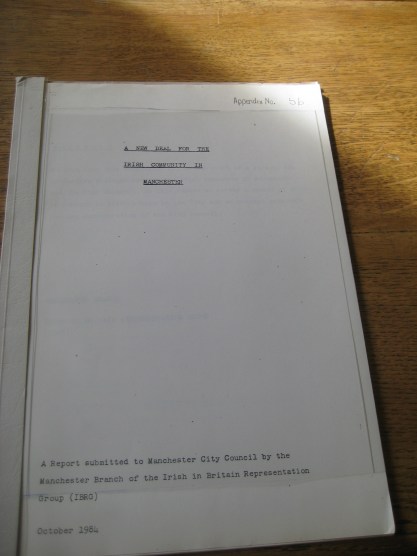
1984 report

Jim King IBRG chair welcomed  this development as fit and proper, and stated ‘The IBRG in Manchester has put a lot of work into winning this recognition and the results should be of considerable long-term benefits to the local Irish community’. Two Irish representatives could now sit on Manchester City Council’s Race Committee. The same weekend Manchester Labour Party held a Conference on Ireland at the Town hall.

Ruari Quinn, the Irish Minister for Labour, had a letter in the Irish Post defending giving votes to British citizens in Ireland that nobody had asked for, nor was there any lobby for this. Yet, Irish citizens in Britain were denied a vote in Ireland despite strong voices that they be given the vote.

Quinn talk of the enfranchisement of EEC citizens in a reciprocal basis was nonsense as he ignored the fact that British citizens living abroad, like the vast majority of other European citizens living abroad, retain the vote in their country, this was denied to the Irish abroad in a very discriminatory way. There was no evidence whatsoever that British citizens living in Ireland suffered any discrimination whatsoever, unlike the Irish in Britain,  who were daily subjected to anti Irish vile in the British media, and had the racist PTA laws to deal with, and were disadvantaged in housing health and employment.

Gearoid McGearailt took Ruari Quin to task in a detailed response in the Irish Post, and showed how the Irish government had ignored the needs of its own citizens abroad on the PTA on travel conditions, Northern Ireland, transfer of prisoners, on the framed prisoners such as the Birmingham Six, Guildford and Maguire Seven. He pointed out that the amount given to Irish welfare in Britain by the Dublin government amounted to the cost of running one ministerial car in the government. The policy of the Irish government had always been that once you leave Ireland, you are no longer the responsibility of the Irish government who will do as little for you as they can get away with.

On 30 July 1985 the BBC, after pressure from Leon Brittan, the Home Secretary, banned the television programme  At the Edge of the Union because it included a speech by Martin McGuiness. Two weeks later Thatcher stated that that the Republican movement should be starved of the oxygen of publicity. (Make your own mind up about the programme here) 

At the beginning of August 1985, the IBRG took on the Daily Star  over a ‘pig in the kitchen’ article in reference to Ireland. On 2  August 1985 the Evening Press Dublin front page story headline was ‘Star brings Irish pigs’ line into the parlour’.  The headline in the Daily Star article was ‘bejasus, your clever swine’ telling some fake story about an English tourist in Ireland taking tea in a remote cottage in the West of Ireland, being surprised when a pig wanders into the kitchen.

Earlier in the same paper Joe Ashton, the racist anti Irish labour  MP,  had another racist article denigrating the Irish. The Irish Independent ran the story ‘Another of Fleet Street’s rasher pieces.  Pat Reynolds told the newspaper ‘It is part of an insidious campaign of anti-Irish bigotry with the article stating ‘In Ireland the kitchen is often shared by all sorts of friendly livestock’.

Within days the Daily Star was running another anti Irish story with a story entitled ‘the Blarney Clone’ in which it referred  to the Irish ‘using a shocking new system  to improve the pedigree of their stock.  The genetic characteristics of both partners are fed into the computer, mating takes place and hey presto a new Irish master breed is born.’ Only in the last sentence of the article does it indicate that this is for Irish livestock on the farm.

On 3 August 1985 the Irish Post had the headline ‘Press Council No to IBRG complaint’.  The story stated that the British Press Council –  which had a notorious reputation of protecting newspapers rather than the public –  had rejected an IBRG complaint about the racist anti Irish MP Joe Ashton article in the Daily Star on 25th February 1985.

The Press Council letter stated: ‘the complaints committee of the Press Council; sitting under the chair Sir Zelman Cowen has carefully considered your complaint against the Daily Star. After taking full account of your comments the committee decided that you had failed to establish a case warranting adjudication by the Council’. The wording of the complaint was that the Star had ‘published an article which was racist and insulting to Irish people portraying them as ignorant and backward, and neither the editor nor the author was willing to acknowledge their distortion’. The PRO stated in reply ‘recently Fleet Street newspapers have driven a coach and horses through the subjudice  laws and acted as judge and jury over Irish people arrested under the PTA. What Standards is the Press Council defending. Its failure to take up this complaint shows it to be as much part of the problem as some Fleet St newspapers. We call for an end to the Press Council’s collusion with Fleet st in abusing the Irish community.’

The Evening Herald in Dublin on 2 August 1985 covered this story with ‘Insult claim is lost’ which covered the IBRG statement in full.

On 3 August 1985 the Irish Post ran the story ‘Breakthrough by IBRG in Lambeth’. The article stated that ‘The Lambeth branch of IBRG in south London has achieved a major breakthrough in having the local Borough Council accept its seven-point plan for assisting the Irish community. The detailed plan covers a wide range of services and extends to the local Irish community special treatment in areas of welfare, housing and cultural needs as well as a recognition that the Irish have been victims of racism and discrimination.

Ted Knight leader of Lambeth Council and the majority Labour group had met IBRG and agreed to progress the proposals. Lambeth now had an Irish welfare project with two workers funded by the GLC the deal also included Lambeth declaring itself an PTA free zone and recognising the PTA as racist. Here Lambeth was following the GLC, Islington and Manchester City Council in recognising the Irish.

On 8 August Pat Reynolds and other IBRG members joined the Troops Out delegation to Belfast where for the first time the IBRG took part in the Anti Internment March in Belfast where the crowd gave us a huge reception, as the Anderstown News regularly were covering IBRG activity in Britain. It was important to the community in Belfast that the Irish in Britain were standing with them, and sending out a clear message they were not alone.

On 10 August 1985 the Irish Post headline had ‘Storm over ‘pigs in kitchen’ story.  IBRG PRO Pat Reynolds responded by stating ‘The Press Council’s unwillingness to reprimand racist newspapers gives publications like the Star a licence to print such vile material. The Star the Sun and the Daily Express seem to have a fixation with pigs and piggeries. Its time they came out to breathe the fresh air of truth and reality. Their anti-Irish propaganda stinks and speaks volumes about their colonial mentality towards the Irish. We reject their racist definitions and rejoice in our Irishness’.

On 10 August 1985 Manchester IBRG had a letter in the Irish Post setting out  their differences with BBC Radio  Manchester  over their Irish line programme. In it Eileen Murphy, Declan O’Neill, Tony Farrell and Peter Ledwith gave a full history of the programme, and how they had been thrown off the programme by the BBC management  in Manchester. The programme  was targeted after the arrests of Dr Maire O’Shea and others when they had interviewed over time Peter Barry, Ken Livingstone, Jim King, and Father Raymond Murray over the Birmingham Six.

The BBC started to cut out any reference to the IBRG being associated with the programme  and then started  to censor interviews. The final straw was when the BBC cut an interview with Bernadette Hyland of IBRG who had been a recent delegate on the International Woman’s day delegation to Armagh with the interview focusing on strip searching.  The delegation also included Women Against Pit Closures, Labour Women and Ireland, Women Trade unionists. (Read full story here)
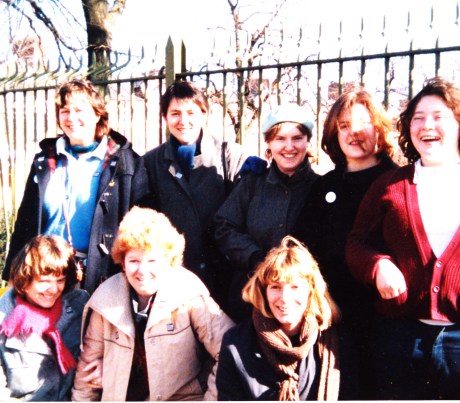
Women's delegation to Ireland

IWD Delegation to N.Ireland March 1989.

It was another example of the BBC censoring anything to do with Ireland or the conflict or even innocent Irish prisoners in Britain. Later the BBC were to ban Shane McGowan’s song about the Birmingham Six.

On 17 August 1985 the Irish Post reported that ‘Haringey showing of banned BBC programme ’ called “At the Edge of the Union” which Haringey council put on a public showing on 19th August 1985 with speaker on censorship on Ireland.

Steve King, Deputy Leader of Haringey,  stated ‘We believe that the people of Haringey are quite capable of making up their own minds about the situation in Ireland. We don’t need the government to decide what views we are to hear. This council is committed to defend the right of local people against all attempt by government to take on the role of Big Brother’.

The Irish Post further reported than over 70 people including Jeremy Corbyn MP attended the IBRG picket of the BBC HQ in London at Portland Place to protest over their banning of the programme  on Northern Ireland. Pat Reynolds had helped to organise the picket.

The IBRG stated: ‘We condemn years of silence and self-censorship ion Ireland by the BBC and the British media. This media had never been impartial on Ireland. It supports and promotes British interference in Ireland without question, and suppress and censors any challenge to that position. The IBRG especially condemn the cancelation of the program at the Edge of the Union and deplores the hypocrisy of this governments talk of democracy, while it suppresses the views of democratically elected representative of the Irish people’.

Haringey Council was led by Bernie Grant,  the first Black leader of a Local Authority in modern times. (Many forget that that John Archer who was Black and Irish was the Mayor of Battersea back in 1913.) The film, “Edge of the Union” was shown at Haringey Civic Centre.


On 7 August a national one day strike was  called by the  NUJ following the decision by the BBC Board of Governors to ban the Real Lives documentary on Northern Ireland “At the Edge of the Union”.  In Manchester  at UMIST the  Manchester Campaign for Press and Broadcasting Freedom and the local NUJ branch organised a meeting about  the censorship of the documentary. Bernadette Hyland of Bolton IBRG spoke from the floor about censorship and the Irish community relating to the BBC’s closure of their radio programme “Irish Line”.

On 21 August 1985 Pat Reynolds IBRG was the speaker at Brent Nalgo Irish Workers Group, the first of its kind in the country. Pat was working with Brent council at the time running their Community Home with Education (CHE), and was also a founding member of the group.

Later John Tymon, a member of the group, would become Brent Branch secretary, and later the group became part of the National Nalgo Irish Workers Groups with a view, to get motions to National conference and supporting the Irish community locally.

In 1986 ten of the group took St Patricks Day off work to organise a St Patrick’s day celebration in Brent for the Irish community at the Brent Irish centre. The council who threatened to dock the pay of the 10 workers backed down, and the following year Brent Council took over the running of the festival which had continued to run to this day.

On 24 August 1985 the Irish Post reported on ‘Leeds Irish centre and IBRG clash’ where Leeds IBRG accused the Leeds Irish Centre of discriminating against it, and refusing to allow the IBRG to put on Irish language classes at the centre. Leeds IBRG had also asked the centre to hold a cultural evening with Donall  MacAmhlaigh the Irish writer to speak but were refused. The local Polish Centre then had to help out  IBRG. It was a shocking story on ongoing discrimination against both the IBRG and members of their own community by the Centre and the suppression of Irish culture in Leeds.

On 24 August 1985 the Irish Post covered a story ‘Bolton Irish join the Festival’. It highlighted the Bolton Irish Festival  24-31 August 1985 which included a concert, an Irish traditional music workshop and an Irish crafts display including stalls with Irish goods for sale plus Irish dancing on the streets.

On 31 August 1985 the Irish Post covered the story ’Too few Irish council officers’ in reference to Islington Council in North London. The Irish community make up some 11% of the local population yet only 5.2% of the non-manual workforce. The study had been carried out by the Council’s own Personnel department. Of the 181 employed at officer level only two were senior managers out of 83 such senior positions. The council came up with various excuses as to why the Irish figure was low, claiming that some Irish may not identify as being Irish, despite there being no evidence of this. For example, if only two senior officers identified as Irish, they would know if there was more of them

IBRG stated: ‘the truth of the matter is that Irish ability is being overlooked by Islington council. There is no positive policy of recruiting Irish people to ensure that they are proportionate to their number in the borough, represented among the council’s officer workforce.’

The Irish were often kept in the low paid manual type jobs, in 1970 over 50% of Irish males worked in construction whereas the figure in Ireland was about 15%. Irish women worked in the local hospitals but in local authorities tended to have manual type jobs as dinner women or home helps which paid poorly.

On 3 September 1985 Tom King became Secretary of State for Northern Ireland.

Maire O’Shea had been a member of the Connolly Association and its newspaper the “Irish Democrat”  covered the campaign.
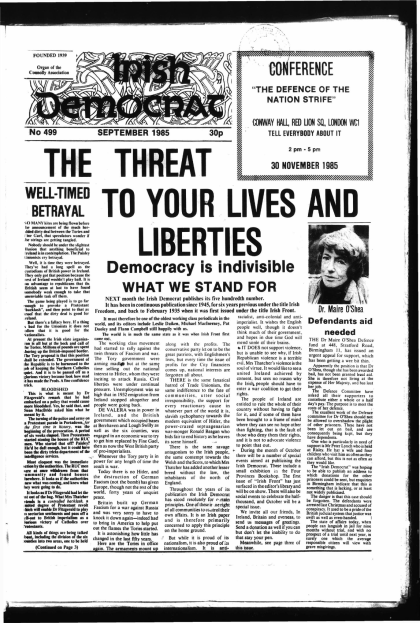
Maire 4

On 6 September 1985 a new IBRG branch was set up in Wigan.

The IBRG Ard Choiste took place on 7th September 1985 (7) at St Lawrence Hall, Manchester.  14 officers and delegates attended including Jim King chair, Judy Peddle Runai, Michael O’Cnaimhsi Pat Reynolds Marie Wynee, Eddie Whyte, Gearoid MacGearailt, Caitlin Wright Joe Mullarkey, Alan Wallace, Maurice Moore, Sean Cross, Anthony McFarrell, Maire O’Shea and Paul O’Brien.

The meeting agreed to send delegates to the American Irish Unity Conference   from 31 October -2 November 1985 in Washington DC, and that Jim King Chair and Pat Reynolds PRO should go to represent IBRG. The meeting heard that Southwark and Newham IBRG had been set up in London, and that Haringey IBRG had received GLC funding for two workers for a welfare project of £26K. John Doyle has resigned as Youth officer. Nessan Danaher had been speaking at an Education Conference in Oxford.  Haringey IBRG had referred an article in the Mail on Sunday to the Press Council over its attack on Sr Sarah Clarke who worked with Irish prisoners.

The Comhcomhairle would have workshops on the Media by PRO, Education by Nessan Danaher, Welfare by Caitlin Wright,  Northern Ireland  by Alan Wallace,  PTA/Civil Liberties by Gearoid McGearalit, Political Prisoners by Prisoner’s Subcommittee and IBRG Image by Michael O’ Cnaimhsi.

It was agreed to set up new branches in Lewisham and Leamington Spa. The Ard Choiste agreed to set up a working party to identify ways of convening a conference on withdrawal from Ireland and that Joe Mullarkey, Michael O’Cnaimhsi and Paul O’Brien be part of this group.

Islington IBRG proposed that the Ard Choiste endorse the demonstration called to support Maire O’Shea and the repeal of the PTA which was agreed and that Gearoid speak. The meeting agreed to donate £40 to the Maire O’Shea Defence Fund. Pat Reynolds had secured £100 from Brent Nalgo for the PTA Campaign.

There were 20 active registered IBRG branches. Judy Peddle Runai resigned after the Ard Choiste meeting in Manchester because of ‘a clash of personalities between herself and a number of London based members of the executive.’ She had been Runai for three years and a member of the NEC for over four years. She was thanked for all her work on behalf of IBRG. The Irish Post ran the story on 21st September 1985 ‘IBRG secretary quits after row.’

On 10 September 1985 the Irish Press covered the story ‘Tories challenged on emigrant claim’ when they claimed that Irish emigrants were a crippling burden on the welfare state and that over 20,000 Irish were coming to Britain each year. The Tories had based their false claim on a  report by Action Group for Irish Youth that had prepared a special report on emigration for the Dublin government.

Pat Reynolds, PRO, responded ‘Irish people coming to Britain do not cause unemployment. In fact, Irish born people are more economically active than the British born population.  More people leave Britain every year than enter it, and we regard this as an attempt to make the Irish a scapegoat for the Thatcher’s government’s failure to tackle high unemployment’.

On 18 September 1985 John Stalker submitted his report of his inquiry into a cover up of a shoot to kill policy by members of the RUC.

On 21 September 1985 the Irish presenters of Manchester IBRG Irish line had a letter in the Irish Post with heading ‘BBC dodging the Irish line issue.’ It notes the Sunday Press of 11th August 1985 stated that most of the production team of the regular Irish show have been fired because they attempted to transmit political interviews and features.

They stated that John McManus the Radio Manchester programme  controller was more honest.” He admitted to us that the BBC had been pressurised by people outside the corporation over its content and approach. In the light of recent revelations about political and M15 interference on the running of the BBC, we suppose that it is hardly surprising’.

The IBRG Ard Choiste took place at the Battersea Arts Centre on 5 October 1985 (8) with 20 officers and delegates present  including Jim King chair,  Marie Wynee, Sean Cross, Colm O Floinn, Denis Casey, Gearoid MacGearailt, Pat Reynolds, Paul O’Brien, Steve Morris, Joe Mullarkey, David Wright, Caitlin Wright, Maura Cassidy, Elizabeth Cassidy, Eddie Whyte, Michael O Cnaimhsi and Maire O’Shea with observers Peter Murray Islington, Steve Brennan and Alex McDonnell both from Lambeth.

The meeting heard reports from the various officers.  The Ard Choiste gave £40 to Leeds branch to support Peter Lynch and donated £25 to the Committee for British Withdrawal. Brent Nalgo Irish Group wanted to affiliate with IBRG but the rules did not allow it. The Ard Choiste called for an ending of strip-searching of Ella and Martina in Brixton prison

On 12 October 1985 the Irish Post carried the story ‘IBRG slams Labour Policy’ in which the IBRG stated ‘Trade Unions and  the Labour Party continue to support repression in Ireland while they hypocritically shout about similar suppression in South Africa.  The IBRG must ask if the Irish community is willing to continue to support the party which maintains its colonial position on Ireland. The IBRG will continue to endorse candidates who publicly state their support for a United Ireland and an end to the British presence there’.

The report also stated that Haringey IBRG expressed concern that plastic bullets had been made available for use at the weekend disturbances at Broadwater Farm, but not used, as the Home Office  feared using them in Britain, while still prepared to use them in their last colony of occupied Ireland.

On 12 October 1985 the Irish Post covered the founding of an Irish Workers Group within Brent NALGO, which had been recognised at Brent Nalgo AGM at Brent Town Hall. They  gave the group £250 for its activities to support Irish workers within  the council and activities in the Irish community.

Pat Reynolds seconded the motion for recognition, while Mike Trant the Branch secretary proposed it. Pat Reynolds stated this is a significant development within our union. It is also an acknowledgement of a new awareness of the Irish community in Brent and of the need for Irish workers to organise themselves within trade unions to work on issues affecting the Irish community in Britain and with issues affecting N. Ireland such as the PTA, the use of Plastic bullets and strip searching.

On 19 October 1985 the Irish Post carried the story ‘IBRG irate at Star acquittal’, which stated that the Press Council had rejected two complaints from the IBRG regarding items which had appeared in the Star newspaper on 2 and 8  August 1985.

The first one on 2 August was entitled ‘Bejasus your clever swine’ a Victorian pig in the kitchen story. The IBRG had agreed with the Press Council ‘That the newspaper published a racist and offensive diary item which was insulting to Ireland and the Irish people, tending to reinforce negative stereotypes about the Irish’.

The second one published on 8 August entitled The Blarney clone which claimed the Irish were using a shocking new system to improve the pedigree of their stock so a new Irish master breed is born. Generic engineering at its worst.  When PRO Pat Reynolds complained to the editor, he replied treating the matter as some kind of joke and stated I hope you can accept my assurances that there are no anti Irish feelings here at the Star. I do not feel that a little bit of fun hurts anyone’.

In reply to the Press Council rejection of the IBRG complaints the IBRG stated ‘the refusal of the Press Council to condemn the racism of the Star for the second time confirms that it condones and by silence supports this racism. The denigration of Ireland and its people are an essential part of the British media propaganda war on Ireland. There are close links with Britain’s role in Ireland. The Press Council is acting as an apologist for the anti Irish racism of Fleet St, as witnessed by its failing to uphold complaints regarding the infamous JAK cartoon, and the column by racist labour MP Joe Ashtons which was s also in the Star. The IBRG for its part will continue to campaign against anti Irish racism in the media and will broaden its campaign to Ireland and the USA.

On 6 November 1985 the Guardian reported ‘Sun’s report on fire not racist’ in which they reported the Press Council findings on the IBRG complaint by PRO Pat Reynolds.  The Press Council created new history and a new departure in order to rule against the IBRG complaint. Previously newspapers could not refer to the race of a person unless it had a relevance to the story. Indeed, they had ruled so earlier that year in another case involving a Black person.

The IBRG complaint against the Sun regarded a 36-year-old man who had been jailed for five years for manslaughter. In May 1985 the Press Council censored four daily newspaper for mentioning the colour of a 17-year youth who was convicted of murder and five rapes. The Press Council has consistently held that a person’s race or colour should only be introduced into a newspaper report, where it is relevant to the story being told. In that case the Press Council pronounced that the youth’s colour was irrelevant and should not have been mentioned by the four newspaper, the Sun, the Daily Express the Star and the Standard. Of interest these were also the papers the Irish community were battling with.

In this case the Press Council changed its own regulations and rules to rule out the Irish case and now in a major departure from its previous judgements stated that newspaper could now mention a person race or colour  as long as it was not pejorative or prejudicial to describe a defendant in court case as Irish.  Of interest, the Sun even use the word “Swine” in their heading on the case. How could any complainant now have a case where he could prove that the mention of the person’s race or colour was pejorative or prejudicial as this was extremely subjective with no examples given in either case. This case showed the extremes the racist Press Council were prepared to go to deny Irish people any access to redress in Britain from the vile racist of that media.

The IBRG Ard Choiste met In Birmingham on 26 October 1985 with 13 branches represented and where the workshops took place as planned on the various issues identified at the last Ard Choiste. The Comhcomhairle did not take place as it required two thirds of branches to be present, and there was not clarity as to how many branches were fully functioning at this stage.

At the end of October 1985 Jim King and Pat Reynolds headed off to Washington DC for the American Irish Unity conference where Jim King got a standing ovation for his speech on the Irish in Britain which included our work on the PTA, anti Irish racism in the media and the cases of the Birmingham Six, Guildford and Maguire Seven. Pat Reynolds also brought in material to the USA on Dr Marie O’Shea case which was subjudice in Britain but not in the USA. The only other person to receive a standing ovation that weekend was Sean McBride.

The IBRG met Sean McManus of Irish Caucus Group in America based in Washington DC, where they made a trip to his office where he ran a very powerful Irish American lobby. IBRG also met Paul Dwyer, Michael Flannery, Sean MacBride, Thomas Gallagher the writer, Rona Fields the writer who wrote on children in Northern Ireland, whose book was banned,  and Des Wilson from Belfast, and met with all the Irish American groups with whom we exchanged details for further cooperation AOH, Irish Unity, Noraid,  along with trade unions and cultural groups.

In New York City IBRG joined the picket of the British Consulate. On 7  November the PRO  got a number of interviews on the Birmingham Six case and that of Dr Maire O Shea where he could say more than he could in the UK. The PRO got an immediate piece in the Irish People in the USA on Press Bigotry in England which they lifted mostly from the Irish Post. The IBRG delegates paid their own way and got put up by delegates they met at the Conference. They  were invited to a Christy Moore concert in Washington DC where the audience went totally silent for the song The City of Chicago.

The Anglo-Irish Agreement was signed by the British and Irish Government on 15 November 1985 by Maggie Thatcher and Gareth Fitzgerald. Despite pressure from the Irish Embassy and Orla O’Halloran to give it a fair wind the IBRG rejected it.

The IBRG statement stated that ‘The IBRG condemn it as an attempt by the Irish government to deny the nationalist communities any political expression of nationhood, other than thorough those political parties considered acceptable or alternately through a Dublin representative over whom they had no control. The IBRG condemn it as a vehicle whose primary function is to allow Dublin to concede to Britain’s consistent demands for closer co-operation insecurity with all the political economic and security implications that such joint activity holds. The IBRG condemn the Irish government for implicating itself in the criminalisation policy of Britain with regard to the security and  judicial machinery of the statelet, and for not addressing  itself directly to the problems of harassment under the racist PTA, the humiliation of strip searching, the injustice of the Diplock Courts and of supergrasses and the dreadful hardships suffered by the Nationalist people since the 1922 treaty. The IBRG accuse both government of deliberately creating a framework for treating the symptoms of the struggle in Ireland and not the cause, and of intending to draw public attention away from the real situation, and towards controlled but false media type break through and solutions. The IBRG accuse Dublin of sell out of the sufferings and hardship of the Nationalist people over the last 60 years by  participating in such a shambles and note  that the only gains the Nationalist communities,  are to  have  is Dublin putting forward  views and proposals over which they have no control; and the possible attainment of the normal civil and cultural rights which are a minimum  expectation in any civilised county. The IBRG support the continue demand for and United Ireland and a British withdrawal as the only formula for lasting peace. This agreement only postpones any settlement of the   real problem of the British presence in Ireland. the agreement falls far short of the minimum expectations of the Forum report and seeks an internal solution within a British defined context, thus denying an All-Ireland prospective on peace and unity.

The IBRG reject the proposed facile changes in security and justice, in its ignoring of the history of British security and justice in Ireland, and its evasion of the fact that the central issue in N. Ireland is political and not criminal. The IBRG notes that this agreement gives credence to the view that the British government stands to gain more from the Irish government’s terms of cross border security, extradition and border maintenance, then the corresponding Irish views and proposals on the internal structures of N. Ireland. Indirectly this agreement gives the British government an influence upon the Irish government and Ireland through cross border security and extradition. This agreement is not the way forward, it is a stumbling block to any aspiration of Irish Unity’.

Prior to the debate on 27 November in the  debate on the Agreement in the House of Commons Joan Maynard of the Labour Committee on Ireland called the agreement an attempt to head off the rising support for Sinn Fein, and the Labour Committe on Ireland described it as another attempt at an internal settlement within the Six Counties.  As such, it would founder against the rock of partition, and will suffer the same fate as previous attempts to reform the Northern state.  Tony Benn MP stated there can be no peace while Britain denies the Irish people their right to unity and independence, the real problem was partition.

On 18 November 1985 Senator Mary Robinson, future President of Ireland, resigned from the Labour party in protest at the Anglo-Irish Agreement because it is unacceptable to all sections of Unionist opinion. And ‘I do not believe it can achieve its objectives of securing peace and stability within Ireland or on the island as whole’.

The Agreement under Article 1 reiterates the British guarantee to the Unionists, but at the same for the first time ever, added a rider to say if eventually the majority wanted Irish Unity the British government would not stand in its way. It was in its way the first time in an  international treaty,  that the objective of Irish Unity had been put on the table, and that Britain had declared  that they had no ulterior motive, strategic or otherwise  for remaining in Ireland, and the Irish government were claiming to  advocate  the views of the minority community at the highest level. To many republicans and Nationalists there was still a Unionist veto on progress. When Fitzgerald went to Thatcher after the signing of the Treaty to seek her backing for the International Fund for Ireland from the EEC Thatcher’s reply said it all. ‘More money for these people. Why should they have more money’.

On 21 November 1985 the Dail approved the Anglo-Irish Agreement by 88 votes to 75.

On 23 November 1985 over 100,000 unionists marched against the Agreement.

At the end of November 1985, the IBRG condemned the arrest of several Irish people under the notorious racist PTA law,  including Conor Foley and Brendan O Rourke. The IBRG called it a propaganda exercise to give the impression the police were doing a job. The Labour Committee on Ireland protested at the arrest of their National Student Organiser Conor Foley. The LCI stated ‘this is a dangerous and insidious undermining of civil liberties and cannot be tolerated by a democratic society The PTA is a piece of legislation blatantly designed to intimidate Irish people and organisations campaigning on Ireland into silence The LCI demand its repeal’. Read Conor’s own story here

The Irish Press covered the story with ‘Irish angry at arrest in Britain’. The IBRG ‘condemned the arrest under the notorious PTA laws during a police trawling exercise. Brendan O’Rourke was a member of Lambeth IBRG one of the arrested.  These arrests were an attack upon the democratic political work of the Irish community in Britain. The IBRG called for an end to state organised terrorism against the community and called for freedom of speech for the Irish in Britain. In this case the Irish Embassy did help out over the arrested persons.

In November Marie O’Shea and Caitlin Wright spoke at a public meeting in Leeds along with the Black community and called for joint Black and Irish solidarity against the PTA and the conspiracy laws.  Caitlin Wright welcomed  the recent Granada World in Action programme  on the Birmingham Six which should open up the case to the British and Irish public.

world in action 1

On 9 November in Birmingham a national demonstration took place to promote Maire’s case. This highly policed demo showed the support for her from across the labour movement and the Irish community locally and nationally. ( Watch a video of the demo here )

On 26 November 1985 in the Commons debate on the Anglo-Irish Agreement John Hume stated ’The unionist parties have consistently sought to protect the integrity of  their heritage in Ireland-the Protestant heritage-and no one should quarrel with that. A society is richer for its diversity. My quarrel with the Unionist parties has been that they have sought to protect their heritage by holding all the power in their hands, and by basing that that on a sectarian solidarity. This is an exclusive use of power which is inherently violent because it permanently excludes a substantial section of the community from any say it its affairs’.

On 1st December 1985 IBRG members in London attended the GLC Youth Conference to have an Irish input into the meeting.

On 3 December 1985 Tom King speaking in Brussels stated ‘We have signed an agreement in which the Prime Minister of the Irish Republic has in fact accepted for all practical purposes and into perpetuity that there will never be a United Ireland.’ The Irish Minister for Justice, Michael Noonan, stated ‘In effect we have been given a major and substantial role in the day to day running of N. Ireland’.

In December 1985 the Green Ink Bookshop founded by Pat Reynolds and the Green ink Writers opened their doors in Archway, North London.  It sold books in Irish and in English, music and supplied  libraries,  schools and colleges and the Irish community with Irish literature and poetry.

Notes

1.Ard Choiste minutes 13/01/1985

2.Ard Choiste minutes 23/02/1985

3 .Ard Fheis minutes 23/03/198

4. Ard Choiste minutes 21/04/1985

5.  Ard Choiste 9/06/1985

6. Ard Choiste minutes 14/07/1985

7. Ard Choiste minutes 7/09/1985

8. Ard Choiste minutes 5/10/1985

Listen to my talk about the IBRG in the northwest in the Irish Collection at the WCML here

Read Part 1, 2 and 3 of IBRG history here

An excellent history of 200 years of Irish political activity in Mancheser – including Manchester IBRG read “The Wearing of the Green” by Michael Herbert. Buy it here
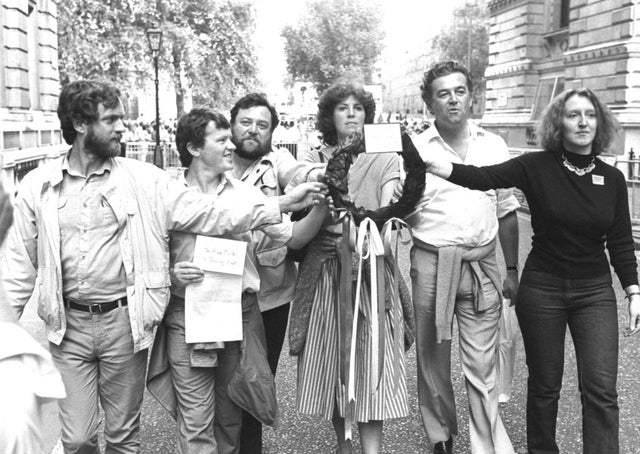
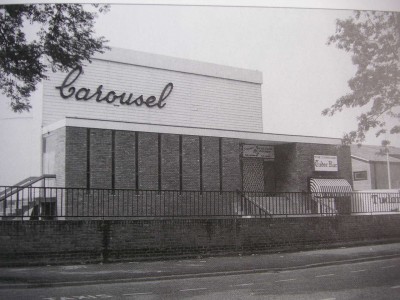
What do you want to do ?

New mailCopy

What do you want to do ?

New mailCopy

What do you want to do ?

New mailCopy

What do you want to do ?

New mailCopy

What do you want to do ?

New mailCopy

What do you want to do ?

New mailCopy


What do you want to do ?

New mailCopy

What do you want to do ?

New mailCopy

What do you want to do ?

New mailCopy

Posted in education, human rights, Ireland, Irish second generation, labour history, Manchester, North of Ireland, political women, Salford, Socialist Feminism, trade unions, Uncategorized, women, working class history, young people | Tagged , , , , , , , , , , | 1 Comment

History of the Irish in Britain Representation Group by Patrick Reynolds. Part 4: 1984. Regrouping and Rebuilding.

Patrick Reynolds was one of the founders of IBRG and played a key role in its history. He is now writing up that history and putting it into the context of radical history in Britain and Ireland in the C20th.

sean downes march

Jeremy Corbyn (left) with (second left to right) Cllr Jim King, Kent miner Malcolm Pitt, MEPs Christine Crawley and Richard Balfe and Young Liberal chairman Janice Turner, the organisers of a ‘British Out of Ireland’ march walking down Downing Street carrying a black wreath in memory of Sean Downes, killed in Belfast in 1984.


The NEC met at the Olympus Hotel, Cardiff on 21st January 1984 (1). Nine NEC members were present including Jim King Chair, Runai Judy Peddle, along with Pat Delaney, Caitlin Wright, Mike Forde, Maire O’ Shea and Joe Mullarkey.

Joe Mullarkey wanted more action taken on the Daily Express Crossword anti-Irish racism, while Judy Peddle raised an offensive anti-Irish poem published in the Observer.

The Chair reported that new branches would be opening soon in Glasgow, Newcastle, Coventry, Blackburn, Gloucester and Doncaster.

Jim King reported that Manchester IBRG had been given a weekly radio programme on Manchester BBC and that he had been selected by Labour to stand in Salford in the local elections.

The Chair stated that at a meeting in Birmingham there had been some confusion over the IBRG position re- violence, but IBRG recognised that the British government’s actions in Ireland were the root cause of the violence there. The IBRG believes that the voice of the Irish in Britain should be heard on the problems of Northern Ireland. We will work in a peaceful law abiding and democratic way for a political solution to the problem. It was reaffirmed that we as an organisation would act accordingly.

Judy Peddle reported that she had sent the Northern Ireland policy statement to the leaders of the three main British parties and to their spokesperson on Northern Ireland. She had also sent our material on the Birmingham Six to sympathetic MPs.

An Runai read letters from Haringey and Islington IBRG which expressed their dismay at the London Regional Council meeting which the NEC Chair had attended, where they were not allowed to speak and were asked to leave. They claimed that the LRC was not representative or accountable to anyone as it only represents Brent and no one from South London, East London or North London. The PRO reported that at the recent LRC meeting two members himself and Juliette O Shea had been selected as workers for the new project in Brent. Members present felt that this was a breach of Equal opportunities as the jobs should have been advertised, shortlisted and interviews arranged.

The Internal co-ordinator Caitlin Wright and the Prisoners Sub-committee had written to Neil Kinnock and Peter Archer about the Birmingham Six. Caitlin had produced an Internal newsletter for IBRG.

On 11 February 1984 (2) the 1st IBRG National Education Conference was held at Soar Valley, Leicester organised by IBRG Education officer Nessan Danaher. Ninety five people had registered for the conference which was a major success in raising issues affecting the Irish community in Education.

Speakers at the Conference included Nessan Danaher, IBRG Education officer, Barry Dufour of Leicester University and Tim Ottevanager of Leicester Council. Barry Dufour stressed the need to look at the social and economic background and structure of the Irish community in Britain and the problem of racism which the community had been encountering. Ivan Gibbons from London criticised the ILEA (Inner London Education Authority) for not giving the Polytechnic of North London £6k to set up an Irish Studies course. He also criticised the Irish middle classes for failing to identify positively and publicly in an Irish ethnic sense thus depriving the second generation of support and example.

Among the attendance were Steve Brennan GLC Irish Policy officer, Justin Harmon from the Irish Embassy, Jim King Chair IBRG, Maurice Moore Coventry IBRG, Father Joe Taaffe Birmingham, Maire O’ Shea Birmingham, the Gaelic League, Luton libraries, Manchester Education Irish Video Project along with various education authorities school heads and teachers.

The IBRG NEC met on Saturday 25 February 1984 at the Camden Irish Centre in London (3) Nine members of the NEC attended included Jim King chair, Judy Peddle Runai, Pat Delaney PRO, Jim Curran, Nessan Danaher Education officer, Caithlin Wright and Joe Mullarkey from Bolton.

The Chair reported back from opening an IBRG branch in Glasgow and that Joe Mullarkey would be opening a new branch in Blackburn on 27 February 1984. New branches were planned for Salford, and Manchester Polytechnic plus one in Newcastle. The Education Officer was congratulated for the success and his pioneering work in hosting the 1st Irish national conference on Education in Britain.

Pat Delaney and Jim Curran reported back on the Greater London Council Conference held at Camden Irish Centre on 12 February 1984. The Federation and Irish Counties Association tried to carve up and control the three different GLC commissions which had been set up. They were content to leave the Political Commission to the IBRG since there was no money in it, but wanted the Welfare Commission to be controlled by the Federation with Gearoid O Meachair in control, and the Irish Cultural Commission with Brendan Mulkere in control.

The problem was that IBRG were strong in both of these areas and were as much involved in the welfare of the Irish community, as were the Federation likewise with Irish Culture as IBRG were active in the GAA, in Green Ink, and in Comhaltas.

In the end the Political Commission never functioned at all, the Welfare Commission died a death, while the Cultural Commission did function for several years and got funding from the GLC for two workers. Education came under Culture and the IBRG were most active on Education and were putting on Irish language and history classes plus members such as Nessan Danaher, Mary Hickman, Cass Breen, Brid Keenan, and many others.

Branches had been opened in Stafford, Manchester Polytechnic, with one opening in Newcastle in March. Donall MacAmhlaigh, the Irish language writer, had written from Northampton to give details of the work of the branch there. Joe Mullarkey reported on the opening of a new IBRG branch in Blackburn.

Judy Peddle had also written to the CRE over an anti-Irish article in the Observer, and had written to a student magazine in Scotland after Glasgow IBRG had complained of anti-Irish material.

Lambeth, Haringey and Islington branches had written to the NEC complaining about the London Regional Council and the November 1983 AGM. Both Jim Curran, Chair of the LRC, and Pat Delaney left the meeting after some angry exchanges over the issues which were left unresolved.

There was concern expressed that Pat Delaney, PRO, had endorsed an article in the Daily Telegraph which referred to the Irish economy in a very disparaging way and had used anti-Irish stereotypes. Pat Delaney quotes had appeared in the Irish Press and appeared to endorse the Daily Telegraph article. Members felt the Telegraph article was extremely offensive and had factual material wrong. The PRO stated that the Irish Press had edited his comments.

The meeting agreed that the PRO should write to the Irish Press to indicate he was expressing his own views rather than IBRG, as the organisation had never discussed the Irish economy. Jim Curran and Pat Delaney claimed that the three branches, Haringey Islington and Lambeth, were trouble makers, and both falsely claimed that Lambeth branch were only the local Troops Out branch.

The meeting agreed to write to all London members asking them for their views of the situation, but Pat Delaney and Jim Curran refused to accept this and stated they would declare UDI in London and left the meeting. Concern had also been raised about the Fleet St branch which London branches felt was a bogus branch. The matter was then left to the Ard Fheis in March.

There were a number of separate issues here. The PRO being out of control and doing his own thing, and also being out of his depth in dealing with the media, and also having no experience of how to counteract anti-Irish racism in the media, and not challenging the editor or using the Press Council. Islington IBRG had far greater experience of dealing with the media and anti-Irish racism and of taking direct action such as twice picketing the Sun newspaper plus using local papers to good effect.

In March 1984 Waltham Forest IBRG had accused the Daily Telegraph of racism over an article which stated that the Irish in Britain were quietly despised, and that many people in the British government considered the Irish to be too volatile, too scatterbrain, too disorganised and a lot of “paddywhack clowns’. The article envisaged an United Ireland as a centralised single party dictatorship rather like Nicaragua. Waltham Forest IBRG had referred the matter to the GLC Working group on racism for action.

Waltham Forest IBRG were granted funding by the GLC to set up an Irish Advice and Resource Centre in Waltham Forest. They also got funding to create a mobile exhibition on history of anti-Irish racism which could go around Britain later, part of the GLC anti-racist year.

The third IBRG Ard Fheis took place on 24/25 March 1984 (4) at the Carousel Club, Manchester. Twenty branches sent delegates from Bolton, Blackburn, Birmingham, Cardiff, Manchester, Manchester South, Ealing, Kensington, Southwark, Paddington, Lambeth, Glasgow, West Hampstead, Leeds, Islington, Harrow, Haringey, Leicester, Merseyside and Burton- on- Trent.

carousel club

The outgoing officers Jim King, John Martin, Judy Peddle, Pat Browne, Pat Delaney, Nessan Danaher, Mike Forde, Kathleen Wright, Joe Mullarkey, Maire O Shea, Mary Duckett and Gerry Gallagher were present.

Jim King, Chair, in his opening address to the Ard Fheis spoke of a year of great progress, of many new branches, and the active promotion of Irish culture in many areas. The highlight of the year had been the very successful IBRG National Education Conference organised by Nessan Danaher in Leicester in February which was a real flag ship for IBRG. The Chair expressed concern over the continuous flow of anti-Irish racism in the British press, and the injustice of British rule in Northern Ireland continued.

Nessan Danaher, Education Officer, got a great reception from the Ard Fheis for his hard work in putting on the first IBRG National education Conference that ninety five people attended with every major Irish community organisation in Britain represented.

It had raised the banner high of Irish issues in education and had put the issue on the map, while making using contacts across the board. He was concerned that some teachers were racist or held patronising attitudes towards the Irish and that the Northern Ireland conflict was impacting on Irish children, because of the racism in the media and the lack of recognition of Irish history or culture in the curriculum. He called for the question of Irish ethnicity to be sorted out and for the Irish to be recognised as an ethnic minority in Britain. He recommended Irish Studies in Britain as an excellent magazine highlighting Irish issues in the curriculum.

The verification of branches then took place as members wanted to clarify the situation in London. After it was found that the few members of Fleet St branch were members of existing branches Pat Reynolds moved that for the purpose of the Ard Fheis that Fleet St be ruled out as a branch which the meeting voted on and agreed. Pat and Freda Delaney were then asked to join the meeting as observers since Brent already had two observers.

Pat Delaney, PRO, then gave his report and talked of the success of Islington IBRG in getting Woolworths nationally to withdraw their anti-Irish materials from all its stores after picketing of their Holloway stores

Judy Peddle, Runai, then presented her report the Ard Fheis and concluded by raising concerns about the situation in London she had received in writing from London branches. During the discussion which followed Pat Delaney outgoing PRO, Freda Delaney, Maureen Ferns, Kay Coughlin and Juliette O Shea walked out of the meeting.

Gearoid MacGearailt from Lambeth stated that the lack of a good constitution had been the main cause of the problems which had beset London, and he had brought a new constitution to the meeting so that IBRG could have a solid constitution. Manchester proposed the abolition of Regional Councils such as the LRC which was voted on and agreed. The new constitution was voted on and agreed by the meeting.

The elections of Officers then took place with the new Constitution using Gaelic terms for the various positions.

Cathhaoireach/Chair Jim King (Manchester)

Leas Cathaoireach/Vice Chair Seamus Carey (Islington)

Uachtaran/President John Martin (Burton)

Leas Uachtaran Joe Mullarkey (Bolton)

Runai Secretary Judy Peddle (Cardiff)

Leas Runai Gearoid McGearailt (Lambeth)

Internal Co-ordinator Kathleen Wright (Bolton)

PRO Pat Reynolds (Islington)

Education Officer Nessan Danaher (Leicester)

Youth officer Mike Forde announced he was standing down so left open

Cisteoir/treasurer Alan Wallace (Leeds)

An Runai Ballraoichta/Membership Finbarr Cullen (Haringey)

Although the Officers represented an even spread of branches across Britain only 2 women were elected out of 11 Officers. This was concerning given that there were many able women within IBRG.

The following motions were passed by the Ard Fheis.

The abolition of the no jury system in Northern Ireland, an end to the use of uncollaborated testimony by witnesses bribed to perjure themselves with offer of immunity and money, a searching investigation into the cases of all those convicted under this blatantly unjust system (Haringey),

The transfer of all Irish political prisoners to prisoners nearer their homes and relatives (Birmingham)

The ending of strip searching in Armagh Jail and the organisation of a campaign in Britain against strip-searching (Manchester)

Condemn the removal of the Irish language and Irish studies from Irish political prisoners in Northern Ireland.

That IBRG support the Stop the Show trials committee and the Relatives for Justice (Paddington)

That IBRG campaign in support of Irish neutrality (Cardiff)

That IBRG campaign against nuclear waste being dumped by Britain in the Irish Sea.

That IBRG urge the Irish government to take its statutory obligation to the Irish language seriously (Cardiff)

That the IBRG recognise the undermining effect of a racist campaign organised against the Irish in Britain by such media instruments as the Sun newspaper and therefore resolves to monitor such media at both local and national level. We further resolve to bring the anti-Irish policies of those media groups to the attention of the Irish community and the public at large and to mount a concerted campaign to end that (Lambeth)

That IBRG recognises that the intimidation of the nationalist communities in Northern Ireland extends far beyond military repression and includes social injustice and educational control. The IBRG notes with concern the withholding of grant aid to Bunscoil Ghaelach Belfast and recognises that this has ceased grave financial difficulties for the survival of the school. (Lambeth)

In keeping with its policy on Northern Ireland the IBRG recognises that any lasting solution to the war must include payments of adequate reparations to the Irish people of the damage and hardships caused by British policies in Ireland (Lambeth)

That IBRG initiate an open committee of enquiry (encompassing impartial groups of MPs councillors NCCL etc). to examine the trial documents and all other material in relation to the cases of the Birmingham Six, Guildford and Woolwich public house bombings and the Maguire family and Friends (Lambeth)

That IBRG recognise the support for our language must be practical as well as theoretical and in keeping with this resolve to adopt Irish titles where possible e.g. Ard Fheis, Runia, Cisteoir and that this policy should be reflected in internal communications as well as with other Irish organisations and to use their Gaelic names whenever possible (Lambeth).

The walk out of five people from the Ard Fheis had no impact on the IBRG as Pat Delaney faded completely from the Irish community scene, and the IBRG emerged stronger and more determined to get on with its work in the Irish community.

The Irish Post had a front-page story on 31 March 1984 entitled Shake Out by IBRG Annual conference’s London Purge. The story told of the disbandment of the London Regional Council and the fact that the IBRG had strengthened by electing some of the more successful branch officers.

Gone from the NEC are Jim Curran and Pat Delaney who were the dominant figures in the now disbanded London Regional Council and onto it come Seamus Carey and Pat Reynolds of Islington, Gearoid McGearailt of Lambeth and Alan Wallace from Leeds. The anticipated confrontation between the NEC and the London Regional council was surprisingly mild with the NEC receiving the overwhelming support of conference.

At the end of March 1984 ITV ran a Minder episode with offensive racist stereotypes of Irish people in a pub scene where the Irish were portrayed as being into mindless violence. The IBRG protested at this blatant display of anti-Irish racism in a popular culture programme.

Islington IBRG complained that members giving out leaflets on the no jury trials in Northern Ireland were subjected to abuse by a small minority of people on the annual St Patricks day Parade, which had assembled at the British Army HQ, which in itself was an insult to the people of Northern Ireland who were occupied by the British military.

In Islington the IBRG had addressed the Police Committee of Islington Council as Islington Council earlier had come out against the PTA.

Islington IBRG also addressed the local Gillespie Ward near the Arsenal on issues affecting the local Irish community and on issues relating to Northern Ireland.

Pat Reynolds spoke at Goldsmiths College in South London on issues affecting the Irish community in Britain.

Green Ink Writers and Pat Reynolds, their chair, was given an Irish Post Community Award for their work with young Irish writers in London and the production of an anthology of Irish writing which was highly praised by Neil Jordan in the Sunday Tribute.

Green Ink Books advert

After accepting the award from Noel Dorr, Irish Ambassador, Pat told the audience that Green Ink had been awarded a grant from the GLC to set up an Irish community Bookshop in London with two workers. He explained that the aim of the bookshop would be two fold; to challenge anti-Irish racism by promoting Irish literature and culture into school colleges and universities, and to give Irish children born in Britain access to Irish culture language music and video, as they would target libraries and specialise in books in both languages for children.

The Bookshop would aim to be the cultural wing of IBRG and link in with the work of the Education officer in Leicester by providing much needed Irish resources for students at all levels for teachers and school universities and communities. They would be taking books across Britain to community events in Manchester, Birmingham, Newcastle and to community festivals, taking books back to the people and their children.

Green Ink also planned to hold an annual Irish bookfair which would highlight Irish literature and culture in Britain, including the Gaelic language and would put on the best writers in public readings, which would also include political writing and issues affecting Northern Ireland, plus also equal rights for women and the gay community. In years to come they would sell over one million books and bring Irish books and music to a whole generation of Irish people.

On 22nd March 1984 a new Prevention of Terrorism Act became law following on from the Lord Jellicoe report. Arrested persons could now be held for 48 hours or up to seven days with the permission of theSecretary of State.

The Ard Choiste (NEC) met at St Patrick’s Club, Leicester on Saturday 28 April 1984 (5) with seventeen people attending, including Jim King Cathaoirleach, Judy Peddle Runai, Seamus Carey, John Martin, Joe Mullarkey, Gearoid McGearailt, Alan Wallace, Fionbarra O Cuillin, Caitlin Wright and Nessan Danaher.

Branches could now send a delegate to each Ard Choiste meeting and six branches did. In addition the officers were also there from different branches and could be the branch delegate, but being an officer did not in itself give you a vote.

The meeting was informed that Clare Short MP had joined the Lambeth branch. The meeting was pleased to hear that Derry City council had dropped the London-imposed colonial part of their name, and would write to congratulate the new council for their actions. The Chair stated that IBRG needed to make a contribution to 1984 being an Anti-Racism Year. It was felt that IBRG should hold an IBRG anti-racist day which would highlight all forms of racism, including anti-Irish racism. Branches were encouraged to take part in any local authority events on the matter.

The meeting decided to set up a Media Subcommittee. It was agreed to write to the Labour Party NEC and the other parties plus the General Secretary of the TUC informing them of the work of the IBRG and to seek a meeting. Concern was express that the Carousel in Manchester had charged the IBRG £337 for the two-day conference which was outrageous given we could have got a venue free or much cheaper elsewhere.

Pat Reynolds, PRO, reported that Pat Delaney had given a false report to the Kilburn Times on the Ard Fheis to which he had replied in writing refuting Delaney’s falsehoods. The meeting congratulated him on the quality of his reply, which had been published and which was important given the largest Irish community in Britain lived in that area. Pat Delaney had since led a 14-person delegation to the GLC trying to retain the grants offered to the Brent IBRG project. Mike Forde and Gerry Gallagher had travelled from Manchester to the GLC meeting. The matter was extremely serious that Delaney was trying to claim money for an organisation where he had no authority to do so, and was giving false information to an outside body.

The meeting decided to expel Pat Delaney from IBRG for his behaviour and ask Mike Forde and Gerry Gallagher for an explanation as to why they had supported Delaney in this matter. Pat Delaney had already received £4k of the grant by mistake but Steve Brennan GLC Irish Officer was fully aware of the situation and the money identified for Brent had got back into the grant kitty. It was later found out that Pat Delaney went across to Washington DC in April 1984 to attend Irish American Unity Conference purporting to represent the IBRG. The IBRG meeting decided to support the 18 August demonstration on British Withdrawal from Ireland.

The Education Officer proposed that we should not just agree things but action them, and should have a standing list of outstanding issues to be actioned.

IBRG members Seamus Carey and Pat Reynolds from Islington had a major two-page article in Labour and Ireland which features the IBRG position on Northern Ireland and the Irish community in Britain. It raised the question of the PTA and anti-Irish racism.

IBRG members in London attended the GLC Irish Anti-Racist evening at the Queen Elizabeth Hall on the South Bank where Christy Moore was the lead artist.

On 2 May 1984 the New Ireland Forum Report was published. It restated the traditional nationalist position ‘that Ireland is one nation that Britain is ultimately responsible for partition by refusing to accept the democratically expressed wishes of the Irish people, and by establishing an artificial political majority in the North’. It goes on. “The desire of the nationalist is for a united Ireland in the form of a sovereign independent Irish state’

In May 1984 Gearoid McGearailt went on Channel Four’s Right to Reply programme over its Passages to Britain programme to correct some of the false impression made on the program by Dr Anthony Clare claiming there was no anti-Irish racism or discrimination in Britain.

Pat Reynolds, PRO, also used the Channel Four’s Voice Box to record his views on the programme. Gearoid was given extensive time to debate the issue with the programme makers and won the debate well.

On 29 May 1984 Councillor George Seawright at a Belfast Education and Library Board meeting stated ‘taxpayers’ money would be better spent on an incinerator and burning the whole lot of them. The priests should be thrown in and burned as well’.

On 1 June 1984 President Reagan visited Ireland for four days.

On 5 June 1984 Lord Justice Gibson acquitted three RUC officers of murdering an unarmed IRA man stating that the RUC men should be commended ‘for their courage and determination in bringing the three deceased men to justice, in this case to the final courts of Justice. ‘

The Ard Choiste meeting was held on 10 June 1984 at the Leeds Trade Club Leeds where nineteen members attended, including Jim King, Seamus Carey, Joe Mullarkey, Judy Peddle, Gearoid McGearailt, Caitlin Wright, Nessan Danaher Maire O Shea and Pat Reynolds

Twenty four branches had registered so far, including Manchester (who now had one branch), Marylebone, Cardiff, Bolton, Middleborough, Ealing, Leeds, Bradford, Kensington, Shepherds Bush, Glasgow, Haringey, Lambeth, Harrow, Newcastle, Leicester, Hammersmith, Birmingham, Islington, Southwark, Merseyside, Waltham Forest, N.E. Lancs, and Paddington. Jim King stated he was going to Bristol and Coventry to open new branches soon. Gearoid MacGearlailt was congratulated for his recent Right of Reply programme performance.

The meeting was told that the London Irish Festival had refused IBRG a stall at Roundwood Park.

Judy Peddle had recently spoke at a Labour on Ireland public meeting recently.

The meeting heard that the Irish government had recently appointed two Federation members to their new Dion Irish government committee but had ignored the IBRG. There was also a clear conflict of interest as the Committee were making decisions on funding their own groups.

Nessan Danaher reported that he had recently spoken at a Leicester Education in-service training course which recognised the Irish as an ethnic group and Irish Studies in Britain had covered the IBRG Education conference with an article. Birmingham and Haringey were holding in-service training which included an Irish dimension plus having an Irish speaker on the courses. Bolton IBRG were involved in anti-racist work while Manchester had produced a document

Pat Reynolds reported on the Conference held in London on “British Imperialism and the Media” which included an Irish dimension.
Pat Delaney, Gerry Gallagher and Mike Forde were expelled from IBRG for attending a lobby of the GLC over the LRC grant pretending to be IBRG.

The agenda for the meeting with the Irish Ambassador Noel Dorr was drawn up. It included : the Six Counties including extradition, use of paid perjurers, the lack of Irish government funding for Comhaltas, welfare of the Irish in Britain including the question of consulates in Scotland, Wales and Manchester, travel to Ireland, language and culture, the PTA , racism in the media, pensioner’s rights and government encouragement of Irish emigration.

The meeting discussed the New Ireland Forum and opted for the first option ie a unitary state but criticised the exclusion of Sinn Fein.

The Prisoner’s Sub Committee proposed that the IBRG support the demands of the Irish political prisoners, repatriation, release of framed prisoners, end to solitary confinement, and special control units, the release of Patrick Hackett on medical grounds, and the abolition of the PTA. This was agreed by the Ard Choiste.

On 28 June 1984 the IBRG had their first meeting with Commission for Racial Equality. Islington members and both NEC officers Seamus Carey and Pat Reynolds met them at CRE HQ at Victoria, London. Michael Maguire of Islington IBRG also attended. The IBRG learned that Michael Kennedy, the former Irish Foreign Minister, had been detained under the PTA at Birmingham Airport. His claim to know Maggie Thatcher and half the British cabinet did him no good, but it should be noted Kennedy and Fianna Fail supported the use of the racist PTA against the Irish community.

Lambeth IBRG had got in touch with their library services to discuss the provision of Irish newspapers and books in local libraries. Southwark IBRG want to do a history of the Irish in Southwark. Islington IBRG want to set up a cross community constituency committees to lobby prospective MPs on Irish issues. Haringey IBRG wants to campaign for an Irish radio programme in London and have taken up the poor reception of RTE radio in Britain.

An IBRG delegation met with Noel Dorr the Irish Ambassador on 5 July 1984 (6) at the Irish Embassy in London. Seamus Carey (Islington), Gearoid McGearailt (Lambeth), Caitlin Wright (Bolton), Dr Maire O Shea (Birmingham), Peter Lynch (Birmingham), Pat Reynolds PRO, John Martin (Derby) and Judy Peddle (Cardiff) attended.

Dr Maire OShea and Peter Lynch gave the Ambassador details of IBRG concerns over the recent extradition of Dominic McGlinchey to the Six Counties and the collaboration of the Dublin government with the British colonial system in Northern Ireland. The Ambassador was made aware of the paid perjurer’s system there, and the recent remarks of Judge Gibson who practically congratulated the RUC for shooting three IRA volunteers. Concern was expressed over conditions for Irish prisoners in Britain and the impact upon their children and parents, and complained that the Irish government had yet to sign the International Treaty on the Transfer of Prisoners.

The Irish Ambassador replied that Peter Barry had raised concerns over Judge Gibson’s remarks. There were 1143 Irish prisoners in British jails – the highest figure for any community – and that prisoners from the Six Counties were the responsibility of the UK. It was noted that the Embassy did not have anyone directly working with prisoners at the Embassy despite the high number and their needs, nor apart from Cumman Cabrach for republican prisoners, nothing in the Irish community either.

Gearoid McGearailt raised the lack of funding for Comhaltas in Britain when they were showcasing Irish culture in Britain and transferring Irish culture down the generations. The IBRG stated that the Irish government had a clear duty to support Irish culture in Britain.

On the issue of support for Irish Welfare in Britain, the funding via Dion had been doubled to £68K, which was still a tiny sum. The IBRG made clear that the Dion committee, with two Federation members, were not representative of the Irish community in Britain. The Embassy claimed it was because these organisations had social workers in them, but the IBRG had far more social workers and the IBRG delegation had two social workers on it along with a psychiatrist.

IBRG called on the Embassy to include one IBRG member on the committee, recognise the needs of the Irish community in the Midlands, north of England and Scotland/Wales, and that the decisions of the Dion committee be made public.

IBRG raised the matter of Irish citizens abroad to have the right to access their language and culture in another EEC country, the matter of having consulates in other parts of Britain were raised again. Dublin would be asked to look into this matter. Concern over the high cost of travel was brought up and the Ambassador agreed to confer with Dublin as to whether Irish citizens, particularly elders, were entitled to free or cheap travel with CIE.

The delegation expressed their concern that Irish state organisations were still advertising with newspapers which were clearly anti-Irish like the Evening Standard, the Sun, the Express and the Mail and called for such advertising by semi -state bodies to be stopped.

On the PTA, IBRG called on the Embassy/Irish government to issue a statement stating that the PTA was racist with 99.8% of those arrested being Irish and less than 1% of these arrested had ever been convicted. It was just a racist trawling expedition against our community. The Ambassador would check with Dublin to whether he could issue any statement on the matter. The Embassy should have a solicitor present who could support Irish persons arrested under the Act. Again, he would defer to Dublin. That a detailed investigation be carried out by the Embassy into how the PTA was used against the Irish community and its impact upon the community, and that Irish people arrested under the Act could ring the Embassy, and for this special number to be made public.

The Irish Post covered the story with headline Embassy Solicitor for PTA Victims. It reported the demand the demands made by the delegation including calling on the Irish government to condemn the PTA as a racist weapon which was used indiscriminately against the Irish community in Britain.

On 7 July 1984 London IBRG members attended a Conference on Education Racism and the Irish held in Camden. In Haringey IBRG attended public meetings at Haringey Civil centre to defend the right of travellers to have proper sites in Haringey, despite a strong local right-wing campaign against Irish travellers led by the Tories.

The IBRG Ard Choiste met on Saturday 21 July 1984 (7) at the County Hall in London on the South Bank. Joe Mullarkey chaired the meeting with Judy Peddle as Runai. Also present were Gearoid McGearailt, Fionbarra O Cuillin, Marie Wynee, Rita Lewis, Arthur Delvin, Marie O’Shea, Peter Lynch, Pat Reynolds PRO, Caitlin Wright, Maire Duckett, Len Lewis, Seamus O Coieain and Martin Joyce.

The meeting decided to affiliate to the Campaign for Press and Broadcasting Freedom. The meeting decided to set up a Media Subcommittee which would monitor all instances of anti-Irish racism and maintain records of this, to respond to instances of anti-Irish racism and issues relating to Ireland, to contact broadcasting authorities, to initiate activity which will generate programs relating to the Irish community, and produce material leaflets etc for IBRG use. Pat Reynolds PRO would be the main link for this group.

The meeting heard that Sean Sexton from Waltham Forest had contacted every MP regarding the lack of Irish material on Channel Four. The local MEP Alf Lomas had agreed to raise the issue at the European Parliament. Marie Wynee from Haringey stated that they had contacted the local media, and had contacted all London radio stations on the same issue.

Marie Wynee raised the issue of supporting Irish travellers in Haringey where the IBRG were supporting the setting up of proper sites, despite a very racist Tory party campaign against travellers. It was agreed to set up a working party to work out an IBRG strategy on Welfare with Caitlin Wright being the main link.

The meeting decided to write to the Irish Ambassador to remind him of the time limits regarding the IBRG demands on the PTA which were put to him on 5 July 1984 at the Irish Embassy. If no suitable response came, IBRG should produce a petition and an information sheet to go to the Irish Government calling on them to meet our reasonable demands. That the petition be circulated to all organisations in Ireland such as Trade Unions, student bodies, and welfare groups and for IBRG to use their relatives in Ireland to promote the petition. A second petition would be prepared aimed at the British government calling for the repeal of the racist PTA and the withdrawal of the Prevention of Terrorism Bill and for it to be circulated to the Trade Unions.

The meeting to write to the NCCL, offering support for their research into the working of the PTA. A further motion called on branches to raise the issue of the PTA with their local Police Committee and also their local Race Relations Committee. The meeting also agreed to contact the Haldane Society, CAB offices and Law Centres to find out which have emergency numbers which could be used to help people arrested under the PTA

The meeting agreed to set up a working party on problems relating to travel between Britain and Ireland, to include harassment under the PTA at ports and airports, the high cost of airlines and ferries and the lack of facilities at ports, where the Irish were herded like cattle into pens before travel. Marie Wynee to act as link for this group.

The meeting agreed to ask Mary Hickman, Cass Breen and Brid Ni Ceanain to join with other interested individuals in IBRG to produce a strategy document on the issue of anti-Irish racism, and which would include involvement within general anti-racist initiatives. The meeting further agreed that Haringey be asked to join with other interested individuals to produce a portable exhibition on anti-Irish racism which could be taken around the country. The meeting also asked the Education Officer to produce a strategy document on Irish input into education in Britain for consideration by the Ard Choiste.

The meeting heard that new branches were being set up in Camden and Hackney in September 1984.

On 12th August 1984 Sean Downes was killed by a plastic bullet at the anti-internment rally in Belfast when the RUC tried to arrest Martin Galvin.

On 11/12 August 1984 Bolton IBRG put on a Bolton Irish Festival with other Irish groups, a two-day event which had Irish music dancing and Gaelic games. Joe Mullarkey had also written up an article on the history of the Irish in Bolton for the Bolton Friendship Festival.

On 15 August 1984 London IBRG members picked 10 Downing St over the killing of Sean Downes by a RUC man using a point-blank plastic bullet.

Bolton IBRG, on the Thursday 16 August following the murder of Sean Downes, held an open meeting in the Socialist club and the  invited speakers were two striking miners who were observers at the protest in Belfast where  Sean Downes was murdered. Eileen Murphy, who chaired the meeting, “I do remember the two miners coming to a well attended meeting. They were from Agecroft Colliery and of course in the thick of their own strike. Both had been over on the anti-internment march and were shocked at the levels of violence shown to demonstrators in the 6 counties. They’d experienced nothing like it over here.”
The chair of the meeting had to appeal for calm when two reporters from the “Bolton Evening News” identified themselves from the body of  the meeting.

On 17 August 1984 Clive Soley, Labour Party spokesperson on Ireland, called for the harmonisation of Northern Ireland with the Republic as a prelude to reunification. In October 1984 Clive Soley would hold talks with Sinn Fein but Labour Party policy remained “unity by consent” with Labour leader, Neil Kinnock, stating that Irish unity would take many many decades.

On 18 August 1984 IBRG marched with their banners on the anti-internment march from Hyde Park corner to Jubilee Gardens at the GLC.

The IBRG issued a statement before the march calling ‘on all Irish organisations and individuals to give full support to the Rally. We (IBRG) call on Irish people to stand up for their rights in Britain and join us on the march to show clearly that the PTA will not intimidate us or silence our voice. We ask them to remember the previous generations of the Irish in Britain who stood up and marched for Irish unity and freedom, and we ask them to march in that proud tradition. Let us all march together to show that we stand with the Irish people against British oppression and colonial rule in Ireland’.

The IBRG also condemned the British government’s ban on Irish marches and rallies from Trafalgar Square which was censorship. A letter of protest on this matter would be handed in to Margaret Thatcher at 10 Downing St by the march leaders which included Jim King Chair IBRG, Jeremy Corbyn MP, Christine Crawley MEP, Richard Balfe MEP, Janice Turner – Chair Young Liberals, and Malcolm Pitt – Kent NUM Leader. A wreath in memory of Sean Downes was also handed in at 10 Downing Street.

On 25 August 1984 the Irish Post stated that 4,000 Irish people had marched that day one of the biggest in several years. Speakers included Jeremy Corbyn MP, Christine Crawley MEP, and Richard Balfe MEP. The march stopped at Trafalgar Square in protest before being moved on by police.

In September 1984 the GLC launched its Policy Report on the Irish Community. The Irish Post gave it the front page with ‘A Charter of Rights. GLC calls for New deal for Irish in Britain. It stated ‘The most wide ranging and important official document ever produced on the Irish in Britain has just been issues by the Greater London council. It amounts to a Bill of Rights for the Irish community and calls for the vigorous preservation in Britain of Irish culture and identity. It calls on the Inner London Education authority and other education bodies to include courses and degrees in in-service training for teachers, to establish links between academic institutions in Ireland and their counterparts in London, to introduce Gaelic games and the Irish language to school which have a significant number of second and third generation Irish children’. The report itself stated that ‘In times of hostility between the two countries the Irish community is looked upon with distrust and resentment. The Irish community has found itself under attack whenever Ireland’s interests were seen to be in conflict with the host country as seen during the Malvinas dispute’.

The Ard Choiste met on 9 September 1984(8) at Solihull Road, Birmingham. Present were Jim King Chair, Judy Peddle Runai, Maire O Shea, Arthur Devlin, Seamus Carey, Caitlin Wright, Gearod McGearailt, John Martin, Joe Mullarkey, Michael O Cnaimhsi, Alan Wallace and Seamus O Coileain

The meeting heard that a new branch had been set up in Wigan. Coventry branch would be reactivated at a public meeting. The PRO had issued a statement on the killing of Sean Downes by a point blank plastic bullet in Belfast.

The Ard Choiste voted to picket Aer Lingus unless they withdrew advertising from the Standard. The Comhchomhairle was set for 27 October in Birmingham at Digbeth Civic Centre. The Ard Choiste agreed the following London branches to be disbanded as they had not met, and there had been no response from any of them; Brent, Westminster, Shepherds Bush, Kensington, Marylebone and Ealing.

The meeting agreed to support the case of Muhammad Idrish who was facing deportation, and which Nalgo were supporting. The IBRG agreed to write to the Home Office expressing concern over the treatment of Jonathan Block, a South African, who had written a book on the Secret Services in Britain. The IBRG agreed to attend the Terence MacSwiney mass at Southwark cathedral at the end of October.

In September IBRG Prisoners Subcommittee announced that a public inquiry would be held into the Birmingham, Guildford and Woolwich public house bombings for which innocent Irish people were serving long sentences. The inquiry would examine the transcript of the trials and take new evidence from various sources. Lord Gifford had offered to help with the inquiry who would also look at the forensic evidence used and the prosecution witnesses.

Birmingham IBRG were campaigning against the closure of a local psychiatric centre where Dr Maire O’Shea used to work before her retirement. The centre had been founded by Dr O’Shea. Local MEP Christine Crawley was supporting the campaign.

On 20 September 1984 Ken Livingstone and John McDonnell got re-elected to the GLC. Jim King, National chair of IBRG, had written a letter to the Irish Post calling for full support for Ken Livingstone. IBRG PRO had earlier put out an IBRG statement calling ‘for maximum support for the four Labour candidates. It is in our interest and the interests of our children to vote, for the first local government in Britain which has responded to the needs of our community, and given the Irish a voice in public affairs’.

The background to the by-elections was the Tory threat to abolish the GLC so to challenge the Tories directly four Labour members stood down in constituencies with similar boundaries as general elections to challenge the Tories.

The Irish Post Dolan column on 15 September 1984 entitled Our Duty included both the PRO statement on the elections and referred to Jim King’s letter which was on the Letters Page.

Jim King’s letter Our Chance to Respond on 15 September 1984 stated ’the relationship between Ken Livingstone and the Irish community is unique in the history of the Irish in Britain. Never before have the Irish had such a principled friend in political office- a friend who has the courage of his convictions and who backs up his words with positive action. Ken Livingstone stand on Ireland is well known. He has for over a decade been an eloquent public advocate of the only possible solution to the Anglo-Irish problem, namely British withdrawal and the reunification of Ireland.’ It was a very clear statement of what Livingstone had done for the Irish community, much more than the Irish government had over the previous 60 years.

Nessan Danaher in Leicester was putting on an Irish Studies course at Soar Valley with speakers Michael Maguire IBRG, Mary Lennon, Donal MacAmhlaigh, Tom Paulin with a showing of Hang Out Your Brightest Colours on the life of Michael Collins.

On 6 October 1984 the Irish Post carried the headline IBRG sets up Travel Monitor which detailed the working party the IBRG were setting up to monitor fares conditions and PTA harassment at British ports and airports.

On 12 October 1984 (9) Islington IBRG with Pat Reynolds, Dr Michael Maguire, and Catherine Kelly met with four members of the Commission for Racial Equality at their HQ at Victoria.

The delegation demanded that the CRE recognise the Irish an ethnic group, produce a briefing paper on the needs of the Irish in Britain and include anti-Irish racism, that they include the Irish in any relevant research, and appoint an officer for Irish affairs.

Sadly, it was to be another 11 years in 1995, before the CRE would act on this matter and recognise the Irish and include them in their ethnic categories. This matter should have been made an Ard Choiste matter to be pursued at that level of the organisation. The Irish Post covered the meeting ‘We(IBRG) discussed with Commission officials the position of the Irish community with regard to Education, Employment, Health, Media and Culture and we stressed the need for the Commission to recognise the Irish in Britain as an ethnic group whose members are subject to racial discrimination’.

On 10 October 1984 the Irish Post headline ran Islington Irish win formal recognition. It was the first Council outside the GLC to do so and set a new precedent for other local authorities in Britain with Irish communities.

Islington Council’s Race Relations Committee adopted a resolution formally to recognise the Irish as an ethnic minority and to resolve that in all areas of its concern and activities, that it shall recognise the fact and therefore make clear on all occasions, when the council uses the term ethnic minorities or similar that this includes the Irish, adopt the following definition of Irish for such purposes, persons who come from or whose forebearers originated in Ireland, and who consider themselves Irish, instruct the controller of personnel to report on the introduction of Irish as an ethnic category, give full recognition to Irish arts and cultural activities in Islington as being the product of a distinct culture to be dealt with as a priority by the Recreation Committee, request that Housing and Social Services Committee recognise the Irish as an ethnic group and that officers of both committees ensure that the requirements of the Irish community are adequately researched, monitored and met.

Margaret O’Keefe, Co-opted IBRG member of the Race Relations Committee, moved the motion and a delegation led by Seamus Carey of Islington IBRG addressed the meeting on the needs of the Irish community.

In its submission to Islington IBRG, aided by Dr Michael Maguire, who worked at the Irish in Islington project, the IBRG listed a range of social issues affecting the Irish community in Islington including; poor housing, low house ownership, high rented sector, poor health including mental health, with 20% pensioners. They lived in the poorer northern wards of the borough away from where Tony Blair and his kind who lived in Canonbury.

The Irish had built the roads, railways, hospitals and houses in the borough while the Whittington and Royal Northern hospitals had large numbers of Irish nurses. The Irish ran many of the public houses in the borough, while many Irish players had won honours with Arsenal from Pat Jennings to David O Leary. Bronterre O’Brien Irish Chartist leader had lived in the borough, and Patrick Kavanagh had written those immortal words ‘In Islington Green the happiest I have ever been’ . Others including Anne Scher, famous drama teacher, and singer Johnny Rotten had all lived in the borough.

The Irish were the largest minority ethnic community in Islington. The Green Ink Bookshop had also set itself up at Archway in Islington. The Holloway Road had two large Irish ballrooms of Romance the Gresham and the Round Tower where most Irish couples met.

On 12 October 1984 the IRA bombed the Tory Party Conference in Brighton with five dead. The IRA stated ‘Today we were unlucky, but remember we only have to be lucky once-you have to be lucky always’.

On 13 October 1984 the Irish Times had a major article entitled Emigrants urge Political Solution which quoted PRO Pat Reynolds at length.

The PRO stated that ‘The British media and Government often used incidents like the Brighton bombing as an excuse to pour out anti Irish racism. The British people were given no political analysis in the reporting of such incidents. The reasons behind such attacks were not be explained They were portrayed as irrational the media did not go into the frustrations which lay behind such attacks. They were presented as being done by the mad violent Irish. It is very difficult for us to protect ourselves against the media. The Irish in Britain were vulnerable particularly because of the prevention of Terrorism act. They were asked if they supported the IRA which was the wrong question. They think that we have to take responsibility that somehow it is our fault. They come to us to condemn the IRA. The conflict in the N. Ireland was not seen as the British problem it was. The Irish in Britain were in a sense hostage, they were considered to blame rather than British political interference in Ireland. I do not think the Irish community should have to answer for such violent action. The problem lay at the door of the British government.’

Fr Bobby Gilmore gave a good response ‘A vacuum existed and violence would continue within it unless the source of violence was addressed and recognised. Security is no solution to the socio political and economic problems that exits. A new political initiative and courage are needed’. Fr Claude Malone at the Camden Irish centre came out with his usual abhorrence at the total disregard for life and Jim McGrath of the Federation said the bombing was the route to nowhere.

On 13 October 1984 the Irish Post covered a letter from Pat Reynolds entitled Help needed in monitoring anti Irishness in media. Based in Islington, IBRG, is seeking the help of the Irish community in combatting the daily abuse of Irish people in the British media.

The letter stated ‘When Islington Council at our request passed a resolution calling for troops out and self-determination for the Irish people, and condemning the media for their constant misrepresentation of Irish affairs. The Sun newspaper distorted the story. We promptly organised a picket on the newspaper’s headquarters which resulted in the Sun agreeing to publish a letter of reply.’. The letter stated boldly ‘It is our experience that picketing usually gets results’. The letter called for a sustained campaign against this ongoing abuse and for constant monitoring plus increasing demands for both TV and radio shows for the Irish.

On 18 October 1984 the IBRG picketed the London Evening Standard, with Jeremy Corby MP for Islington North and IBRG members, over its anti-Irish racism. Previously Islington IBRG had twice picketed the Sun and had used the flying picket to hit Woolworths and other shops selling anti-Irish materials.

On this occasion the other London branches supported Islington on the picket. The Irish Post ran the story IBRG to picket the Standard. The story told how the Standard and all the British tabloids had attacked the Irish in Islington Project because it had got funding from the GLC a year earlier, but got their facts all wrong. It was the GLC who funded the project not Islington Council. The Standard dismissed the Project as a group that campaign against Irish jokes and racism in the media, whereas the project was set up to support Irish elders and the Irish community welfare needs, and to counter anti-Irish racism. This was the second attack by the Standard against the Project as they had targeted the Project back in September 1983 when they first got funding.

On 18 October 1984 Lambeth IBRG made a major intervention in a local by election which Labour needed to retain control of the council. The Irish Post ran the story under Labour face Irish anger in Lambeth.

Lambeth IBRG had accused the Labour run council of being dismissive of the problems of the Irish and of refusing to adopt the policies of the GLC towards the Irish community. The IBRG stated ‘It is sad that the enlightened policies of Ken Livingstone’s GLC in relation to the London Irish do not appear to be reflected in the position of Ted Knight’s council towards the Irish in Lambeth.

IBRG wanted the Irish to be recognised by Lambeth Council as an ethnic group and included in monitoring and services. Irish elders were of particular concern. One Lambeth official had told IBRG ‘It is true that the common experience of the Irish and Black people is colonisation. However, the options open to the former are not usually open to black, Asians and Afro Caribbean’s’ and the ‘the Council provided special support for those who are discriminated against primarily on the basic of their skin colour’. The remarks were considered offensive by the IBRG who felt the officials were saying that the Irish could just assimilate and become British, and forget about their own history religion and culture. The statistics from Britain did not justify this distinction as the figures on the Irish from mental health, housing, employment and so on, were on a par with the figures for the Afro Caribbean community.

The IBRG argument was that, if it was found from research that the Irish were suffering from discrimination and disadvantage, then the Council had a clear duty to address the needs of each community.

Gearoid McGearailt stated ‘having suffered centuries of political and cultural persecution the Irish were now been presented by Lambeth council with the ultimate solution to discard their cultural identity and vanish without trace among the indigenous population’.

IBRG made a seven point program for adoption by the council; to recognise that racism and its associated disadvantages is practised against the Irish community in Lambeth both Irish and British born and that this racism had led to discrimination in housing and employment and has had a serious effect on the ability of Irish people to transmit their culture and language to their children, as well as diminishing the ability of Irish children to absorb and feel proud of their heritage and culture.

The programme called on the Council to include the Irish among the ethnic groups to which support is given and especially it wants the Council to recognise the needs of the elderly Irish in the borough by supporting Irish voluntary groups who are endeavouring to cater for them. IBRG wanted Lambeth to recognise that the PTA was a racist weapon used indiscriminatory against the Irish community. Lambeth Police Monitoring committee should address this issue.

Here we find the battle ground which was seen across several Councils in Britain with large Irish communities and the fight the Irish community had to get recognition.

Thus, Livingstone had set out a very clear policy in recognising the Irish and their needs, and both Islington and Haringey were following this lead in response to their local Irish communities. In Lambeth they played the colonial divide and rule even among colonial groups trying to divide them against each other’s and play them off. Thus, the Black community felt that recognition of the Irish could lead to less resources for their community instead of fighting for more resources across the board.

The Irish Post in October 1984 ran a story just headed Lambeth which ran through the arguments around colour, culture and discrimination and argued that Black people would gain more from the culture argument than just a colour argument. The dismissal of Irish culture, as a thing to be forgotten, and for the Irish to assimilate, had also consequences for Black culture in Britain which needed to be preserved for that community and their children. The article went on to praise the GLC Irish Policy Report on the Irish Community document which had set out the history and argument of the Irish case for inclusion.

This battle for ethnic recognition and for the needs of the Irish community to be met would be fought across Britain for several years in all the London boroughs Islington, Haringey, Lambeth, Southwark, Lewisham, Camden, Greenwich, Brent, Ealing, Harrow, Waltham Forest, Hackney, and others and outside London every English city, Manchester, Birmingham, Liverpool, Leicester, Bolton, Blackburn, Coventry, Bristol, Leeds, and Sheffield,

On 27 October 1984 the Irish Post carried the story Lambeth IBRG claims victory when the support of the Irish community had clinched the Lambeth by election and the IBRG had leafletted every Irish family in the ward. The Labour candidate John O’Malley had agreed to support the IBRG demands of the council. Lambeth council was a marginal one with only one single seat giving it to Labour.

On 24 October 1984 the Guardian had a feature on the Irish community in Britain entitled Time to cut out the blarney which featured Pat Reynolds PRO, Gearoid McGearailt, Leas Runia, and Miriam James from the GLC Irish office, who all took a stand against anti-Irish racism in Britain and the treatment of the Irish community as a colonial minority with Britain. The same evening Pat Reynolds spoke for IBRG at a public meeting on Ireland at Conway Hall in Central London.

In October 1984 the Irish Post had a story entitled BBC apologises for Irish joke which detailed how the BBC had for the first time apologised for racial jokes. In a letter to the IBRG PRO, John Howard Davies Head of BBC Light Entertainment, stated ‘You might be interested to know that we have attempted to eradicate racial jokes on television. I admit it is a slow process, but we are aware that they can be offensive and destructive’.

On 27th October 1984 (10) the IBRG Comhcomhaire met at the Digbeth Civic Centre in Birmingham. Delegates attended from Cardiff, NE Lancs, Bristol, Haringey, Bolton, Islington, Harrow, Leicester, Birmingham, Wigan, Manchester, Waltham Forest, and Merseyside – some 13 branches. Officers attending including Jim King Chair, Judy Peddle Runai, Pat Reynolds PRO, John Martin, Joe Mullarkey, Gearoid McGearailt, Caitlin Wright and Nessan Danaher.

Christine Crawley, the first Irish woman in Britain to be elected a MEP, opened the meeting and stated her commitment to help IBRG locally and nationally. She reported that the European parliament had voted to ban plastic bullets and she urged the Irish government to use their year as President of the EEC to push for a political solution to Northern Ireland.

Dr Maire O’Shea gave details of the campaign for a public inquiry into the Birmingham, Woolwich and Guildford bombings which Cardinal O Fiaich and Jeremy Corbyn MP were supporting. The Chair called on IBRG to work towards holding a national Conference on British withdrawal from Ireland.

The following motions were passed;

A Lambeth motion calling on the Ard Choiste to get British MEPs to support funding for Irish language initiatives, repeal of the racist PTA, the introduction of an Irish dimension into the British education system, and support for the fostering of Irish culture among younger Irish children.

A Lambeth motion congratulating Ken Livingstone on his re-election to the GLC and welcomed his support for the Irish community including the GLC policy report on the needs of the Irish community along with GLC grant support for Irish welfare and cultural projects.

Wigan and Bolton put forward a motion calling on Ard Choiste to organise a campaign to demand effective legislation against anti Irish and other racist propaganda including jokes and shop items and to seek trade union support for the campaign.

Lambeth IBRG put forward a motion calling on Ard Choiste to hold a national conference on Irish welfare in Britain. Another Lambeth motion condemned the shipping lines for exploiting the Irish community by both high fares and by expensive goods on their ships.

A Bolton motion called on the Ard Choiste to organise a national conference for trade unions, labour movement and pressure groups on British withdrawal from Ireland.

A Lambeth motion called on the Ard Choiste to produce a fact sheet on the PTA and a petition against the PTA and a delegation to Ireland to push for these demands to end the PTA. A motion from Cardiff and Haringey noted the similarities between the tactics used in the current miners’ strike and those used in N. Ireland such as riot control, the terrorising of whole villages, and offered the miners support and solidarity.

A motion from Wigan condemned the shooting dead by point blank range plastic bullets of Sean Downes.

A Lambeth motion condemned the Irish Government for collaboration with Britain and NATO over early warning systems and called for extending of such cooperation.

A N.E. Lancs motion deplored the collaboration between the Irish government and Britain over extradition and cross border cooperation

On Sunday 28 October 1984 Sir John Junor, honoured by the British Queen and editor of the Sunday Express, stated in that newspaper ‘wouldn’t you rather admit to being a pig than to being Irish’. The IBRG acted immediately by complaining to the Press Council and called for an immediate boycott of the paper and a boycott of all advertising with the Express by Irish Companies.

The IBRG Ard Choiste met on Saturday 10 November 1984 (11) at the Socialist Club in Bolton. Present were Jim King Chair, Judy Peddle Runai, Alan Wallace Cisteoir, Caitlin Wright Internal Coordinator, Michael O Cnaimshi Youth officer, Bill Washe (Merseyside), Maire O’Shea (Birmingham), Arthur Devlin (Bolton) and Enda McCarthy (Leeds).

The meeting was informed that Sinn Fein had disbanded in Britain. The IBRG had received an invitation to the INC meetings in London but it had come too late. The meeting heard that the London Evening Standard had refused to meet with IBRG in London.

A letter from Conor McGrath, General Manager of Aer Lingus in Britain, was read to the meeting who implied that any picket of Aer Lingus would harm their relationship with IBRG. The situation had since changed in that John Junor’s racist article had appeared in the Sunday Express just above a big advert for Aer Lingus, this matter should be raised with Aer Lingus immediately.

Paddy Hill of the Birmingham Six had written to the IBRG asking for support.

The Youth Officer stated he was producing a factsheet for young Irish people urging them not to emigrate because of the high unemployment in Britain, and another one with information for the young Irish who did come over. He was also involved in helping to organise the Irish community games in Britain.

Birmingham IBRG raised their concerns about John Martin being a working miner given the IBRG support for the NUM strike. John Martin’s position was due to the NUM not holding a national ballot on the strike and each pit voting separately around earlier action.

On 19 November 1984 Maggie Thatcher gave her response to the New Ireland Forum with her Out, Out, Out. Gareth FitzGerald later described her behaviour as ‘gratuitously offensive’.

On 18 November 1984(12) Pat Reynolds spoke at a conference on Anti-Irish Racism held at the Brent Irish centre and organised by the Irish Interest group.

The Conference was addressed by John McDonnell, GLC Deputy Leader, and Ken Livingstone, Leader of the GLC, also spoke and stated ‘No one is in any doubt that the systematic denigration of the Irish community in Britain and of Ireland is seen as essential to retain control of the northeast of Ireland. There is nothing new about this. Anti-Irish racism has always been part of British colonial policy on Ireland’. Other speakers included Brian Parsons, Mary Hickman, Councillor Ivan Gibbons (Hammersmith) and Councillor Russell Proffitt (Southwark).

Pat Reynolds called for greater activism to challenge media distortion including pickets and boycotts. The meeting passed a resolution condemning John Junor for his recent racist ‘Pigs’ article in the Sunday Express and called on him to apologise. If he did not make an apology the Group would mount a protest campaign against the Express. The meeting stated that anti Irish racism could never be effectively countered without cooperating with other ethnic minorities in Britain since the issue of racism was common to all these communities.

On 18 November 1984, ten years after the Birmingham pub bombings, the Sunday Tribune in Dublin carried a major article on the injustice of the six men wrongly jailed by the British justice system. The article had a personal profile of each of the six, of their families and children. It was the first time that their story had been brought to the Irish public in Ireland.

On 21 November 1984 the IBRG had a meeting with NCCL to discuss the PTA and other repressive legislation used against the Irish.

In 27 November 1984 IBRG set up a new branch in Camden at a public meeting where Pat Reynolds spoke for the Ard Choiste. Coventry had earlier set up a new branch with Maurice Moore as chair.

On 27th November 1984 Dr Michael Maguire, IBRG member and lead worker at the new Irish in Islington project, was arrested under the PTA and held for thirteen hours in relation to an article he had written for the Sunday Tribune. The IBRG acted immediately to help secure his release, as usual the police refused to inform his employers which police station he had been taken to, a common practice under the PTA where Irish people just disappear and the police refuse to confirm their arrest or whereabouts. On 8 December 1984 the Irish Post covered this with a protest over the PTA arrest.

On 28 November 1984 Islington IBRG organised a picket of the Express newspapers over the racism of the editor Sir John Junor. Over one hundred people attended from across other IBRG branches and other Irish communities’ groups. Jeremy Corbyn MP and Steve Bundred, later Chief Executive of Camden Council, attended the picket.

In Haringey the Borough Librarian had apologised to the Irish community over stocking a book entitled Are you Irish or Normal? which had now been removed as it was racist and offensive.

On 7 December 1984 Donall MacAmhlaigh had a full page article in Ireland’s Own on the IBRG as an effective group. He covered all the main areas of IBRG including the framed prisoner’s, PTA, welfare and travel to Ireland.

Donall

Donall MacAmhlaigh

Early on 7 December the Sunday Press covered the IBRG demand for boycotting the Express but was attacked by Edna Brophy as it being odd that we should be asking Irish state companies not to advertise in those papers.

The following week the Sunday Press covered two long IBRG letters one from PRO Pat Reynolds and one from Michael Sheehan which set out the record on the matter about anti Irish racism in British newspapers as the PRO stated ‘It does not make any economic sense to advertise Ireland in newspapers which calls Irish people pigs and Ireland a dung heap. We should not have to ask an Irish company to uphold its own dignity and that of Ireland and its people’. Irish taxpayers’ money should not be used to subsidize the slander of Ireland and its people. Michael Sheehan put it well when he stated ‘To the Irish in Britain it is more than just a little odd that Irish taxpayers should subsidise racist abuse directed at their own people-it is a national disgrace’.

On 8 December 1984 the Irish Post front page story was headed Downright Disgrace Anger growing at Slur on Irish. The paper reported that twenty six Irish organisations have threatened to picket the offices of Aer Lingus, Bord Failte and B&I and to organise a boycott of their services, if these state-owned Irish companies again advertised in any newspaper owned by the Express group. The action is threatened as the result of Sir John Junor, editor of the Sunday Express, having declined to apologise for the remark in his column of October 28th ‘wouldn’t you rather admit to being a pig than to being Irish’.

This coming together of twenty six Irish community organisations came from the Conference on Anti-Irish racism held at the Brent Irish centre on 18 November 1984 which both Ken Livingstone and John McDonnell addressed, who passed a motion to this effect and wrote to the Sunday Express. Islington IBRG had since placed a picket on the Express building with over one hundred people turning up. Pat Reynolds PRO stated It is a downright disgrace that Irish taxpayer’s money should be used to subsidize the slandering of Ireland and the Irish people. The groups called for a boycott of the Express and Standard and for public bodies to cease advertising with them. John Junor stated after President Reagan visit to Ireland ‘Ah well every man to his own taste. For my own part I would infinitely prefer to spend three days looking for worms in a dung heap’.

After the siege of the Iranian Embassy Junor stated about one of the groups inside who tried to hide from the SAS after the siege ‘Isn’t that instinct for preservation uncanny reminiscent of another and more familiar group of contemporary terrorists. Could it just be possible that Mr Nejad’s mother came from Ireland’. During the Malvinas war Junor started on the Irish in Britain calling for us to lose the vote ‘if they are so keen on Argentine why don’t they go and stick their snouts into the Argentinian trough instead of ours’. Clearly some fixation with pigs and dung heaps.

On 15 December 1984 the Irish Post front page headlined Row hots up. Growing pressure on Aer Lingus and Bord Failte. The article indicated that Aer Lingus had refused to pay for the advert which was just below the Pig comments but refused to stop advertising in the Express as did Bord Failte.

Meanwhile Councillor Luke Kearns and twenty two of his councillors from Bradford had written to the Council for Racial Equality on the matter. The CRE responded:’the article which you mention may indeed contravene those provisions of the Race Relations Act which refers to racial hatred. The enforcement of this part of the Act is down to the police and the Attorney General.

On 9 December 1984 the Ard Choiste met in Leicester where Jim King, Caitlin Wright, Nessan Danaher, Judy Peddle, Gearoid McGearailt and Pat Reynolds attended. The Minutes of this meeting are missing from the National Minutes Book so no record is available of what took place.

The Irish Post gave the Express story its front page and ran it in the Frank Dolan column on 10 December 1984 and pointed out that the Evening Standard and the Express were owned by the same company. Dolan supported the position of the IBRG on the matter and compared the position of the GLC who had banned advertising in the Standard with that of the Irish companies Aer Lingus Board Failte and B&I who still continued to advertise in the Standard.

On 13 December 1984 Pat Reynolds PRO did an interview with RTE Radio in Dublin on the John Junor abusive article in the Express.

On 15 December 1984 Lambeth IBRG advertised for two workers for their new IBRG Welfare Project in Lambeth funded by the GLC

On 18 December 1984 Lord Lowry, Lord Chief Justice, threw out the case where police informer Raymond Gilmour had put thirty five defendants in jail for over two years. All are acquitted and on 24 December fourteen Loyalists were also acquitted over another police informer’s evidence.

On 22 December 1984 (13) the Irish Post covered the IBRG response to the failure of the Irish Embassy to respond to our demands on the PTA. The story PTA No Help from Embassy and went on to state The IBRG has expressed grave concern at the Irish government having turned down its request for support for the Irish community in Britain in contending with the effect of the PTA.

In July 1984 the IBRG had met Noel Dorr, the Irish Ambassador, and had made the following demands: that the Embassy put out a public statement condemning the use of the PTA against the Irish community, that the Embassy monitor every arrest under the PTA, and that the Embassy retain a solicitor to help those arrested under the Act. Peter Barry had come back to state that a public condemnation of the PTA would not be helpful in impractical terms, that it would not be proper for the Embassy to disclose information on any PTA case it dealt with, and that it would not be appropriate for the embassy to retain solicitor to help those arrested under the PTA.

The IBRG statement in response stated ‘the silence of the Embassy and the behind the scenes talking is totally inadequate while our community is daily harassed in Britain. The IBRG realises that the Irish community is on its own and must now take positive action to protect itself in the absence of adequate consular protection. We say to Peter Barry that they are not giving us the service we need and expect from them. The IBRG now plan to take a delegation to Dublin to push the matter with all Irish political parties, trade unions and other public bodies in Ireland.

The Sunday World on 30 December 1984 also covered the story and stated that the Gaelic League and Irish Women’s Group supported the IBRG position and all had called on GLC to boycott the Express. Aer Lingus stated they had received strong representation on the matter and would bear this in mind regarding future advertising decisions, while Board Failte stated that they found Junor’s remarks to be disturbing, that they monitored the papers and what was said about Ireland, and would have to take a serious look at its policy if such remarks continued.

On 31 December 1984 IBRG held a picket over Irish prisoners outside the Home Office.

In 1984 Liz Curtis and Information on Ireland published Nothing but the Same Old Story The Roots of Anti Irish Racism which ran into several editions over many years and which became a useful tool in fighting anti-Irish racism.

nothing but

The IBRG had a meeting with Liz Curtis before publication and the IBRG view was that, while the publication was extremely useful, it failed to make the link between racism and discrimination leading to poor health housing and employment. It was still extremely useful because of its historical images and the sharing of common origins with anti-Black racism and the history of colonisation.

  1. Ard Choiste Mins 21/01/1984
  2. Irish Post 25/02/1984
  3. Ard Choiste Mins 25/02/1984
  4. Ard Fheis 24/25/03/1984
  5. Ard Choiste 28/04/1984
  6. Embassy Visit Doc. 5/07/1984
  7. Ard Choiste 21/07/1984
  8. Ard Choiste 9/09/1984
  9. CRE Doc 12/10/1984
  10. Comhcomhair 27/10/1984
  11. Ard Choiste 10/11/1984
  12. Irish Post 24/11/1984
  13. Irish Post 22/12/1984

Listen to my talk about the IBRG in the northwest in the Irish Collection at the WCML here

Read Part 1, 2 and 3 of IBRG history here and here

and here

An excellent history of 200 years of Irish political activity in Mancheser – including Manchester IBRG read “The Wearing of the Green” by Michael Herbert. Buy it here

 

What do you want to do ?

New mailCopy

What do you want to do ?

New mailCopy

What do you want to do ?

New mailCopy

What do you want to do ?

New mailCopy

What do you want to do ?

New mailCopy

Posted in Uncategorized | 2 Comments

My review of “Never Counted Out! The story of Len Johnson Manchester’s Black Boxing Hero and Communist” by Michael Herbert

len jWhen my parents moved to Clayton, a working class suburb of Manchester in 1963, it was a large sprawling council estate surrounded by engineering and manufacturing factories and dominated by two busy main roads, Ashton New and Ashton Old Roads. The population was very white working class with a small Irish community that had lived there for many years.

It had a radical edge due to some of the people who lived there including Harry Pollitt General Secretary of the Communist party and   communist activist and co-founder of the WCML: Eddie Frow.  It was Eddie who encouraged my partner, Michael Herbert to write about another less-known Claytonian, communist and boxer Len Johnson (1902-1974).

Eddie and Ruth had known Len through the CP and were keen that his life should be written up.  By this time, Len was dead, but some of his family, boxing pals, and comrades were still alive so it was an opportune moment to record the life of a much loved and important member of the Manchester radical family.

Over ten years, whilst he was also working full-time in Manchester City Council, Michael dug deep into the archive that the Frows had produced on Len as well as newspaper archives and most importantly interviewing Len’s friends and family. Unlike many working class activists Len did not write his own biography but Michael was able to access a document that Len wrote about his life for the “Boxing News.”

Michael really did not like boxing but his research put it into context; it was one way that working class men could make some money and get out of the poverty many of Len’s generation experienced.

len and boxers

Len was from a mixed race family. His father was , William  “Billy” Benker Johnson, a ship’s engineer who originally came from Sierra Leone. Billy took up boxing to earn a living and through this he met Len’s mother, Margaret Maher. Len described her as “Irish and proud of it” but she was going to need that tenacity as throughout her life she would experience racism and predujice for marrying a black man.

Margaret would have to find lodgings, by herself, and then bring Billy along, hoping that they would not be chucked out by the landlord. She was attacked by other women and her face was permanently disfigured by it. The family found lodgings in 12 Barnabus  Street, Clayton and made  good friends there  a bricklayer called Sal Connell and his wife.  They became Margaret and Len’s family.

Len had two brothers, Albert and Billy and one sister called Doris. The family moved to Leeds for Billy’s work in the boxing booths. By 1914 the family were back in Clayton and living with the Connells.

Len left school and got a job as a moulder in a foundry carrying two hundred weight shanks of white-hot metal.   At this time, Len and his brother Albert, were taken by their father Billy  to the boxing show at the Alhambra on Ashton Old Road which led to Len taking up boxing as a career which he pursued for the next twenty years.

Len’s career in boxing, as Michael shows, was blighted from the first time he set foot in a boxing ring. “The official racism directed at Len Johnson and other black boxers was intimately linked to Britain’s role as an imperialist world power in the nineteenth and twentieth century’s.”

His career involved beating opponents up and down this country and defeating the European middleweight champion. But because, he was black,  he was denied proper title fights and  he became disillusioned as well as suffering ill health.  He gave up boxing in 1933.

Len became a local hero in East Manchester. One of his neighbours,  Mr.Green, remembered: “We would gather around the door awaiting his emergence to enter the waiting vehicle and his appearance never failed to bring a tumultuous welcome. He was so gentle and friendly and never failed to acknowledge the adulation so bestowed upon him.”

len-johnson-at-new-cross-greyhound-stadium_490x695

After the Second World War Len became a driver of buses and lorries. He was now married to Maria Reid and her three children. And when Maria’s sister died she and Len adopted her three children. One of them, Brenda, forty years later remembered Len. “When I think back, it took a black man to take three children that our own father didn’t want to know and he was a white man. …I loved that black man, I really did. He was one hell of a guy. I can’t put my feelings into words.”

The family now lived at 10 Bold Street, Moss Side. Len joined the Communist Party of Great Britain towards the end of the war and remained a member to his death.

Like many working class people of that era, Len probably turned to the CP, because of his own experiences,  as a black man, as a person who could see the way in which society discriminated against working class people including poverty, unemployment and of course the bigger political picture of the Spanish Civil War and  the rise of Nazism. The CPGB was very active on all these issues and was very attractive to people like Len. He also found like-minded comrades in Syd Booth who had fought in the Spanish Civil War and Wilf Charles another CP activist.

Len became friends with Paul Robeson, actor, singer and communist.  “I was at another of my “fed-up” phases when I was introduced to him one day in Manchester….Paul Robeson put new life in me with a few words. He drew me a picture of his fight for recognition. He pointed out that my job was fighting, and that I could fight in the ring I ought to be able to fight outside it.”

He was active in the CP until the late 50s – over ten years. Through the Pan African Congress in Manchester he made contact with black radicals from Britain and across the world.

Len stood for the Council six times in the Moss Side area of Manchester 1947-1962. He was never elected but at that time it was a Conservative seat.

Len election

With his friends, Syd Booth and Wilf Charles he set up the New International Society, of which Len was the Secretary. The Club was at 28 Ducie Street, Moss Side. Not just a social club it took up campaigns including challenging racial discrimination – one was a separate queue for black men at the local  Labour Exchange. Social events included a successful Irish Easter Rising social. Links were also made with international campaigns and lectures and educational meetings were an important part of the Club’s activities.

When Michael went out and discussed his research with Len’s family, friends, boxing and political comrades many of them commented on what a gentleman and gentle man he was.  Len did not have an easy life but he was and still is an inspiration to people today.

Michael’s biography of Len is; “Never Counted Out! The story of Len Johnson, Manchester’s Black Boxing Hero and Communist”.  Buy it for £4.95 here

What do you want to do ?

New mailCopy

Posted in book review, Communism, education, human rights, Irish second generation, labour history, Manchester, Socialism, trade unions, Uncategorized, working class history, young people | Tagged , , , , , , , | 1 Comment

History of the Irish in Britain Representation Group by Patrick Reynolds. Part 3: 1983

Patrick Reynolds was one of the founders of IBRG and played a key role in its history. He is now writing up that history and putting it into the context of radical history in Britain and Ireland in the C20th.

<div id=”mailtowindowquestionToModal”

IBRG badges June (2)

Badges produced by Diarmuid Breatnach of Lewisham IBRG

On Sunday 16 January 1983 (1) the IBRG National Executive Council  met at the Yorker Public House in Nottingham with Jim King in the Chair and Judy Peddle as Secretary. Nine members of the NEC attended including John Martin and Nessan Danaher.

The meeting heard that Jim Curran had been elected Chair of the London Regional Council after NEC London member Bridgit  Galvin had resigned.  There was a structural problem within IBRG in that London despite having a number of branches it  had only one member on the NEC because of the way IBRG was set up outside of London.  It was agreed that London could elect three members to the NEC. It was decided to hold the 1983 Ard Fheis (AGM) at Nottingham Town Hall.

In Islington Jeremy Corbyn Prospective candidate for the Labour Party in North Islington had attended the IBRG branch meeting in January 1983 along with Alan Clinton (later Leader of Islington Council) and Cllr Alex Farrell.

IBRG were now represented on Islington Council Race Relations Committee and could put forward items relating to the Irish community. On 26 January 1983 Islington IBRG led a picket of the Sun Newspaper because of their anti-Irish racism and got a good crowd with banners and placards showing the anger in the Irish community over racist abuse in the British media.

On 2 February 1983 Islington IBRG organised their second picket in a week on the Sun newspaper and doubled the number attending.  This time the Sun management came out to speak to the IBRG.

On 17  February 1983 the Labour Party decided to oppose the Prevention of Terrorism Act  in its existing form. This was a major breakthrough for the IBRG and the Irish community to shift the position of the Labour Party on the Act.

On 24 February 1983 (2) Dennis Lynch, an IBRG member, was elected for Labour in Brent in a by election giving Brent Council back to Labour. The IBRG strongly supported Dennis Lynch and went canvassing for him and got the Irish Post to call on the Irish in Harlesden to vote for him. The IBRG became a key factor in pushing the Tories from power in Brent.

It was the second showing of political muscle by the IBRG, the first one was getting  the  Greater London Council  to stop advertising in the racist Evening Standard. It made the point that the Irish could vote politically when needed at local level, and showed a marked difference with the Irish Civil Rights group who advised the Irish community in 1981 not to vote at all. Dennis Lynch was strongly in support of setting up an Irish Cultural centre in Salsbury Road with both GLC and Brent Council funding.

On 24 February 1983 Islington IBRG organised a public meeting at Caxton House Archway to set up a community project in Islington which later became the Irish in Islington Project. Twenty  people attended. On 26 February 1983 Islington IBRG held a social at Caxton House to raise funds.

On Sunday 27 February (3) 1983 the IBRG NEC met at the Yorker Public House in Nottingham with Jim King in the Chair and Judy Peddle as Secretary, also in attendance were John Martin: President and Nessan Danaher: Education Officer along with Pat Delaney and Steve Brennan from London.

Nine members of the NEC attended. Steve Brennan listed the London branches as Fleet St, Camden, Brent, Islington, Braintree (Essex), Waltham Forest, Southwark, Harrow, Ealing, Shepherds Bush, Hammersmith, Paddington, Marylebone and Westminster, a total of fourteen branches.  The meeting decided on the structure of the Ard Fheis (AGM) for March in Nottingham.

On 11 March 1983 the Irish government   set up an Ireland Forum as proposed by the SDLP. This was due to  Sinn Fein becoming the largest nationalist Party in Northern Ireland.  Sinn Fein was excluded.

On Saturday 26 March 1983 (4) the second   IBRG Ard Fheis (AGM) was held at Nottingham County Hall.  Twenty  branches attended :  Birmingham (Two), Brent, Oxford, Islington, Keighley, Waltham Forest, Southwark, Harrow, Manchester, Leicester, Cardiff, Merseyside, Burton on Trent, Nottingham, Lambeth, Westminster, Bradford, Northampton, and Bolton. On the day forty delegates signed the attendance book, but not all signed in on the day.

The Ard Fheis was opened by Nottingham MEP Michael Gallagher who welcomed the growth of the IBRG which opened up possibilities for the Irish in Britain to unite on a wide range of issues, and spoke of how the European parliament had been able to raise a range of issues relating to Northern Ireland. John Martin gave the President’s speech and outlined the growth of IBRG and the room for further growth.

Jim King, Chair, listed the achievements of IBRG so far.  This  ncluded:  forcing Woolworths to withdraw anti-Irish materials from all their shops: the successful lobbying of the GLC in banning advertising with the London Evening Standard because of the racist JAK cartoons: the election of Dennis Lynch for Labour in Brent taking Brent from the Tories:   and securing a grant  for a large Irish centre in Brent.  He spoke out against  anti-Irish racism, and against the PTA having been renewed, and stated that we should never be afraid to speak out on Northern  Ireland on areas of human rights.

Nessan Danaher, Education Officer, talked of his work about getting Irish history and culture into the curriculum and stated that IBRG needed to work with Local Education Authorities, the Catholic schools and adult education to get recognition for Irish language culture and history. He also spoke of getting Irish books into libraries schools and colleges.

The following officers were elected;

Chair: Jim King – Manchester

Vice Chair: Steve Brennan – Waltham Forest

President: John Martin – Burton on Trent

Vice Presidents:  Donall MacAmhlaigh – Northampton, Michael Gallagher – MEP Nottingham and Jim Curran- London.

Runai (Secretary): Judy Peddle – Cardiff

Cisteoir (Treasurer):  Pat Brown -Manchester

Internal co-ordinator: Peter Fallon- Nottingham

Membership: Pat Browne

Public Relations Officer:  Pat Delaney – London

Legal officers: Dennis Lynch – London and Lloyd Tucker

Education Officer:  Nessan Danaher- Leicester

Of the 14 officers elected only one was female.

Nine additional members were elected to the NEC four of whom were female.

Gerry Gallagher – Manchester

Des MacCurdy -Leicester

Bill Walsh- Liverpool

Mary Cahill- Waltham Forest

Joe Mullarkey -Bolton

Rita Lewis -Waltham Forest

Mike Evans- Keighley

Maire O’Shea  -Birmingham.

Mary Duckett – London.

It was agreed that the policy document on Northern  Ireland, produced by Manchester IBRG, would be debated at and agreed at a special conference later in the year and motions on Northern  Ireland were remitted to this conference.

The Ard Fheis agreed motions as  follows:

That  IBRG launch a national campaign against the PTA.

That the IBRG formulate and publish clearly stated policy on the humanitarian aspects of Irish prisoners

 That the IBRG organise a national debate on plastic bullets and conduct an education campaign with a view to the total banning of these weapons

That IBRG sponsor and join the Bobby Sands march with banners in London on 7 May 1983.

That IBRG condemn the raising of the price of Irish passports to £27 and raise this matter on its delegation to Ireland.

That the Irish Embassy did not do enough to help the Irish community in Britain

That IBRG petition Channel 4 to show the hurling and football All Irelands.

That IBRG congratulate Ken Livingstone on all the help he had given the Irish community in London.

That IBRG put pressure on local authorities to provide the teaching of Gaelic Games.

That IBRG call on the Irish Government to provide cheap charter flights between Britain and Ireland and cheaper   and improved ferry services.

That IBRG encourage and foster a sense of identity and an understanding of Irish cultural inheritance among people of Irish origin and their dependents and also to combat all forms of racism within the fields of education noting that 1984 was anti-racism year.

That the European Parliament take on its full responsibilities with regard to Northern  Ireland and Human Rights

Motions on giving Irish citizens abroad the vote, standing IBRG candidates in local elections, and forming a separate Irish trade union section were not passed. Surprisingly the motion on the vote for the Irish abroad was not carried since John Martin had raised it in 1981 as his one single issue to give the Irish abroad more power.

The IBRG NEC met on 9 April 1983 (5) at Brent Town Hall next to Wembley Stadium where the Gaelic Athletics Association used to use for their Easter matches every year. Eleven  NEC members attended with Jim King in the Chair, Judy Peddle as Secretary/Runai,  also in attendance were Steve Brennan – GLC Irish Liaison Officer, Jim Curran – Chair London Region,  Nessan Danaher -Education Officer,  Mary Cahill and Rita Lewis from Waltham Forest and Joe Mullarkey from Bolton.

The NEC decided to hold their special delegate Northern  Ireland Conference at Brent Town Hall on 2 July 1983; to set up a subcommittee to campaign against the PTA which could co-op people from outside IBRG;  to set up a Prisoners subcommittee  to highlight the plight of Irish prisoners  in British jails both political and non-political, with emphasis on the innocence of some of those serving long sentences and the injustice concerning repatriation to raise the  issue with Irish Embassy;  to set up a subcommittee on plastic bullets  for campaigning on the issue;  and finally   agreed to sponsor the Bobby Sands March  on May 7.

The meeting agreed to send an  IBRG delegation to Dublin on 15 April to meet Charlie Haughey,  leader of Fianna Fail, and Independent T.Ds,   including Neil Blaney in the Dail.  It was intended to raise the issue of the cost of Irish Passports, to ask B&I   and other state companies to stop advertising in the London Evening Standard, to take action on the PTA, and the plight of Irish prisoners especially innocent ones in British jails, complain that the Irish  Embassy was not doing enough to help the Irish in Britain, and to explore youth interchange between Britain and Ireland along with cultural  and welfare grants and funding.

The meeting agreed to write to Ken Livingstone, Leader of the Greater London Council,  to thank him  for his principled stance on issues affecting the Irish community both here and abroad and that IBRG looked forward to his continued support.  The NEC passed a  motion from Cardiff  IBRG that efforts to drag Ireland into NATO should be monitored.

The meeting agreed that Don Magee (London), Cass Breen (London), Mary Hickman (London),  Rick Hennelly (Manchester),  Declan O’Neil (Manchester),  Eileen Murphy (Manchester) and Peter Ledworth (Manchester) be co-opted onto the NEC without voting rights.

An IBRG delegation went to Dublin in April and met with Charlie Haughey, Leader of Fianna Fail,  and Brian Lennihan and discussed the issues raised at the NEC meeting. Pat Delaney was part of the delegation.

On 30 April 1983 a large delegation from  IBRG representing several London branches attended an Inner London Education Authority Conference on multi ethnic education to demand an Irish dimension to multi ethnic education within ILEA.

On 4 May 1983 Jim Curran and Pat Delaney attended a packed meeting in Haringey to set up an IBRG branch there. The Federation of Irish Societies, who were present, were opposed to the IBRG setting up in Haringey as they had their strongest base in Britain there with Gearoid O Meachair (George Meehan) who  later became Leader of Haringey Council,  and Bill Aulsbury.

On 5 May 1983 a Bobby Sands Rally was held at the Camden Irish Centre at which Tom Devine Mayor of Camden, Caoimhghín Ó Caoláin , Ken Livingstone,  and Jim Curran frpm  IBRG spoke. 1,000 people attended the meeting. Livingstone got a standing ovation from the crowd.

On 7 May 1983 IBRG branches marched with their banners on the Bobby Sands March from Hyde Park to County Hall where Ken Livingstone, Caoimhghin O’Caollain  from Sinn Fein and Jim Curran of  IBRG spoke. 3,000 people attended the march.

On 20 May 1983 the IBRG picketed the Labour Party Press conference at Transport House over its Northern  Ireland policy : Seamus Carey, Mary Hickman and Pat Reynolds were among those protesting.

On 22 May 1983 eight London IBRG branches attended the GLC Irish Consultative Conference (6) held at County Hall London with twelve delegates,  including Pat Delaney, Sean Sexton, Brid Keenan, Seamus Carey, and Sue O’Halloran.  Ken Livingstone  opened the Conference attended by ninety delegates. He pointed out the distortion of events and racial stereotyping of the Irish which had become particularly virulent during the conflict in the North of Ireland, and the use of the Prevention of Terrorism act (PTA) to intimidate the Irish  and to deny them their right to political expression and stated that  the general ignorance about Ireland was worrying.

The Conference approved three papers; Cultural and Education, Political, and Welfare,  with a list of recommendations with each paper. The Conference marked the arrival of the IBRG as a political force in London in terms of putting forwards the demands of the Irish community.

On 1 June 1983 the IBRG had a meeting in London with Ken  Livingstone Leader of the GLC and Pat Delaney as  part of the delegation.

On 4 June 1983 (7) the IBRG NEC met at Our Lady’s Centre Manchester. Fourteen members of the NEC attended along with three observers. Jim King chaired, Judy Peddle Secretary/Runai, while among those present were John Martin, Pat Delaney, Nessan Danaher, Joe Mullarkey, Moira O’Shea, Mike Forde and Rita Lewis.

The meeting heard a report back from the four-person delegation to Ireland and the meeting with Haughey and Lennihan where they raised the issue of passports, and  the plight of Irish prisoners. It was agreed to set up a meeting with the Irish Ambassador, Dr Kennedy.  Charlie Haughey had asked IBRG to send a submission to the New Ireland Forum. The meeting agreed two documents put forward by Brent and Haringey with support from Bolton and Cardiff on the Birmingham Six who were innocent prisoners in British jails. The Irish Embassy had panicked when they heard that IBRG were going to Dublin to meet Haughey and quickly arranged for the Federation of Irish Societies  to go to Dublin to meet the Taoiseach Gareth Fitzgerald. It was the first time ever the Federation had been to Dublin.

On 4 June 1983 Islington IBRG organised a motor car rally through the streets of Islington in support of Jermyn Corbyn and the next day leafletted the main churches in North Islington. Michael O’Halloran, originally  from Clare,  was the standing MP but had been deselected and was now standing as an Independent.

The British General Election took place on 9 June 1983 and the Tories, on the back of the Malvinas war,  won by a landslide of 144 seats. Gerry Adams was elected MP for West Belfast and the ban on him entering Britain was lifted, and Jeremy Corbyn was elected MP for North Islington. Gerry Fitt was sent to the Lords after his political defeat in Belfast.

On 15 June 1983 the IBRG met the Irish Ambassador, Kennedy,  in what was a tense meeting when he asked the IBRG who they represented and where IBRG stood on republican resistance. The IBRG informed him that the primary violence in Ireland was British and had been so for over 800 years.

The delegation included Steve Brennan, Jim Curran, Pat Delaney, Michael Forde Seamus Carey, Don Magee and Pat Reynolds. Later in the week Pat Reynolds wrote to the Ambassador condemning his attack on the delegation and his one-sided view of violence and his refusal to recognise a bone fide Irish community organisation.

Brendan McLua,  Editor of the Irish Post,  backed the letter and went further  in an editorial  of 2 July 1983 (8) stating  the confrontation had arisen from the Embassy’s inability or unwillingness to comprehend that ours is now largely a second generation community and that, as a result, is  diverse , much of it highly educated,  and it can no longer be fitted into the tidy and comfortable  structures of county associations and the Federation of Irish Societies which, in their own admirable ways, have over the years represented the organised Irish born community. These structures were unchallenging for the Embassy, easy to understand,  and easy to patronise.

Remarks made to the delegation were offensive and uncalled for. The IBRG’s  membership included a number MP’s, a Euro MP, who is a vice president of the organisation and many councillors up and down the country. More to the point the IBRG’s approximately forty branches comprise a wide cross section of our community of all backgrounds and persuasion. Diplomats are transient here today gone tomorrow, they have little compatibility with the permanent community and they should not seek to dictate the course of its development. The Irish Embassy has no entitlement, no authority to insult such a representative section of our community and the IBRG are entitled to a formal apology.

The Ambassador’s days were numbered but the Embassy would never forgive the IBRG or the Irish Post for shifting an incompetent Ambassador. At the meeting the IBRG raised the question of the Birmingham Six, Guildford Four and the Maguire Seven who were innocent prisoners. The Ambassador had not been briefed on them and had no knowledge of what we were talking about despite Cardinal O’Fiaich stating that they were innocent people. Both Alf Lomas and Richard Balfe MEPs  had joined the IBRG.

On 16  June 1983 a new IBRG branch  was set up in Bristol, on 17 June a new IBRG branch at Coventry at St Finbarr’s Club, and one in Stafford on 30 June. The new N.E. Lancashire  branch, set up in February,  announced that it was taking up welfare work with Irish elders.

The IBRG Northern  Ireland Conference took place on 2 July 1983 (9) in the Council Chamber at Brent Town Hall in  Wembley. Sixteen branches were  present including Brent, Fleet St, Westminster, Haringey, Islington, Paddington, Waltham Forest, Lambeth, Harrow, Manchester, Bolton, Cardiff, Leicester, Merseyside, Birmingham (two branches) with apologies from Nottingham and Bradford.

Jim King, Chair,  in addressing the meeting, stated that the ending of British involvement in Northern Ireland is an absolute prerequisite to peace and a lasting solution in Ireland. John Martin, President,  stated that ‘I cannot imagine the IBRG ever failing to speak out when required and as required on the national question’

The Policy called for an immediate withdrawal of British troops from Northern  Ireland, the ending of all repressive measures, plastic bullets to be banned,  Irish prisoners wrongly convicted  including the Birmingham Six, Guildford  Four and Maguire Seven to be released,  Irish political prisoners to be transferred back to Ireland nearer their families, an ending of censorship and distortion, an ending of the Loyalist veto, Irish neutrality to be maintained and the support of political parties and trade unions to be sought for the policy.

The document entitled Northern Ireland Policy was adopted by the meeting.  The policy stated that ‘our life in Britain and Ireland is underscored and structures by Britain’s relationship with Ireland. This relationship has historically been one of intervention on the part of Britain and it this intervention which has resulted in the situation in Ireland itself and our position as members of the Irish community in Britain. The IBRG recognises that the war in Northern  Ireland is a direct result of a British colonisation policy and we therefore maintain that any just and lasting solution must include a recognition of the island of Ireland as a single, independent sovereign political unit. We therefore see the ending of the war in Ireland and a political solution in the Six Counties as a priority for all Irish people in Britain.

NI policy

On  17 July 1983 Merlyn Rees former Northern  Ireland Secretary said that around 1975 a cabinet subcommittee had considered withdrawal from Northern  Ireland but no Minister would support it.

On 18  July 1983 Islington IBRG held a public meeting on Northern  Ireland at Islington Central Library with speakers including  newly elected MP Jeremy Corbyn,   Greater London Council  Member Steve Bundred, Labour Councillor Alan Clinton and Pat Reynolds IBRG. The meeting was  chaired by Seamus Carey, brother of Donal Carey Fine Gael TD in Clare.

In July 1983 (10) IBRG NEC members Pat Delaney and Michael Forde attended the Irish American Unity Conference in Chicago as observers.  They were warmly received by over five hundred  delegates from American Irish organisations and made useful connections.

On 26 July 1983 (11) an IBRG delegation met Peter Barry Tánaiste and Irish Foreign Minister at the Irish Embassy in London. The IBRG delegation was led by Jim Curran – Chair London region,  Nessan Danaher-  Education officer, Steve Brennan _ GLC Irish Policy Officer,  Vice Chair – Pat Delaney and non-NEC members Pat Reynolds and Brid Sexton from London.

Out of interest,  Barry in an earlier speech in Limerick stated ‘I am an Irish Nationalist. I resent the political division of this island and I regard the long term British presence as an obstacle to the reconciliation of the two traditions and to the achievement of peace and stability on this island  As long as the two traditions are in conflict, the Irish people north and south, Unionist and Nationalist,  will not achieve their full potential-economically, politically, socially or culturally. As long as the British government supports one side in that conflict, we cannot hope for a normal relationship between the people of these islands.’ The IBRG were happy to endorse Peter Barry’s statement at that time.

Jim Curran started the discussion with Peter Barry   by calling on the Irish government to set up funding for the welfare and cultural needs of the Irish community in Britain, pointing out that the Irish abroad had sent home millions of pounds over the years to help their families at home and the Irish economy, they bought Irish products  abroad from butter to beef, spent their holidays in Ireland and promoted Irish culture abroad.  Jim Curran indicated that instead of spending millions on the Irish border and the partition of Irish some of this money could be spend on supporting the Irish in Britain.

Nessan Danaher raised the issues of Irish culture history and literature in the British curriculum and asked that the Irish government support cultural exchanges for second generation Irish and provide resources for school. Nessan spoke on the impact of anti-Irish racism on Irish children in the school system and the impact of the troubles in Northern  Ireland.

Barry  wanted the IBRG and the Irish community in Britain to condemn IRA violence but was challenged on this narrow interpretation of violence. He was asked by Pat Delaney to condemn British violence in Ireland such as Bloody Sunday and other atrocities including the killing of children by plastic bullets, the PTA,  and the framed Irish prisoners in Britain.  Barry refused to  condemn British violence in Ireland. Pat Delaney left the meeting in protest of Barry’s British one-sided view of political violence and called him a hypocrite.

Years later the Irish government would adopt Jim Curran and the IBRG proposal of funding the Irish community in Britain and abroad for their welfare and cultural needs. The IBRG also raised the cost of Irish passports, the PTA, and Irish prisoners in Britain including both political ones and framed ones.

Peter Barry in his meeting with the Irish National Council described Gerry Adams as fascist and Sinn Fein members as Fascists. This raised questions about his understanding of history and his understanding of Northern Ireland in that Sinn Fein won 42% of the Nationalist vote in Northern  Ireland and would have to be part of any solution. Barry told the INC that the Irish in Britain had no role to play in Anglo Irish affairs apart from letting their English neighbours know they were different from the IRA gunmen.

In its report of the IBRG meeting with Barry it was recorded ‘Since the IBRG was  founded 18 months ago the Irish Embassy has looked on disdainfully and apprehensively. The Irish Embassy has seen the IBRG as too green and capable of disturbing the orderly and deferring Irish community structures with which the Embassy officials have been closely associated. The Federation for example has long had a tradition where an Embassy official attends every meeting and is called upon by the chair to sum up at the conclusion of businesses. The IBRG had criticised the Embassy for not doing anything for the Irish community in Britain at its AGM and the Irish Ambassador Kennedy had at the Irish Post Awards publicly attacked the IBRG.”

On 27 July 1983 Gerry Adams MP, Ken Livingstone GLC Leader, Jeremy Corbyn  MP and Chris Smith MP spoke at Finsbury Town Hall in Islington North London. Over one thousand people attended the meeting.

Chris Smith made a one-sided attack on republican violence while ignoring British violence in Ireland such as Bloody Sunday and the Ballymurphy massacres.  Pat Reynolds challenged him over his one-sided view on violence based on a colonial perspective in the local Islington Gazette. In the letter of 19  August 1983 Pat Reynolds wrote ‘Why is there so much repression of any debate on Ireland? Surely the British people have a right to know what their government is doing in Ireland, just as the Americans had to find out what was happening in Vietnam. Let’s have less distortion and start a rational and intelligent debate in Ireland and end the conspiracy of silence’.

The IBRG NEC (12) met at Mount Street Community Centre in Birmingham on Saturday 6  August 1983 where ten NEC members  attended including Jim King  – Chair, Judy Peddle – Secretary/ Runai,  Joe Mullarkey,  Moira O’Shea, Pat Delaney and Nessan Danaher- Education Officer .

The NEC heard  a motion from Lambeth IBRG, supported by Haringey IBRG, calling on the NEC to initiate an open committee of enquiry (encompassing impartial groups of MPs councillors, National Council for Civil Liberties etc) to examine the trial documents and all other relevant material in relation to the case of the Birmingham, Guildford and Woolwich public house bombings and the Maguire family and friends. The NEC agreed to raise the matter with Amnesty International (both British and Irish sections) the NCCL and to the main political parties in Britain.

The NEC agreed to write to the Irish Ambassador raising protest at his objectionable references to hypothetical links between IBRG and the IRA and his unsatisfactory response and conduct during the recent meeting with IBRG. It was agreed that the delegation should also try and meet Sinn Fein and Independent T.D. Neil Blaney.

The NEC put forward an agenda with  travel and related issues  including cost of passports, on politics they would raise  the racist PTA,  harassment of Nationalist community in Northern  Ireland and Human Rights issues like plastic bullets and the plight of both political and framed British in British jails.   Nessan Danaher, the Education Officer,  talked of raising the need for a  National resources centre for Irish education material in Britain which could be supported from Dublin and from Europe. The NEC would also raise financial support for Irish cultural and welfare projects in Britain and it noted that Ken Livingstone was supporting Irish Welfare and cultural projects in London.

The delegation was planned for October with ten  delegates including Officers and NEC members. An Runai (secretary) had sent a copy of our Northern  Ireland policy document to the New Ireland Forum and IBRG would raise the exclusion of Sinn Fein from the Forum whilst  in Dublin.

The NEC agreed to send an IBRG delegation to Dublin in the autumn as they had letters from both Fianna Fail and Labour who were willing to meet a delegation.

In 17/18 August 1983 (13) the Guardian did a two-day feature on the Irish in Britain,  which included Pat Delaney from the IBRG, the Federation of Irish Societies, Irish National Council , Catholic clergy and Kevin McNamara M.P.  It was almost totally a male article with only a little piece of the PTA arrest of Margaret O’Neill.

Ivor Stanbrook in the Daily Mail stated that ‘Without a sea of expatriate Irishmen in which to swim the IRA would never escape detection in Britain’ and called for the vote to be taken from the Irish. The article is interesting in so far that the Guardian has always ignored the Irish community in Britain and has only covered their position three-time in 30 years, although they will cover English games like soccer and rugby for Ireland along with literature and arts but never the Irish community in Britain.

On 28 August 1983 Ken Livingstone  stated that Britain’s treatment of the Irish over eight hundred years had been worse than Hitler’s treatment of the Jews.

On 7 September 1983 a referendum on abortion in Ireland showed a two thirds majority for a pro-life amendment being added to the constitution.

On 15 September 1983 Islington IBRG met with Margaret Hodge, Leader of Islington Council, to discuss issues affecting the Irish community in Britain.  By the end of September the IBRG had set up the Irish in Islington project as an independent project for the Irish community with two full time workers which was  funded by the Greater London Council.

The agenda for their September meeting at Caxton House shows the variety of issues the local IBRG were involved in;  Islington Race Committee Report, Police And Criminal Evidence  report, Corbyn’s Irish Group in Commons, IBRG Conference on Northern  Ireland and the Northern  Ireland Policy, IBRG London Region report, Education Irish language and History classes, meeting with Islington Housing, Social Services, Recreation including Irish books in Libraries, delegation to BBC,ITV, Home Office, Parliamentary Labour Party, Women’s Committee and Irish Women’s Group and Racism in Shops.

On 25 September 1983 thirty eight  prisoners of war escaped from the UK detention Maze camp (in Northern Ireland) in a lorry.  Nineteen  were retaken later but the other nineteen  got clean away. The retaken prisoners were assaulted by the warders and later won compensation for the assaults.

Neil Kinnock was elected Leader of the Labour Party in October 1983.

The IBRG NEC met at Brent Town Hall on 15 October 1983 (14) chaired by Jim King with  Secretary/Runai  Judy Peddle.  Fifteen  NEC members attended alongside  observers from London branches. John Martin: President, Jim Curran: Vice President, Pat Delaney: PRO, Nessan Danaher: Education Officer, Joe Mullarkey  (Bolton) Mary Cahill, Cllr Dennis Lynch from Brent, Steve Brennan, Mary Duckett and Rita Lewis.

The unresolved London problem had raised its head when observers from the London branches wanted a hearing and a discussion on the matter. IBRG had started after the first meeting at Westminster Central Hall by setting up a London Area Organising Committee (LAOC whose first chair was Bridgit Galvin).  Since then Jim Curran, Pat Delaney, and Steve Brennan had set up branches in Islington, Haringey and other areas of London. Jim Curran had replaced Bridgit Galvin as Chair but this was disputed because Bridgit Galvin was the NEC representative on the body.  While Jim Curran was now an officer of the NEC, there were issues over democracy and the constitution of some London branches.

It was a constitutional mess as the LAOC had no standing in the constitution and was becoming an organisation within an organisation.  It was a dangerous situation in that LAOC had applied to the GLC for £50k funding and looked like getting it.  It now called itself the London Regional Council of the IBRG. The disputed branches were Fleet St, Ealing and West Hampstead which were not registered. The meeting voted against hearing the dispute and decided to allow the GLC funding bid to go ahead. The NEC accepted the new officers of the LRC,  despite all of them being from West London with no representation from South, East or North London.

The problem would rumble on until the 1984 Ard Fheis( AGM). The following London branches were registered with NEC;  Harrow, Islington, Lambeth, Haringey, Westminster, Waltham Forest and Brent. Steve Brennan GLC Irish Liaison Officer spoke to the meeting on the GLC grant position.  The NEC decided that the LRC grant be allowed to go ahead. The LRC had even created their own constitution. It was agreed to hold a special LRC meeting on 30 October 1983 at which the National Chair and Secretary would attend to try and resolve the situation.

Nessan Danaher, Education officer, informed the meeting that he was holding an IBRG National Education Conference at Soar Valley in Leicester on 11 February 1984, the first of its kind in Britain.

The meeting noted that a new Ambassador had been appointed in London.

A Birmingham Six paper which had been prepared by the Prisoners subcommittee was read to the meeting and adopted. It was agreed to co-op Sandra Hunter, (the wife of one of the Birmingham 6  Gerry Hunter) onto the Prisoner subcommittee. Plaid Cymru had written expressing sympathy and interest in the Birmingham Six case.

John Martin drew attention to a Daily Express crossword of 15 September 1983 which had a clue: Irish activist- answer: terrorist. It was agreed that the matter should be referred to the Press Council and the Council for Racial Equality. The question of setting up an Irish in Britain Unity Conference in 1984 was raised.

On 2/3 November 1983 (15) an eight person IBRG delegation went to Dublin to meet the political parties : Fine Gael and Labour from the  Government, Fianna Fail and Sinn Fein. Jim King Chair led the delegation along with President, John Martin, Secretary/Runai Judy Peddle, Michael Forde, Gerry Gallagher, Pat Delaney PRO, Mary Duckett and Maire O’Shea.

IBRG met Ruari Quinn, Minister of the Environment, and discussed free travel in Ireland for Irish pensioners in Britain, met with five Fine Gael TDs including future leader Enda Kenny who were hostile to IBRG, Brian Lennihan Deputy of Fianna Fail and Joe Cahill of Sinn Fein and later Labhras O Murchu of Comhaltas.

Fine Gael adopted the same approach of the Irish Ambassador and Peter Barry towards the IBRG by questioning the role of IBRG, but the delegation called on them to provide funding for Irish welfare, culture, education and research for the Irish in Britain. The IBRG also called on the Irish Government to set up Irish consulates in Scotland, Wales, Manchester and Birmingham.  Jim King felt that the delegation had been successful, constructive and had established lines of communication and that recognition of IBRG had been won.

On 13 November 1983 Gerry Adams is elected President of Sinn Fein to replace Ruari O Bradaigh a shift from the Republic to the North in the Sinn Fein power block.

A new IBRG branch was set up in Middlesborough on 19 November by Cllr Tony Campbell.

The NEC met on 26th November 1983 (16) at Bolton Town Hall where eleven members turned up including Jim King, Chair, Runai,  Judy Peddle, Jim Curran, Pat Delaney PRO, Kathleen Wright, Mike Forde,  Joe Mullarkey and Moira O’Shea. Steve Brennan had resigned as Vice Chair because of conflict of interests as he was Irish Liaison Officer with the GLC and was dealing with IBRG over grants.

The NEC heard that the LRC had met on 30 October 1983 and that the dispute was definitely settled and the GLC grant had been approved. The Labour on Ireland magazine was circulating at the meeting so that individuals could contribute to it. The NEC decided to approach the Young Liberals for support and to send the Northern  Ireland policy to all the political parties in Britain. Kathleen Wright from Bolton had taken over as Internal Co-ordinator. Bolton now had a newsletter for the Irish community.

An Runai (Secretary)  then read a letter from Pat Reynolds of  Islington IBRG who asked that the NEC set up a system of monitoring the national and local media in Britain for anti-Irish racism after the Fleet St tabloids attacked the Irish in Islington Project in an extremely racist manner. Pat Reynolds also put forward the need for a weekly Irish radio programme  at both national and local level. It was agreed that the Fleet St branch would undertake this role. Joe Mullarkey was trying to set up something similar in Bolton and had had a constructive meeting with the editor of Bolton Evening News.

The NEC expressed concern about the amount of nuclear waste being dumped in the Irish Sea and agreed that branches should take this up with their MPs and MEP and the IBRG would write to the Irish government on the matter. Members would be attending the Manchester Martyrs March the following day and the NEC supported the march.

On 17 December 1983 an IRA bomb outside Harrods killed six people,  including three police officers. The IRA state that the Army Council had not approved the action and regretted the deaths caused.

On Boxing Day 1983 Islington IBRG met with Jeremy Corbyn, MP North Islington, to plan ahead on Irish issues in the borough and national issues which included Corbyn trying to set up a group for MPs in the Commons who were supportive of Ireland and the Irish community, plans to meet with the Home Office, Inner London Education Authority, Council for Racial Equality, Channel Four and getting an Irish centre in Islington.

  1. NEC Minutes 16/01/1983
  2. Irish Post 24/02/1983
  3. NEC Minutes 27/02/1983
  4. Ard Fheis Minutes 26/03/1983
  5. NEC Minutes 9/04/1983
  6. GLC Irish Conference Report 22/05/1983
  7. NEC Minutes 4/06/1983
  8. Irish Post Editorial 2/07 1983
  9. Northern  Ireland Conference Policy 2/07/1983
  10. Irish Post 23/07/1983
  11. Irish Post 30/07/1983
  12. NEC Minutes 6/08/1983
  13. The Guardian Irish reports 17/18/08/1983
  14. NEC Minutes 15/10/1983
  15. Irish Post 12/11/1983
  16. NEC Minutes 26/11/1983

Listen to my talk about the  IBRG in the northwest in the Irish Collection at the WCML here

Read Part 1 and 2 of IBRG history here  and here

An excellent history of 200 years of Irish political activity in Mancheser – including Manchester IBRG read “The Wearing of the Green” by Michael Herbert. Buy it here
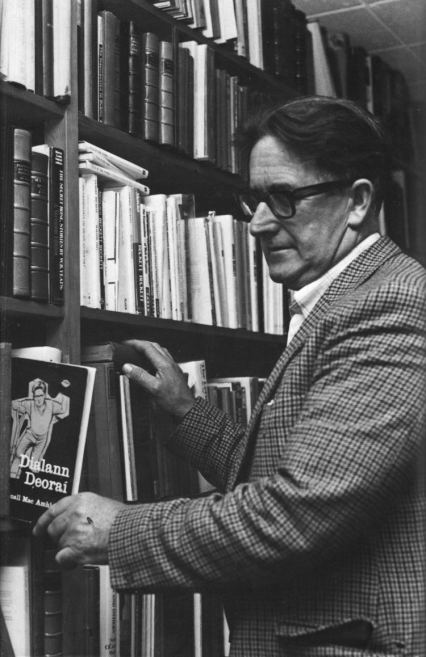
Posted in education, feminism, human rights, Ireland, Irish second generation, labour history, Manchester, North of Ireland, political women, Socialism, Socialist Feminism, women, working class history, young people | Tagged , , | 2 Comments

My review of “A Collective Bargain. Unions, Organizing, and the Fight for Democracy” Jane McAlevey


What do you want to do ?

New mailCopy

a collective bargain

There are three reasons why I like this book.

One; it’s written by an activist. There are too many books being published by people who want to preach about what we should but do little beyond that. Give me people who actually make a difference.

Two:  it reminds readers in Europe that the USA is not Trumpland but is a society with a radical trade union history – past and present.

Three; it’s an inspiring book. Jane has a history of activism and she highlights many individuals and groups of workers who are on the frontline of defending their jobs and conditions –and particularly the  women and black workers who are a significant part of the American labour market.

At the heart of this book is the belief that unions are the only effective response to the destruction of democracy by the super rich corporations. Trade unions have existed as long as the USA has,  but it was in 1935 that they really became part of the social fabric of society. The depression of the 1930s was brought about by the capitalist class and, as Jane explains,  the response was :  “Congress passed the National Labor Relations Act (NLRA) which guaranteed workers the right to collective bargaining –the right to negotiate wages and other terms of employment – and created one national legal framework for unions in the private sector.”

Trade unions now existed to balance up the power structure within society. Jane goes on to prove the point that trade unions are an important institution in the  democractic process in the USA. but  once unions were challenging the power of the market the backlash came and,  as she points out,  the decline of unions is directly, in the USA, related to the growth of the union busting industry. As she says; “My firm belief that only strong, democratic unions can get us out of the myriad crises engulfing the United States, and large parts of the world, is based on my twenty five years as an organiser in the field, running and winning hard campaigns.”

Some of the most interesting parts of the books are  Jane’s own experience as an organiser. One of her early experiences, in 1991, when she was hired to do some preparatory work for the arrival of a delegation of interfaith leaders to take a tour of the US-Mexico border as part of a faith-based conference on conditions in the maquiladora zone. She observed that,  as early as the 1960s in Mexico,  the globalisation process was already underway, as  well-known US companies including GM, Ford and IBM had set up there and were paying poverty wages, the corporations benefitted from less regulation whilst making big profits and  were destroying the environment. There is no way American workers could compete.

In this book Jane shows how it is through unions that people can claw back power from global industries and improve their lives and their environments. The book is a instruction manual  not just on why workers need unions but  has some important examples of how they can go about it.

Just like the UK some of the most important strikes are being led by women as women dominate some of the biggest industries including health, education and hospitality. The power of the union to combat racism and sexism is shown in a case in Philadelphia in 2016 when Jane was a chief negotiator in contract talks between a thousand nurses and their employer.

One of the nurses involved was Marie Celestine, a black nurse who had worked in the hospital for forty years,  and was respected by  her colleagues and patients. Through the union Marie found out that for  over the forty years she had been paid thousands of dollars less than her mostly white juniors. As she comments “I’ve been denied the merit raises for most of my entire lifetime at this hospital.” Racism was the only explanation for her being denied pay equality.

Taking a leader role in the  collective bargaining process Marie won a fair and equal wage scale, eliminated the abusive merit system,  ended racial inequalities and gained 100 percent equality between women and men. This case is a reminder, as Jane comments; “Today, with women dominated fields growing, including societally urgent ones such as home health care, the future of the union movement is even more so the future of the women’s movement. If only women will unite, together.”

Jane has devoted her life to organising within the trade union and labour movement. She knows that unions can and do win and that central to that is organisation and building a movement that will challenge corporate domination of our lives. This book  is essentially about the American experience but there are many comparisons that can be made with our lives in the UK.

Over here we have seen the rise of new trade unions such as United Voices of the World which are more democratic and which have encouraged and supported their members to fight and win better pay and conditions. Groups such as the Angry Workers Collective are inspiring in taking the struggle to some of the big battlegrounds such as the food industry and their  communities to show that trade unions and organising are about more than just pay and conditions.

And as Jane says; “Good unions point us in the direction we need to go and produce the solidarity and unity desperately needed to win. We can fight, and we can win.”


Buy it, it costs £20 from the real Amazons here

Posted in anti-cuts, book review, Communism, education, feminism, human rights, labour history, political women, Socialism, Socialist Feminism, trade unions, Uncategorized, women, working class history, young people | Tagged , | 3 Comments

History of the Irish in Britain Representation Group by Patrick Reynolds. Part 2: 1982

Patrick Reynolds was one of the founders of IBRG and played a key role in its history. He is now writing up that history and putting it into the context of radical history in Britain and Ireland in the C20th.

1982 saw the early beginnings of building up the branch structure of IBRG,   expanding the organisation and setting out the constitution and structure of the organisation.

On 16 January 1982 the IBRG held its first meeting in Liverpool where Bill Walsh was elected local Chair and Siobhan Sandy as Secretary.

On 16 January 1982 the IBRG held its first meeting in Liverpool where Bill Walsh was elected local Chair and Siobhan Sandy as Secretary.

The Irish Post (1) reported on 23rd January 1982 that IBRG had two functioning branches in Manchester and was planning a meeting for Birmingham and one in London for 24 January 1982. The delay of the IBRG to set up in London led to a flurry of other groups trying to fill the vacuum.

On 30 January 1982 a broad-based meeting was held at the Irish Club in London which over eighty people attended from various groups with a view to form a representative Irish National Body.

Michael Sheehan, who attended the meeting, stated that ‘the primary aim of the IBRG is the social cultural and economic welfare of the Irish community, with concerns about Human Rights in Northern  Ireland.  The meeting called for the abolition of partition, the repeal of the PTA, the promotion of realistic images of Irish identity tradition and culture in this country, concern over republican prisoners and called for their repatriation. “   It was agreed that Richard Balfe MEP would set up an inter party group of MPs and MEPs to look at Ireland and the Irish community in Britain. The IBRG agreed to liaise with this new group.

The Irish Post further reported on a national meeting of the Federation of Irish Societies (F.I.S.) where they decided to hold a conference on Northern Ireland. George Meehan, later Labour Leader of Haringey Council in North London, stated ‘never again must we sit idly by, never again must we run away’ while Tommy Walsh from Liverpool stated ‘I fear we missed the boat, we are already a laughing stock’ referring to the failure of the Federation to make any statement on the Hunger Strike of 1981 where 10 young Irishman died demanding to be treated as political prisoners.

On  6 February 1982  the Irish Post carried a photo of three IBRG members Jim King, Michael Sheehan and Gerry Gallagher from Manchester who had attended the meeting at the Irish Club with a big story heading ‘Finding Common Ground’. (2)

Jim King spoke about passing on our heritage to our children and that previously the focus had always been on the Irish border and not on a community in Britain. Michael Sheehan stated that the IBRG were ‘opposed to all kinds of violence’. The Irish Information Partnership, Connolly Association, Cumman na Poblachta and Labour Committee on Ireland and IBRG were present. Clearly the Irish Post were wondering out loud how these two new groups could work together in the interests of the Irish community in Britain. The meeting exposed the lack of any IBRG presence in London at that stage.

IBRG Jim King and Joe Mullarkey

Joe Mullarkey and Jim King

On 18 February 1982 a minority Fianna Fail government came into power in the Republic of  Ireland, and in general Fianna Fail were seen as better than Fine Gael in terms of Northern  Ireland and the Irish in Britain, although all Irish governments had ignored the welfare of the Irish community in Britain,  leaving it to the Catholic Church to attend  to the community.

On 28 February 1982  the IBRG held their fourth rolling conference in Birmingham Civic Hall following their earlier meetings in Derby, Manchester and Liverpool. (3)

On 13 March 1982  the IBRG, Connolly Association and Troops Out Movement  lobbied Labour MPs regarding  their position on the Prevention of Terrorism Act. (4)

On 20 March 1982  the Irish Post stated that another IBRG branch was to open in Burton on Trent where John Martin lived and  that they were going to put on Irish classes. (5)

For three weeks in April 1982 the Irish Post  ran full page stories on the Federation of Irish Societies (FIS) and their Conference on Northern  Ireland which fifty six  people attended. At  the conference  Tommy Walsh Liverpool welcomed the lobbying of the IBRG on the PTA. The Irish Post spoke of a ‘Federation Reappraisal’ but there was nothing of any substance to come out of it apart from stating they should speak out on issues affecting the Irish community in Britain. (6)

tom walsh

Tommy Walsh of F.I.S.

The Spring/Summer edition of Irish Studies in Britain had a two page article on the IBRG setting out the main areas of IBRG work: the preservation of the Irish way of life, a fair share of resources for the Irish, access to the media, local authority courses, school curricula, anti-Irish racism, travel links with Ireland, the PTA and Northern  Ireland.

Irish studies in Britain 1982

Irish Studies in Britain Spring/Summer 1982

On 1 May 1982    the Irish Post reported that IBRG had set up a branch in Oxford and had plans for London and Cardiff branches. The IBRG now had eight  branches. The IBRG decided they would attend the Bobby Sands March in London on 8 May 1982 and march  under their own banner, their first attendance at any political march in relation to Ireland. (7)

The Irish Post talked of the new body the Irish National Council (INC) having six branches in London and the emerging IBRG and there being no question of amalgamation between them at this stage but co-operation.  At this stage the IBRG had no London branches and had left it late to set up something in London, and there was clear evidence that other political groups were organising to take centre stage before the IBRG had a chance to set up. In retrospect it  was a big mistake to leave London to be the last place to set up in.

The Irish Post commented on the views of the Chair of the Federation ‘the Chairman has on numerous occasions during the past year expressed resentment on the emergence of the IBRG and the London based Irish National Council’.

A Federation motion on Northern  Ireland which opposed the PTA, condemned the use of violence, and supported a United Ireland by peaceful means supported British withdrawal and an end to the Unionist veto was ratified at the AGM without any debate.

On 3 May 1982 the British sank the Belgrano   whilst it was retreating. The Irish Minster Paddy Power stated that ‘Britain themselves are every much the aggressors now’

On 15  May 1982 the Irish Post  reported that the IBRG intended to hold its first London meeting at Central Hall Westminster on 22 May 1982. The IBRG also stated they were to set up a branch in Nottingham.  The IBRG had decided to set up sub committees to look at isues such as  anti-Irish racism, education, travel between Britain and Ireland, media monitoring and civil liberties. (8)

On 22 May 1982 the Irish Post had an editorial entitled:  IBRG Comes to Town,  stating that Manchester had led the early development of IBRG. The London meeting at Central Hall was packed with members of the Irish public in London. Irish Civil Rights, British Association of  Irish Studies, Irish Republican Socialist Party,  Cumman na Pobhlachta, Irish Archives, Gaelic Athletics Association, Conradh na Gaeilge,  Green Ink, and the  Irish in Britain History Group attended along with many others.(9)

On 29 May 1982  the IBRG held their first London Inauguration meeting which sixty people attended and planned four branches in London. A London steering group was set up to advance the IBRG in London.  This later led to internal IBRG problems as the London Steering Group were a loose grouping without clear links to the National Organisation. The preservation of the Irish way of life in Britain, a fair share of resources for the Irish community in Britain, an anti PTA position,challenge anti Irish racism and use the Race Relations Act for any test cases, work for reconciliation and peace in Northern  Ireland and condemn the use of plastic bullets were seen as early priorities. (10)

On 3 June 1982 the Irish Post reported on new IBRG branches in Nottingham, Leicester and Cardiff.

On 18 June 1982 Lord Gowrie Minister of State at the Northern Ireland Office  stated ‘Northern Ireland is extremely expensive for  the British taxpayer… if the people of Northern  Ireland wished to join with the south of Ireland, no British Government would resist it for twenty minutes.

On 19  June 1982  the Irish Post the IBRG took up the issue of shops in London selling racist Irish mugs and other materials to denigrate Irish people.  Camden Council for Community Relations were supportive and IBRG called on the Attorney General to prosecute the shops involved. The local press covered the story. (11)

On Saturday 26  June 1982   the IBRG held their first Ard Fheis (AGM) at the Civic Centre in Digbeth in Birmingham and seven branches attended from Birmingham, Manchester, London, Liverpool, Nottingham and Burton on Trent with apologies from Derby and Oxford. Jim King from Manchester chaired the meeting. (12)

Papers were accepted at the meeting on;

Preservation of the Irish way of life in Britain,

A fair share of resources for the Irish in Britain,

Access to the media,

Local authority Courses in Irish studies,

 The inclusion of Irish studies in multi-racial school curricula,

Anti-Irish racism in all forms,

 Travel and links to Ireland,

The Prevention of Terrorism Act (PTA) and Northern  Ireland.

Manchester IBRG presented a paper to the meeting on a framework for IBRG policy on Northern  Ireland which was agreed and adopted as a consultative document to be circulated to all branches.  It was decided to call a special conference meeting three months later to agree the IBRG policy on Northern  Ireland.

The meeting elected the NEC;

President John Martin -Burton on Trent,

Chair Jim King: Manchester

Runai  (Secretary) and Public Relations Officer  -Mike Sheehan of Manchester

Vice Chair:  Bridgit Galvin – London

Cisteoir (Treasurer) : Patrick Browne – Manchester

Internal Co-ordinator: Peter Fallon -Nottingham

External Liaison Officer: Ted Rowan –  Nottingham

Education Office: Nessan Danaher – Leicester.

Six other members were elected to the National Executive Committee: Ms Gregory: London, Judy Peddle: Cardiff, Bill Walsh: Liverpool, Kevin Doherty: Birmingham, Gerry Gallagher: Manchester and Desmond MacCurdy: Leicester.

The IBRG now for the first time had a national structure within Britain and had set out its areas of concern for future work. It also had an early policy document on Northern Ireland.

On 3 July 1982 the Irish Post reported that that the Attorney General Michael Havers had refused to prosecute these shops selling anti Irish materials. Michael Havers represented the Crown in two of the worst cases of Irish injustice in British history in the prosecution of the Guildford Four and the Maguire Seven. (13)

On 10  July 1982 the Irish Post reported on a new IBRG branch being set up in Camden on 18 July 1982.

On 17  July 1982 Pat Reynolds complained to the editor of the Weekend Daily Mirror because of their anti-Irish jokes published on 17 July 1982

On 24  July 1982 the Irish Post  reported that IBRG had put in a five-page submission to Channel Four calling on the TV station to give air time to Irish affairs. (14)

On 7  August 1982  the Irish Post  had a front page story entitled ‘A Victory’ as the  Camden shop had agreed not to sell racist Irish mugs as more which showed that the IBRG could achieve things for the Irish community and were not afraid to take action  on behalf of the community and give a lead. (15)

On 14  August 1982 the Irish Post  reported that the Federation for Irish Societies  had called for the British living in the Irish Republic to be given the vote in Ireland. This was an extraordinary call given they never supported the Irish abroad having the vote at home. In the same issue the Irish Post reported that forty  Tory Party constituencies had put forward motions on taking the vote off the Irish community in Britain. When the Irish Civil Rights Group reported this to the Commission for Racial Equality they were dismissed. (16)

On 28 July 1982 the Irish Post carried a big advert calling on the Irish to join the IBRG and gave the addresses for nine different branches. This advert was repeated in October 1982.

On 25 September 1982 the IBRG received a reply from James Prior Northern  Irish Secretary stating that plastic bullets would not be withdrawn. Here we get the Irish community beginning to have their views known on abuses of human rights in Northern  Ireland with particular concern for the deaths of children by the use of plastic bullets.

On 1 October 1982 the British Labour Party Conference called for a ban on plastic bullets throughout the UK.

On 20 October 1982 Sinn Fein took  part in the new Northern  Ireland Assembly elections and got 10% of the vote with Adams and McGuinness elected. The performance of Sinn Fein causes consternation in the British establishment fearing that Sinn  Fein might eventually replace the Social and Democratic Labour Party.

On 23  October 1982 Jim King, Chair of  IBRG, had a letter in the Irish Post questioning the role of the Federation of Irish Societies and what had they achieved and welcoming  the call for a meeting of all groups representing the Irish in Britain. (17)

On 30  October 1982 the Irish Post reported IBRG as stating that ’a solution of the Northen  Ireland conflict is hindered by irrational anti-Irish prejudice and misrepresentation of events in Ireland’.  The paper also reported on the setting up of a new branch in Islington by Seamus Carey and Pat Reynolds. In the same issue Pat Reynolds had a letter attacking the far right in Britain who were trying to divide the Irish and Black community and pointed out that anti Irish and anti-Black racism had their roots in the colonial system of plantation and slavery.

On 6 November 1982 in the Irish Post Jim McGrath, of the F.I.S., responded to Jim King’s earlier letter and attacked the IBRG for its name and purpose. It was as if the Federation had lost the argument and had had nothing to add to the debate or to the way forward. Meanwhile the IBRG had started discussion with the Greater London Council (GLC) who had appointed an Irish Community Liaison Officer Steve Brennan who was a member of IBRG.

Ken Livingstone was leader of the GLC and John McDonnell his deputy,  both with progressive views on Ireland and the Irish in Britain. Here the IBRG were moving away from the traditional Federation position of following the Irish Embassy, instead starting a dialogue on behalf of the Irish community with Local Authorities in Britain asking them how they were addressing the needs of the Irish community.  The GLC responded by convening a meeting on London at County Hall for all Irish groups in London.

On 14 November 1982 the IBRG held their Ard Choiste meeting at the Yorker Public House in Nottingham where eight members of the NEC attended from London, Manchester, Nottingham, Liverpool and Burton on Trent. (18)

Jim King chaired the meeting which was spent mostly on drawing up a constitution and standing orders. The meeting considered whether the organisation needed to be split in two,  one for the charity work and one for its political work. The Charity Commissioners had been approached for registration.  The meeting decided on having an Ard Fheis in March 1983, welcomed an approach from Bradford & District Irish Association for affiliation, and agreed to take action about an article in the Daily Express.

On 19 November 1982  Islington IBRG took its first direct action by picketing three local shops in Islington including Woolworths for selling anti Irish materials such as joke books and racist tea towels. Jeremy Corbyn, Prospective Labour candidate for Islington North,  attended the pickets. It marked a new beginning of taking action onto the street in defence of the rights of the community to live free from anti- Irish racism. (19)

In 20 November 1982 Sean Sexton, an IBRG member,  wrote to the Irish Post asking why the Federation (F.I.S) never campaigned on anti-Irish racism, why they were silent on the Hunger strikes,  have no presentation of Irish culture in Britain, and no promotion of Irish talent in Britain, no lobby of Parliament on issues affecting the community,  and no response to Tory party attack on the Irish vote.  Bridgit Galvin replied in the same issue to an earlier Federation attack by Jim McGrath. (20)

On 24 November 1982 Islington IBRG attended the Race Relations Committee at Islington Town Hall.  Again this was a new departure for the Irish community. The Irish were clearly a racial group under the terms of the Race Relations Act and the House of Lords judgement on the matter and were therefore entitled to protection from discrimination in employment and racial abuse.

On 24 November 1982 a General Election in Ireland saw with return of a Fine Gael/ Labour coalition government.

On 27 November 1982  Woolworths agreed to withdraw their anti-Irish joke books after the IBRG met them at Woolworths HQ in London.  (21 )They also agreed to withdraw racist tea towels which portrayed the Irish in racist terms.  The IBRG had threatened national boycott of Woolworths stores in the UK. It was an instant quick victory for the IBRG and showed the Irish community what could be done to protect our children from this daily abuse in schools modelled on these adult examples of anti-Irish hatred.

It was a major victory in the fight against anti- Irish racism in Britain and sent out a clear warning that such anti- Irish materials would not be tolerated.  The IBRG also called on Radio Telfis Eireann  not to broadcast any BBC programme which included anti- Irish materials such as anti-Irish jokes.

On 27 November 1982 in the Irish Post  there were a number of letters including the leading letter supporting the work of the IBRG .(22)

On Sunday 28 November 1982 the IBRG NEC met at the Yorker Public House. The meeting heard that the London regional committee had run into trouble the previous Sunday in London where there had been a dispute which would rumble on into 1983. The London Region did not fit into the National structure of IBRG and was set up originally to facilitate growth in London but now London had branches in different areas like Islington,  Camden and Lambeth.

On 4 December 1982  the IBRG stand on anti-Irish racism was endorsed by the Labour Party when they stated ‘we welcome your statement and thoroughly endorse it. The racism faced by Irish people must we believe be revisited as that faced by Black people and Jews’. This was a major breakthrough to have the British Labour Party take a position on anti-Irish racism and to see it as an issue. (23)

On 4 December 1982 the IBRG had another major victory when Ken Livingstone of the GLC took up the issue the IBRG had with JAK,  the cartoonist for Evening Standard,  who on a regular basis published anti Irish cartons which were racist in the extreme.  Livingstone stated ‘The IBRG claim they have received complaints from Irish residents of London who find the material extremely offensive.  We will not put another penny into the Standard while they continue to vilify the Irish’ while John McDonell  stated ‘we will stand shoulder to shoulder with the Irish community’.

The IBRG congratulated Livingstone and the GLC for their action in withdrawing £100,000 advertising from the Evening Standard and their  support for  the community ‘The IBRG asked Ken Livingstone to take up this matter in behalf of the Irish community and he did so splendidly.”

IBRG talk Jak Cartonn

JAK cartoon in Evening Standard.

The GLC also supported the Irish community retaining the vote in Britain and condemned Tory Party attacks on this right to vote. This was a major victory for the Irish community in their fight against anti Irish racism in Britain.

On 8 December 1982 the British Home Secretary banned Gerry Adams and Danny Morrison from entering Britain under the PTA and the following day Ken Livingstone accepted an invitation from Adams to visit them in Belfast.

On 11 December 1982 Brent Council came out in favour of the Irish retaining the vote in Britain campaign that the IBRG was now running. The Council for Racial Equality (CRE)  agreed to ask the Attorney General to speak out on Irish voting rights. This was the first time the CRE had agreed to do anything for the Irish community in Britain. (24)

On 18  December 1982 the London Regional Council held a meeting. Jim Curran was elected Chair, Steve Brennan as Vice Chair and Pat Delaney as Public Relations Officer.

On 20 December 1982 the British Government increased the number of MP seats in Northern  Ireland  from 12 to 17.

IBRG ended 1982 in a strong position with a functioning National Executive and a strong base in London. There were however some issues with the London Regional Council to be sorted out. The organisation had taken street action against anti Irish racism, had persuaded Woolworths to withdraw their anti-Irish materials from their shops in Britain, had persuaded the GLC to ban all advertising in the Standard because of the racist JAK cartoons, had got the Labour Party to support the IBRG position on anti-Irish racism and had begun to talk to Local Authorities about the needs of the Irish communities in Britain.

Notes.

  1. Irish Post 30/01/1982
  2. Irish Post 6/02/1982
  3. Irish Post 27/02/1982
  4. Irish Post 13/03/1982
  5. Irish Post 20/03/1982
  6. Irish Post 3/04/1982
  7. Irish Post 1/05/1982
  8. Irish Post 15/05/1982
  9. Irish Post 22/05/1982
  10. Irish Post 29/05/1982
  11. Irish Post 19/06/1982
  12. Minutes of IBRG Ard Fheis 26/06/1982
  13. Irish Post 3/07/1982
  14. Irish Post 24/07/1982
  15. Irish Post 7/08/1982
  16. Irish Post 14/08/1982
  17. Irish Post 23/10/1982
  18. Minutes of IBRG NEC 14/11/1982
  19. Irish Post 19/11/1982
  20. Irish Post 20/11/1982
  21. Minutes of IBRG NEC 26/11/1982
  22. Irish Post 27/11/1982
  23. Irish Post 4/12/1982
  24. Irish Post 11/12/1982.

Listen to my talk about the  IBRG in the northwest in the Irish Collection at the WCML here

An excellent history of 200 years of Irish political activity in Mancheser – including Manchester IBRG read “The Wearing of the Green” by Michael Herbert. Buy it here
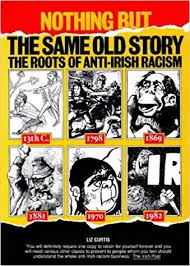
Posted in Catholicism, Communism, education, human rights, Ireland, Irish second generation, labour history, Manchester, North of Ireland, political women, Uncategorized, women, working class history, young people | Tagged , , , , , , , , , | 1 Comment

My review of “Just Like Tomorrow” (2004) by Faiza Guene


What do you want to do ?

New mailCopy

just 2

It is hard to imagine a working class female migrant from the deprived areas of Clayton (Manchester), Glodwick  (Oldham ) or Hyde (Tameside) being offered a book contract. Faiza is from a similar background; North African descent, working class, living in the less glamorous suburbs of Paris. She wrote her first novel at 17 years old, Just like Tomorrow,  which was a massive success.

Faiza writes about her life and her community but she also draws the links with the position of North African people and their colonial situation in France. Her books are angry, funny and direct: opening up a world of discrimination and deprivation but one where people have their own ways of dealing with their circumstances.

In Just like Tomorrow the heroine is 15 year old  Doria.  Her father has returned to Morocco to marry another woman so he can have a son: her mother does not speak French and works as a room assistant in a local hotel. Doria is angry – not just teenager angry – but angry about her life and her position within the category allocated to her and her community in France.

Doria hates the way her mother is treated at work . “Everyone calls her Fatima at the Formula 1 in Bagnolet. They are always shouting at her, and they keep a close eye on her to check that she doesn’t jack anything from the bedrooms”.

Of course Fatima is not her mother’s name; that is  Yasmina. It is just the everyday racism that she experiences as a migrant woman trying to make a living in the low wage economy. Later on in the book when the rest of the hotel staff go on strike poor Yasmina has no choice but to keep working. She says to Doria that she wants to support the other women but has no husband to support her.

Going on strike is everywhere in Doria’s world. Her teachers are on strike after the Head teacher has a gas canister thrown at him. But violence in the school is not unusual and it is not surprising given the lives of the young people and their lack of hope for the future.

Doria does have some people she can talk to,  including her social worker Mrs Burland and a local young man Hamoudi.  Doria knows that people are watching her and that, because of her father leaving, that she has been labelled as a “problem” by the authorities. And, although Mrs. Burland irritates her – “she is old, ugly and she smells of Quick Nits shampoo” – Doria feels able to talk to her about her feelings.

Hamoudi is a street wise young man of 28 and someone who  does take time to  listen  to Doria. Like a lot of North African young men he has been in prison and now spends his time selling drugs because there are no other choices. Hamoudi quotes poetry to Doria and it saddens her when she sees how the police treat him. “So when I see the police frisking Hamoudi near our main entrance or I hear them bad-mouthing him with stuff like “shithead” or “piece of scum” I tell myself they don’t know anything about poetry.”

Life for migrants in France is not easy. Films like Le Haine and Girlhood have shown that few of them enjoy the ideals of the French Republic of “equality, fraternity and liberty”. Faiza in this novel reveals the reality for young people  which is often harsh and unrelenting oppression. But, as in her other novels,  the main character is a young woman who is  angry  but also intelligent enough to realise that she can change her life and maybe even that of her community.

Reading this novel reminds me of my relationship with my mother. She was Irish and experienced similar acts of racism and hostility. It is not good for any child to see their mother being treated in this way. For me the power of this novel is that it makes real the experiences of many migrant women across the world but not as victims but as people who can overcome discrimination and live a happier life.

Buy it here

What do you want to do ?

New mailCopy

What do you want to do ?

New mailCopy

Posted in book review, drama, education, feminism, human rights, labour history, novels, political women, Socialism, Socialist Feminism, Uncategorized, women, working class history, young people | Tagged , , , | 2 Comments

History of the Irish in Britain Representation Group by Patrick Reynolds. Part 1:1981


Patrick Reynolds was one of the founders of IBRG and played a key role in its history. He is now writing up that history and putting it into the context of radical history in Britain and Ireland in the C20th. This is  the story of the first year of IBRG………….

Pat Reynolds speaking at Bloody Sunday rally

Pat speaking at the annual Bloody Sunday March

1981: The Founding of IBRG

1981 was a pivotal In Irish history with the death of ten men on Hunger Strike in Northern Ireland. It led to significant shifts in Irish political history and the entry of the modern Republican movement into political life and the electoral system in Northern Ireland and the Republic of Ireland.

On 1st March 1981 Bobby Sands started his Hunger strike, on 5th March 1981 Frank Maguire MP for Fermanagh-South Tyrone died, on 26th March Bobby Sands was nominated to stand for the vacant seat. On 9th  April 1981 Bobby Sands became the new MP for Fermanagh South Tyrone. On 5th  May 1981 Bobby Sands MP died  and over 100,000 people attended his funeral on 7 May 1981 in Belfast.

On 29th  May 1981 nine republican prisoners,  four of them on hunger strike,  are  nominated in the General Election in the Republic of Ireland. On 11th  June 1981 two republican prisoners were elected to Dail Eireann –   Kieron Doherty and Paddy Agnew. The new government was made up of Fine Gael and Labour. On 20th  August 1981 the last of the ten men Michael Devine dies  on Hunger strike. On the same day Owen Carron wins the by election held after the death of Bobby Sands MP. On 23rd  August 1981 Sinn Fein announces that they will contest all future Northern Ireland elections.

On 29th  September 1981 the British Labour Party votes to campaign actively for a United Ireland by consent. On 31 October 1981 Danny Morrison make  his famous speech of ‘a ballot paper in one hand and an Armalite in the other’ to mark the new departure in Republican politics.

The Hunger Strikes were to move the international community none more so than the Irish abroad. In London the Irish Civil Rights Association statement said: ‘No Irish person should join, vote or give support for any British political party” and called on “the Irish community to abstain in the 7th May local elections” (1). On 13th  June 1981 Ken Livingstone addressed a Hunger Strike march in Finsbury Park before it started on its way via Camden to Michael Foot’s House in Hampstead. Only the North Hackney Labour Party were on the march which had no Trade Union banners:  the Irish community was left to march on its own.

1981-Ken-Livinstone huger strike

Ken Livingstone at Hunger Strike Demonstration

The Irish Post  newspaper was critical of the AGM of the Federation of Irish Societies which was  held at the height  of the Hunger Strikes stating ‘Conference was remarkable in that at no time were the H Block or Hunger Strike mentioned’. Harry McHugh of the earlier Anti Partition league in a letter to the Post stated ‘when people who call themselves Irish people refuse even to talk about them (Hunger Strikes) I am impelled to ask What kind of Irishmen are you? (2)

On 1st  August 1981 John Martin (later to be the first Chair of IBRG, and credited as the original founder of IBRG0  had a letter in the Irish Post. (3) The letter stated: ‘The time has come for the Irish in Britain to acquire an organised effectiveness in contending with the major issues besetting their homeland as well as their adopted country… one positive action would be to begin campaigning for the postal vote in Ireland… we can still organise and do so independently of the established Irish community in this country…once a dedicated organisation is in existence  speaking for the mass of the Irish in Britain then we can pursue out voting intentions through the European Court’. While calling for a new Irish organisation to represent the Irish in Britain the letter only mentions one issue,  that of voting rights for the Irish in Britain at home in Ireland.

In the same issue of the Irish Post (3) John Fahy, a USDAW Trade Union Official, and later a Labour Party Councillor in Greenwich and  an Officer of the Federation of Irish Societies, had a much stronger letter stating: ‘The Irish in Britain can be an effective force in the political life of this country and we must coordinate out activities to exert the maximum pressure on MP’s to demand the ending of the Emergency Powers Act and the prevention of Terrorism Act, and extract from them a clear commitment to begin the process of moving towards an united Ireland over the next decade’.

It was clear that the Irish Post and its Editor Brendan McLua was very unhappy about how the Federation of Irish Societies failed to give any expression to the feelings of the Irish community over the Hunger Strikes and was opening its pages to a debate on the subject, and to where the Irish community should go. The Irish Post was to become the public forum of the Irish community over the next year as to how they should organise themselves for the future.

On 15th August 1981 Michael O’Callanan of Cuman na Poblachta in the leading letter in the Irish Post entitled Call to Action Welcomed (4) stated: ‘Should John Martin’s proposal receive the support it deserves from the Irish in Britain, and should he decide to promote further the idea of an Irish national organisation to give our community political effectiveness, we can assure him of our support all the way to victory’.

On 5th September 1981 in the leading letter in the Irish Post John Martin responded  in a letter headed Now the Time for Action (5). He wrote ‘I now propose to convene a meeting to take place in about six weeks’ time at which a new organisation will be formed to pursue the political interests of the Irish in Britain…one positive action we could take is to begin campaigning for the postal vote in Ireland…I would urge people born in Ireland to write to their TD and ascertain their opinion about Irish citizens in Britain having a postal vote’ Again, apart from the vote in Ireland, there were no other demands.

On 26th September 1981 Liam Og O Lochlain from the Green Ink Writers Group wrote in a letter to the Irish Post (6) in support of this proposal: ‘there is a tremendous amount of goodwill and latent support for any worthwhile organisation that will effectively represent the interests of our community…It deserves our wholehearted support’.

In another key letter written on the same date, entitled Its Time to go Political,   Michael Sheehan of Manchester sets out a political agenda, listing  several key issues, votes in Ireland, anti-Irish racism, anti-Irish legislation like the PTA,  Northern Ireland and Irish political prisoners.He  stated: “it appears to me that there is a pressing need for the development of an Irish political organisation as no existing political party reflects Irish opinion on the issues I have isolated nor will they till the Irish are effectively organised”.

On 3rd October 1981 the Irish Post headline stated Political Role the Primary Objective. (7) It gave notice of first exploratory meeting to be held on 10th October: ‘the John Martin proposition is for an Irish political organisation which while deeply concerned about the situation in Ireland would also derive its raison d’etre from the social and political  need so the Irish In Britain  while editorial stated: ‘Because of the diversity of our community at this time the odds must be against the emergence of a representative and effective political organisation..and yet the need is there and the vacuum begs to be filled… Certainly an organisation which seeks to represent the diversity of the Irish In Britain has a difficult undertaking’.

On 10th October 1981 the Irish in Britain Representation Group (IBRG) was founded at the New Inn Public House, Newhall, Burton on Trent in Derbyshire with John Martin as convenor.

Twenty three people attended (8). The name IBRG was adopted with John Martin electedas  Chair and treasurer, Michael Sheehan as Secretary and PRO with Michael O Callanan as vice Chair.  Other named persons who attended were John McDonald from Cumanna Publachta, Siobhan Sandys from Liverpool, Kay Jones from Bradford, and Frank Gormley from Burton. The names of the other 16 attendees are unknown and no minutes of the meeting have survived. The issues discussed were the reunification of Ireland, PTA, anti-Irish racism, Labour Party policy on Ireland, Votes in Ireland and the high cost of  travel to Ireland.

On 13th October 1981 a student, Pat Reynolds, proposed a United Ireland motion at the National Union of Students Annual General Meeting at the North London Polytechnic three days after the Chelsea Barracks bombing. The Irish students who supported the motion  got racially abuse by students from the Engineering section, who called the Irish students Paddies and Micks,  but a good continent of African students supported the motion and helped it get  through by a handful of votes.

On 17th October 1981 the Irish Post headline was New Organisation gets Moving. (9)  It stated that London, Liverpool, South Wales, Watford, Bradford, Manchester and Derby were represented. It was to model itself on the SDP in having rolling meetings before hitting London. ‘Its primary role is the representation of the Irish In Britain on issues relating to their lives in Britain’.

Six main issues were identified to pursue: Unification of Ireland: Kay Jones to report back, PTA: John McDonald to report back, Anti Irish racism in media: Michael O Callanan to report back, Labour party policy on Ireland: Frank Gormley to report back, cost of travel to Ireland: John Martin to report back, votes in Ireland: Siobhan Keys to report back.

On 14th November 1981 the IBRG held their first rolling conference meeting in Derby where 16 people attended. (10). The Derby meeting condemned the indiscriminate and unjustifiable use of the PTA to frighten people into silence, condemned all forms or racism including anti-Irish racism such as anti-Irish jokes, media stereotyping and misrepresentation, claimed that the Race Relations Act was not protecting the Irish from many forms of racism, urged to use Press Council to complain, called for political solution to Nt Ireland, talked of the electoral system in Ireland and  how expensive travel to Ireland was, and ‘condemned all violence in Ireland and in Britain from whatever source’.

The danger of having the first meeting in Derby and having rolling meetings is that it left the field open to other groups to come in and set up in London which is exactly what happened, and left the group without an early base in London.

On 21st November 1981 a new rival political group was set up in London at the Irish Club with 30 people attending. (11) Richard Balfe MEP attended and welcomed the group. The Connolly Association, the Irish National Council and the Irish Lobby group attended the meeting along with Gerry Lawless.

On 12th December 1981 the IBRG held their second rolling conference meeting in Moss Side,  Manchester at which 40 people attended. (12) A steering committee of 14 people was set up at this meeting. They decided to set up two branches in Manchester and campaign for air time on Manchester Radio.

1981 was a pivotal year in the history of the Irish in Britain in many ways. The Hunger Strike did impact upon the community and was primarily the reason why there was an explosion of rage in the community at the failure of existing organisation like the Federation of Irish Societies (FIS),  including all its affiliates, to speak out on the Hunger strikes.

Another very significant event was the GLC election of 7th May 1981 with Ken Livingstone taking over. He was to do more for the Irish community in Britain in five years  than the Irish government had done in the previous 60 years. 1981 was also the year of the Brixton Uprising because of the police oppressive stop and search policy and unemployment of over 3 million people in the UK.

The Irish community were beginning to organise themselves eg on 28th February 1981 over 200 Irish people attended an Irish study day at the North London Polytechnic with a further big meeting on 25th April at the same venue for an Irish in Britain History Workshop.


NOTES.

1.Irish Post 2/05/1981

2. Irish Post 6/06/1981

3. Irish Post 1/08/1981

4. Irish Post 15/08/1981

5. Irish Post 5/09/1981

6. Irish post. 26/09/1981

7. Irish Post 3/10/1981

8. Irish Post 10/10/1981

9. Irish Post 17/10/1981

10. Irish Post 14/11/1981

11. Irish Post 21/11/1981

12. Irish Post 19/12/1981

Listen to my talk about the  IBRG in the northwest in the Irish Collection at the WCML here

An excellent history of 200 years of Irish political activity in Mancheser – including Manchester IBRG read “The Wearing of the Green” by Michael Herbert. Buy it here
What do you want to do ?

New mailCopy

Posted in education, human rights, Ireland, Irish second generation, labour history, Manchester, North of Ireland, working class history, young people | Tagged , , , , , , , | 4 Comments

“Anti-Nazi Germans” “Enemies of the Nazi State from within the Working Class Movement.” by Marilyn Moos “German Volunteers in the French Resistance” by Steve Cushion. (2020)

anti-nazi germans

This review is written by Mike Luft, lifelong anti-fascist and communist.


‘Not by beatings, nor by hanging can you

Be brought to the point of saying

Nowadays twice two makes five….

But you remain determinedly committed to the truth.’

Brecht


This book, written with passion and scholarship, refutes the slander that there was no opposition to Hitler from the organised working class. For the English reader this will bring to light perhaps for the first in a more comprehensive form the heroism of the “small people” who time after time withstood unimaginable torture,cruelty and even murder.

People who, after leaving the concentration camps battered and bloodied, returned to the struggle against Nazi barbarism, often giving their lives in the struggle for freedom.

Even when forced to flee their country they did not give up the struggle. They joined the International Brigades in Spain defending the democratically elected Republican government against the fascist usurper Franco who was supported by Hitler’s Nazis and Mussolini’s fascists They came from the Nazi concentration camps bloody but unbowed to fight for their Spanish brothers and sisters. Even after the defeat of the Republic they did not give up the struggle but joined the French Resistance.

This book memorialises and honours their sacrifice. In spite of the authors meticulous research many will remain unknown heroes.There are many instances of heroism of the fighters we know about who are honoured in this book. But rather than single out individuals and separating them from their comrades, I will mention a few resistance groups who typify the courage of their comrades:

The Baum group in Berlin that united predominantly Jewish antifascists.

The Saefkow–Jacob-Bastlein group of workers.

The heroic miners of Carmaux who organised a massive insurrection against the coal owners and the Nazis.

The refugee fighters of the FTP-MOI comprising of Armenian, Polish, German and Jewish resistance fighters, some of whom were immortalised in the French film “The army of crime”. These heroes have been consciously hidden from history in the English speaking world.

But thanks to Moos and Cushion they have been rescued from obscurity and revealed to us in their true dignity, courage and humanity. This book with its copious references, a useful multilingual bibliography and committed scholarship is essential reading for anyone opposed to fascism and racism or is a serious student of the Nazi period.

It’s conclusion is a timely warning against the emergence of far right and fascist organisations in a society in crisis.

It is eminently readable and an inspiration in the coming struggles.

Nothing should be forgotten.

No one should be forgotten.

Soviet saying about World War II

Read this book. You need it!


Buy it – only £10 – from s.cushion23@gmail.com


What do you want to do ?

New mailCopy

Posted in book review, Communism, education, human rights, labour history, Socialism, Uncategorized | Tagged , , , | Leave a comment