Stop! Look! Listen! a weekly selection of some of my favourite films/books/people…


Watch…
Ken Loach at the BBC. During the 60’s and 70’s at the BBC he directed some of his most innovative work with Tony Garnett and Jim Allen which is now collected on this excellent DVD. It includes Cathy Come Home, a heartbreaking account of homelessness; Big Flame, a hard hitting political drama which imagines dockers occupying the Liverpool docks; and Days of Hope which covers the political events of 1916-1926.

Listen to…
Hey Dreamer  by John Spillane, 2005. John is from Cork in Ireland and writes beautiful songs in English and Irish. This is the first of his CDs that I bought and still play for one track in particular, The Dunnes Stores Girl”. It sounds like it should be a punk track, its funny and heartfelt about a young man falling for a shopgirl.
Hey check out the Dunnes Stores Girl
She’s the one who rules my world
I’m gonna walk down the aisle with the Dunnes Stores Girl
I’m gonna waltz down the aisle with the Dunnes Stores Girl
She rules my world

Read…
The Life and Death of Mary Wollenstonecraft by Claire Tomalin. Written in 1974 it tells the story of a remarkable woman. Mary was a pioneer in terms of her radical views on womens’ lives , she lived the life she wanted to, including having a child outside wedlock, and living in France during the revolution. It was Claire’s first biography and it was groundbreaking in terms of the new material she unearthed concerning Mary’s life.

Book now….
One Big Blow at the Hyde Festival Theatre from May 15-19.Set in a coal mining village in the 1980s, One Big Blow portrays the two sides of the miners’ lives – the tough conditions under which they work and the effect this has on their health, and how they  escape from this when they play in the colliery brass band. To book for this production please go to the Hyde Festival Theatre web site page for this production and click on the “book tickets logo” or telephone 0844 804 2634.
Posted in biography, book review, drama, films, labour history, music, Socialism, Socialist Feminism, trade unions, TV drama, women | Tagged , , , , , , , | 2 Comments

St.Patrick and reflections on a day………..

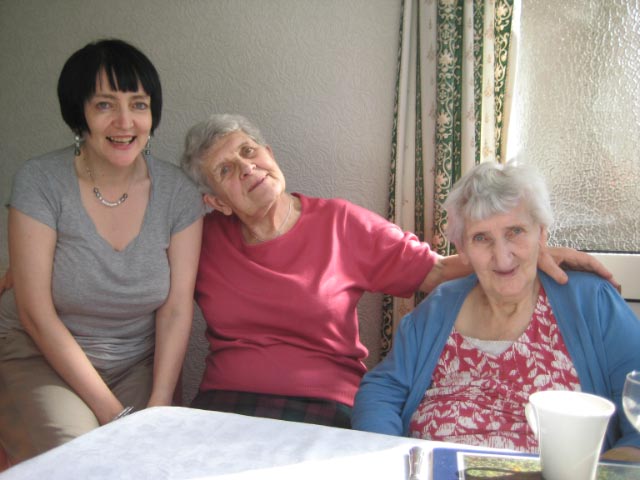
Me, Auntie Margaret and Mum, 2010

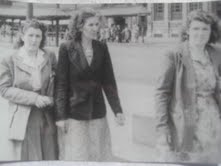
Maureen, Mum and Margaret, 1940s, Manchester

St.Patrick’s Day is on 17 March, a day to celebrate Irishness. Growing up in 70s Manchester, it meant shamrock and family celebrations with our relatives. It was the backdrop to our parents’ definition of Irishness: Dave Allen, John McCormack, Dana and Val Doonican. I grew up on Dad’s stories of building sites and Irish pubs dancehalls in London and Manchester and Mum’s stories of her single life in the 1940s, buying lovely outfits to wear to visit friends and going boating on Platt Fields lake.

By the 80s being Irish had changed. The downturn in the economy of the Irish Republic meant that 40,000 Irish people were coming to England each year while others left the North of Ireland as the conflict there intensified. Second generation Irish young people like me were now redefining what it meant to be Irish, cultural and politically. We listened to Christy Moore, Sinead O’Connor and, above all, the Pogues. I chose to become very active in the Irish in Britain Representation Group, of which I was the first woman chair. Our politics were of being proud to be Irish, proud of a history of rebellion against the occupation of Britain in our country, proud of our parents and their struggle to live a decent life in this country and battle discrimination because of their Irishness.

In Manchester in the 80s the Labour Council had a policy on Ireland which included hosting an Irish week. At that time the Labour party had a progressive policy, opposing Britain’s occupation of the North of Ireland and supporting Irish groups which campaigned on a variety of issues from the Prevention of Terrorism Act to Irish studies in schools.

When it came to deciding the content of the Manchester Irish week in 1988, it came down to the Labour Council stepping in to ensure that IBRG events were included, as we came up against strong opposition from the “traditional” parts of the Irish community, fearful of any mention of what was happening in the North of Ireland.

To us celebrating St. Patrick’s Day meant remembering the bad and the good side of being Irish. So, in the Irish week, I and others organised an Irish Women’s Day, a meeting to highlight the Birmingham Six and various cultural events.

In the 90s thousands of Irish people (including second generation) left Britain and went back to Ireland to take jobs that had not existed when their parents were growing up. By 2012 the downturn in the Irish and global community has meant that “thousands are sailing” again, while Irish Ministers can call emigration a “lifestyle choice” as upwards of 300,000 people are leaving the country. And what has happened to St.Patrick’s Day/Irish Week in Manchester?

In the programme for Manchester Irish Week 2012, it is hard to find anything that reflects the harsh reality for the Irish. Instead we are told “2012 Manchester Irish festival gets ready for the world’s friendliest three day Non Stop St. Patrick weekend party” So the image of the Irish is back to drinking, music and friendliness. In other words we are just a brand to sell alcohol and entertainment.

For me St.Patrick’s Day is a time to remember all those Irish (including my mother and father) who never got to return home to Ireland. And to remember that whatever our background or ethnicity, we need to pursue human rights for all peoples who have to flee their home country.

To know more about the activities of the Manchester branch of the Irish in Britain Representation Group in the 1980s and 1990s, please go here and here.

If you have enjoyed this article and would like to support this blog by making a donation you can do using this button

Posted in human rights, Ireland, Irish second generation, Manchester, North of Ireland | Tagged , , , , , , , | 1 Comment

Stop! Look! Listen! a weekly selection of some of my favourite films/books/people…


Watch
Passion Fish(1992). A film by John Sayles (US equivalent of Ken Loach). The story of the relationship between a soap star, who is paralysed and returns home to rural Louisiana, and her care assistant. Not just the story of their relationship but of their men, their families and their search for happiness.

Read…

While there is Light  by Tariq Mehmood (2003). This is no “East is East”. Tariq is a political writer and activist. He grew up in Bradford and was a founder member of the Afro-Asian group; United Black Youth League. He was arrested alongside 11 other young people who were dubbed the Bradford 12. Charged with conspiracy Tariq conducted his own defence and was acquitted. The novel starts with the main character, Saleem, writing to his mother from his cell in a Leeds prison. “Mother I am now in jail, in this bitch of a country called England. I may never see you again.” Using Saleem’s story, the author takes us on a trip from urban Bradford to the villages of Pakistan and invites us to listen to the debates about what it means to be Muslim today.

Listen to …
Kaleidophonica by Spiro (Real World 2012) A Bristol based band producing music that takes in lots of genres, including folk and dance but are hard to pin down. The music is great on a Sunday morning,  eating your croissants!

Visit
Working Class Movement Library  to see The Clarion – a Paper,a Movement, a Way of Life  The exhibition displays the Library’s extensive collection of Clarion material and tells the story of how a newspaper came to inspire a way of life. On 17 March at 2pm Bolton Clarion Choir will be performing and Denis Pye,  author of “Fellowship is Life;The National Clarion Cycling Club 1895-1995,  will speak about the Clarion movement.

Educate yourself
Jailhouse Lawyers; Prisoners defending prisoners v.the USA by Mumia Abu–Jamal. (Crossroads Books)
Mumia has been in prison in the USA for over 25 years and his own trial and sentence has been challenged by Amnesty International. He has become an award winning journalist during his time in prison and in this book tells how prisoners in the USA have to learn the law in order to win justice for themselves and other prisoners.With introductions by activists, Angela Davis and Selma James,  it is a powerful demostration  of what even people in the most powerless situations can do if they get together and challenge the system.

Posted in biography, education, films, human rights, labour history, Manchester, music, Socialism, women | Tagged , , , , , , , | Leave a comment

Reclaim the Day!

German Socialist Feminist Poster 1914

What does IWD mean to women today? International Women’s Day was started in 1909 in America by the Socialist Party and was first celebrated internationally two years later. It was originally called International Working Women’s Day, its aim was to promote equal rights for women, and particularly the vote. In Britain it has been traditionally celebrated by trade unions and women’s groups including National Assembly of Women on  8 March .

In the 70s it was revived by the Women’s Liberation Movement and became a focus for women to debate what kind of society we wanted including  issues such as sexuality, childcare and  abortion. There was always a wider political dimension ie highlighting women such as the Miners’ Wives in the 80s, women in Northern Ireland and Palestine.

In 2012 IWD looks very different. We have somehow moved from events that challenged what it meant to be a woman to a lifestyle fest of pampering and cupcakes.

Stockport Council’s IWD event, for instance is a partnership event with the Women’s Organisation, an economic development agency, with the publicity proclaiming ”This is a FREE event sponsored by Stockport Council for women running their own business in Stockport”. Down the road in Manchester the Council has organised a day of “Inspiring Futures” with the emphasis on gaining skills and applying for education or jobs. But the role models offered include a barrister and the chief executive of Nuclear Enterprise.

It is hard to reconcile these events with the stark reality that the numbers of women out of work is the highest in 25 years. Of the 2.67 million people who are unemployed 1.2 million are women. And as women make up 65% of the public sector they are being disproportionately affected by the cuts. And if that is not bad enough the changes in benefits including housing and tax credits are having a massive effect.

I came into Socialist politics in the 70s and for me the spirit of IWD is remembering those women who have challenged the stereotype of what it means to be a working woman and been active in grassroots campaigns. This is why I am pleased to be chairing an event at the Working Class Movement Library which will involve discussing the life of Ethel Carnie Holdsworth. We will be bringing the discussion back to 2012 with input from trade unionist Karen Bosson of the Communications Workers Union. The event starts at 2pm . For more information go here

I have asked some women to contribute their views on IWD and this is what they wrote. What do you think? Please add a comment.

“During the 1970’s and 80’s, when women were organising for themselves and as part of wider movements in Europe and US (anti-war, Greenham Common, in trade unions, women’s health movement etc) we organised marches and events on March 8th that highlighted our issues (access to abortion services being a prime one, which no-one else was going to organise). The events were also a tribute to those unsung women who had struggled in many different spheres, before us. The events were joyous and celebratory. IWD still has meaning for many struggling women’s groups in S.America, the Caribbean, in Africa and the Middle East. But in Britain, most of the activities I have seen advertised are the overt posturing of an anti- working class Labour bureaucracy, trying to hide behind a feminist apron/ petticoat – and a far cry from any independent feminist voice. So I’m not planning to celebrate 8th March this year, although I say “Good Luck” to any women trying to do something.” Pia Feig, trade union activist

“For me International Women’s Day is a time to celebrate our strengh, our successes, our diversity and to focus on the need to continue fighting for rights and equality worldwide because if we don’t who will. It’s also an opportunity to meet inspirational women at a variety of events and re-charge the batteries so we can keep up the struggle for another year!” Claire Mooney, musician and activist.

Finally there is an excellent article by Louise Raw in the Morning Star about International Women’s Day which you can read here.

If you have enjoyed this article and would like to support this blog by making a donation you can do using this button

Posted in International Women's Day, labour history, Socialism, Socialist Feminism, trade unions, women | Tagged , | 3 Comments

Stop! Look! Listen! a weekly selection of some of my favourite films/books/people…


Watch
Shabby Tiger. Made by Granada TV in 1973 it’s the adaptation of  a novel by Howard Spring. Set in 1930’s Manchester,  it’s the love story between an artist and an Irish waitress,  and  the story of how the depression affects the lives of the lovers and as the city. Brilliant acting (especially by the late Christine Hargreaves as Communist Olga Kepple) and it’s well worth tracking down the book and its companion piece, Rachel Rosing. The author, Howard Spring was a journalist for the Manchester Guardian and in the books he describes the life of the city including the Irish and Jewish communities. The DVD is available from Network DVD.

Go to

The Daughter-in-Law by D H Lawrence at the Lowry in Salford until 10 March 2012 Set in Lawrence’s home town of Nottingham in 1912 on the eve of the Miner’s Strike. Its class and passion writ loud. Its not just war between the couple, Minnie and Luther but the real battle is between wife and mother-in-law.Using the original script there is a wonderful Notts dialect but not too much or the real drama might be lost on us. It might be 100 years old but it seems very modern in its take on sexual politics. Further info here

Listen to …
radio plays by local playwright, Sheila Delaney. In  Baloney said Salome, for instance, four older women prepare for a farewell. Sheila was born in Broughton,Salford of Irish descent. Her first play and most famous drama was A Taste of Honey which she wrote at the age of 20 and in 10 days. Her plays depicted the working class she knew and valued. Even today her plays stand out for their freshness, courage and honesty. they can be heard for a short time on Radio Four extra.

Speech Project by Gerry Diver (OneFineDayRecords 2011) Over four years Gerry interviewed various musicians and singers and interwove   their words into the music and by doing so produced a heightened emotional experience for musician and listener. Some of the interviews are taken from the past and one of my favourites is that of Margaret Barry, singer. Her beautiful Cork voice tells the story of her Mum dying and  the effect it has on her. The  wonderful music and Margaret’s voice  will make you want to cry……

Posted in Communism, drama, films, labour history, Manchester, music, novels, radio drama, Socialism, TV drama, women | Tagged , , , , , , , , , , , , | Leave a comment

Stop! Look! Listen! a weekly selection of some of my favourite films/books/people…


Watch…

Army of Crime (2009)  French film about the Resistance. Directed and co-scripted by Robert Guédiguian,  son of a German mother and an Armenian father,  who is best known for his leftwing movies about working-class life in the Marseilles area.  He wanted to make this  film because he was concerned about the rise of the right in France and  wanted to to remind French people that  many members of the  Resistance were outsiders,  including refugees from the Spanish Civil War, Hungary, Poland, Armenia and Italy. It’s a shocking and horrifying film, truthful about the reality of war, which poses the question none of us really want to think about; what would you do if you lived in an occupied country?

Listen

I Could Read the Sky…(2000) ..the  sound track to the lives of the Irish in Britain. A mixture of sounds and voices….anonymous and familiar…telling the story of moving from rural Ireland to urban Britain.

Read…

I Could Read the Sky by  Timothy O’Grady and Steve Pyke (1998)  to quote the preface “I dare not go deeply into this book, for if I did, I would stay with it forever and I wouldn’t return.”

The Anatomy of a Moment by Javier Cercas. Spain, not the sun, sea and sex version,  but all you need to know about the history of a country that in the last forty years has gone from a dictatorship to a modern democracy. Nothing is that simple, of course. It begins with an attempted coup in 1981 and ends with Javier examining his relationship with his father. Secrets and lies..

Follow…

Blog of the week –Going Postal..occasional thoughts from an overworked postie. One of the few blogs that have been used to record the life of a working class person. Roy is a postal worker  and details the destruction of one of the few national institutions left; the Royal Mail. Postal workers used to have  good jobs, offering decent pay, a unionised workforce and a pension. Roy explains how this has been swept away and  how its now almost impossible to get a permanent job with the increased casualization of the workforce and an enforced privatisation policy from both Labour and the ConDem government.

Posted in films, human rights, Irish second generation, labour history, music, novels | Tagged , , , , , | Leave a comment

Labour takes a bath…..!

Margaret Thatcher said there was no such thing as society. After the August 2011 riots David Cameron said “he wants to mend our broken society”. But as the public sector cuts start affecting people at a grassroots level, it has spurred on individuals and groups to challenge local councils and national government in their definition of what a community is and what services are needed by people. What happened in Levenshulme in 2011 is a good example of what a group of people who get together as a community can achieve.

On 8 February 2011 Manchester City Council by announcing the closure of Levenshulme Baths and unwittingly spurred the community in that area to get together – and fight. Unlike other areas in Manchester which have benefitted from new community centres or were part of regeneration schemes, local people felt that Levenshulme had missed out and that the area had declined, and thus the threatened closure of the only community provision led to the people in the area deciding that they had to do something about it.

Local resident Bethan Marshall explains. “I use the baths and was shocked when I heard the news about the closure. I just felt I had to do something as its so important to the community.” Her response was, like other people in the area, to use Facebook and Twitter to arrange to meet up at the baths to oppose the closure. And the next evening with the press and media present over 200 people turned up.

The “Love Levey/Hate the Cuts” campaign which came out of this meeting was made up mainly of women, who quickly got to work to make the case for keeping the baths open. Says Bethan, “We consulted everyone who used the baths including schools, GPs and every type of user. We gathered evidence and looked at all the reasons why people needed the baths this included social and medical reasons.” Publicly the issue was raised by petitions, posters, a swimathon and a 500 strong demonstration through Levenshulme, as well as the lobbying of the council by local Labour Councillor Julie Reid. The Council organised a consultation process and over one-third of the community responded, which led Levenshulme to be dubbed as one of the most militant areas in Manchester.

By the end of February the Council decided to reverse its decision to close the baths. Bethan believes that “The campaign showed how all these people getting together empowered the community and how important the baths are for us as a focus for the community”. And even more important for the future of Levenshulme she says that at the celebrations they held to mark their victory the children were coming up to her and pointing out that they too were part of the campaign. Its a good sign for the future that young people understand the importance of the word community. Now they just need to educate the Con/Dem Government and Labour Councils.

If you have enjoyed this article and would like to support this blog by making a donation you can do using this button

Posted in anti-cuts, women | Tagged , , | Leave a comment

Stop! Look! Listen! a weekly selection of some of my favourite films/books/people…


Watch…

Testament of Youth.  The autobiography  of Vera Brittain, who grew up in pre-war  Buxton.  It’s a reminder of the restrictiveness of women’s lives in that period. Her parents did not see any point to her going to University,  but eventually gave in and she went to Oxford. Her life was shattered by the First World War, during which  her brother and many male friends were killed. Working as a nurse, she saw at first hand the brutality and banality of the war. This changed her life forever and after the war she become a campaigner for peace (amongst  many other issues) and a writer. Her book was published  in 1933 and filmed by the BBC in 1979 with Cheryl Campbell playing Vera wonderfully. It has been rightly commended as one of the best dramatisations of its era.

Read

South Riding by Winifred Holtby. First published in 1936,  its subtitle is an “English Landscape”. Winifred came from Hull and the book is a fictionalised account of some aspects of the lives of women and men she knew – including her mother who was a county councillor.  Winifred  was a great  friend of Vera Brittain and a fellow campaigner on peace. She was a feminist, and running through the book is a sense of the  struggles of women and girls to achieve happiness and independence. It is  also fascinating for its description of local politics – in a period when local authorities had real power. (It was dramatised by Yorkshire TV in 1974,  with Dorothy Tutin memorably  playing Sarah Burton,  and this is available as a DVD from Network TV)

Listen to…

Slow Riot by Claire Mooney. Brought out originally in 1997 but still topical.  From the title to the words of the songs they are speaking to us about the time we are living today. Claire has a beautiful voice and through it conveys the reality of those (particularly women) who are involved in political struggle. She has made many more CD’s since this one and all are worth listening to. You buy this from Claire’s own website.

ABCDEFG by Chumbawamba.  The Leeds based anarchist band  have been making records for nearly 30 years. Famous in 1997 at a Mercury awards ceremony for trying to chuck a bucket of water over Cherie Blair and John  Prescott. Their latest CD (number 17) takes in music from different genres including opera/classical and folk just to mention three. It’s not only good to listen to but brilliant to sing along to as you head down the motorway to the next demo!

Follow…

Unemployed Hack, memories of a downwardly mobile journalist. This blog records the day to day reality of life in Con-Dem Britain on JSA. As the author  says, “ Here I share my memories of life as a journalist, the day-to-day existence of attending Jobseekers’ Gym (where one walks everywhere) and the benefits of Dieting on the Dole (sardine curry recipes and a love of mushy peas)”.


Posted in biography, drama, labour history, music, novels, Socialism, TV drama, women | Tagged , , , , , , , | Leave a comment

Book review: This Slavery by Ethel Carnie Holdsworth

Original cover of This Slavery published 1925

This Slavery by  Ethel Carnie Holdsworth (Trent Editions, 2011)  ISBN 9781842331415

The Ragged Trousered Philanthropist is  often lauded by trade union leaders as the book of choice for their members, though I am not sure how many of them have ever actually read it!  But This Slavery is a much more dynamic story of women activists as sisters and  union activists and the choices they make  as they face unemployment, and deserves to be much better known

Written  by Ethel Carnie Holdsworth  this novel shows a different world to the usual portrayal of  a young Lancashire woman who didn’t get an education beyond the school leaving age, works in a factory  and lives with their family in rented  housing.   Set in her home town amongst  the cotton mills in Lancashire, the author  shows that working class people can be political, can be feminist, can  be active in campaigning for  a better world and can  enjoy  classical music and  poetry.

Ethel Carnie was born in 1886  in Oswaldtwistle near Blackburn. Like her family and friends she went to work in a mill at aged 11 years, whilst going to school on a half-time basis. At 13 years she went into the mill full-time as a winder. Working ten hours shifts she was self taught through using the local Co-operative library, with her reading ranging  from Dickens to the Persian poet Omar Khayyam.  She started to write  poetry and eventually had some  published in the local paper. Spotted by socialist author Robert Blatchford she eventually left the mill and took up a writing career. She was clear that she  wanted to write  books about her own class: “What I feel is that literature up till now has been lopsided, dealing with life only from the standpoint of one class.”

Mayor, Patti, 1872-1962; The Half-Timer

Half Timer by  Patti Mayor

In This Slavery  Ethel wrote from her own experience of the factory system and the specific viewpoint (although not the only one) of the lives of women.  Set before the First World War it’s the story of a family of women cotton workers (the Martins)  and it is    through their story, and the effects of poverty  and unemployment that Ethel educates the reader in the historical traditions of why there was a vibrant labour movement during this period.  It is not a story of victims but  of real  people: women and men who took militant action against the factory system.

What I like about the book is the anger felt by the Martin sisters; Hester and Rachel. Rachel becomes active in the fight against the factory owners; “So long as this system remains as it is I’ll attack it.” Her sister, Hester, on the other hand,  decides to marry a factory owner to escape poverty; “I am tired of being a slave. I don’t want to spend my life like my mother has spent hers” Although the sisters then end up on different sides during the dispute,  the story shows how they both struggle in their own ways against two systems of slavery; the factory and marriage.

In October 1923 it was serialised in the labour movement paper the Daily Herald which made it more accessible to a working class audience. Two years later the labour movement published a cheap edition of the novel, making it more affordable for  the audience it was written for.

This Slavery is very much a polemic. Ethel spent her life campaigning for justice,  and specifically the rights of working women.  Some of the language seems old-fashioned and reads like a political tract,  but running through the book is a sense of anger at a system that makes slaves of people who are denied not just roses  but bread too. In many ways it’s a story for 2023, showing that even the poorest people can make changes to the lives they live,  not just as individuals but also  in society generally.

Buy it here

Posted in biography, book review, labour history, novels, poetry, Socialism, trade unions, women | 4 Comments

Stop! Look! Listen! a weekly selection of some of my favourite films/books/people…

Watch…

The film  Frida (2002). A fictionalised account of the life of Mexican artist and political activist  Frida Kahlo (1907-54).  Her pictures tell the story of her life.  Crippled in an accident as a young woman  she portrayed this experience in  her paintings. She produced 143 paintings, of which 55 were self  portraits.  Apart from her physical suffering her paintings explored her tempestuous relationship with Mexican muralist Diego Rivera.There is much more in the film,  including the heady politics of Mexico, fabulous music and singing.

Listen to…

The music of Gustave Holst(1874-1934). Famous for “The Planets”,  he was also  interested in a wide variety of music and people. He mixed with socialists such as Vaughan Williams and became interested in folk music. He conducted the Hammersmith Socialist Choir, rode a bike and became a vegetarian.  His music would now be dubbed “world music” for the way in which it reflects  different musical cultures.  Listen to “Holst Orchestral Works Volume 2“ with the the Manchester Chamber Choir, BBC Philarmonic, and Andrew Davies.

Listen again…

My Generation, a play on Radio 3 by Alice Nutter (late of Chumbawamba and  now a writer for TV and radio). It tells the story of people trying to live an alternative lifestyle and the effect that the history of the last thirty years has had on their lives, from living in a commune to the rave culture, the Miners Strike and the present recession. Its all there but intertwined with real life stories of people who are trying to live a decent life and making a difference to society. Very different from the usual BBC drama. You can still catch it on BBC  IPlayer  until Sunday.

Read…

The books of Maude Casey and Moy McCrory.  Both are second generation Irish writers,  whose books reflect the lives of thousands of similar young people growing up in Britain.  Class, identity, location, sadness and laughter are all there. Written in the 1980s, they were part of an Irish renaissance of literature, poetry and music that reflected a growing confidence in the Irish community in Britain. Seek out their work, they still have something important to say about what it means to be part of a valued working class culture. Maude Casey wrote Over The Water (1987), Moy McCrory wrote a number of novels of which my favourite is The Water’s Edge (19850.

Striking a Light The Bryant and May Matchwomen and their Place in History by Louise Raw.  The story of 1400 poorly paid women workers who walked out on strike against a rich and powerful national company.  It’s not just the story of a strike of women workers but of the politics of the people who sought to represent them including  Annie Besant and the powers that took them on.  Louise overturns conventional histories of the strike and puts the women centre stage. Well written and researched this is  a book for all activists.

Posted in films, Irish second generation, labour history, music, novels, radio drama, Socialism, trade unions, women | Tagged , , , , , | Leave a comment