Stop! Look! Listen! a weekly selection of some of my favourite films/books/people…


WatchCaramel, (2007) set in Beirut in a beauty salon, this film concentrates on women’s lives, rather than the politics of the Middle East. In beauty salons across the world women gather together to chat, exchange secrets and seek support from one’s sisters. (My sister was a hairdresser in a salon (or “shop” as they said in East Manchester) and the only man allowed across the threshold during opening times was the gay bartender and he was there to get his hair dyed!) The director of Caramel, Nadine Labaki, also starred in the film. Her latest film, Where Do We Go Now?, will be shown at the Cornerhouse next month as part of their Arab and Lebanese film season.

Read….Resolution (1986) Maeve Kelly is not just an incredible writer of fiction, but also a poet who directly addresses the politics of being a woman. In this collection she takes on many issues; love for a man, love for her children,  as well as the bigger issues of the war in Ireland. She has written three poems about being a feminist and looking back (she is now aged 82) at her life as an activist she says ; Lucky to have made that leap/out of the dark of youth’s complacence (from Feminist I). I had to buy this from a secondhand book website,  it’s a shame that Maeve Kelly isn’t up there with the likes of Seamus Heaney.

Listen to….The Liberty Tree (CD) by Leon Rosselson and Robb Johnson. Originally a show commissioned by the Labour Party (that won’t happen again!) in 1987 to commemorate the 250th birthday of Thomas Paine. It tells the story of an incredible man, a radical, who didn’t just write about what was wrong with the world, but went out there and did something about it! Leon and Robb have used Tom’s words and their music to show how important he is to us today. To quote the man, “My country is the world, my religion is to do good.” Buy it from Fuse Records

follow ….new blog and a fun way of learning about the radical history of Manchester in the places where it happened, Red Flag Walks


Posted in films, interesting blog, labour history, Manchester, Middle East, music, poetry, women | Tagged , , , , , , , , , , , | Leave a comment

Maeve Kelly: Irishwoman, Feminist,Writer, Activist

Cover of Florrie's Girls

As a feminist and campaigner in the Irish community in Britain in the 1980s and 90s, it was great discovering the novels of Maeve Kelly. There were (and maybe still are) many depressing stereotypes about the lives of Irish women and these seem to be used in lots of the media (including the Guardian) to portray them  as victims of a particularly nasty Ireland. This is not to dismiss the fact that Ireland (on both sides of the border) treated women in a particular discriminatory way. Of course women were denied abortion, divorce and  sexual equality. But this history was not unconnected with the unfinished political process, and the continuing prescence of British troops in part of the island.

The history of Ireland is also the history of women who have sought to campaign on all issues from the (big)political situation to the specifics of abortion, divorce etc. Maeve Kelly’s books, I think, are an important part of the discourse about women’s activism. She was born in post Independence Ireland in 1930, writes poetry and fiction, and has been active within the women’s movement.

Her first publication was A Life of Her Own (1976) which is a collection of stories, stories of women who lead ordinary lives, but try to do so with integrity. These are women who are part of the rural economy; as farmers and fisherwomen, as well as mothers and wives. Amongst all the anger and discord, she also writes beautifully about the countryside. “Turf smoke was rising from the chimney straight up to the blue sky. The river was like a looking-glass, cut easily by the oars. The island was an emerald rising from its blue setting.”

In Necessary Treasons (1985), Maeve gives us a glimpse into the life of a young woman who is active in the women’s movement in Limerick in the 1980s. Little has been written about why women chose to join and work in campaigns and in this novel the main character, Eve, is a young middle-class woman who is facing questions that women ask themselves when we are making choices about how we should live our lives. She works in the women’s advice centre, and is confronted with the reality of other, poorer, women’s lives. “Every other Wednesday they sat in a small room, hardly bigger than a cubicle, and heard the stories of the women who came to them for help. At times the complaints seemed monotonously repetitive and Eve wondered why the women seemed unable to help themselves. Until, that is, she learned how unskilled they were, unable to find work to support themselves; and even when they did, who would mind their children.”

In her next novel, Florrie’s Girls (1989) she explores the lives of Irish women, like herself, who came to Britain after the Second World War to train as nurses. Her main character, Caithlin Cosgrove (Cos), comes from a rural background in Kerry. Post war Britain was a dreary place, and the hospital she works in reflects the country: she is living on rations, working long hours and. as a trainee nurse,  is the lowest of the low. The book is funny,  and the feisty Cos challenges the rule of Sister Maguire. “I thought she’d leap over the desk and fell me with a crucifix”. Through Cos we learn of the casual anti-Irish racism. When she goes to an English friend’s home,  her parents tell her, ”You’re a nice little thing, even if you are Irish.” More Irish women emigrated than Irish men, which meant that many married non-Irish men. This dilemma is faced by Cos when her friend decides to marry an Englishman, and her response is; ”It would wear me out having to forget all that I am, all that I am rooted in and the thousands of years that went into making me what I am.” Maeve wrote this novel in 1985 when 60,000 Irish were emigrating each year and it is sad that in 2012 once again Irish women will be forced to leave their own country to find work,  with little prospect of returning home.

Maeve’s other books include; Orange Horses (1990) and Alice in Thunderland;a feminist fairytale (1993)

If you have enjoyed this article and would like to support this blog by making a donation you can do using this button

Posted in book review, Catholicism, Ireland, Irish second generation, NHS, novels, women | Tagged , , , , , | Leave a comment

Stop! Look! Listen! a weekly selection of some of my favourite films/books/people…


Watch…..Las Acacias (2011 Argentina) A lorry driver, a road journey from Paraguay to Buenos Aires and a woman with a child who joins him on the trip. There is little script and the baby plays a big role in bringing together two people who are struggling to find happiness. Like so many good films, it’s not about the script, but the unspoken relationship between the two main characters. Also the wonderful landscape as the trip takes us through South America.

Read…Burning Bright(2007) by Tracy Chevalier. Set in London in 1791, an exciting if dangerous time, it’s the story of a family who move from rural Dorset to the urban madness of London. The son,Jem, meets a young woman, Maggie, and together they get to know the political radical, poet and artist, William Blake. The children become swept up in the lives of the Blakes and the political turmoil going on in the city. Beautifully written and illustrated, it shows how Blake had much to say that we can relate to today, including his stance against the corruption of government and the importance of opposing tyranny.

Visit….Albert Adams (1929-2006) exhibition at Working Class Movement Library and University of Salford. The latter was given a collection of Albert’s paintings and prints. Albert was born in Johannesburg in 1929 but due to apartheid he was forced to leave the country in 1953 to pursue his art. Influenced by Goya and Durer many of his paintings are about suffering and war. Although he lived most of his life outside South Africa he never lost his identity. “I have never regarded myself as an exile, although South Afican born and raised. I was a secondclass citizen who never felt South African.” One of his paintings,South Africa 1959, was likened to Picasso’s Guernica. A political artist to the end, even in his later years he was depicting the suffering of prisoners in Abu Ghraib in Iraq. Sadly there is little publicity about the exhiibiton and, although its easy to access at the WCML the Salford University part is at the Clifford Whitworth Library, so you have to sign in and make your way through a busy study centre. But it is well worth the effort!

Listen to…for all the Au Pairs fans…just got this. ..Sense and Sensuality...their  second and final album..issued in 1982, remixed in 2002.   Enjoy!

Posted in art exhibition, book review, films, music, novels, poetry, young people | Tagged , , , , , , , | Leave a comment

And down with all kings but king ludd!

“Riots in our city streets, the worst economic crisis for decades, a long war fought abroad with no sign of progress. Sounds familiar? Welcome to England 1812”.  Mikron Theatre’s latest  production  “Can You keep a Secret?; the rise and fall of the Yorkshire Luddites”  seems bang-up- to- date in the  Britain of  2012 in telling the story  of the Luddites;  northern  workers  who, when faced with their home-based craft  industry being replaced by machines in factories,  took direct action to oppose and destroy the new system.

The show’s director Marianne Mcnamara sees a direct link between the Luddites and political events of today. “They were artisans who saw their way of life being destroyed. Like many present day movements, including Occupy,  it was about people demanding a control over their lives and opposing  globalisation.” A list of the tour dates can be found here.

The term “Luddite” is used to label someone who is against new technology,  but it actually refers to a political movement  of weavers who attacked mills and machinery in response to the threat to their jobs and their  livelihood.  It was a secret society with a mythical leader “Ned Ludd”, hence the name.

Luddism was about preventing unemployment,  and maintaining what they would call commonality; preserving their way of life and their dignity. Machine breaking was a hanging offence,  and the political climate meant that it was a secret society in which  members swore oaths of loyalty and at night marched through the towns and over the moors to the mills. Local people supported the Luddites,  and did not inform on them to the authorities. The nature of the organisation means that much of their history is  still hidden and fragmented.

This year, in its bicentenary, there are a series of events  in West Yorkshire, one of the heartlands of the movement,   which  retell the story of the Luddites.  As Marianne points out; “We are in a time of austerity now, just like 1812, and people are now facing their livelihood being taken away. People are asking questions about what kind of society do we want to live in.”

Mikron are  part of a local network of groups brought together to commemorate the Luddites; the Luddite Link. This  includes the University of Huddersfield,  the Lawrence Batley Theatre and local museums and archives. Apart from the Mikron play,  there are  events ranging  from a public lecture to an evening with Tony Benn.

Another set of events are being organised  by  Luddites 200, whose  website has  lots of information on the history of Luddism  and links  it up trade unions, technology and present day movements.  Their commemoration includes a festival of Luddite culture and ideas.

The  Luddite Bi-centenary website has a wealth of material drawn from contemporary sources and also lists  events. Thanks for the excellent logo!

The Luddites in 1812 felt a sense of powerlessness as their craft skills were replaced with machines and factory owners made large profits from increased production. In 2012 it is easy to see the same frustration amongst people. Nowadays the response is reflected in the popularity of the Occupy movement,  and the the growing disenchantment with the main political parties,  as was voiced at the by-election in Bradford. It will be interesting to see if we all become Luddites in 2012!

As the Liberty lads o’er the sea
Bought their freedom, and cheaply, with blood,
So we, boys, we
Will die fighting, or live free,
And down with all kings but King Ludd!

Byron 1812

If you have enjoyed this article and would like to support this blog by making a donation you can do using this button

Posted in anti-cuts, drama, education, labour history, trade unions | Tagged , , , | Leave a comment

Stop! Look! Listen! a weekly selection of some of my favourite films/books/people…


WatchLe Havre a film by Aki Kaurismaki. Set in Le Havre in 2012, the film is about a man who shines shoes for a living and helps save a refugee African boy from the French police. It’s more than that, because it’s also a reflection on France’s past history of resistance to the Nazis. France did more to save Jewish children from the concentration camps than any other European country. Aki makes us think about the present and how in France (and across Europe, including Britain) refugees are routinely rounded up and deported, even though many of them are fleeing torture and possible death in their home countries.

ReadThe Price of My Soul by Bernadette Devlin. My dad adored Bernadette and cheered her on as she took part in the Battle of the Bogside in Derry in  1969. Her book explains why a civil rights movement started in Northen Ireland in the 1960s,  and how she became an activist,  and later a Member of Parliament. As she says, the title is not what she would pay to sell out,  but “rather to the price we all must pay in life to preserve our own integrity”. Over the years she has been subject to censorship on the broadcast media, excluded from travelling and speaking abroad and nearly killed by loyalist death squads, but remains one of the most interesting commentators in terms of her analysis of the politics of Ireland.

Listen  to 33 Revolutions Per Minute by Marxman.(1993) On this album they cite some of their influences as Marx, Engels, and Bobby Sands. A four piece band, they formed in 1989, and their music mixed hip hop with traditional Irish songs. “Sad Affair” and “Ship Ahoy” directly address issues about the colonisation of Ireland and the slave trade. Other songs such as “All About Eve” spoke about domestic violence but the overall theme was uniquely political, calling for economic and social justice. Sadly they broke up in 1995.

Attend…events to mark the bicentenary of the Luddites. They were workers who refused to accept that their craft could be replaced by machinery. They formed secret societies and took direct action against the factory owners. In Westhougton (Bolton) the Luddites burnt down a mill in protest against mechanisation and factory slavery. On Friday 13 April at 8pm at the Bolton Socialist Club there will be a reading of local playwright, Neil Duffield’s play Bolton Rising. You can just listen or take part in the reading. All welcome.

Posted in book review, Communism, drama, films, human rights, Ireland, Irish second generation, labour history, music, North of Ireland, Socialism, women | Tagged , , , , , , , , , , , | Leave a comment

My interview with Ken Loach; remembering the dreamers and the builders…….

Ken Loach at the Working Class Movement Library, March 2012

“This is my truth, tell me yours”, Nye Bevan

Last week I met up with Ken Loach at the Working Class Movement Library in Salford, where he was researching and filming a new documentary to be released later this year. “It’s about the spirit of 1945”, he told me, ”the election and war victories, and what people thought they were building when they took over the public utilities, including the mines, railways and established the NHS.”

It is hard for any modern generation to remember what it was like in Britain after the Second World War. Whilst the country was wrecked, physically and mentally, by the war, it was also a time when working class people had had enough of the poverty of their existence, and wanted a better world.

Nye Bevan, ex-miner, Welsh, Labour Party hero, explained this anger in his election speech in 1945, “We have been the dreamers, we have been the sufferers, now we are the builders. We enter this campaign at this general election, not merely to get rid of the Tory majority. We want the complete political extinction of the Tory Party.”

Ken Loach and writer, Jim Allen, previously explored part of this history in their epic BBC TV drama Days of Hope, which told the story of the trade union and labour movement from 1916 to the General Strike of 1926. Eddie Frow, one of the founders of the WCML, used to say, “There is bosses’ history and there is workers’ history”. Ken and Jim definitely, and defiantly, made workers’ history.

The Spirit of 45 aims to recapture the spirit of an era when working class people were winning. The Labour Party won a landslide victory in the General Election, and went on to nationalise public industries such as the mines, railways and also create the National Health Service. As Ken says, “It’s to celebrate the possibilities that people had in the 40s and to remember them.”

He is clear about who is responsible for the destruction of the dreams of 1945, believing that the key principles of that period have been betrayed by successive politicians, “It began in the late 70s with Thatcher at the forefront of attacks on nationalised industries” Ken says, “but carried on under New Labour. It is not politically correct to remember the times when we owned things collectively. Now people are taught to be competitive and not to work together as a team.” He feels that if we are to reclaim the NHS, and other forms of common ownership, a new mass movement is needed. “We need people to come together, to stop the sectarian splits, stop the charismatic leaders and get together in a mass, democratic organisation.”

The Working Class Movement Library is a shining example of that spirit of 1945. Created by two Communists, Ruth and Eddie Frow, in the 1950s, it embodies the values of collectivity, common ownership, and a free and accessible resource that is by and about the working people of this country.As Ken Loach says, “Our history is very important. It’s where our strength comes from and is not reflected in the mass media. This library is a very important institution.”

But like most treasures it needs your support. The funding given by Salford City Council is now being slashed. Those of us who support the library as an invaluable historical resource and archive are calling on our friends and comrades to become Friends of the WCML and to get your trade union branch, community group or family to join. For information on how to become a Friend, please go to our our website;

Get more  information about The Spirit of 1945, go to Film Four

If you have enjoyed this article and would like to support this blog by making a donation you can do using this button

Posted in films, Ken Loach, labour history, NHS, trade unions, TV drama | Tagged , , , | 1 Comment

Stop! Look! Listen! a weekly selection of some of my favourite films/books/people…


Watch.35 Shots of Rum (DVD), a film  made by one of my favourite directors, Frenchwoman Claire Denis. It’s about  a side of Paris that most tourists (and maybe many Parisians) never notice; African workers. The main character is an African man, who is a train driver and single parent. Central to the film is  his existence as a worker, and his relationship with his teenage daughter. When a colleague retires and then commits suicide, it makes him question his life and his future. As with most of Claire’s films, it gives the viewer much to meditate on, and no easy ending.

Read…..Painter of Silence by Georgina Harding (Bloomsbury). Romania isn’t a country I know much about. I do buy the Big Issue from the many Romanian women who now are a significant part of the community in the northwest. This book is the story of two young people pre and post the Second World War. It not only tells their story but also  that of Romania during this period. Although a fictional account of this period of history, the author has travelled in and written about Romania. This book made me want to find out more about its history and why Romanian women are moving to this country.

Listen to.. Playing With A Different Sex (1981) by British punk band the Au Pairs. A mixed band of women and men they wrote and performed some of the most interesting lyrics and music about sexual politics.From songs about heroin addiction to the political protests of Irish republican prisoners in Armagh prison, their music showed their intellectual view of the world. It’s not just that it is political but also that they sing and perform with great emotion; angry and principled. catch them live on this Youtube clip

Visit…Salford Museum and Art Gallery for David Dunnico’s exhibition 1984 Looks Like This (17 March to 1 July). It’s a combination of black and white photos of CCTV surveillance and ephemera of George Orwell’s book 1984, different editions of the book, film posters etc. There is also William Robert’s painting of The Control Room, Civil Defence Headquarters, (1942) which was used as the front cover of 1984. It’s a scary exhibition which asks the question; why do some people feel safer with CCTV watching their daily life? Is it a weird twist on the celebrity status factor???????

Next blog post…exclusive interview with Ken Loach!!!

Posted in art exhibition, book review, films, Ireland, music, novels, Socialist Feminism, women | Tagged , , , , , , , | 2 Comments

Trade Unions; the next generation….

In the past 18 months there has been a surge in political activity by young people in the Occupy Movement, in student protests against tuition fees and withdrawal of EMA and in anti-workfare campaigns. At the same time, but less visible, there are a growing number of young trade unionists who are just as angry and are getting active in their unions . I spoke to two young people who are trade union members in Manchester.

Jane Warburton, member of PCS and chair of the National Young Members Network, is clear about her commitment to trade unionism. “I am from a working class background, my Dad is active in Unison and he took me on my first picket line when I was 8 years old”. She left school at 16 and it was only when she was ill at work that she realised how important trade unions are. “I joined PCS at 17 when I started work in the civil service. During my probationery period I wasn’t well and it was only through the support of the union that I kept my job.” Jane has now progressed through the union from being branch Youth Officer to Chair of the National Youth Members Network. Her work involves recruiting young people and encouraging them to get involved with PCS campaigns. The age range for young members is 16-27, and she has a growing number of young people in her branch, some 200 out of 1,500 members, with over 80% of all workers in her workplace now in the union. “We have an agreement with the management to meet with new members of staff and encourage them to join the union. In the past we have taken strike action to challenge the management over their heavy handed monitoring of staff, even checking how long people take over toilet breaks. We won, and this encouraged staff to join the union.”

Emma Chorlton is a member of Unite and a student on a Clinical Psychology course. She does not come from a trade union background. “I am educating my parents about trade unions.”, she laughs. At university she was not involved in student politics but when she went to work in the NHS Emma got involved in her union when there was an issue over pay scales. “I joined because it made sense, we got advice from the Union (I was then in Unison) and we won the dispute. I learnt how important unions are”. Emma has now joined Unite because they have a section specifically for psychologists, but due to the nature of her training programme, which involves being on a course and doing placements spread across the north-west she is finding it difficult to be active as she would like in the union. “I don’t feel able to become a union rep, but I am doing the job informally, I tell people about issues and keep them up-to-date.” She has some criticisms of Unite. “I organised for the union to come in and talk to the 24 people on my course. They were not very dynamic. Most students do not understand about unions, and they didn’t sell how important it is to be in a union.” Emma took part in the pension protest last November.”It was inspiring to see all these workers out on the picket line. It gave me a sense of how powerful trade unions can be. Many people on my course joined the union after the protest. It built their confidence in the union.”

Both Jane and Emma are aware that there are many young people who either do not know about trade unions or have a poor image of their role. Jane says, ”Unions need to advertise what they do. They need to involve young people at a school level. ” Emma agrees, ”The image of trade unions is of old men sat around a table. Unions need to be able to relate to young people.” At a time when more young people are flooding into non-traditional activist groups such as Occupy and UK Uncut, it will be up to trade unions to catch up with the young people and ensure that they not only speak the same language, but prove that in 2012 the unions can respond to the demands that young people are making.

If you have enjoyed this article and would like to support this blog by making a donation you can do using this button

Posted in anti-cuts, Manchester, NHS, trade unions, women, young people | Tagged | Leave a comment

Stop! Look! Listen! a weekly selection of some of my favourite films/books/people…


Watch…
Happy People (2010) A year in the Taiga by Dmitry Vasyukov. Siberia extends from the Urals to the Pacific and is one and a half times the size of the USA. 38 million people live in this area, but this film concentrates on 300 people who live in the heart of the Siberian wilderness, deep in the taiga and far away from civilization with no telephone, running water or medical support. Written and presented by Werner Herzog the story follows a trapper through the four seasons. It shows a way of life that has continued with little changes for centuries and celebrates its harsh, but beautiful, landscape and…its happy people.

Listen to…
angry people on the Inspiration EP by Easterhouse. Formed in the 1980s by brothers Andy and Ivor Perry together with Mike Murray, Gary Rostock and Peter Vanden,  they were Manchester’s only avowedly Marxist band. Whilst there were plenty of left wing bands in the 80s, few of them mentioned the conflict in Northern Ireland. The first song on the EP Inspiration is about Bobby Sands, one of the 10 men who died on hunger strike in prison in Northern Ireland in 1981, as part of a campaign to gain political status for Irish republican prisoners. Their deaths inspired many people, Irish and non-Irish, to join the campaign for a political solution to Britain’s rule in Ireland. It led to myself, and other second generation Irish people in this country, to open the debate about human rights abuses in Ireland and discrimination against the Irish in this country. Easterhouse had no time for the shortcomings of the Labour Party or the dalliances of the trade union leaders with the establishment. They were angry, highly politicised, and wanted other young people to join a workers’ movement to oppose the State and build a better society. At a time when there are over a million unemployed young people, and each person is chasing four jobs, the question has to be asked…where is the Easterhouse of 2012? As well as this EP, track down their other albums Contenders and Waiting for the Redbird“. You can find some clips of them on Youtube, including this brief interview.

Read...
Tom Paine A Political Life by John Keane(Bloomsbury, 1995) Thomas Paine (1737-1809) is a man for our times. A man of conviction, he wrote rebellious political tracts on citizenship, republicanism and democracy and, most importantly, he wrote them for the person in the street. His publications, Common Sense, The Rights of Man and The Age of Reason inspired political activists in Britain, America and France. Not just a writer and philosopher, he was also a soldier in the American Revolution and nearly died in a prison in France during the Reign of Terror in 1793. John Keane’s book is a fitting tribute to a man whose writings  are still seen as important in debating the relationship between citizen and state.

Visit...
Manchester Town Hall to gaze in wonder at the Ford Maddox Brown murals in the Great Hall. Started in 1879 and completed in 1893, they are a Victorian idealised version of the history of the city. I particularly like the story of William  Crabtree, usually described as a draper (but more likely a merchant), who was asked to observe the Transit of Venus in 1639, and went on to correct the faulty calculations of the scientist, Jeremiah Horrocks, and observe the transit on 4 December. Watch out for Eric Northey’s play on Crabtree The Transit  of  Venus, performed by Cul-de-sac theatre company,  to be premiered in July at Buxton Fringe Festival. (More information from Eric, e.northey@gmail.com).

Posted in biography, Communism, education, films, Ireland, Irish second generation, labour history, Manchester, music, Socialism, trade unions | Tagged , , , , , , , , , | Leave a comment

Dirty Old Town Fights Back!

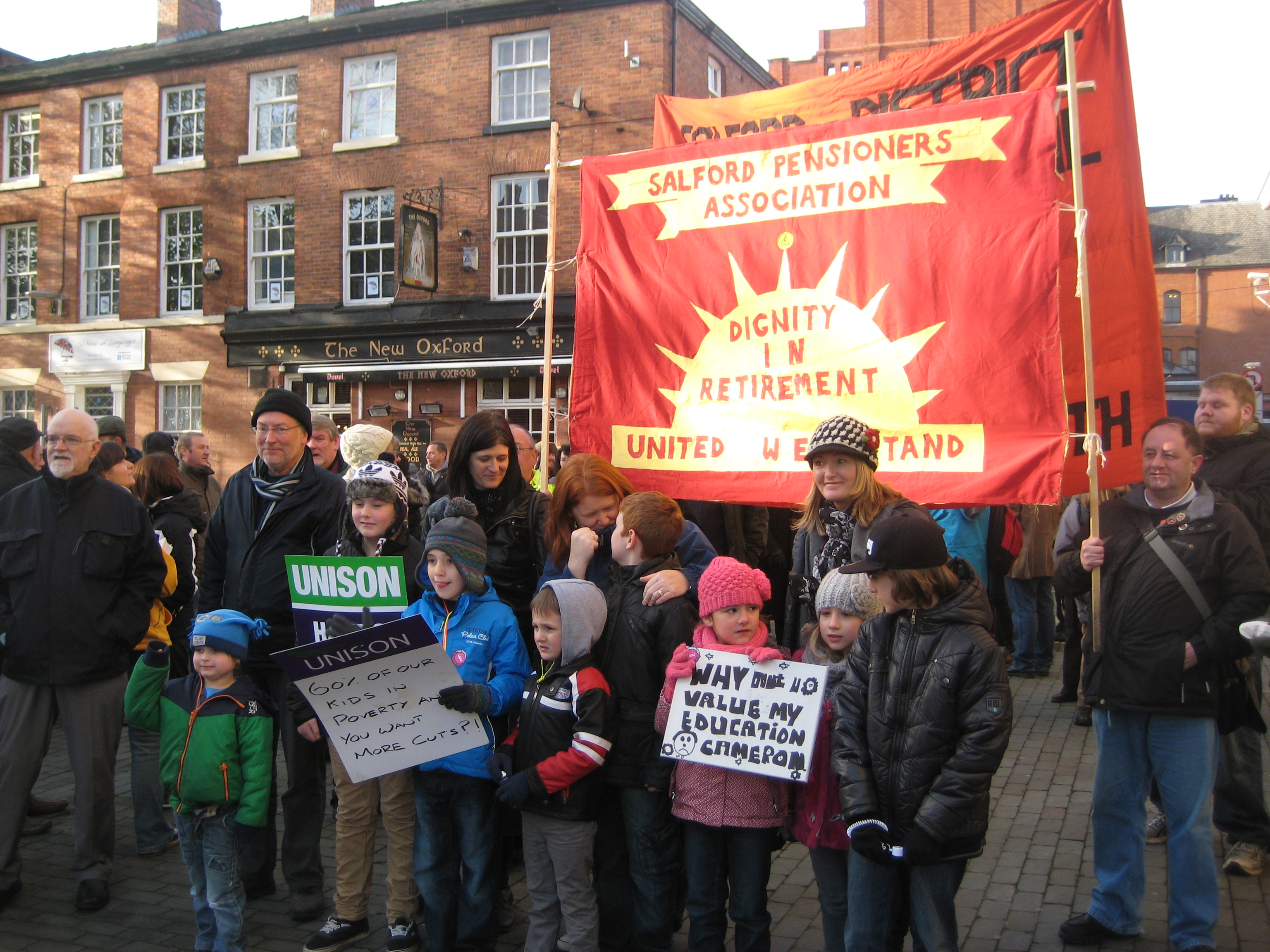
 Salford people marching from Bexley Square on 30 November 2011

The last time the Tories were in power they had a clear plan, based on what we now call a neo-liberal agenda. This involved the destruction of much of manufacturing, the privatisation of nationalised utilities and the promotion of the financial services industry. In the years following 1979 the battlelines were clear, with Labour councils from the GLC to Manchester, Salford and Liverpool lining up alongside the trade unions, the left and many community groups to hallenge the cutbacks.

In 2012 we are in the midst an economic crisis akin to the 1930s, in which the poor and unemployed are expected to pay the cost. This time round, however, there is a weakened left, the New Labour Government pursued its own privatisation agenda and now only feebly challenges the Tory cuts, whilethe main public sector unions have failed to organise themselves to oppose the large scale cuts. They did call a one day national strike on 30 November 2011,  but this was to defend pensions, rather than a rallying cry for opposing the Tory agenda of  wholesale privatisation of the public services.

Labour Councils have had their spending budgets cut by millions of pounds: in Salford a cut of £24 million in 2012-13. Salford Council has said it will “protect the most vulnerable who live in the City”,  but beyond such rhetoric it’s only response has been to manage the cuts, which  has included paying staff to leave through voluntary early retirement, cutting grants to the voluntary sector and privatising services and jobs.

So where has the opposition to the Tory government come from this time? One of the most dynamic local anti-cuts campaigns is in Salford which emerged from the local Trades Council. Trades Councils have struggled to survive in modern Britain but recently have shown their key role in bringing together not just trade unions but also individuals and groups to challenge the Con/Dem cuts.

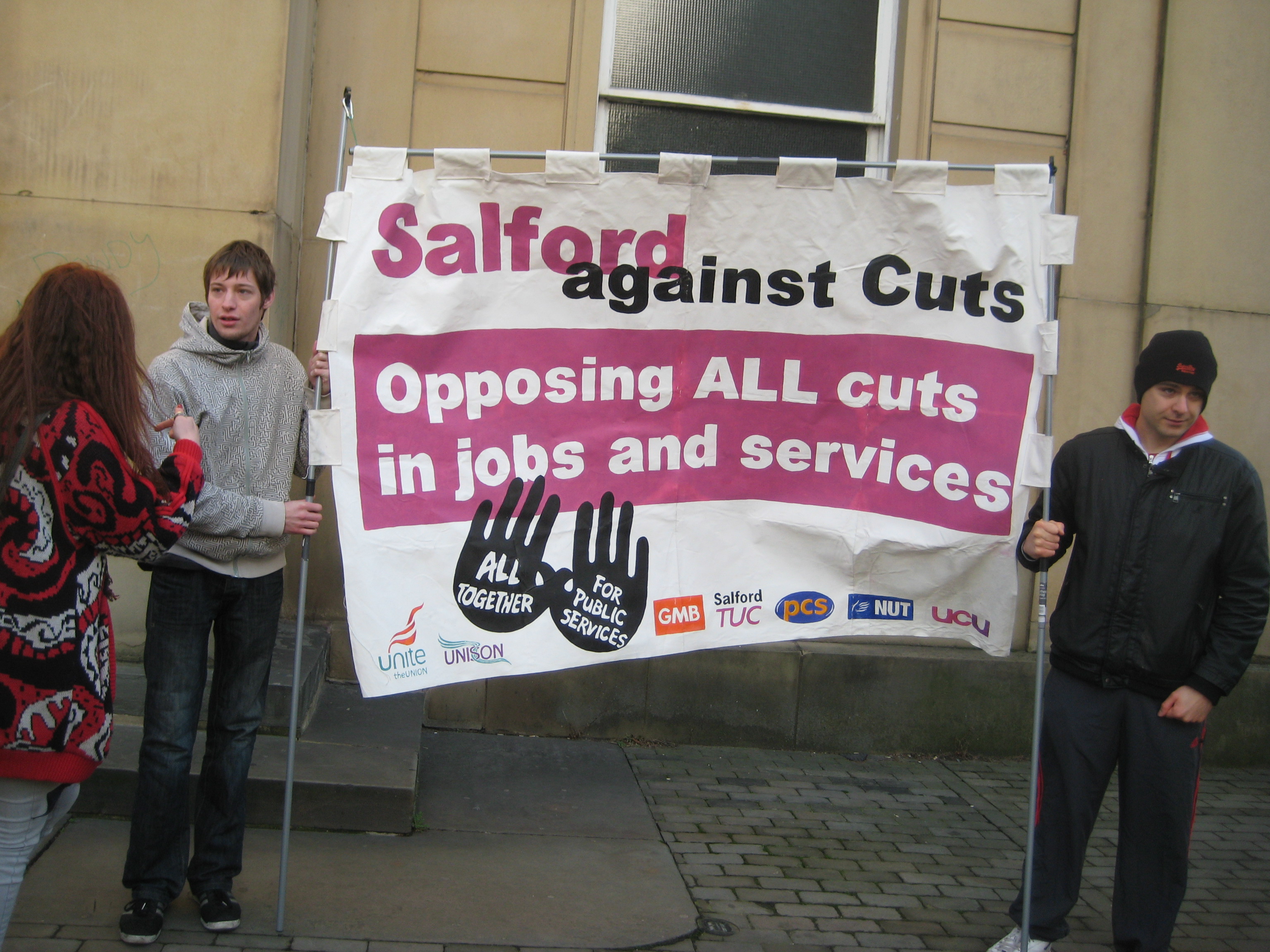
Salford Against the Cuts, started in October 2011,  and which brings together  trade unions, community groups and individuals. Salford Unison, which openly opposes the Labour Council agenda of “managing the cuts”, is a key partner.

Vice chair of SAC Paul Gerrard explains, “Our agenda is to demand the Council challenges the government over the cuts. The council budget should be based on the needs of the local community and Salford Council should be demanding their money back.” Taking a highly political stance SAC have challenged the Labour Council to a debate on the cuts.  They produce regular newsletters and leaflets, funded by Unison, and cheekily have used the Salford council colours of magenta and black as their branding. From the outside the SAC looks like what the Labour Party used to be in its pioneering days of Keir Hardie.

SAC’s recent campaign to save two day centres involved publicising the threat of the cuts; building links with the staff, the users and local communities; lobbying the council – and winning. They are not under any illusion that if they win in one area, then the council will announce cuts elsewhere and the whole cycle starts again. As Paul says, “No sooner have we won a reprieve on the day centres then we are  onto our next battle.” That is why their overall strategy is about challenging the cuts on a national level. “Councillor Merry (leader of Salford Council) said he’d protect the vulnerable from the cuts. Why is the council just passing on Tory cuts, why aren’t they fighting the government?” Unison in Salford have managed to unite different groups within the borough including workers, user groups and the general population.

A recent survey by the Institute of Fiscal Studies showed that only 6% of public service cuts had been made so far. As the economy sinks into a recession, unemployment increases and people become more angry about the economic downturn, it will be interesting to see if they start to blame Labour Councils, as well as the ConDem government, for the deterioration in their living standards. In cities such as Salford where Labour used to be the natural opposition to a Tory government is that role going to be taken by organisations outside party politics? Increasingly in these anti-cuts organisations people who are natural Labour supporters asking “What are Labour Councils for?”

If you have enjoyed this article and would like to support this blog by making a donation you can do using this button

Posted in anti-cuts, Salford, trade unions | Tagged , , , , | Leave a comment