Falling through the craic……..

Manchester IBRG and Lord Mayor Eileen Kelly at the Hearts and Minds Conference November 1987

Review of Irish Blood: English Heart, Irish second generation musicians by Sean Campbell, published by Cork University Press.

In this interesting, but flawed, book Sean Campbell discusses what it means to be second generation Irish. He argues that “the presence of the second generation at the hub of British popular culture became most striking in the 1980s”, the period addressed in this book.

He looks at some of the research from that period and correctly identifies the fact that the research “neglected to consider the possibility of second-generation cultural agency, and has instead assumed their passivity”. What makes this book difficult to read is the use of jargon such as “agency” when he means activity by political or community groups.

In the 1980s and 1990s I was involved in the Irish in Britain Representation Group and we actively and vigorously challenged the stereotypes about what it meant to be Irish. Sean quotes from the Irish Post, the national Irish newspaper during this period, and it is incredible that he has not included our organisation in his research.

IBRG was not about passivity but about activity. Many second generation Irish were involved with it and debates about Irish identity were constantly played out. One of our big issues (there were many) was campaigning for an Irish category on the census which was on our agenda when we started in 1981, and was finally achieved in 2001. He describes this as a backward step; “the British state… in the 2001 census forced the second generation to choose between accepting the notion of complete assimilation….or rejecting..the land of their upbringing…by asserting that they were unequivocally ‘Irish’”.

For IBRG gaining an Irish category on the British census was about the British state’s recognition of our existence, although ironically it was achieved at a time when many Irish (including the second generation) had returned to an economically booming Ireland. The government was only following in the footsteps of many other local government organisations who had recognised the Irish as an ethnic minority in the 1980s. Sean recognises the role of the Greater London Council and Ken Livingstone who included the Irish in their multicultural policies, but the truth is that it was the Irish communities in London, and particularly individuals such as Pat Reynolds of the IBRG, who lobbied the GLC to get recognition. Ken Livingstone was canny enough to see the importance of the Irish vote in London and he put his money where his mouth was and funded many Irish organisations until Thatcher abolished the GLC in 1986.

In the 1980s it was a common belief in the community that to assert yourself as Irish, particularly If you had an English accent, was to make a political statement. This comes through in his interview with Kevin Rowlands of Dexys Midnight Runners. In 1979 he brought out Dance Stance a record that challenged anti-Irish jokes by listing the greats of Irish literature.

“never heard about (Oscar Wilde)
don’t want know about (and Brendan Behan)
don’t think about (Shaun O’Casey)
don’t care about (George Bernard Shaw
Samuel Beckett)
won’t talk about (Gene O’Neil)
won’t know about (Edna O’Brian)
won’t think about (Laurence Sterne)”

and warns the ignorant, “shut your mouth ’til you knows the truth”. The song led a number of Dexys fans to find out more about the writers, something Kevin was pleased with.

Kevin went onto publicly challenge Julie Burchill and her racist tirade in the Face magazine. Today this might be seen as a media stunt, but it was a brave thing to do in the 1970s in the face of the ordinariness of anti-Irish racism at that time , plus the harassment and surveillance that the Irish community was facing from the state   through legislation such as the Prevention of Terrorism Act

The other interviews are not so interesting. Shane McGowan and the Pogues could be said to be influential in terms of some of the songs they wrote about the Birmingham 6 and the effects of emigration for the Irish. They do deserve credit for playing benefits for the Birmingham 6 at a time when it was seen as dangerous to do so but the families and supporters of the men really deserve our respect.

Other chapters on Morrissey and the Smiths are painful. Morrissey and Johnny Marr may be from Irish backgrounds, but neither their songs or actions could give credibility to their influence on the second generation. Marr changed his name from the distinctive Maher, and is only interesting when he gives credit to the influence of his family’s traditional Irish music background. The inclusion of the Gallagher brothers is an insult to the Irish community. They were never interested in their Irish background and brandished the union jack and their invites to Britpop events with pride.

By concentrating on the Irish impact on pop and rock music, I think Sean has ignored a vital part of the jigsaw about where Irish second generation young people felt able to express their identity. Looking at the role of second generation in the traditional music scene would provide a more interesting and relevant insight to definitions of Irishness. Comhaltas Ceoltóirí Eireann is the largest group that promotes Irish music, dance and the Irish language. It started in 1951 and throughout the years it has worked in community centres throughout Britain and Ireland. In the 80s it was little known and due to the environment in Britain many people kept their head down and hid the fact they were involved. But in the last thirty years it has flourished and part of that has been the influx of second generation young people into the organisation.

Sean Campbell should be given credit for being part of the debate about what it means to be Irish second generation but it is shame he failed to do any interviews with community activists.

In Manchester in the late 80s bands such as Toss the Feathers and Rattle‘nReel who drew on a mixture of influences from Christy Moore to the Pogues filled the clubs and dancehalls with people such as themselves and newly arrived migrants from Ireland.

The reality is also that singing songs is not enough and all communities, including the Irish, need individuals and organisations who will speak out and campaign for justice.

For a popular and readable book about the Irish community in Manchester read Michael Herbert’s The Wearing of the Green. more information about this here

If you have enjoyed this article and would like to support this blog by making a donation you can do using this button

Posted in book review, Ireland, Irish second generation, music | Tagged , , , , , | Leave a comment

Stop! Look! Listen! my weekly selection of favourite films, books and events to get you out of the house…


Watch.. Satin Rouge (2002) starring fabulous actor, Hiam Abbass. Set in Tunisia, it’s a sensual story of a widow who finds a way out of loneliness by becoming a belly dancer in a nightclub. For once, in a film, we get a sensitive and sympathetic story about a modern Arab woman’s life. Hiam Abbass was born in a muslim village in Nazareth and identifies herself as a Palestinian. She is a brilliant actor and director. See further info on her films, go here………

Read..The Angel of History by Bruno Arpaia (2006) A fictionalised account of the latter part of the life of poet and writer Walter Benjamin set in Paris as masses of people move to escape the Nazi war machine. A German, Jewish refugee Benjamin had openly opposed the Nazi ideology and was therefore doomed to death if captured by them. Interlinked with his story is that of a Spanish loyalist, Laureano Mahojo, who eventually escapes to Mexico. As the two men’s lives are thrown together we get an unforgettable insight into war and a critical time in Europe’s history.

Listen……..to Sarah Irving discuss her new book Leila Khaled;Icon of Palestinian Liberation. Due to harassment by phone callers, Blackwell bookshop had to cancel the launch last week. New date; Friday 25 May at 7pm at the Manchester Digital Laboratory.

Go for a walk…… The Irish in Manchester, Saturday 26 May starting at noon
meet at Oxford Road station.This walk will include Little Ireland, John Doherty, the Irish at Peterloo, Free Trade Hall, arrest of William O’Brien in 1889, Eva Gore-Booth and Mary Quaile and the Manchester Martyrs The walk will last about 2 hoursFees £6/£5 further information: redflagwalks@gmail ot visit Red Flag walks

The walk will be led by Michael Herbert who has been researching, writing and speaking about Manchester’s radical history for many years.. He is a Trustee of the Working Class Movement Library and past editor of the North West Labour History Journal. His published work includes many articles about Manchester for the Radical Manchester website as well as The Wearing of the Green, a political history of the Irish in Manchester, and Never Counted Out!, a biography of Len Johnson, the Manchester boxer and Communist. He is currently working on a history of radical women in Manchester.

Posted in films, Ireland, labour history, Manchester, Middle East, novels, women | Tagged , , , , , , , , , | Leave a comment

Bill Brand; It is the People who Create………

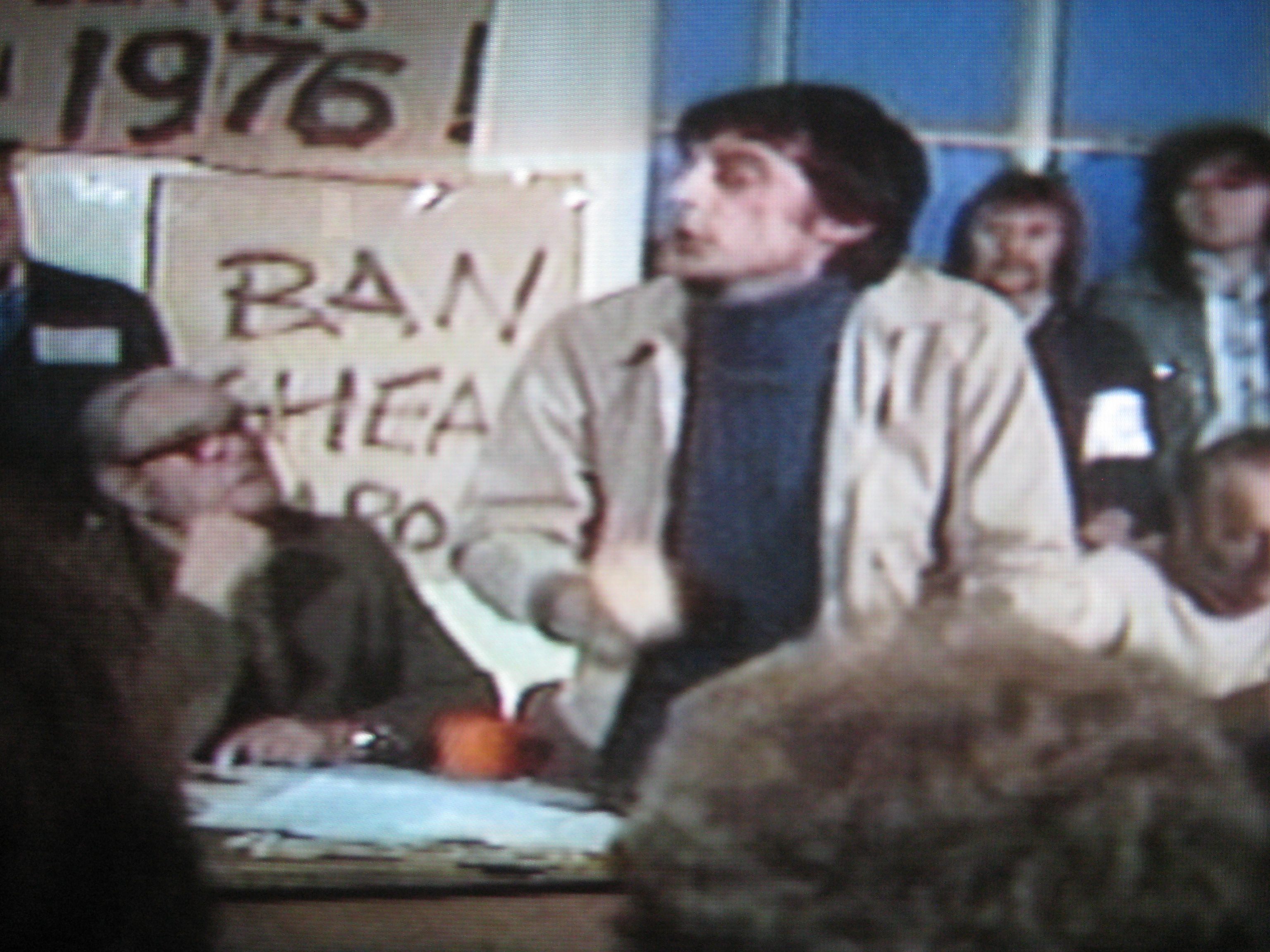
Bill Brand (played by Jack Shepherd) speaking at a workers occupation

Bill Brand, a TV series broadcast on ITV in the summer of 1976, was written by one of Britain’s (and Manchester’s) greatest playwrights, Trevor Griffiths. The drama is the story of how Bill Brand (played excellently by Jack Shepherd), who is from a working-class background and a college lecturer, after a flirtation with revolutionary politics, becomes a Labour MP. It mirrors Trevor’s life and, to an extent, mine. Trevor grew up East Manchester and, unlike his brother who left school at 15 to work in a factory, he was one of the lucky working-class children who benefited from the Butler Act of 1944 and gained access to the grammar school system. In 1952 he went to Manchester University on a state scholarship to study English.

After university Trevor became a teacher, first in a school and then in a local college. By the late 50s he was politically involved in CND and the New Left. He joined a discussion group through the Left Club which included historians such as Edward Thompson and John Saville. By 1962 he was a member of the Labour Party and wrote for their local paper, Labour’s Northern Voice. But his disillusionment with the Labour Government of Harold Wilson led to him leaving the party in 1965.

In the late 1950s and early 1960s television producers of programmes such as Armchair Theatre and the Wednesday Play brought in new writers to reflect on the radical social changes going on in Britain, and particularly the experiences of the working-classes. By 1961 Trevor had written three scripts for the BBC and was now working for them fulltime in Leeds as a Further Education Officer. He said that he wanted to write plays because of “the tremendous stimulation I got from seeing rough reflections of lived experience on television.”

Many of his plays drew on his own lived experience. Trevor’s father was a chemical process worker and a Welsh Nonconformist background, whilst his mother was an Irish Catholic. When he was two years old his father lost his job and they had to leave the family home and live with relatives. Trevor was brought up by his Irish grandmother in nearby Bradford, who taught him to read before he went to school.

In the 70s our family were Irish Catholics, the emphasis being on the Irish, and we went through the Catholic selective system. That meant the 11 plus, and three different schools for myself and my three siblings; Secondary Modern, Technical High (which I attended} and Grammar. Highly divisive and highly unfair. Children who went to Secondary Modern schools usually left at 15 years, and were excluded from sitting O’Levels and were only allowed to do CSEs. This obviously affected their entry into higer level jobs, and many were destined for manual work. Not just a poverty of attainment, but the experience of not passing the 11 plus undermined people’s confidence throughout their life in many different ways.

Throughout the 11 episodes of the series we see how Bill and his brother’s life chances have shaped their futures. His brother works as a shirt cutter, but as the textile industry goes into decline he becomes unemployed. What is different about Bill Brand compared to present-day drama is that it shows the workers, including his brother, through their union, opposing the closure of their factory and taking industrial action. This collective action is a theme throughout the series. It is also great to see positive images of working class men and their families, which is something really lacking in the media today.

The 1970s in Britain were dominated by the death throes of the Labour Government, and its intertwined and incestuous relationship with the rest of the labour movement, particularly the trade unions. We see Bill Brand wrestling with this as a Labour MP: not just in his relationship with the Parliamentary Labour Party, but in his struggle to represent his constituents: whether they are workers on strike, women seeking abortions or the Irish community subject to state harassment.

In 1974 the war in Norhern Ireland came to Britain as the IRA set off bombs as part of their strategy to get the British forces out of Ireland. Many Irish people took the backlash, in terms of anti-Irish racism on the streets and in workplaces, as well as restrictions on their civil rights through so called anti-terror legislation.

In a powerful speech in Parliament, Bill explains how this legislation is affecting his Irish constituents and wrongly being used to target the irish community. It then shows how Bill’s family is targeted by fascists and when their house is attacked it is Bill’s comrades in the union who come down to defend his family. In the 70s this was not unusual for anyone who spoke out in support of a debate on the war in Ireland and it happened to many Irish people, who were activists. Bill Brand is one of the few dramas that have put the argument for a debate on the role of Britain in Ireland and shown the consequences for the supporters of the rights of Irish people.

But it is an important drama on many other levels. Trevor Griffiths shows working class culture in the home, the factory and the Labour Party. We are reminded of how rich left politics were in the 70s: a time of struggles and campaigns around unemployment, Ireland, sexual politics, Chile and anti-fascism. Trevor says about the series; “What I was trying to say throughout the series was that the traditions of the labour movement were inadequate to take the struggle further, and that we had to discover new traditions or revive even older ones. And that we had to seek connective tissue between electoral party politics, which still has a mystifying mass appeal, and extra-parliamentary socialist activity.”

In 2012 those of us who grew up in the 70s and were part of that rich political culture know how far the labour movement has diverted from that past. The Labour Party is no longer seen as the party for the working-classes and apathy dominates in any election whether at a local or national level. Trade unions have been slow to challenge the Government and local Labour councils over the cuts. In the 70s it was easy to see where and how people could challenge unfairness and injustice, these days it is not so simple and for many people there are no easy answers in how or where to begin that fightback.

Bill Brand the complete series is available fron Network DVD

Trevor Griffiths work in the 1970s and 1980s is discussed by Mike Poole and John Wyver in their book Powerplays

If you have enjoyed this article and would like to support this blog by making a donation you can do using this button
Posted in Catholicism, Ireland, Manchester, North of Ireland, Socialism, trade unions, TV drama, women | Tagged , , , , , | Leave a comment

Stop! Look! Listen! my weekly selection of favourite films, books and events to get you out of the house…


WatchThe King of Comedy (1983) One Of Martin Scorsese’s finest films, although it was not one of his most successful when it came out in 1983. A mixture of fantasy and real life it features Robert DeNiro as Rupert Pupkin, a man with dreams of being a famous comedian. He stalks Jerry Langford (played by Jerry Lewis) whose character is based on Johnny Carson, the acclaimed comedian and talkshow host. Nowadays we are too aware of the celebrity culture and its domination of the psyche (and tv screens) so this film was prescient of its times. Painful to watch, but incredibly clever, it is Scorsese at his best.

Read…An Act of Love (2011) by Alan Gibbons. Alan is not just a writer, but an activist and founder of the Campaign to Save the Book. This is the story of two boys who grow up together through the 90s and 2000s. One of the young boys is white and the other Pakistani. The story is set against the rise of fascism in small towns in the north and also the growing tension in the Asian community as Britain and the USA invade and occupy Afghanistan and Iraq. There is lots more in the book, but for me I love the story of the young men’s friendship and the way in which Alan creates working-class male characters that are humane, complex and compelling.

ListenSearching for the Young Soul Rebels (1980) A fabulous album by Dexys Midnight Runners. Led by Kevin Rowlands – not just the front man but the main man! Part of his search for his Irish identity the front cover shows a riot in Belfast as a young Catholic boy is caught by the camera as he makes his escape. Part of a whole Irish renaissance in the 80s, Rowlands mixes songs about being proud of your Irish heritage as in “Burn it Down” to “Geno” a celebration of soul singer Geno Washington. After 25 years the band is about to bring out a new album called One Day I’m Going to Soar which includes more musing on his Irishness identity “Take your Irish stereotype and shove it up your arse”. So nothing changes. Cannot wait to see the stage show!!!!!

Join the debate……. Was the election of George Galloway and 5 Respect councillors in Bradford a one-off, or part of a larger process, and what are the implications for trade unionists? Give your views on Wed 16 May at 8pm at the Mechanics Institute Princess St. Manchester. Speakers from Labour and Respect will star. more information here

Attend a book launch of Sarah Irving’s biography: Leila Khaled; Icon of Palestinian Liberation. Leila is known for her involvement in the hijack of a passenger jet in 1969. Find out about her activism today, the role of women in the Palestinian movement and the rise of Hamas. Blackwells Bookshop Manchester, 24 May 7-8.30 admission free.

Go to a play…about the lives of working class women.. noticed this on the 24/7 site.
Player’s Angels by Amanda Whittington, directed by Joyce Branagh. Presented by Manchester School of Theatre at the Capitol Theatre, Manchester Metropolitan University, Mabel Tylecote Building, Cavendish Street, Manchester M15 6BG. It’s 1953 and all the girls in Nottingham want to work at John Player’s, the best employer in town. Whilst Cyn dreams of being a beauty queen and Vee adjusts to married life, widowed Glad shares a secret with her young supervisor Bill. When the youthful Mae comes to work at Player’s, however, the lives and secrets of all the women change forever.

Wed 16 – Sat 19 May Further details More information here.

Go for a walk….The Irish in Manchester:Walk 1. Learn about the history of the Irish in Manchester including trade unionists John Doherty and Mary Quaile, the Irish at Peterloo, the Manchester Martyrs and Eva Gore Booth. Meeting point: Oxford Road Station at noon, Saturday 26 May, Fee £6/5. More information here

Posted in biography, book review, drama, films, human rights, Ireland, Irish second generation, Middle East, music, North of Ireland, novels, trade unions, women | Tagged , , , , , , , , , , | 1 Comment

My interview with playwright Lee Hall

George Orwell in The Road to Wigan Pier wrote this about miners: “In a way it is even humiliating to watch coal miners working. It raises in you a momentary doubt about your own status as an ‘intellectual’ and a superior person generally. For it is brought home to you, at least while you are watching, that it is only because miners sweat their guts out that superior persons can remain superior. All of us really owe the comparative decency of our lives to poor drudges underground, blackened to their eyes, with their throats full of coal dust, driving their shovels forward with arms and belly muscles of steel.”

Orwell wrote from the perspective of an upper middle-class man, and to his credit, he never pretended to be anything else. Lee Hall, playwright, is from a Newcastle, working-class background, and much of his work is about celebrating the complexities of what that means today.  “The older I get, the more interested I am in exploring in the richness of working-class culture. It is a culture that is sophisticated, and as varied, as any other culture. In my Play The Pitmen Painters I wanted to show how, between the two world wars, that there was a great hunger for education and betterment. “

Lee grew up in a working-class, but not particularly political, family. His father was a self employed painter and decorator, while his Mum was a housewife. “I was lucky that at my school I had scores of inspirational teachers , who had come through the 60s, and helped politicise me. They introduced me to poetry, drama and art. I am still friends with them today.”

Newcastle has a history as an industrial and trade union heartland. Growing up in the 70s and 80s, Lee was aware of this heritage, as well as of the politics going on around him. “ It was only after University that I put everything together and I take the best of both worlds into my work.”

He went to Cambridge University, a big jump for a young working-class man, where he encountered the upper class for the first time. “They didn’t have a clue about what ordinary people thought or did. The predujice was more subtle but I had been made confident by working in the youth theatre, being politicised by what was going on in Newcastle and I was confident in arguing my case.”

In his work Lee has explored many issues relating to the lives of working-class people. For me, it is his portrayal of working-class men which is particularly outstanding. Compared to most other drama, his male characters are complex , sensitive and heart-warming. “I write about the people I grew up with, my dad, other people’s dads and grandfathers. I think that they were sophisticated emotionally and intellectually, quite well read. Being hard blokes in rough manual jobs didn’t make them one-dimensional.”

In works such as Billy Elliot, The Pitmen Painters and now Close the Coalhouse Door he has told the history of the role that the miners, their union and their community has played in this country. And shown how we are impoverished by its destruction. “The Miners Strike in 1984-5 and the closure programme was an act of political and cultural vandalism in smashing up organised labour in a very deliberate way. What is happening now is from the seeds of 25 years ago.”

His latest production is Close the Coalhouse Door, which he has updated from the original 1960s drama by Alan Plater and Alex Glasgow. Lee sees an important role for drama to educate people about their past. “It is to remind people of that past heritage and history. That people did fight back, that unions do matter. It is very important that people know their own history.”

Close the Coalhouse Door is currently on tour, for more information go here.

If you have enjoyed this article and would like to support this blog by making a donation you can do using this button

Posted in drama, Socialism, trade unions | Tagged , , , | 1 Comment

Stop! Look! Listen! a weekly selection of some of my favourite films/books/people…


Watch…The Good Companions (DVD) The TV series was made in 1980. It is Alan Plater’s adaptation of the J.B.Priestley’s book of the same name. I loved the book, which is the story of a struggling concert party, set in 1929, and the TV production includes wonderful songs and dance routines. It’s full of well-known actors, including Judy Cornwell, Roy Kinnear, Denis Lawson and Nigel Hawthorne. It is TV drama, and Alan Plater, at their best.

Look…the Subversion exhibition and installation at the Cornerhouse in Manchester. I particularly enjoyed Larissa Sansour’s contribution in which she re-enacts Stanley Kubrick’s 2001; A Space Odyssey with a Palestinian twist. She is the Palistinaut,  who declares the moon for Palestine! Her other project in the Gallery is The Nation Estate which is a political comment on the continuing expansionist policy of the Israeli state into Palestine land. Larissa’s solution is a single skyscraper in which Palestinians finally have their own state within one tall building ie the Nation Estate. Each city has its own floor, allowing visits by elevator: therefore no need of soldiers or checkpoints. Each lobby floor re-enacts central squares and landmarks to make the occupants feel at home. It is absurd,  but so are Middle Eastern politics , and this was shown when her work  faced censorship and her nomination for the Lacoste Elysee Prize 2011 was revoked after the sponsors found the project “too pro-Palestinian”. This story has had a happy ending. as the outcry from the censhorship has meant that Larissa has been able to realise the whole project,  which should be available this year.

Get involvedThe People’s History Museum has a Protest Photography Competition for young photographers who work in analogue (film not digital). The PHM are looking for contributions that define protest in all its forms from large to small, peaceful or controntational, creative or absurd. The closing date is Thursday 10 May at 5pm. Prizes have been donated by Lornography Manchester and your work will be displayed at the PHM.

Go to. Will Kaufman’s Woody Guthrie: Hard times and Hard Travellin‘  a live documentary with Will singing Guthrie’s songs is a fundraiser for the WCML. Woody was the voice of the protest movement in America in the 1930’s and Will, who is a talented singer and musician, believes Woody’s songs are just as important and relevant today. See what you think….the event is on Sunday 13 May at 6.30pm at the Islington Mill, James St. Salford M3 5HP. Tickets £10 on the door.Further information here I have written about this event for the Guardian Northerner blog which can be read here.

Enjoy….I married a cult figure from Salford, a video made by Bafta winning filmmaker, John Crumpton, about local hero John Cooper Clark at the Black Lion on Wednesday 9 May at 7. 30pm. Tickets £4/3. Further information here

Second Chance to see… The Bubbler, Cathy Crabb’s latest play about the Salford riots. It is on at the Lass o’Gowrie from 9-12 May. More information here. You can read my interview with Cathy for the Guardian Northerner blog here.

Mass Participation and Collaboration at the Fanzine Convention, Victoria Baths on Saturday 19 May. Guided tours, workshops and screenings. Further info visit Natalie Bradbury’s unique and creative blog The Shrieking Violet.

Posted in art exhibition, drama, Manchester, music, TV drama | Tagged , , , , , , , , , , , , , | Leave a comment

A Manchester Spring ?

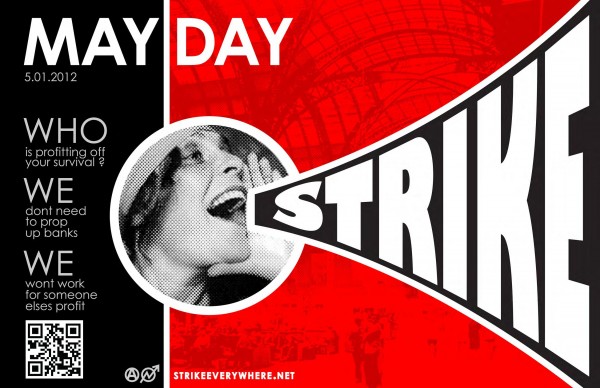
Poster from Occupy Long Island 2012

The First of May is the day when workers across the world march together to celebrate their existence and, often, to highlight a particular issue. This week across Europe workers have challenged growing unemployment levels and shown their opposition to their governments’ austerity plans.

From 1890 May Day became an international Labour Day, the focus of a long running campaign to reduce the working day to 8 hours and highlight the demands of the workers for a better life.

May Day as a workers’ day was first marked in Manchester on 1 May 1892. Workers got together and publicly demanded representation as a political organisation and a shorter working week. Over 60,000 people took part in the march and rally. The Guardian reported that the procession was headed by a white banner calling for “Work for all, Overwork for None”. Other banners said; “Unity is Strength”, “Equality by Right, Justice to All.”

In 1926 thousands marched in Manchester in the pouring rain on the eve of the General Strike when millions struck work for ten days in support of the miners.

The May Day marches continued for a century but, as the trade unions declined and faced defeats, so the marches followed suit. Recently there has been a revival in the May Day marches, but the numbers are small in comparison to those of earlier years.

Other marches such as anti-war, the student protest and pensions strike last November have seen tens of thousands of people take to the streets to show their anger over government policies.

This year a march linking Salford and Manchester has been organised by the Manchester, Salford, Bury and Oldham Trades Councils, with the aim of bringing together the organisations that are campaigning against the cuts: this includes not just trade unions but also community groups such as people with disabilities and pensioners. As well as a march and rally, there will also be a social with food and entertainment for children.

One of the ironies of next week’s march is the involvement of the Labour Party. The north-west is Labour council land and they have been involved in pushing through the ConDem cuts. Not just making the cuts but also privatising services and worsening the terms and conditions of their workers.

In the 1980s the Labour Party had a respectable record of opposing the Tory Government cuts and it will be interesting to see how many people vote Labour on Thursday given their present supine actions. Several Trade Union and Socialist Coalition candidates are standing across the northwest and we may have a Bradford Spring effect in the local polls. I will be marching next Monday to celebrate being a trade unionist but not to give credibility to the declining Labour Party. If we want to revive trade unionism we have to throw off the chains to the Labour Party and make new alliances with organisations that share the same ethics, including defending and promoting the rights of workers. I think that leaves out the Labour Party…….Hope to see you on Monday!

Manchester and Salford May Day March and Rally Monday 7 May starts 11am Bexley Square Salford. Nearest station; Salford Crescent Train Station.

If you have enjoyed this article and would like to support this blog by making a donation you can do using this button
Posted in Uncategorized | Leave a comment

Stop! Look! Listen! a weekly selection of some of my favourite films/books/people…

Watch….Down with the Dictator, written by Cameroonian playwright and community activist, Lydia Besong. Lydia is currently fighting a high profile campaign to remain in the UK with her husband Bernard Batey. The play is produced by Afrocats and is supported by Community Arts North West as part of their Exodus Greater Manchester Refugee Arts programme. Holy Innocent’s Church, Wilbraham Road, Fallowfield, Manchester
Saturday 5 May 7.30pm
Tickets on the door / Information: 0161 234 2987Tickets: £5 / £3 concessions All performances are followed by a post show discussion giving audiences the opportunity to discuss the play and related issues with the playwright, cast and others involved in Lydia and Bernard’s campaign.More information about the campaign go here.

Look…..Beyond the Frame Exhibition is aimed at raising the case of the Miami Five. The M5 were falsely accused of committing espionage against the US government . They have been imprisoned for 13 years and their case has been condemned by Amnesty International and several British trade unions. The exhibition includes artwork by two of the M5 as well as UK artists, and the sale of work will contribute to the campaign to free the M5. The exhibition will open at noon on Friday 4 May at the Anthony Burgess Centre, 3 Cambridge St Manchester M1 5BY. Entrance is free. At 7pm there will be a meeting to discuss the artwork and the case of the M5. Entrance is £5&£7 including a buffet at 6pm.
For further details go here

ReadThe Solitude of Thomas Cave (2007) by Georgina Harding. the book is set in the 17 Century. Thomas Cave makes a wager with the crew of his whaling ship to stay in the Arctic alone until the next season. It’s a story of one man’s survival in the wilderness and his ability to come to terms with not just the Arctic winter but also his own fears, his past and his grief for his dead wife and child. Beautifullly written and almost biblical in its content and expression.

Celebrate..May Day, International Workers Day

Red Flag history walk, Tuesday 1 May, starting at noon, Dr Marx and Mr Engels. This walk, led by Michael Herbert, will visit places connected with Karl Marx and Friedrich Engels. Meet at Oxford Road Station, fee £6/£5. For more information about this and future Red Flag walks, go here. For an article by Michael about the first May Day marches in Manchester, go here.
March and rally Monday 7 May. Assemble at Bexley Square, Salford for speeches at 11am , march at noon to Cathedral Gardens, followed by a rally in the Friends Meeting House. Speakers include Matt Wrack, FBU. For more information, go here.

Posted in anti-cuts, drama, human rights, labour history, Manchester, May Day, novels, Salford, trade unions, women | Tagged , , , , , | Leave a comment

Sheila Rowbotham; a dreamer of a new day


Watching the DVD of Trevor Griffith’s 1976 TV drama Bill Brand reminded me how exciting and important the 1970s were for the Left. Brand (played by Jack Shepherd) is a newly elected Labour MP from a northern constituency. Apart from trying to find socialism within the Parliamentary Labour Party, he also struggles with his own relationships with his wife, Miriam, and his girlfriend: feminist and activist, Alex. I kept hearing the mantra “the personal is political” whilst watching this part of his life unravel. In one episode we see Brand with a copy of Sheila Rowbotham’s Hidden from History, reminding me of how important this book was then.

Published in 1973, Sheila gave the Left a book on socialist feminist history which responded to, and was part of, an awakening of consciousness about the role that women had played in the history of capitalism. As Sheila said in her introduction, “This book comes very directly from a political movement. The decision to work over some of the territory I had gone through and find out more came out of discussions in women’s liberation and on the left about the situation of women in contemporary capitalism.” Her book challenged traditional history, written by men, which had excluded women, and it encouraged other women to research and write about women’s history.

Thirty years later in her new book, Dreamers of a New Day: Women Who Invented the Twentieth Century, Sheila wrote that it rests “on the extraordinary growth of interest in women’s and gender history which has occurred since the emergence of the women’s movement in the late 1960s” In this book she looks at the period from the  1880s to the First World War,  and celebrates what women achieved during that period, not just in Britain, but also the USA.

In 2012 women’s lives are getting worse as we take the burden of public sector job cuts and cuts in benefits and services, so it is good to look back and see how other women during this period got together to transform their lives and, most importantly, they believed that it was possible to change society – and did something about it!
The period that Sheila writes about was an exciting time with many technological and scientific discoveries. In an era of massive changes, nationally and globally, women challenged their own unequal position in society and their historic subordination to men, and also joined with other groups to oppose the social and economic injustice of the societies they were living in.

Dreamers is an inspiring book to read because of the breadth of its content: its subjects ranging from campaigns on birth control, family and work to consumer power and  the struggles of American black women. We hear the stories of immigrant women in the New York Triangle Shirtwaist Factory,  and union member Pauline Newman, who, like many other women in factories, had worked there from the age of 12 years and learnt the importance of trade unions and friendships at work. ”You are no longer a stranger and alone.” Sadly, in 1911, 146 of these workers were forced to jump to their death as a factory fire engulfed their workshop. The factory owners had resisted their union’s attempts to stop them locking in the young women whilst at work.

Today we live in a highly individualised society where people find it difficult to organise together but Sheila reminds us of past times, where cities such as Glasgow were highly politicised. Women played a key role there in the rent strike of 1915 and the network of radical Sunday Schools, newspapers and Clarion organisations which meant that activists, including socialists and feminists, could organise in their workplaces and neighbourhoods to bring less political people into a broad alliance to challenge injustices such as rent rises.

Dreamers shows us that we do not need to just dream about challenging a right wing government, but, like the women in this book, we can get together with like-minded women and men to make a better world.

Sheila is giving the annual Frow Lecture at 2pm on Saturday 28 April at Old Fire Station, Crescent, Salford. More details here.

If you have enjoyed this article and would like to support this blog by making a donation you can do using this button

Posted in anti-cuts, book review, Socialist Feminism, women | Tagged , , , , , | Leave a comment

Stop! Look! Listen! a weekly selection of some of my favourite films/books/people…


WatchCaramel, (2007) set in Beirut in a beauty salon, this film concentrates on women’s lives, rather than the politics of the Middle East. In beauty salons across the world women gather together to chat, exchange secrets and seek support from one’s sisters. (My sister was a hairdresser in a salon (or “shop” as they said in East Manchester) and the only man allowed across the threshold during opening times was the gay bartender and he was there to get his hair dyed!) The director of Caramel, Nadine Labaki, also starred in the film. Her latest film, Where Do We Go Now?, will be shown at the Cornerhouse next month as part of their Arab and Lebanese film season.

Read….Resolution (1986) Maeve Kelly is not just an incredible writer of fiction, but also a poet who directly addresses the politics of being a woman. In this collection she takes on many issues; love for a man, love for her children,  as well as the bigger issues of the war in Ireland. She has written three poems about being a feminist and looking back (she is now aged 82) at her life as an activist she says ; Lucky to have made that leap/out of the dark of youth’s complacence (from Feminist I). I had to buy this from a secondhand book website,  it’s a shame that Maeve Kelly isn’t up there with the likes of Seamus Heaney.

Listen to….The Liberty Tree (CD) by Leon Rosselson and Robb Johnson. Originally a show commissioned by the Labour Party (that won’t happen again!) in 1987 to commemorate the 250th birthday of Thomas Paine. It tells the story of an incredible man, a radical, who didn’t just write about what was wrong with the world, but went out there and did something about it! Leon and Robb have used Tom’s words and their music to show how important he is to us today. To quote the man, “My country is the world, my religion is to do good.” Buy it from Fuse Records

follow ….new blog and a fun way of learning about the radical history of Manchester in the places where it happened, Red Flag Walks

Posted in films, interesting blog, labour history, Manchester, Middle East, music, poetry, women | Tagged , , , , , , , , , , , | Leave a comment