Enough is Enough: The Tameside Care Workers Dispute 1998-99

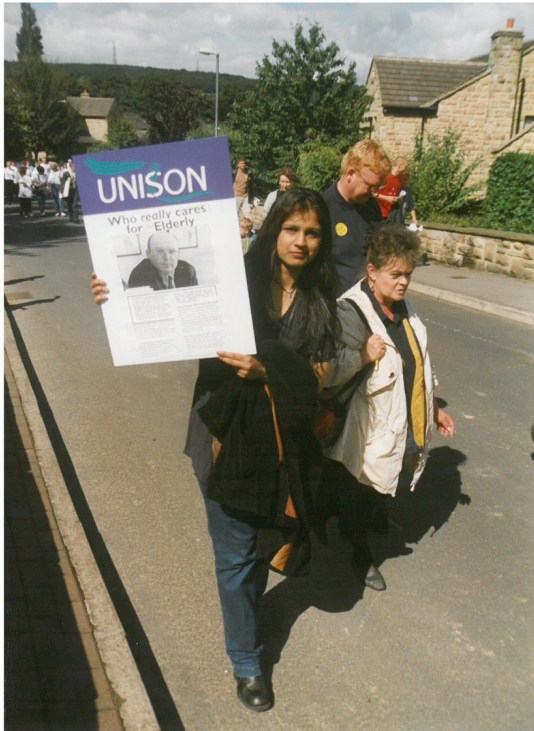
TCW demonstration through Ashton-u-Lyne


In April 1999 Unison asked the Centre for Public Services to  report on what had gone wrong in the privatisation of Tameside Labour Council’s elderly care services.

They summed it up: ““This report shows a catalogue of mismanagement of a key service to vulnerable, elderly people. Tameside MBC created the worst of both worlds – it established a trust (Tameside Community Care Trust) and hived off its residential care services into the Trust’s subsidiary company  – Tameside Enterprises Limited  – which subsequently became Tameside Care Group. But the council then mismanaged this structure through political appointments, poor management, weak financial controls and lack of transparency.”

Tameside, a  Labour  Council, was the first  local authority in Britain  to privatise its residential care services in 1989 when it transferred 12 of its elderly persons homes in Tameside (450 beds) and 8 homes in Stockport  to a private company: Tameside Enterprises Limited. (TEL). The Council owned one-sixth of the new company, while  the leader of the Council, Roy Oldham,  attended board meetings until 1995.

Tameside Community Care Trust owned the other five shares. The Trustees of this company included  local Members of Parliament, Andrew Bennett and Tom Pendry,  and the local Member of the European Parliament  Glynn Ford.

The Tory Government at the time was encouraging local authorities to privatise services and  increased funding was available if homes were private rather than council owned.

The story  of Tameside Care Trust shows a blatant disregard for the needs of the elderly people in their care, the exploitation of a largely female and low paid workforce and a lack of accountability of public money. Unfortunately most of the unions, as well as the local Labour Party, MPs and MEPs went along with the privatisation agenda.

Right from the beginning of TEL the conflict of interest between the Council and the people appointed to run the new organisation was transparent – but no one challenged it.

TEL appointed the Council’s Director of Policy Paul Stonier as its Chief Executive, who  was also the husband of Shirley Stonier,  a Labour councillor om Tameside Council. .

Paul Stonier was also a member of the National Union of Public Employees and  sponsored by them as a   prospective Labour Parliamentary candidate for Littleborough and Saddleworth. Labour Councillor Simon Walker was appointed as its head of Finance. Margaret Oldham, wife of the leader of the Council, was  appointed to take TEL through quality assurance certification for TEL and given £10,000 to do so.

The National Union of Public Employees (NUPE)   was given  a single union agreement with the new organisation,  thereby excluding the other unions from any  recognition.  Documents in the archive contain  allegations that NUPE members were not properly informed of the transfer details and that they were called to union meetings without being fully aware that they were going to be asked to vote on important changes to their working conditions.

Tameside is a borough on the eastern edge of Greater Manchestermae up of  nine towns  and, although there are some wealthy areas,  it  had  and still has  many poor households. Many working class women worked in the care industry – one not known for above average wages or decent working conditions.

By April 1992 the  accounts show that TEL was insolvent.  They then  asked Tameside Council for a loan but instead  Tameside Council (who saw themselves as “landlords” ) gave £430,000 to TEL for structural improvements,  not a loan.

The management turned to the staff to save £500,000 by cutting sick pay and holiday pay. Staff refused to accept cuts and a were angry that they were not covered by a “no redundancy” policy. Stonier responded byissuing  a 90 days’ notice to staff for  a new and worse contract unless they agreed to the cuts.

NUPE responded by calling for TEL’s accounts to be inspected and for  the management to resign. In December  1992 20% cuts were imposed by the management on all staff and Unison  (who were  a new union that included NUPE)  responded by serving writs on TEL and called for the resignation of the Labour leaders.

In April 1993 Stonier was given a 43% pay rise evn though  TEL finances were found to be irregular, included faulty bookkeeping, : the auditor refused to sign the 1991/2 accounts.

Seven Labour councillors voted against the TEL cuts and were  then removed from the Labour group. The  North West Regional Labour Party later  reinstated them.

In June 1993 the police were called in to investigate TEL. Stonier was sacked for gross misconduct,  while  Head of Finance and Labour Councillor Simon Walker resigned.

Tameside Labour Council with the Cooperative Bank set up an emergency aid package and the Tameside Community Care Trust was created in September 1994.

A new  Managing Director, Alan Firth, was appointed on £40,000 per year salary. The Trustees included local Labour MP Andrew Bennett, Tameside National Union of Teachers  secretary Mike Custance , solicitor Alan Thornley (ex-Labour councillor) and senior Council Officers are advisers to the Trust.

Immediately staff were removed from national conditions and cuts of 10% in pay, shift pay and sickness payments were  instituted. Pay for the care workers had not increased since 1993. Unison lodged a pay claim for workers as the TCG announced a profit of £750,000.

On New Year’s Eve 1997 Unison were called to a meeting and the management,  instead of discussing pay rises,  offered   new contracts for staff with more cuts to pay, fewer holidays, lower pay for working Bank Holidays and the removal of all sick pay.  They then issued a 90 day notice to chnage  their contracts.

On 30 March 1998 , following a strike ballot, 200 carers went  on strike against the cuts. The management responded  by bringing in “scab” workers to whom they paid a higher rate and  used taxis to ferry them back and forth to work.  In response  the  strikers  picketed and occupied the offices of two of these agencies, against the advice of the Unison Branch Secretary;  the agencies then  withdrew from the contract.

On 3 June 1998 the carers refused to sign the new contracts and were  informed that they were  sacked.  They   went on  indefinite strike.  90% of the strikers were women and many of them were single parents. They led the strike.

In an interview in Schnews July 1998 one of the strikers summed up their feelings:

“For the past 16 years the leader of Tameside has been Roy Oldham and he has got a finger in every pie. We had a public meeting last week and invited all the Labour Councillors but not one turned up. They put off sacking us until after the May local
elections, where only one in five of Tameside voted, which I think tells you something about what people think of their local council!”

A strike committee was set up by Unison,  but it is clear from the Minutes and actions that the women ran the campaign with great support from the local community. Unfortunately Unison never broadened the strike to include Unison members in Tameside Council who carried on servicing the care homes.

An independent  support group for the strike was also set up in Manchester which the local Unison Branch Secretary was not keen on; he said it might “bring the strike into disrepute if linked with other actions.” But this was disregarded by the strikers. Martin Ralph of the group produced a pamphlet on the dispute “Support Tameside care workers: good wages, conditions and care are indivisible ” which is in the archive at the WCML.

Whilst locally, Labour MP’s deserted the women strikers, nationally left wing MPs including  Ken Livingstone, Tony Benn and Jeremy Corbyn supported them. Jeremy Corbyn organised a meeting with them at the 1998 Labour conference.

Apart from the usual activities of a strike which include demonstrations through the centre of Tameside, linking up with other strikes going on at the same time,  there are some really funny incidents that are documented. One day two of the strikers, Rose and Hazel, noticed the leader of Tameside Council Roy Oldham going for lunch. They decided to join him at his table and they started a discussion about the strike.
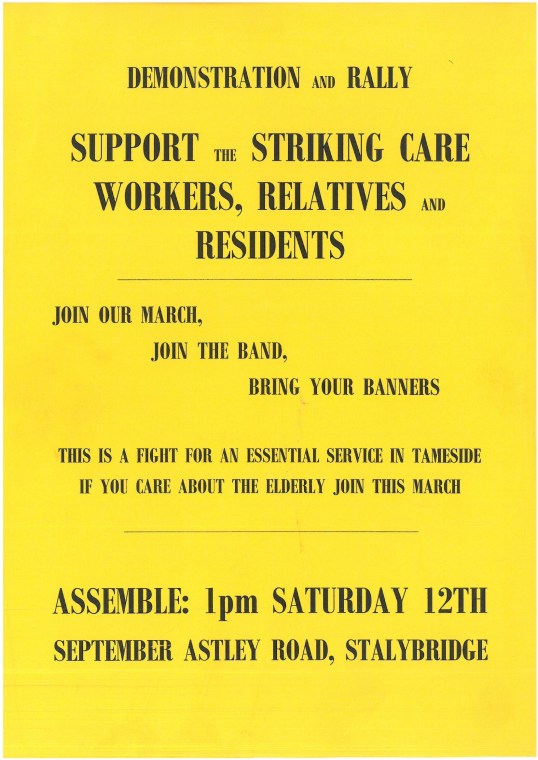
Leaflet for demonstration.

The striking carers were supported not just by local people in Tameside but the relatives of the elderly residents who organised a meeting at a local hotel to discuss their concerns.

Strikers set up pickets at the care homes operating on a daily basis from 630 a.m. to 11pm. Collections for the strikers took  place in local shopping centres. Letters of solidarity were sent to the strikers as well as information about what was happening in the care homes.
Unusual for any strike is support from a local Conservative Association but on 13 May the Ashton-under-Lyne branch wrote to Alan Firth, Managing Director of the TCG to register their concerns. They also send a donation to the Strike Fund.

Financial support for the strikers was raised by socials with radical singer Clare Mooney.  On International Women’s Day  a solidarity benefit was held at the Chorlton Irish Centre.

Banner Theatre and local singer Bernie Murphy took part in socials locally to raise the spirits of the carers and fill up the strike fund.

On December 6 a radical history walk around Manchester was organised and run by Ruth Frow  and Michael Herbert of the Working Class Movement Library   in aid of the Tameside Care Workers.

A preliminary hearing of the Industrial Tribunal took place at which the TCG’s Managing Director Alan Firth finally admitted that the Company was still owned by Tameside Council. The Tribunal unaminously agreed that the workers were sacked before they went on strike and did have a case for unfair dismissal and a date for the  full hearing of the Tribunal was set.

But this did not stop the Labour Council two months later taking out half page advertisements in the local press to say it did not own or control the Company.

One of the strikers’ son produced a Xmas card for sale with the slogan “Enough is Enough”: 1000 were sold and the money donated to the strike fund. During the period of the strike the Hardship Fund for the strikers raised  over £263,000  from Unison branches, members and the wider Labour movement.

xmas card produced by strikers’ son.

In  May 1999 six sacked care workers stood in the local council elections: Sheila Carpenter, Hazel O’Neill, Liz Taylor, Joan Ashton, Rosemary Young and Pauline Carmody. None of them were elected. Labour was returned with record low turnouts.

On 20 May strikers ended industrial action and  most accepted a settlement by Tameside Council. But  18 strikers refused the settlement and instead took their case for unfair dismissal to an Employment Tribunal.  They wanted to highlight the conditions for workers and residents in the homes. But the Tribunal voted against the strikers and made no criticism of Tameside Care Group.

Unison called on the Audit Commission to conduct an inquiry into the financial affairs and management of the Tameside Care Group. They also called on Tameside Council to conduct a wide ranging review of the future of residential care provision and operate within a “Best Value” framework as recommended by  the  (Labour) Government.

Locally the newspapers covered what turned into a national controversy over the Labour council, elderly care home residents and a strike of angry and determined women workers. A documentary was made about the strike as the strikers took their dispute up and down the country at meetings and demonstrations.

The TCW dispute is a reminder of what has happened to our public services. It shows how all the unions failed the workers and the public in defending public services. It showed the complicity of the Labour Party in the privatisation of the public services. It is one of the reasons why   few people vote in local elections, take part in local politics or are   members of a trade union.

Today it is new  and independent unions such as the United Voices of the World that are taking on care homes who are offering inadequate pay to care workers. They have just won at  Sage nursing homes in London. Find out more here

The archive of the TCW dispute is under Tameside Care Group at the WCML in Salford here


Posted in Uncategorized | Tagged , , , , , , , , , , , , | 1 Comment

40th Anniversary of radical Irish community organisation the Irish in Britain Representation Group.

Spirit of IBRG. Photo T.Shelly.

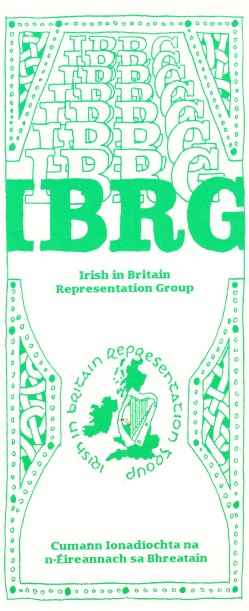
 ON 10th October 1981 the Irish in Britain Representation Group (IBRG) was founded at the New Inn Public House, Newhall,  Burton on Trent in Derbyshire with John Martin as convenor of the meeting. Twenty three people attended.

The name IBRG was adopted with John Martin elected as  Chair and Treasurer, Michael Sheehan as Secretary and PRO and  Michael O Callanan as Vice Chair.  Other named persons who attended were John McDonald from Cumanna na Poblachta, Siobhan Sandys from Liverpool, Kay Jones from Bradford, and Frank Gormley  from Burton. The names of the other 16 attendees are unknown as  no minutes of the meeting have survived.

The issues discussed were the reunification of Ireland, Prevention of Terrorism Act , anti-Irish racism, Labour Party policy on Ireland, Votes for the Irish in elections in  Ireland and the high cost of  travel from Britain  to Ireland.

IBRG was founded as a reaction to the  failure of mainstream Irish organisations (and most left organisations ) to speak out on the Hunger Strikes. 1981 was a pivotal moment n Irish history with the death of ten men on hunger  strike in the North of  Ireland. It led to significant shifts in Irish politics and the entry of the modern Republican movement into political life through the  electoral system in Northern  Ireland and the Republic of Ireland.

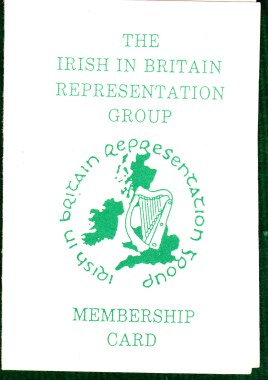
IBRG membership card

The Hunger Strikes had a considerable impact upon the Irish  community in Britain and was primarily the reason why there was an explosion of rage in the community at the failure of existing organisation like the Federation of Irish Societies (FIS),  including all its affiliates, to speak out as ten men died whilst demanding political status.

Joe Mullarkey,  who founded Bolton IBRG,  reflects: “My motivation in convening the inaugural meeting of the Bolton branch of IBRG was to give a voice to Irish people like myself whose views and concerns particularly in relation to events in Northern Ireland were never heard. As a community we were treated with derision, grossly stereotyped by the media as drunken, stupid, bigoted and sectarian. The use of the PTA and the conviction of the Birmingham Six and Guildford Four were issues of grave concern, as was the lack of support from the Irish Government. Many members like myself would have been inspired by the deaths of the hunger strikers and during that momentous event as a community we were unable express our views or concerns.”

Another  significant event was the Greater London Council  election of 7th May 1981 with Ken Livingstone taking over as leader  of this important Labour Council . Pat Reynolds of IBRG says:  “He was to do more for the Irish community in Britain in five years  than the Irish government had done in the previous 60 years.”

Unlike the  Irish Government-supported Federation of Irish Societies,  IBRG took an anti-imperialist stance, had a democratic structure which involved branches and individuals across the country, was non-sectarian and was driven by a civil rights, social justice and campaigning agenda.

IBRG developed in a hostile society for Irish people with anti-Irish racism and discrimination not recognised.  It was a new chapter in the ongoing struggle by Irish people in this country and on the island of Ireland to end Britain’s occupation of the  North of Ireland.

Patrick Reynolds said “The right to be Irish is the first demand of an emerging community. We saw it as essential to the reconstruction fight back on Britain against British colonisation both external and internal, against the war in Ireland, against anti-Irish racism, against institutional racism which left our community with poor housing, employment, health, education and welfare at levels far below those suffered by the British working class.”

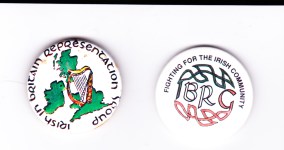
IBRG badges.

In the 1980s at least  forty thousand Irish people each year were leaving Ireland for work, some of whom of  became active on the issues around the British occupation of six counties of the North of Ireland in  organisations such as  the Troops Out Movement, Labour Committee on Ireland, Women and Ireland, Strip Search Committee .

IBRG benefitted from this new generation, as well as building on the experience of Irish women and men who had been active on Irish issues for many years in groups such as the Connolly Association,  Wolfe Tone Society, Sinn Fein and so on.

IBRG was noticeable for the number of second generation Irish involved  who were growing up in what was a  hostile environment for anyone who wanted to assert themselves as Irish. Young people   like me who  came from a background of post-war Irish parents who were socialists and republicans, who were activists in their trade unions and encouraged their children to follow in their footsteps.

In the 1980s the Irish community numbered  around five  million. However official documents did not reflect this and one of the major challenges for IBRG was to get the  lrish recognised as an ethnic community in the National Census as well in other official statistics,  including local authorities and other official bodies. The Irish were the largest ethnic community,  but without a profile, either  nationally or locally.

IBRG  gave respect back to the community. It fought on the hard issues from challenging anti-Irish racism and discrimination to demanding a role in achieving peace and justice across the whole of Ireland.

It had ideas and  policies and was not afraid of airing them,  particularly when faced with a conservative  Irish community and also a Left that often failed to take seriously the issues that we brought up. In its branches it brought together people were not afraid to voice their views  or act on them.

IBRG branches grew up across the country and organised according to local conditions. Some London branches obtained funding for offices and paid staff. Outside of London – which comprised the  majority – branches  had to fundraise through membership (although that was deliberately kept low at  £5/1)  and  social events.

Finding somewhere to meet was a big problem in the 1970s after a series of bombings in England and the arrest and detention of innocent Irish people,  the most notable being the Birmingham 6 and Guildford 4 . It was very difficult to find Irish Centres or Irish clubs that would allow what was seen as a “political” Irish group to meet there.

In Manchester we had a left wing Labour Council who gave free access to their buildings for community groups. Later  one of the poorest Irish Centres offered us free use of their main room. We brought in a younger Irish generation to our events and the Centre benefitted.

Members travelled across the country for  regional and national meetings,    fired up by their ideals and determination to get a fairer deal for Irish people in this country. Policy documents on important issues were discussed and formulated at meetings:  IBRG led campaigns on issues including ethnicity,  education, Irish Language,  Northern Ireland, anti-Irish racism, mental health  and  the positon of prisoners in British prisons.

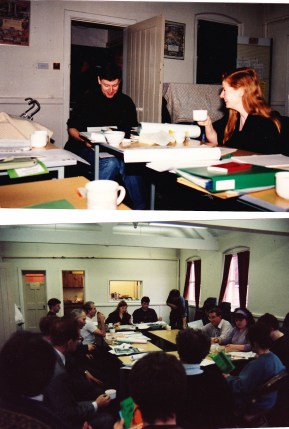
Regional IBRG meeting at WCML in Salford.

IBRG was noticeable for its grassroots campaigning, with a mixture of people from different classes and a high number of women who were active on a local and national level. It was an organisation which for instance had  Dr Maire O’Shea as President , Bernadette Hyland as National Chair. And Judy Peddle and Virginia Moyles were national secretaries.

At a branch level Margaret Mullarkey and Caitlin Wright in  Bolton, Laura Sullivan in Hackney , Ann Hilferty and Joan Brennan, Jodie Clark in Southwark, Theresa Burke in  Lewisham played significant roles. Laura Sullivan says “IBRG connected with and supported many miscarriages of justice and looking back the support I gave to all these campaigns were probably the most important things I did in IBRG,”

Anti-racism and discrimination against  Irish people were topics that many Irish people were very angry about: these  were issues that ran throughout the history of the organisation. From taking national newspapers such as the Daily Mail  to the Press Council, to IBRG members picketing bookshops that sold Irish Joke Books. But it was not confined to the media as branches challenged official bodies such as trade unions and government bodies about their use of racial stereotypes of Irish people.

IBRG magazines

This was at a time when asserting yourself as Irish was seen as making a political statement. And whilst there was support from Irish people and sympathetic English people to overcome some aspects of discrimination,  this was also set against a background of a worsening political situation in the North of Ireland. IBRG’s policy on Northern Ireland called for British withdrawal and self determination for the Irish people.

Links were made with the Republican movement, we shared platforms with Republican speakers in Britain and engaged in or gave support to many activities that would bring about a political solution in Ireland.

IBRG organised delegations to promote the views of the Irish in Britain across Ireland and the U.S.A. Meetings were cross border with the Irish government, political parties, and single issue groups including issues on divorce and abortion.

The annual Bloody Sunday March organised by the Troops Out Movement was a regular event which  IBRG members took part and to which IBRG had a delegate on the organising committee. In 1988 IBRG had its first St Patricks Day march for Justice.

IBRG March for Justice

In  1991, IIBRG members took part in many marches in England and Ireland including  attending one in Dublin on  the 75th Anniversary of the Easter Rising,   the Anti-Internment march in Belfast,   the Hunger Strike commemoration march in Birmingham  and joining with  black  community at Broadwater Farm in London.

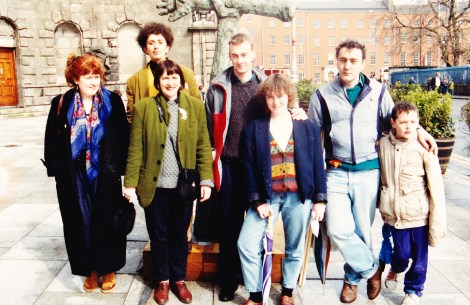
IBRG members at 1991 Commemoration of Easter Rising

Members of Sinn Fein who visited England  would regularly speak at IBRG events. But IBRG  did not have the relationship with Sinn Fein such as   organisations such as  Troops Out Movement. IBRG was often critical of Sinn Fein’s policy towards the position of the Irish in Britain and saw itself as part of wider Irish community and spoke to Sinn Fein  from a position of independence and equality.

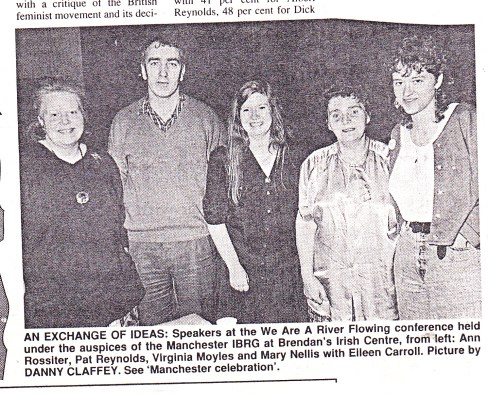
IBRG Meeting in Manchester with Mary Neilis of Sinn Fein

IBRG believed that it was impossible to talk about Irish history, culture and identity without also talking about what was happening every day in the North of  Ireland.

The Prevention of Terrorism Act  hung over the Irish community like a spectre. It was passed by the Labour  government   as a temporary measure after the Birmingham Pub Bombings in  November 1974, with the Home Secretary Roy Jenkins  calling  the new law  “draconian”.  The government  could now proscribe named organisations such as the IRA, issue an order excluding people from Britain to Ireland  or Northern Ireland (part of the Uk) without having to go to court or produce evidence.  The police were allowed to detain people for questioning without charge for 48 hours and this could be extended for a further five  days with the agreement of the Home  Secretary.

The PTA  succeeded in silencing  much of the Irish community (and some others) who were critical of Britain’s role in Ireland and organised an opposition. After 1974 many Irish people dropped out of Irish politics,  whilst Irish clubs and social centres were terrified of any event – political, social or cultural – which might in any way be connected to the war in Ireland.

Labour MP Joan Maynard, a campaigner on Irish unity,  urged Labour MPs to vote against  the PTA, stating that  the law “had absolutely nothing to do with preventing terrorism; there were very few people charged under it and even less convicted; it was really about terrorising Irish people in this country and collecting information.”

Work on the PTA was a constant theme in the work of IBRG , nationally and locally. This involved working with groups including the Labour Committee on Ireland, Troops Out Movement,  and individual MPs and councillors.

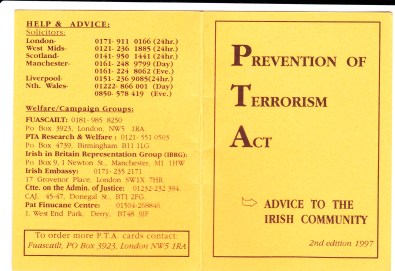
P.T.A. Leaflet.

The West Midlands PTA Research and  Welfare Association included IBRG members Maire O’Shea, Maurice Moore and Kevin Heyes. Based in Birmingham and Coventry – where the Birmingham bombings in Nov 1974 had taken place and Irish people had faced a great deal of popular anger and violence afterwards – it was significant that it became an area that played a significant role in ensuring that the same miscarriage of justice would not happen again.

Alongside IBRG it campaigned for the repeal of the Act,  providing evidence showing that it targeted the Irish community leading to 80,000 detained at ports and airports for questioning every year.

Practical help was offered to those detained including a telephone tree that was activated when a person was detained which included phone calls to the police station where the person was held and finding a solicitor.  The campaign for the repeal of the PTA led to the distribution of leaflets offering practical support and legal advice to the Irish community and over the years the issue was raised at many meetings up and down the country.

Links were made with progressive people within the Irish Community including Tommy Walsh who was chair of the Liverpool Irish Centre. He had been for years working quietly supporting Irish people who were detained under the PTA at Liverpool port which at that time  was the arrival point for many people from Belfast and Dublin which and became a major centre for police activity. He said “It is used as an act of harassment and intimidation against innocent people.”

Tommy would get little support from the established Irish organisations except money.  He would join with IBRG – particular its new Merseyside branch– to speak at our meetings on the campaign to abolish the PTA – and to share information and to encourage others to support people held under the Act.

When IBRG was founded the Birmingham 6 wrote to the organisation asking for support for their campaign to prove their innocence. Their campaign grew in the 80s as  Birmingham 6 support groups were founded  grew across the country and the North West of England saw one of the most vibrant branches  with Arthur Devlin and Joe Mullarkey of Bolton IBRG  playing major roles.Members included Labour Committee on Ireland, IBRG and individual Irish and English people.

Following their successful  campaign to prove their innocence  the men were  released in 1991 and the effect of this was to expose a justice system that was prepared to imprison Irish people wrongly – “because they were Irish in the wrong place at the wrong time.”  It encouraged other people to get involved in miscarriage of justice campaigns leading to the freeing of other innocent Irish people.

Most importantly it gave a confidence to activists to take up the cases of people when they were first  arrested, challenging the use of the PTA, rather than waiting until people had been processed through the legal system.

Over the years IBRG took up many cases including Kate Magee, Frank Johnson and Mary Druhan.  There was a campaign to highlight Irish deaths in police custody, such as that of that of Richard O’Brien in London and Leo O’Brien in Coventry.

Links were made with Irish political prisoners in jails in England – highlighting their campaign for repatriation back to Ireland and opposing unfair and cruel treatment that they experienced over here.

IBRG was founded by people who believed that a progressive organisation was needed to represent the needs and aspirations of the Irish community in Britain. For  the right to be Irish – and the right to civil and human rights.

It followed on from a radical tradition that has also existed in this country – as long as Ireland has been a colony and as long as Irish people and progressive English have sought to oppose and demand the right to a united country.

We demanded the right to speak about the war going on in the North of Ireland and the right to take part in a peaceful solution.

It put anti-Irish racism on the agenda and made it unacceptable.

Ethnic minority status for the Irish was won – and we can be seen  in documents ranging from the Census to local government statistics

We challenged the P.T.A., publicised its abuse, supported its victims  and called for its abolition.

We supported many miscarriage of justice campaigns concerning Irish people and joined together with other migrants in their fight for justice.

IBRG was an organisation of its era. It was a chapter in the continuous history of the Irish and our lives in the UK and in Ireland.  It brought together a mixture of people who identified as Irish. Many of the people in IBRG worked fulltime, often in stressful jobs, had children, partners and also were active in their trade unions as well as running IBRG branches.

It was being active at a time that taking up any issues whether anti-Irish racism or human rights abuses in the North  of Ireland  that led to smears of being a supporter of the Irish Republican Army, surveillance by the security services and the threat of being held under the Prevention of Terrorism Act whilst visiting Ireland.

The commitment of IBRG members should be recognised – and celebrated.

IBRG Meeting.


The IBRG archive which comprises hundreds of documents, leaflets, minutes and photographs can be accessed at the Working Class Movement Library

Read more about IBRG on this blog page . It includes a detailed history and a number of articles about the organisations’ activities.


Posted in Uncategorized | Tagged , , , , , , , , | 1 Comment

My Review of “A Radical Practice in Liverpool: the rise, fall and rise of Princes Park Health Centre” Katy Gardner Susan Graham -Jones

Cyril Taylor (1921-2001) was a communist and a General Practitioner. He took his politics into his work and this new book celebrates his life and his  influence on  generations of patients, health workers and the way in which health care is delivered in Liverpool and beyond.

He was born into an Orthodox Jewish family,   but as a young man he became an atheist and joined the Communist Party of Great Britain. He trained as a doctor at Liverpool Medical  School during the Second World War.

After the war he stood as a Communist  party candidate in local council elections and lost several jobs when employers found out he was a communist. Eventually he set himself up as a single-handed GP and was his own boss.

Cyril in a 1950 Communist Party election pamphlet.

Working from his home in Sefton Drive, Liverpool, his waiting room (the front parlour) included socialist papers for the patients to read, posters of socialist icons and a picture of Cyril with a huge brush sweeping away the Tories.

Throughout his life he joined the dots of being active in health care and politics. In 1966 he was elected as a Labour Councillor. Over the years he was active in  trade unions, campaigning groups and various NHS bodies. He said:

Both as a medical student and later as a doctor, it has always seemed entirely appropriate for me to be part of the broad struggle to change the unequal society for one in which every citizen would have an equal opportunity for education, the development of their talents and the right to work for their own benefit and the benefit of society. (Taylor 1986)

His work as a GP reflected his socialist politics. After thirty years in general practice he summed it up in  his book Socialism and Health. “To be a community-oriented doctor means involvement in all aspects of the community’s health care needs, including health education, screening and prevention. It also means forming an alliance with the community to resist forces – political, social, environmental – which make for ill health” (Taylor 1980).

Cyril’s story is also the story of Princes Park Health Centre and its staff and patients, a  story of a community working together. One of the great strengths of this book is the inclusion  of comments made by the many patients, staff and people who were part of this wonderful collective.

One of the lovely stories is told by Geraldine Poole, a patient who had just had a baby and one night was feeling anxious. She rang Cyril in the middle of the night and he came over (they lived across from the surgery) immediately in his dressing gown and slippers.

His dream was to open up a health care centre which would cater to all the needs of his patients. And on March 17 1977 his dream came true when  the Princes Park Health Centre opened. Together with a team of staff including a practice manager, secretary, practice nurse, health visitor, and  social worker. The centre offered space to other health care professionals,   including chiropodists, psychologists, dieticians and a geriatrician. There were also  rooms for voluntary groups to meet up.

Katy Gardner, one of the authors of this book, was one of the new team. She was newly trained and eager to roll out a community-based service. Active in women’s politics alongside Sheila Abdullah they would be key figures in Liverpool in ensuring working class women would get the health services they needed. Another book could be written about the way in which they took their politics into grassroots activity in the city and beyond.

Cyril and Katy

Originally Cyril had an open door policy to patients and they came from all over the city, though the  majority were from Liverpool 8. As the  authors explain. “This was a very diverse but deprived inner city area with many hostels and small flats mainly owned by private, sometimes exploitative landlords. Domestic abuse had emerged as a previously hidden problem.”

The PPHC went onto to develop policies and practices that responded to the needs of their patients. “It was a visionary practice, born in an era of hope which included the rise of the women’s movement in the 1970s and flourishing community based initiatives.”

Cyril Taylor, Sheila Abdullah and Sylvia Hikins at a fair organised by Princes Park Health Centre

The words that spring out as I read this book are “kindness” and “community”.  But It was fighting against a downturn in terms of funding for the NHS  that began  in 1979 with  the Thatcherite government which sought to undermine policies that tried to address the social and economic determinants of health.

This book is not just about the PPHC:  it is also  the story of the NHS over the last forty years showing how so-called government “reforms” have undermined the service, its practititioners,  and most importantly the health of its patients.

But the PPHC still exists and this book is a testament to the people who have not only  dedicated their lives to the healthcare of some of the poorest patients in Liverpool but who have inspired many others across the UK to follow in their footsteps and bring to life the real meaning of a National Health Service. Everyone should read this book and be inspired that we can take our NHS back!!

Buy it from News from Nowhere here

Posted in Uncategorized | Tagged , , , | 5 Comments

“You are Your Child’s First Teacher”: the Story of Manchester Parents Centre and Education Shop

Ann and Hilary outside the Parents Centre

“I feel I was born to do the job of Education Social  Worker  at Manchester  Parents Centre. It was an extension of everything I believed in my life. It was about addressing justice, giving back to people some control over what happened in their lives and to empower them to change things for themselves. It was not about me being their saviour – because they were capable of making those changes themselves – it was that they needed someone to show them how to and give them the opportunity to do so.”

So says Hilary Jones, who  was the longest serving worker at the Manchester  Parents Centre, which  had opened in November 1981 in the Moss Side Centre,  four months after the Moss Side riots.

Moss Side was a deprived area where many poor communities lived,  including over 100 ethnic minorities. The riots of 1981 reflected a bitter  divide between the  young black  people in the area (although some white people also took part in the disturbances) and the establishment represented by the police.  Issues of poverty, deprivation and racism were highlighted,  and the Parents Centre would be at the heart of the changes that would take place in the area. It was a radical initiative, one of only two such centres in the country.
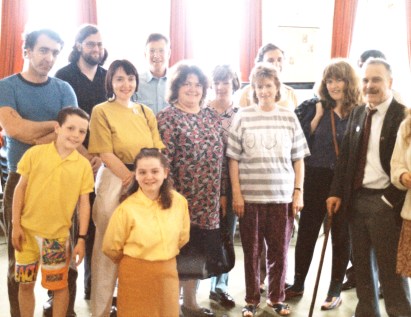
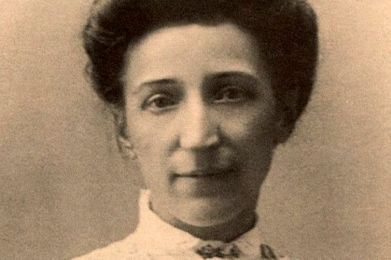
Hilary grew up in Moss Side and comes from a Communist family,  a household where ideas of internationalism and anti-fascism were  seen as  issues that everyone should be concerned with and everyone should be involved with. Hilary set up a Tenants Group on her estate,  as well as  being a shop steward at work.

A single parent with three children , she  had returned to education and became a nursery nurse working in schools. When she saw Bangladeshi women and their children struggling with accessing the school system she set up a pre-school project – half day a week – to bring them together with other parents and children in the school.

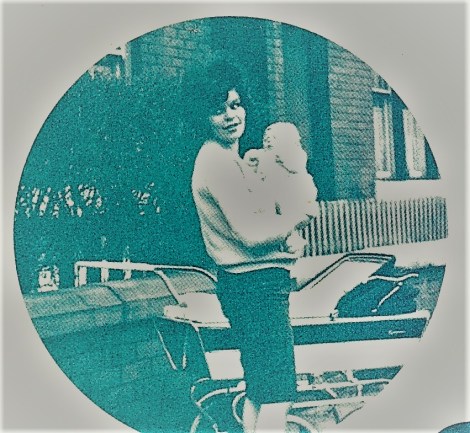
Hilary in 1961

The aim was to address their and their children’s needs so that they could take full advantage of the school system. This was the  embryo of a parental involvement movement that would grow over the years.

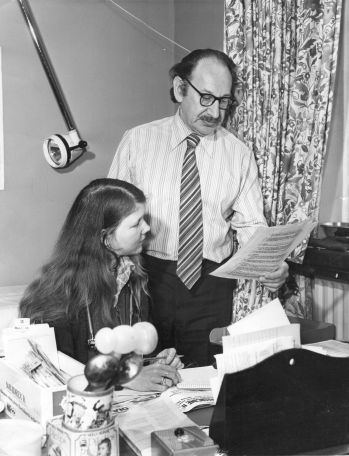
In 1983 Hilary met Ann Hurst through her trade union, the  National Union of Public Employees. Ann encouraged her to apply for the vacancy at the Parents Centre in Moss Side.  Up to this point the two posts at the Centre had  had teachers appointed to them.

The Parents Centre was a in a  shop, originally a bookies,  on the first floor of the Moss Side  Centre. Walking in the atmosphere was not one of a traditional council office,  but a brightly coloured space,  decorated with posters created by the workers and parents  that told the story of the work done in the Centre.

They had a wide brief : “home, school, community”. Everyone and anyone could walk through the door and be listened to,  and people came by word of mouth as little formal  publicity was produced about the Centre.

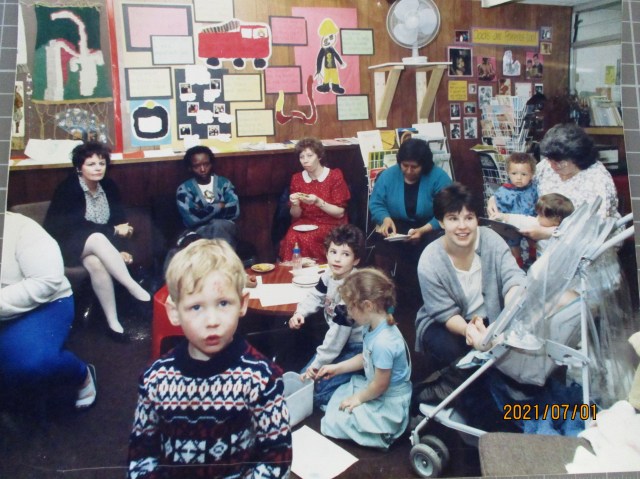
Event at the Centre.

Hilary says: “We were a bridge to schools and other agencies. People would turn up with an issue around benefits and we would listen, give them information,  and help them to deal with the issue. Their being able to get to use the phone was crucial in those pre-mobile days.”

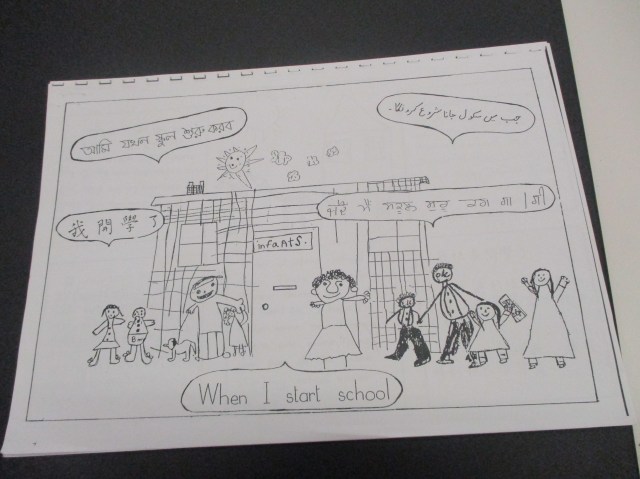
Booklet produced by parents and children about starting school.

Through the Centre parents met and worked together,  and eventually a core group of parents got together  who  would take the initiative in  setting up community lunches, getting involved with working groups,  and even fundraising for they  and their children to go on holidays together.

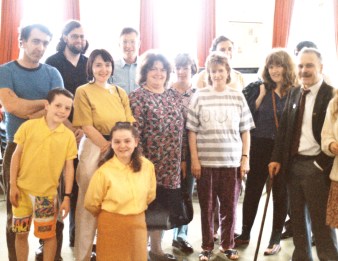
A holday for children and parents from the Parents Centre

Following the riots in 1981  there was a lot of suspicion between the community and the police. Militant groups were set up by black people locally and one of the big issues (and still is today) was about the underachievement of black boys and a school system that was seen as institutionally racist.

The Centre was part of this activity.  “We were part of a network of local groups that shared ideas and gave each other support. A panel was set up and the Education Department came and answered questions from parents.”  Ann and Hilary decided to produce their own anti-racist policy and,  running alongside it,  parents were brought onto the Centre’s Management Committee.

The Centre offered a neutral place to parents, breaking down barriers between the council and other agencies, offering a non-judgemental environment to people who were often seen  as “problems” to council and government agencies.

A local doctor summed this up:  “When I called there I realised I knew some of the people attending. They happened to be some of the parents who for years I had felt to be amongst the most vulnerable in the community. Often I had been amazed at how very well children of such parents often appear to cope – I suspect the answer may often have been that the hitherto unrecognised contribution of the Parents Centre has sustained and empowered such parents and has in fact saved many inner city children from faring as badly as could have been predicted.”

Parents Centre Leaflet

The motto was “You are Your Child’s First Teacher” a radical approach to working with parents  that offered  them the opportunity to explore their own issues around bringing up their children and encouraged them to take part in collaborative work with other parents.

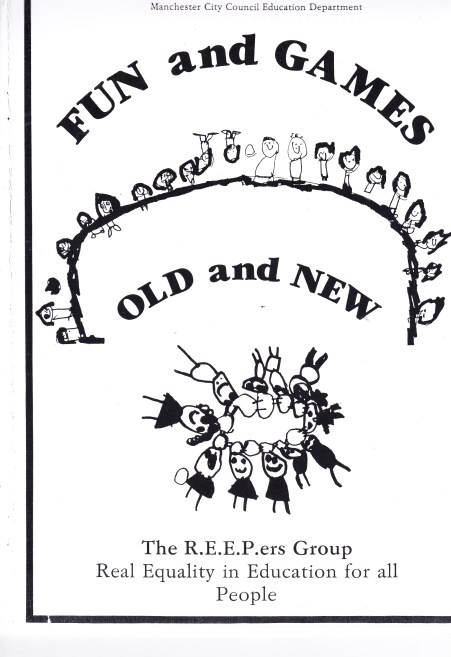
“The Real Equality in Education for all People” was a group set up by Doreen Kirven with parents which met twice a week at the Centre to discuss and exchange ideas. They produced  a booklet, Fun and Games  Old and New, which promoted play for children, showing how important it was, both  physically and mentally. It brought together children’s games from all different cultures and showed that children are learning even when they are playing.

Looking at the pictures of the Centre it does not look like a council run service. Hilary agrees: “We had a benign management who allowed us to make our own policies and decide how we wanted to implement them.”

It was about bringing all kinds of people together from different backgrounds with different languages and cultures. “We wanted to encourage parents to do better – for themselves and their children”.

Event at the Parents Centre

The Centre was next door to the 8411 Project which was a community education project which offered the parents courses to return to education and,  most importantly,  a crèche for their children to be cared for whilst they were learning. Parents were encouraged to become school governors – at that time few black people were represented on school management committees.

Other workers such as Pauline Richards  brought different skills. Tony Atta, an Afro Caribbean father, joined the parents’ group and later became a youth worker who  taught Information Technology  skills to the parents. Doreen Kirven set up a creative writing group with the parents from which books were published. She also liaised with local theatres (including the Royal Exchange) and obtained tickets for the parents to go to their performances for free.

In 1993 the Moss Side Centre was demolished and the Parents Centre was relocated to a local school. It never had  its own separate space again,  but many of its practices and policies were incorporated into Children’s Services across the city.

The Parents Centre was a unique project offering parents and children the opportunity to take part in activities to improve themselves and their children’s lives. The parents had a level of power and influence that was rare (and rarer today) in becoming their child’s first teacher. In terms of numbers of enquiries it started at 30 per month and by the time it closed its doors the number was 900 per month.

After 14 years at the Parents Centre Hilary left to take up another role in the Early Years Service. She continued to work with children and parents and was able to take part in promoting issues around parental involvement in other parts of Children’s Services.

Hilary reflects on her time at the Centrre . “It gave me a validation both personally and politically about how I saw the world and how I could bring that into my working life. I was proud to do the job and it gave me a level of respect that carried into my personal life. “


The archive of the Parents Centre is in the Ahmed Iqbal Ullah Education Trust in Central Library, Manchester  see https://www.racearchive.org.uk/


Posted in Uncategorized | Tagged , , , , , , , | 1 Comment

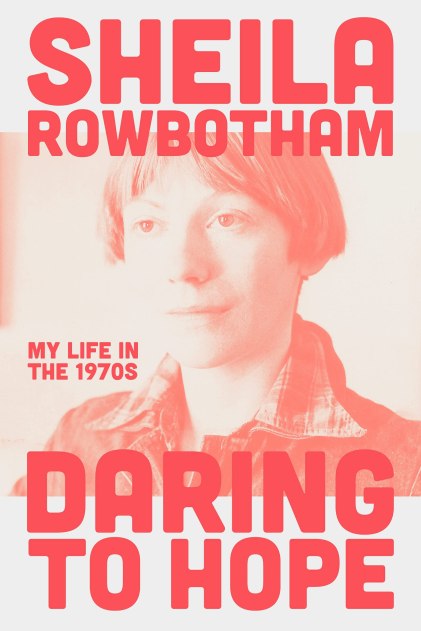
My review of “Daring to Hope My Life in the 1970s” Sheila Rowbotham

Sheila  is the country’s foremost socialist feminist thinker  and historian. This is the second part of her autobiography, following on from “ Promise of a Dream”  and takes us through the 1970s – all in 291 pages!

We watch as Sheila, like Alice through the looking glass, enters  another world. She is from a middle class background,  but instead of following the well worn path of university, marriage  and domesticity,  she threw herself into a journey of  personal self discovery with  a determination to join other individuals and groups who were also looking to turn the world upside down.

Today we are saturated in books and manuals that call on people to change their lives with the mantra, “be the best person you can”,  but for Sheila (and many other people at that time) it was about defining, and   redefining oneself as a woman,  and working collectively with others to change society for everyone.

We are taken by Sheila through her life and loves during  a very dynamic and exciting  period of history. She says “The seventies saw a great surge of rebellion and dissent that spanned politics, culture and personal life.”

As we follow Sheila through her life in these years  we experience how different this country was,  and how much easier it  was for people  to be politically active. Housing was cheap, there were plenty of jobs, you could sign on for benefits and you didn’t have to bother about how you looked. (no selfies!) Young people had the space to think about their life and get active in whatever they wanted to.

Breaking down barriers between classes of people was seen as vital in politics in the 1970s as students made alliances with  factory workers, cleaners, postal workers and so on in challenging an unfair society.

One of the most important part’s  of Sheila’s story is how she works together with women who want to smash the traditional  view of what it means to be a woman. Reading about all the different women’s groups that popped up at that time is incredible when we look around today. The women were working at a grassroots level and their aim was to set up an    autonomous women’s movement. It is inspiring to read about  the way in which   women set up local groups  to discuss, debate and then organise collectively to  take up issues in conferences, on the street and in other  organisations.

One of the big differences between today and the 1970s is   women  believed could change their lives and those around them. The 1970s was a time of a  deepening  economic decline in the country –  which working class people were going to pay for it.

But there was a strong trade union movement with many working class women who were at the forefront of strikes and disputes. Alliances were forged between the new women’s movement and the growing number of strikes started by working class women.

One of the first mentioned in the book is the fierce  May Hobbs, a working class woman from Hoxton, who together with other night cleaners took action against low pay and poor conditions. Sheila and her women’s liberation group took up their cause and joined them by leafleting and supporting their strike action.


May Hobbs

It was not easy for the working class women and some of the biggest disputes were with their own unions  and the men who generally ran them.  For women such as Gertie Roche in the 1970 clothing strike what started out as a spontaneous walk out by many women textile workers led to a bitter dispute with their male comrades. Twenty five year old Sheila is challenged by Gertie who throws back at her “And you. Are you emancipated in your own life”.

The word “socialist” is thrown around all the time these days but to me this is what it means when people like Sheila stand back and support working class people and promote their campaigns, and in doing so do not hijack them  for their ambitions and self promotion.

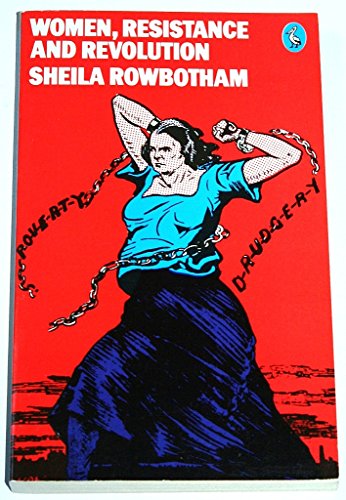
When Sheila’s book “Women, Resistance and Revolution” was published in 1972 she immediately retreated to the laundrette. She did not want the media attention as she says “though we were intent on creating a movement that was non-hierarchical, the media persisted in creating celebrities and labelling individual writers as leaders”.

Nevertheless the book became an international best seller,  particularly amongst women who were also seeking likeminded sisters and  a path to emancipation.

In 1973 her book “Hidden from History” was published,  a  groundbreaking  text  on the  history  of feminism and socialism in the C19th and C20th,  revealing women’s role  in political and social activity. Sheila acknowledges the collective nature of her research.  It was written with the support of her friends with whom she had conversed on subjects as diverse as socialism and feminism, witchcraft and women’s work, and  who had given her copies of what  they had written.

Underlying all this activity is Sheila’s own constant  musings about her life as a woman and her relationships with the men in her life: how to be, and stay, independent,  while  still having  close, intimate relationships with men which allowed  her to grow, to have a child,  to develop her mind and her politics. Through her writing we can hear her chewing over all these dilemmas and I love her poems which she uses to give an insight into her emotions.

“Daring to Hope” captures the mindset of a generation of people in the 1970s.  Through her life and activity Sheila reminds us of how we can set ourselves free,  but that it takes a great deal of activity, of thinking and relating to other people. Labour historians   Edward and Dorothy Thompson were good friends of Sheila and it is one of Edward’s  phrases that  sum up the book and the era:  “Enduring militancy is built not upon negative anxieties, but upon positive aspirations….it is always the business of the Left to foster the utmost aspiration compatible with existing reality – and then some  more beyond.”

Buy it with 20% discount here


Posted in Uncategorized | Tagged , , , , , , , , | 4 Comments

My review of “The White Bird Passes” (1958) Jessie Kesson

On a recent train trip around Scotland I visited Inverness, a pretty little town, but was not aware that one of Scotland’s most famous working class novelists, Jessie Kesson (1916-1994) was born there. At the end of my trip  by coincidence I came across her first novel at the wonderful Edinburgh second hand bookshop Till’s

“The White Bird Passes” (1958)  is biographical as much as any novel can be.Jessie was the daughter of a prostitute as is the main character of the novel:  Janie MacVean, is the daughter of  Lizzie a prostitute ,who grows up in a poor,if close,  neighbourhood of a Scottish city. In  Lady’s Lane  she lives amongst a matriarchy that govern the comings and goings of their community.  The Duchess, Poll Pyke and Battleaxe are the women who police the streets and the children as they charge up and down the lane.

“Only the children of the Lane were irked by such vigilance. To get up through the Lane unnoticed took on the face of an adventure, and became triumph indeed, if they could reach their own doors  without the Duchess confronting them with a pillow slip, threepence, and a threat: ‘Run up to Riley’s back door for a stale loaf, tuppence of broken biscuits. And see you that the loaf isna’ too stale.’”

Janie is a child full of hope; hope that has not been wrecked by the life she is living. Earning money for running a message for a neighbour she debates as to how she should spend it. She buys  her Mum some tobacco and a book for herself. But “Dimly Janie realised that her Mother’s gladness at getting, just didn’t equal her own gladness at getting.”

Janie’s life is about avoiding the Cruelty Inspector, the Free Boot Man  and the Sanitary Men. She has no father to protect her but makes one up, one that is dead in the cemetery that she visits with her Mum.

And it is Janie’s relationship with her Mum, Lizzie,  that is central to the book.   Jessie has a lot of sympathy for Lizzie as she tries to keep her home and child together. The facts of Lizzie’s life are made bare,  including her life as a prostitute and her life as a mother.

Janie and her mother go to visit her grandmother. Lizzie grew up in the countryside and there is a wonderful scene where she talks to Janie about her childhood, her knowledge of the flowers and fruit on the bushes, and the stories of the ancient wood.

Janie as a young woman refuses the usual job description of a  poor working class woman. She says: “I don’t want to dust and polish..And I don’t want to work on a farm. I want to write poetry. Great poetry. As great as Shakespeare”.

Jessie portrays  the harsh life of working class  girls and women in this book but there is a lot of light, singing and  joy. Her characters may be down but they are not out.In her own life she came out of the orphanage with a poor education and worked in many low pay jobs.

But all the time she continued to write and write about her class in a positive and life affirming way. That is the strength of her novels and in her time no doubt was why they were popular. Two  of her books, “The White Bird Passes” and “Another Time,Another Place ” were made into films unfortunately neither  are available to watch.

Jessie Kesson’s  work should be better known because she writes from a Scottish working class experience:  her girls and women are not victims but cry out for justice and demand a better life.It is hard to imagine today any young woman with her life experiences getting her work published.

I am lucky that my local library has a biography of her; “Jessie Kesson; Writing her Life” by Isobel Murray.

I also found online this biography

Her books are now out of print but you may find them in second hand bookshops or online

here


Posted in Uncategorized | Tagged , | 2 Comments

My review of “Stranger in a borrowed land: Lotte Moos and her writing” David Perman (2012)

Thank goodness lockdown is easing and once again I can browse the shelves of City Library in Manchester. And this book is the kind of gem that you can only find in public libraries. The name “Moos” stopped me as I had already read Merilyn Moos’ extraordinary novel,   “The Language of Silence,” and recently  read her new book, “Anti-Nazi Germans” co-authored  with Steve Cushion.

David Perman – who wrote this book – got to know Lotte (1909-2008)  in the early 1980s when he heard her  perform her poetry. She was then in her 70s,  and was gaining  a reputation  for her poetry which was appearing in magazines and  publications. David went on to publish her Collected Poems in a Rockingham Press imprint.

But he knew little about her past – and what a life she had lived.  Lotte and her husband Siegi had fled Germany to the UK in the 1930s, leaving  behind her parents.  Not an  unusual story for that era,  but   Lotte was not the usual refugee.

The British authorities , who were never that keen on allowing refugees from Germany into this country , suspected her of being a Communist spy which was not surprising as Lotte went from England  to Moscow in 1936 and then  on to  USA in 1939. Returning to England  in 1940 she was interned in Holloway Prison and interrogated by M15. In 2003 two thick MI5  files  on Lotte’s life were released into the National Archive which laid bare her life and the interest that  the  British  authorities had in it.

David,  and many of her friends,  did not know the turbulent life that Lotte had lived. Her daughter, Merilyn, only became aware of the extent of Lotte’s writings when she cleared her flat in Hackney when Lotte went into a care home.

As David says: “Lotte began writing in the aftermath of the First World War and continued writing compulsively into her late eighties. She really was a narrator of her turbulent century with its revolutions, wars and massive movements of people as refugees. Lotte regarded herself as a refugee for most of her life and had a particular sympathy  for other refugees.”

Lotte   was born in Germany on 9 December 1909 as Margaret Charlotte Jacoby into a middle class, wealthy family. Like many German Jews their Jewishness was not an issue until the Nazis began persecuting Jews in the 1930s.

She began telling stories from an early age, both  at home and at school. In the 1920s as the political situation deteriorated  Lotte, on her way to school, watched as refugees from Poland and Russia, escaped into Germany:  she recorded this in a story that was published in the Berliner Tagesblatt.

Lotte wanted to be an actress and attended the Berlin State Theatre School in 1926. Failing at this she went onto to become a photographer’s assistant.  Interested in politics she joined the left wing Workers’ Theatre  and it was there she met her husband  Siegi Moos. He was a communist who wrote radical plays and poetry and  Lotte joined the party around the same time.

In 1932 politics in Germany shifted to the  right with the rise of the Nazis. In the New Year the Left staged a demonstration of over 100,000 people in the  centre of Berlin which Lotte and Siegi took part.  But events took a turn for the worst when the  Nazis came to power:  left wing parties were outlawed and their  leaders and deputies were murdered or arrested.

In 1933 Siegi and Lotte fled Germany for Paris. Lotte summed up her experience in a story called “Arrival” written many years later. “I am no historian, nor someone who has studied history. What I have to tell is history suffered, so to speak, by someone who was turned into a refugee in 1933.”

Lotte and Seigi made a life in the UK. Siegi took up a career in economics,  eventually becoming an adviser in Harold Wilson’s  government of 1966. Lotte continued her writing and had some  success. In 1944 she had their only child Merilyn.

In 1976 both of them joined the Hackney Writers  Workshop and a whole new chapter of their lives began as they took part in a group that encompassed people of all ages and  produced  work that reflected the politics of the working class community they lived in.

Lotte never forgot her own refugee status and she reflected this  in her poetry. She took the side of the oppressed and championed their rights.  Her poem “If You Think” (1981) sums this up.

If you think

Blows

struck in Ireland

Won’t hurt you

Think again

They will hurt you

If you think

The knife

Slid between the ribs of a Pakistani

Will glance off your lighter skin

Think again

If you think

Bullets hissing towards beating hearts

In some country we know nothing about

Will miss you

Think again

They will not miss your beating heart

If you think

Needles

Jabbed into veins

To make the blood run docile

Won’t prick you

Think again

They will hurt you, hit you, prick you

And they will not miss you

We are all one

One trembling human flesh.’


It is Lotte’s own words in stories, plays  and poems that illuminate this book. We hear her voice, walk alongside her through some horrendous experiences, and can only be inspired by her, Siegi and many other comrades as they lived the history of this period.

David Perman should be commended for writing this inspiring biography of Lotte. It is well written and includes an appendix of her work. It is also produced by a small, independent press and so is without the usual “Cold War” politics that are rampant in many books produced about this era.

Today poetry has never been so popular,  but much of it is individualistic and shallow.  What we need is a revival of writers’ workshops that will bring in working class people  and activists who will  write up their experiences and reflect the reality of life in this country.

You can see Lotte performing a poem in this film about the community in Hackney in the mid 1980s https://player.bfi.org.uk/free/film/watch-somewhere-in-hackney-1980-online

If you cannot find the book in your local library   you can still buy secondhand copies here https://www.abebooks.co.uk/book-search/title/stranger-in-a-borrowed-land-lotte-moos-and-her-writing/author/perman-david/

Posted in Uncategorized | Tagged , , , , , , | 2 Comments

Jodie Clark: Proud Cork woman and Irish Community Activist

Jodie at the Irish Womens Conference  (second from the left)Jodie 4

 Jodie Clark’s involvement in the Irish in Britain Representation Group reflected the way in which the organisation drew in Irish working class people who were prepared to get stuck into grassroots organising. Women and men who experienced anti-Irish racism of the everyday variety,  but also the more corrosive institutional racism endemic in British society. It is an inspiring story and an important part of the radical Irish history of this country.

Here is her story.

Jodie was born in Lambeth in 1949,  her parents were from Cork . The family split up  and her father kidnapped the children and took them back to Cork to be looked after by their aunt. The children were told  that their Mum was dead:   Jodie  did not see her again until she was 10 years old.

After returning to England to live with her Mum, new partner and two  step sisters, her father kidnapped her  again and  returned  with her to Cork.

When she was 11 Jodie  was sent by her gran to work in a glove factory and then a knitwear factory where she learned sign language in order to communicate with two other workers who were deaf and dumb. Her gran kept her wages, just  giving her the occasional sixpence.

Jodie’s Mum found her when she was 15 and brought her back to London. She then worked with her Mum in catering and was the first woman manager at Joe Lyons cafe.  After that Jodie  went to work at Woolworths and in the evening at a Wimpey bar.

It was here she experienced racism for the first time. She says “I was told Paddy go home. Unbelievable but I gave as good as I got.” Her manager would not do anything. Jodie, was  worried about being attacked going home, so she got her older brother to escort her.

Jodie married an English man, Peter,  and had a daughter in 1972. She decided to bring her younger sister to live with them but needed a bigger flat. She went to the local housing office at Southwark and was told by the officer that “We only give to our own” and “go back to where you come from”. This upset her,  but next day she went back with her birth certificate and those of her family and they were allowed to go on the housing list.

She ended up in temporary housing for the homeless,  but its condition was poor with no heating, damp and only a mobile toilet. Through a contact at the Tenants Housing Group she managed to get a better house. This spurred Jodie on to get active in the Tenants Association in Peckham. She says:  “one of the first things I did was to make sure that anti-racism was in the constitution of the organisation.”

In the 1980s she found out about IBRG at a local Council meeting. There was a full-time Lambeth Irish in Britain Representation Group office at that time. She also met Irish activist Nina Hutchinson who became a close friend and encouraged Jodie in grassroots activity.

Lambeth IBRG Membership Form.

Jodie joined IBRG and also took part in the Southwark Irish Forum which was a network of people who wanted to promote the needs of Irish people in the borough.

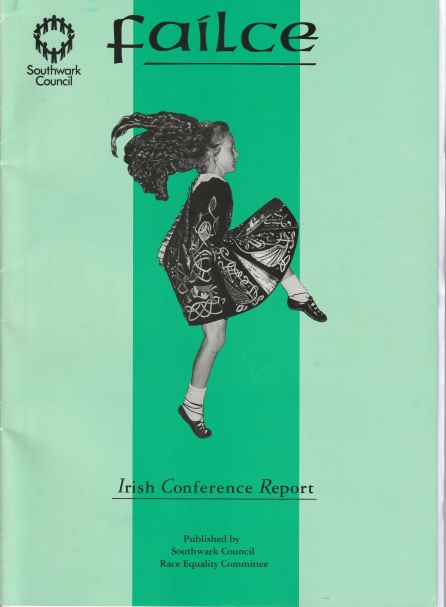
A consultative conference was organised with the Irish community,  out of which a report was produced called the “Failte Report,” documenting the needs of the community.

Jodie 1

“My own experience of housing and racism made me get involved because I felt I could get things changed.”

She worked alongside John Carty, Ann Mathews, Nina Hutchinson, Steve Brennan and Diarmuid Breatnach of Lewisham IBRG.

In 1990 she became a Labour Councillor and was  a member for Irish Affairs on the Council. She was involved in the first free  Southwark Irish Festival in July that year. Housing was a big issue for her and  in particular recognising the needs of the Irish locally. “I established local housing offices, with training for staff on Irish Awareness, and with space for tenants groups to meet.”

Other initiatives that Jodie was involved with included a St.Patrick’s Day and a   free Xmas lunch for Irish pensioners. Morley College ran an oral history project there  called “Now We’re Talking.”

Jodie 2

Irish social

Anti-Irish racism was still rampant. Jodie experienced this personally  and she felt she was also targeted because she had two mixed race children. “They sent me letters threatening the lives of my children. My front door was daubed with racist graffiti.”

 One of her most frightening experiences happened outside her front door. “Someone shouted my name from a car. I leaned inside and my head was grabbed and I was threatened with a shotgun. I was then thrown out of the car and they drove off. A black man in a car asked me what had happened and when I told him he told me to get in his car so we could  follow them. We did, I got the registration, but the police did nothing about it. It was the fascist group Combat 18.”

“What was it like having a famous mother” I asked  her daughter Angelina. She replied “When I was 11,  I went to the local high school for an interview. Walking into the head master’s office I noticed that there were pictures of my mother on the walls.”   Later on,  Angelina noticed that one of her teachers regularly read the Irish papers (the Irish Post and Irish World” “And my mother’s face was in those papers every week.”

Angelina, her brother Bradley, and Kevin Reynolds (the son of Irish community worker Pat) would help set up the room when meetings were being held. Unknown to the children Jodie would regularly receive threats by fascists to kidnap her children when they were leaving school which meant that Jodie had to have back up support to ensure this did not happen. Jodie was also supported by local activist Nina Hutchinson who would take her children on holiday.

Southwark Council decided to appoint an Irish Policy Officer but she was not invited onto the panel until she told them she would be in the room anyway so they changed their minds.

Jodie made sure that Pat Reynolds (IBRG) was appointed so as to ensure that the needs of the local Irish were treated seriously. He was in the job from 1992-1996 and then continued as Manager in Community Development. .

Pat reflects on his time at Southwark . “I was able to set up an Irish Staff Group in the borough which had over 80 members across the Council and Irish Teachers Groups along with Nina Hutchinson. During this time we managed to open up a new Travellers site in Southwark, had a Travellers Working party, had an Irish Forum, Irish Festival, an Irish Pensioners group, started Irish Language classes in Southwark schools, agreed mutual housing transfer to Ireland, got a quota for Irish staff of 10%, got the Irish recognised as suffering from racial harassment in housing. We also had the McSwiney Mass each year in Southwark, held a 1916 commemoration on the 75th anniversary, had Curragh racing on the Thames, held a regional Irish health conference. Jodie was the driving light behind most of this”

Jodie 3

Southwark Irish Festival. Mary Nellis of Derry Sinn Fein with woman (name unknown) from Derry Women’s Cooperative

Jodie went on to support the family of the traveller Richard O’Brien who was killed by two police officers on the streets of Walworth one night. His campaign led to the first unlawful killing verdict at an inquest.

She highlighted the suicides of young Irish men in Brixton, took part in pickets and vigils for campaigns for the Birmingham 6, Guildford 4 and  Danny McNamee, campaigned  against the Prevention of Terrorism Act and went on the Troops Out Movement delegation to the North of Ireland.

Looking back Jodie says her own experience of racism influenced her grassroots activity. “It was the right thing to do. Proud to be Irish, see myself as Cork woman, and you know what they say, ‘they don’t give up’. I knew I could get change – little by little – but I would go the whole hog.

You can read more about Jodie and IBRG’s history here

Posted in Uncategorized | Tagged , , , , , | 2 Comments

My review of “Memoir: My Early Life” by Joe Mullarkey (2021)

In his  memoir Joe Mullarkey, one of the key members of the Irish in Britain Representation Group , reflects on what it means to be Irish and his experiences of being an activist in key events that affected the Irish in Britain over twenty years.

He was born in Bolton in 1942,  but his mother died when he was five years old,  and  so Joe returned to Ireland to be brought up by his Aunt Kate and Uncle Tom in Ballybeg, Tullaughane, County Mayo.

His father stayed in Bolton working until Joe  was 15 when he  returned home.”I only knew him for a very brief time. I would have seen him every year for two weeks and he wrote every fortnight and sent me sixpence.”

Brutal treatment by the Franciscan Brothers led to Joe walking out of school when he was 13. “I told the brother that if he was to try and repeat the beating I would retaliate and so I walked out three months before I was due to finish school.”

Joe moved back to Bolton when he was 17. “The lack of job opportunities was the reason I had to leave. I was an economic migrant although that wasn’t the term used then.”

In the 1960s he played for Gaelic football team Shannon Rangers which provided a social life for many Irish emigrants. “It was a great saviour for many  Irish people. Some of the clubs would meet people coming off the boat train and they did tremendous work finding them accommodation and jobs.”

Life changed for Joe  forever when he had a serious accident on a railway line and lost both legs which were amputated above the knee. Through operations and his determination to walk again Joe mastered the use of prosthetic limbs. Joe was supported by his family and even a coach load of Manchester GAA supporters who turned up in his hospital ward. “Those visits had a magic effect in encouraging me to walk again.”

In 1972 he married Margaret Schofield. They had two children,  Bernadette and Nuala,  and also adopted Margaret’s two children from a previous relationship. Together they went on to encourage the Bolton Irish community to be proud of being Irish, and  not to be ashamed of challenging discrimination and disadvantage.

Joe and Margaret

Events in the North of Ireland following the Northern Ireland Civil Rights campaign in 1969 reflected  back onto the Irish community in Britain. As Joe comments,  “The Irish community in Britain had no community structures that could cope with the aftermath of the 1974 Birmingham and Guildford pub bombings and the introduction of the Prevention of Terrorism Act (1974) that led to the conviction of the Birmingham 6, the Guildford 4 and the Maguire Family and other innocent people.”

Irish activists did respond in 1981 after the death of 10 young Irish men who were  on hunger strike  for the right to political status in the North of Ireland. Joe was one of the founder members of the IBRG. He says “to campaign and to represent the interests of the community in Culture, Education, Welfare, Repeal the Prevention of Terrorism Act, Anti-Irish racism, and political issues.”

Joe and Jim King, Chair of IBRG in the 1980s.

Bolton IBRG had a membership of over 100 people with about 20 active on issues. They organised Irish language classes, as well as taking part in local multi-cultural festivals, starting an Irish radio programme, and  taking  their place on the Bolton Race Equality Council (BREC) and the Minorities Joint Consultative Council.

Joe  was  Chair of Bolton IBRG as well as national Vice President of IBRG and a member of the Ard Choiste ie the six weekly meetings of the organisation which took place at venues across the country.  He was also a shop steward in his workplace for thirty years.

Most IBRG branches had problems finding venues that would allow them to meet and Bolton was no different. After the 1974 Birmingham and Guildford pub bombings Irish pubs and clubs would not allow groups to meet that had any political agenda,  even though the actual event was a fundraiser for a football club.  Bolton IBRG challenged this and organised many  events including the first Bolton Irish Festival.

Bolton IBRG branch had difficulties finding an Irish club or pub that would allow them to meet monthly. In the end  the Socialist Club provided that venue and over the years supported IBRG as well as putting on their own events which highlighted human rights abuses in the North of Ireland.

Being Irish at this time was making a political statement. Joe and IBRG did not avoid the fact that Irish were in Britain because of the occupation of our country by the British over many centuries. IBRG policies were passed on Northern Ireland and the issue was taken up consistently over the years.

This memoir is important because it highlights how activists in IBRG were surveilled   and harassed for speaking out about Ireland and taking part in legitimate political activities.

It did not stop Joe, or other members of IBRG, in taking up issues including anti-Irish racism, the use and abuse of the P.T.A., and the human rights abuses that followed from the occupation of the North of Ireland by the British Government.

In 2002 Joe returned to Ireland for the second and last time. “Following the ceasefire and the various political changes, things improved for the Irish community, but I never felt that I belonged over there. I worked with English people, lived with them, was involved with them on a trade union and  community level but I never felt part of them.”

Joe’s story is part of the radical history of working class people in this country. It is a chapter in the history of the Irish in Britain who take their place in campaigning for a better society over here as well as challenging the role of the UK in the occupation of part of Ireland. It is an important story and one that can only inspire others to follow in his footsteps.

Joe (right0 at a northwest IBRG Ard Choiste meeting.


Bolton IBRG’s Minute Book and documents are now  part of the IBRG archive at the Working Class Movement Library  in Salford.

Contact Joe direct for a copy of his book at Joe@osb.ie. The cost is  £14.50 including postageto the UK

Posted in Uncategorized | Tagged , , , | 1 Comment

My review of “Feminism and the Servant Problem Class and Domestic Labour in the Women’s Suffrage Movement” Laura Schwartz


Both my mother and aunt’s first job in England  after arriving from Ireland  in the 1940s was as servants. Both of them hated it. My aunt ran away from her employer and my Dad had to return to pick up her clothes and the paltry wages she was owed. The title of this book is ironic: it was not the servants who were “the problem”  but the nature of the relationship between them and their mistresses.

In this new and fascinating  history Laura Schwartz unravels the complexity thrown up by the rise of suffrage movement and the response of working class women to the rapidly changing roles between them and the women they served. When I was transcribing the Minute Books of the Manchester and Salford Women’s Trades Council the irony of the roles played by the women was not lost on me. The organisation was funded by upper class women and men who raised money by having “at home” socials. At these fundraising events for the benefit of working class women they were being served by another group of working class women; the maids.

What I really enjoyed about this book was that it gives a voice to the servants – some of them like suffragist Hannah Mitchell – who,  in her autobiography  The Hard Way Up  spoke bitterly about her experience of being a servant and who “absolutely refused to don the muslin badge of servitude”.

Hannah Mitchell

Jessie  Stephen is a prominent  voice in the book who was  founder of Scottish Federation of Domestic Workers. Jessie won a scholarship to train as a pupil teacher,  but due to the poverty of her family was forced into domestic service. Even whilst working long hours in service (16 hours per day), she  took her anger out  onto the streets,  organising her sister servants. Laura uses Jessie’s unpublished biography “Submission is for Slaves” to chart her activity and the rise of the SFDW.

Jessie Stephen

Feminism was, and  still is,  today about the ability of women to make choices about their life but there was an uneasiness in expanding this ideological view to the women who enabled many suffragettes to have an active life within the movement. Domestic workers were excluded from  the WSPU’s newspaper the Suffragette and there were no images of domestic servants in their propaganda.

It was in  other suffrage newspapers that the voices of domestic servants started being heard. Angry letters challenged  an article in the Common Cause in August 1911 which said domestic servants were well paid. Servants responded (anonymously in order not to get sacked ) calling for better wages and shorter hours. I like the response of “A Domestic Servant” “I wonder if she would feel she had been well paid when she had paid for two uniforms out of her wages.”

The anger and bitterness of working class women did find a home in the foundation of the Domestic Workers Union of Great Britain and Ireland in  1909, part of the National Federation of Women Workers. Unfortunately, neither the NFWW or the DWU’s official papers survived. So Laura has used the correspondence pages  of the Woman Worker, the Glasgow Herald  and local and radical press to piece together the history of this organisation.

The significance of the DWU was, according Laura, that “It sought to reconfigure the mistress-maid relationship as a formal employment contract, and did not shy away from the potential for class antagonism between these two groups of women.”

Kathlyn Oliver, a twenty four year old cook, took up the formation of the union in London,  and branches in Manchester and Oxford followed. Organising domestic workers was not easy. Leaflets were printed about the union and circulated to the workers at their back doors. By January 1913 it had a membership of 400 servants. It was open to women and men. The only time most domestic servants had any time off was Sunday afternoons,so  the union opened its offices to members on that day  so  that  they could share ideas and experiences which would shape the direction of the union.

Kathlyn Oliver

The DWU had to deal with all the contradictions of trying to establish domestic service alongside other forms of manual labour. Domestic service was unlike other work as it dominated women’s total life:  not just the long hours,  but its psychological hold over the women’s minds. Kathlyn Oliver summed it up that mistresses failed to see their servants “as an intelligent being with a mind and soul to cultivate and not merely a machine.”

The demands of the DWU forced the suffrage movement to examine the politics in their own home and their relationships with their female servants. The First World War, which saw many servants escape into the munitions industry, led to the demise of the DWU. The 1918 Representation of the Peoples Act excluded servants alongside many working class women, as only women householders over 30 got the vote

Laura calls for more  research  and a feminist approach to this history “which takes account of more than just the male working class, not only highlights the long-standing economic significance of the service industry, but also reveals how, although it was difficult to organise domestic workers, the impulse for collective struggle never was and never can be limited to the factory.”

Jessie Stephen’s autobiography is at the Working Class Movement Library as are the Minute Books of the MSWTUC.

More about Jessie here

You can buy Laura’s book here

Posted in Uncategorized | Tagged , , , , | 3 Comments