Stop, Look,Listen…my weekly selection of favourite films, books and events to get you out of the house..


Watch...Breaking Bad (DVD series 1-3) Walt is a chemistry teacher in New Mexico. USA. He is diagnosed with cancer, his wife is pregnant and his son is disabled. With no medical insurance to pay for his cancer treatment he uses his chemistry background to make crystal meths for the drug trade. The series (which is now in series 4 in the US) explores the moral dilemmas for Walt as he gets deeper into the drug trade and the way in which this effects him, his family and friends. It is gruesome, hilairious and thought provoking.

LookOldham Gallery have a retrospective on the work of Liam Spencer. Liam is a local artist who concentrates on city scapes with an emphasis on light and colour. See new paintings of Salford,Rochdale, Oldham and Saddleworth,  as well as his early work from the 1980s. Support Oldham town centre as it takes the blows from the austerity agenda.

ReadThe Kindly Ones by Jonathon Littell. It took Jonathon over 5 years to research and write this 900 page novel. It is the terrifying  story of a man who was an SS Intelligence officer during the Second World Warand his  involvement with the hol0caust from the Caucuses to Poland, Stalingrad and finally the fall of Berlin. The main character, Max, is an educated man who enjoys philosphy, classical music and literature but is also a bloodthirsty murderer. The novel  is a   mediation on why ordinary people become mass murderers. It is set during the Second World War,  but the Nazis were not alone in history in condmening peoples to such mass inhumanity.

Go..for a walk around Radical Salford on Saturday 14 July at 11am.
The walk will explore Salford’s rich,radical history including the Flat Iron market, the General Strike of 1842,vegetarian Christians, Salford’s first birth control clinic etc..Meet at the Black Lion Pub, Blackfriars St at 11am.
Fees £5/6. The walk will last 2 hours. Advance booking recommended. Email; redflagwalks@gmail.com. More information go here

See.. Salford in a new light Paul Verlaine , famous French poet of the 1890s, wrote this long forgotten poem about Salford…

Souvenir of Manchester
To Theodore C, London

No I haven’t seen Manchester
– all that I have seen is one little corner
of Salford but badly narrowly
in spite of fog and streets with no cabs – dirty
streets that didn’t help my bad leg
and my two club feet – but my spirits don’t sag
under the weight of the memories
– happy memories – I now carry
of this town they call industrial
and despite that so very intellectual
niche I occupy maybe it would’ve been better
if I’d really strutted my stuff – this letter’s
naïve sure but picture the elite of Manchester
below me as I lean on the lectern
and they applaud in Paul Verlaine
our rigorous Racine
even while I make it clear
that the true God is Shakespeare
· From The Road to Inver, collected translations by Tom Paulin, published by Faber price £12.99.

Posted in art exhibition, book review, human rights, poetry, Salford, Uncategorized | Tagged , , , , , , , | Leave a comment

Eva Gore- Booth: Irish feminist, political activist, poet..

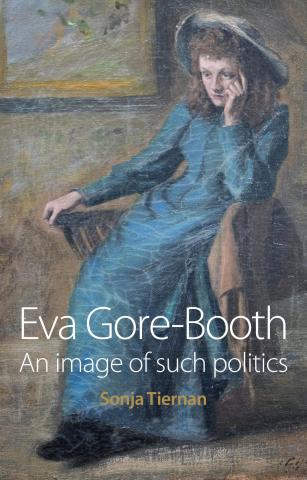
Eva Gore- Booth An Image of such politics by Sonja Tiernan (Manchester University Press) ISBN 978-0-7190-8232-0

Ruth and Eddie Frow were the first people to tell me about Eva Gore- Booth and her companion and fellow activist Esther Roper. They had researched and written about them in the 1980s and felt that, because I was involved in trade union and Irish politics, I should know about two women who had played a significant, if forgotten, role in the history of working class and the Irish on both sides of the Irish sea.

They would be very pleased with Sonja’s book. Not only is it well researched but it is written in an interesting and accessible way. The story of Eva is not just her own history, but also that of her lifetime companion, Esther Roper, and Eva’s sister, Constance Markievicz. Her life was played out in an era that was exciting and a time of massive changes: historically, economically and politically.

Eva was born in Sligo, Ireland on 22 May 1870. Her family were landowning aristocrats and she enjoyed an idyllic life as a child, for her and her sister, spending their time reading, writing poetry and painting, and, like many young women of her class they travelled extensively. However on reaching young adultdood it was a stultifying and limited future that was on offer for her. It was when she was in Italy, in 1896, recuperating from an illness that she met Esther Roper, a meeting that would complete change her life. Esther commented that Eva “..seems to have been haunted by the suffering of the world, and to have had a curious feeling of responsibility for its inequalities and injustices”.

Esther Roper was of Irish descent, born in Chorley Lancashire in 1868. Her parents were working class. “Roper held a unique insight into class structure. She was an educated woman named after an aunt who had worked as a cotton weaver from the age of twelve”. Her parents were missionaries abroad which meant that Esther was one of the first women to get access to an education. By the time she was 20 both her parents were dead and she was responsible for her 13 year old brother. A year later she gained a first class degree at the University of Manchester, and decided to campaign for womens’ equality. In 1893 Esther became the paid secretary of the Manchester National Society for Women’s Suffrage.

Esther told Eva of her work and she moved to Manchester in 1897. It must have been a shock to go from the beauty of rural Ireland, and a rich lifestyle, to a smokey, overpopulated city. Ironically there were more Irish people living there than in Sligo. “In the early 1860s 860,000 Irish were living in England and over half of this population were living in Lancashire and Cheshire”.

Manchester was the first industrial city and was also the cradle of the women’s movement. Thousands of women worked in the mills and factories. Esther and Eva decided to campaign to ensure that these women who were affected most by the industial in which world they lived and worked would gain representation and equality. Influenced by ideas from the French Revolution, they sought equality for women in all areas of their lives. Crucially they saw that thousands of women workers were paying taxes but had no political representation. They also believed that it was the organisation of women into trade unions that would lead to them gaining the vote. Their work in the Manchester and Salford Women’s Trades Union Council led to the creation of many unions specifically for women. By 1904 the labour movement officially supported suffrage for working class women.

Eva shared her love of poetry and drama with working class women in inner city Manchester. Unknown to them she was a talented poet and dramatist and part of the Celtic revival of the early 1900s.

Eva was a pacifist but, being Irish, she was aware of the injustices going on in Ireland. Ireland was still occupied by the British, and from the 1890s to 1920s her sister, Constance Markievicz, was involved in the political and military campaign to gain independence. Eva, whilst opposing physical force politics, supported her sister and her comrades, not just in publicising the barbarity of the British response to the Easter Rising of 1916, but in providing material support to the families of whose husbands had been executed or imprisoned.

During the First World War Eva opposed the war, a stance which was very unpopular to begin with, and worked tirelessly to support conscientious objectors and their families.

Eva and Esther lived during a period of history that saw massive changes in this country. They were active in many of the campaigns that led to the growth of democracy in Britain. For Eva it meant she went against her upbringing and family, but with Esther she found a relationship that allowed her to flourish as a woman and political activist. As Sonja says “Roper was a remarkable character and was clearly the greatest influence on Gore-Booth’s personal, literary and political life.”

Sonja’s book is important in profiling two significant women who understood clearly that class matters. They were at the forefront of not just the women’s campaign for the vote but understood that working class women could be significant figures in their own struggle. Eva and Esther, from their own personal experience, saw that women needed practical support to become political activists. I think there are still lessons today that we can learn from women such as Eva and Esther and that is why this is an important and interesting book for all political activists; women and men. As Sonja says “The story of her (Eva) revolutionary life shows a person devoted to the ideal of a free and independent Ireland and a woman with a deep sense of how class and gender equality can transform lives and legislation”.

If you have enjoyed this article and would like to support this blog by making a donation you can do using this button

Posted in biography, book review, drama, education, human rights, interesting blog, Ireland, Irish second generation, labour history, Manchester, poetry, Salford, Socialism, Socialist Feminism, trade unions, women | Tagged , , , | 1 Comment

Manchester Marxman

To get the most out of life you must be active, you must live and you must have the courage to taste the thrill of being young”
Engels 1840

Friedrich Engels, was born in Germany in 1820. He was an industrialist, political activist, writer, political theorist, and with Karl Marx he was the co-author of Marxist theory. From an early age he was politically active and his parents sent him to Manchester in 1842 to work for the family firm and to remove him from his revolutionary activities at home.

They could not have been more wrong. In Manchester he lived a double life. With his wealthy business friends he indulged in all the delights of the big city. He regularly drank in the pubs, rode to hounds, was a swordsman and spoke many languages.But unknown to his respectable friends he had a relationship with an Irish factory worker, Mary Burns, and it was Mary who showed him the other side to Manchester and Salford.He lived with Mary until her death in 1863.

His walks with Mary through the appalling slum areas of Manchester and Salford led to his seminal work The Condition of the Working Class in England in 1844.

In the introduction to the 1969 edition of Engels’ The Condition of the Working Class in England Marxist historian EJ Hobsbawn commented that “It remains an indispensable work and a landmark in the fight for the emancipation of humanity.”

But of what relevance does it have in 2012? Actor and director Jimmy Fairhurst of theatre group, Not Too Tame, feels it has a resonance with the lives of working-class people today, particularly in austerity Britain. “I couldn’t believe it was written in 1844. Engels could be talking about today”. Jimmy was so inspired by the book that he wanted to “provide a platform for working class people to find out about Engels and explore his work”.

His latest production is a partnership with film company Inside Film, with funding provided by Brunel University where they are based. He has got together 25 people of ages ranging from 13 years upwards to “look again at the condition of the working class in England, today, working from Engels book and their own experiences to create a show of dramatic sketches,songs and performances poetry.”

Many of the volunteers on the project have never been involved with politics before but in reading Engels text they have been able to very easily see its modern day relevance. Rosie said “My dad is always nagging me to get involved with politics, as he says, I am the next generation. Being involved with the project has made me more aware of what is going on and that nothing has really changed since 1844.”

Another volunteer, Jenny, is from an Irish background and works with asylum seekers. She was amazed by the contemporary nature of the book. “My family are Irish, my gran came over from Dublin and I can see parallels with the way they were treated and how it is acceptable to discriminate against some people”

The play will only have four performances,but will be filmed by Inside Film and Jimmy is enthusiastic about the future for political theatre. “People want to see drama about their lives. We need to find ways to make it accessible, to bring it to the pub or the community centre.”

The Condition of the Working Class will be performed at the Salford Arts Theatre July 5 & 6
and at the nexus Art cafe > July 7&8

http://www.nottootametheatre.com/see

http://www.insidefilm.org/who-we-are see

picture courtesy of Salford Starsee website for more about Fred.

If you have enjoyed this article and would like to support this blog by making a donation you can do using this button
Posted in biography, Communism, drama, education, films, human rights, Ireland, Irish second generation, labour history, Manchester, young people | Tagged , , , , , , | 1 Comment

Stop, Look,Listen…my weekly selection of favourite films, books and events to get you out of the house..


Watch... Germinal(1993, a film based on the novel by French writer Emile Zola. It tells the story of a mining town in northern France in the 1860s, where children and women are still working down the pits. There are many accidents due to medieval working conditions and the miners are paid a pittance. But in the 1860s across the world dissent is germinating (the theme of the novel) as Karl Marx in London starts the first international workers movement, the International Working Men’s Association. The film captures this seething anger of the workers as they challenge the mine owners. There are magnificent scenes as the miners and families move as a small army to other pits to bring out the other miners and sing the song of the French Revolution,  La Marseillaise. Stunning is the depiction of the women miners and miners’ wives who are the most militant of the community. Watching it reminded me of the 1984-5 Miners Strike and the tremendous spirit of the miners, their families and supporters. Sadly in Spain the miners are being faced with a similar story of forced closures as their Government wants the workers to pay for the bankers’ misspending. Spanish miners are now occupying their pit in the Asturias. Join their campaign and read more about it here


Listen to...the Dexys (aka Dexys Midnight Runners) are back with a fantastic CD. its 27 years since their last record and Kevin Rowlands is still on his search for personal fulfilment and love. In the song Nowhere is Home he sings ” I don’t know where I belong” whilst at the same time telling the opposition to “take your Irish stereotype and shove it up your arse”. The music is a fantastic mixture of his love for soul and Irish melodies, perfectly in keeping with the maestros’ journey through his own back catalogue of life and pop history

Read… Bring up the Bodies(2012) by Hilary Mantel. The second book in her series about the Tudors. A frightening study of the real history of the Royal Family. Henry VIII and Thomas Cromwell plot to get rid of Anne Boleyn and preserve the monarchy. Forget about the Mafia or Putin in Russia, these are the British mobsters of their era. Hilary brings together history and sexual politics of the highest order to light in a gripping, if scarey novel.

Experience..The Condition of the Working Class..a new play/performance piece by Not Too Tame Theatre and Inside Film. Mix together 25 volunteers and Engels masterpiece on the appalling conditions for people in Manchester in 1844 and the results are going to be exciting and provocative. See the results at
Salford Arts Theatre July 5&6 and Nexus Arts Cafe July 7&8

Posted in book review, Communism, drama, education, films, human rights, labour history, Manchester, music, novels, Salford, trade unions, Uncategorized, women, young people | Tagged , , , , , , | Leave a comment

From the Manchester Martyrs to the Birmingham 6…..


Plaque on Hyde Rd in Manchester which marks the spot where the Fenians were freed in 1867.

Book Review:The Manchester Martyrs by Joseph O’Neill (Mercier Press, 2012)
ISBN 978-1-85635-951-1

The Martyrs were three members of the Irish Republican Brotherhood (also known as the Fenians), who were wrongfully executed for the death of a policeman during the successful rescue attempt of two of their comrades in Manchester in September 1867. They were buried in quick lime, and in the 1990s their remains were secretly cremated.

In his introduction the author, Joseph O’Neill, explains why the Manchester Martyrs are significant to him. “Throughout the 1950’s when I was growing up in Manchester, the minute’s silence at the spot where the Martyrs died was part of our annual commemoration…it did more than forge a bond between the Irish community and the men who, there in our adopted city, died for Irish freedom.”

O’Neill has chosen to tell the story of the Martyrs as “a history book written for the general reader”. This often involves a melodramatic account akin to a novel but, without knowing where he got the information from, it is hard to reconcile the drama with the real events.

James Stephens played a major role in the creation of the Fenian movement. As O’Neill says; “Unlike any previous Irish nationalist organisation, the one Stephens sought to create would combine the power of the Irish diaspora…with that of the most virulent elements at home (Ireland)”. Much of the support for the Fenians came from America, building on the bitterness felt by the Irish who had been forced to leave Ireland after the famine in 1846, whilst the movement was full of men who had gained military experience in the American Civil War.

The story of the Martyrs is the story of the Irish experience in Britain. And, although there are differences in the way in which the three men were unjustly tried and hanged for a crime they did not commit, there are also parallels with contemporary events, and in particular the case of the Birmingham six. As the escaped Fenians were feted in America, O’Neill explains the response of the Chief Constable of Manchester: “The Fenian leaders had escaped but those who had rescued them would not . It was to these men that the police now turned their attention.” And the same thing happened with the Birmingham Six. The police and the government knew they were not guilty of bombing pubs in Birmingham, but framed them anyway. Someone had to be seen to paying, and paying hard.

O’Neill has chosen to locate the Martyrs within a a purely Catholic Irish tradition, failing to highlight the progressive nature of the Fenians, who were very much part of a political tradition harking back to Thomas Paine . In their manifesto, (which O’Neil includes in the index) it is clear that they were for universal suffrage, a free mind and, most importantly, the separation of church and state.

Like ONeill’s father, my father also took part in the Manchester Martyrs commemoration, but unlike him, he saw this as part of a republican socialist tradition, and one which he passed onto his children. O’Neill is scathing in his attack on second and third generation Irish; “Their children, with that chameleon plasticity that marks the irish wherever they settle, assimilated,the next generation even more.” He fails to mention the numerous Irish such as myself who have been involved in Irish politics in Britain, in groups such as the Irish in Britain representation Group , the Labour Committee on Ireland and Troops Out.

Whilst O’Neill is happy to expand on the reasons why the Irish supported the Fenians in the 1860s, he cannot extend the same analysis to the Irish of his own generation. He does not want to talk about the way in which the British government used legislation such as the Prevention of Terrorism Act to stop a debate in the Irish community in Britain about human rights abuses in Northern Ireland. He does not want to talk about the widespread and unacceptable anti-Irish racism faced by children such as me when growing up in 1970s Britain.

The Birmingham 6 on their day of release in 1991

O’Neill says that the story of the Manchester Martyrs “speaks of the transformative power of suffering.” He doesn’t explain what this means. I would argue that the history of the Irish community in Manchester (like many other communities) does show that our community has suffered, but that our life has improved through people getting together and challenging inequality and injustice. I suspect O’Neill is calling for some kind of Catholic revival with the poor Martyrs as “saints”. If they were lying in a grave, I am sure that they would be turning in it, when faced with such a usurpation of their lives and politics.

J.O’Neill will be speaking about his book at the WCML on 27 June – details here

If you have enjoyed this article and would like to support this blog by making a donation you can do using this button
Posted in book review, Catholicism, human rights, Ireland, Irish second generation, labour history, Manchester | Tagged , , , | 1 Comment

Stop, Look, Listen………excerpts from my Roman Holiday…….


WatchChrist stopped at Eboli (DVD) originally a book by Carlo Levi, an anti-fascist, who in 1935 was sent into internal exile by Mussolini. The title comes from a saying by southern Italians that the area has been neglected even by God. Levi was shocked by the poverty of the peasants, not just a material one but their despair, fuelled by superstition and ill health. A doctor, he used his medical skills to help them and they responded with friendship and by breaking the censorship imposed on him by Mussolini. Levi eventually became a Communist Senator in the Italian Parliament. The book was published in 1949 and the film was made thirty years later. A moving and powerful film, it is a brilliant insight into the importance of politics to people’s lives.

Look..……Whilst in Rome last week I went to a meal with Italian lefties. They were despairing of the financial state of the country and I asked about the Occupy movement. Their response was negative, that young people were not active etc. The following day many young and older Italians demonstrated at the Pantheon (one of the most important Roman heritage sites) against the austerity agenda in Italy. You can view footage at Libera TV.

Listen to the CD Filippa (Giordano) . Many classical favourites sung by a wonderful Italian female singer. You can see her on Youtube.

meanwhile back in the North West…

Loiter at the Secret Garden Festival with events in Salford and Trafford until 23 June, including  ‘No Rubbish Tipped Here’,  alternative gardens and unlikely playgrounds…If there’s an empty space,  people will play in it!

Go to the  Future Artists Film Club

THE FUTURE ARTISTS FILM CLUB or the love of indie film.
Join the group! http://futureartists.co.uk/about/

events include

– ‘WE ARE POETS’ + ‘MARINA ABRAMOVIĆ THE ARTIST IS
PRESENT’
Tuesday, July 3, 2012 7:45 PM until Tuesday, July 10, 2012 10:00 PM

Posted in anti-cuts, biography, book review, Communism, drama, films, human rights, music, occupy, Salford, Socialism, young people | Tagged , , , , | 1 Comment

Leila Khaled; Icon of Palestinian Liberation

Sarah Irving, Leila Khaled Icon of Palestinian Liberation
Pluto Press ISBN 987-0-7453-2951-2

Reading this book reminded me of another icon in my own community, Bernadette Devlin McAliskey. Like Leila, she grew up in an occupied country and has spent her life campaigning for a democratic and just solution to the division of Ireland. She has faced assassination, censorship and marginalisation in the Irish political system. She became an hero to the Irish community in the 60s when families,such as mine, across Britain watched (and cheered) when she took to the barricades to defend her community against the massed ranks of the RUC and British Army.

About the same time Leila Khaled was hijacking a plane from Rome to Damascus where the plane nose was blown up. She made the world headlines because she was a young attractive woman involved in militant action. This book is fascinating because the author weaves together the history of the Palestinians with the story of a woman and her struggle not just as a soldier but as a wife, mother, teacher and campaigner and activist in the Palestinian National Council and a leader in the General Union of Palestinian Women.

Sarah wrote the book after a series of interviews with Leila in Amman in 2008. She tells Leila’s story but also says that she wants “to explore some of the issues and passions she arouses; how do militants whose careers start with violent action end them in the arena of political negotiation and discussion? Why, and how, do people – especially women – decide to follow the path of armed struggle and what do they gain and lose.”

Leila Khaled was born to a lower middle class family in Haifa on 9 April 1944. By the age of four her family, and most other Palestinians, had been forced to leave the city by Israeli armed groups, including the Irgun and Haganah. Their escape to the Lebanon made a deep imprint on her life, “At home, Paestinians families were in a miserable state.Whatever we asked for was rejected by our parents, especially our mother as our father wasn’t there. Whenever we asked why? The answer was; because we ‘are not in Palestine’. All the deprivation we lived in, was because ‘we are not in Palestine.’ Like many Palestinian, she was politicised by her forced exile and a return to her homeland was, for her, the crucial issue in identity and nationhood.

As children do in war zones she learnt her politics early. At the age of 14, when conflict broke out in the Lebanon in the late 1950s, she was delivering bread to fighters in the front line.She then became part of the Arab Nationalist Movement , which sought to unite all Arab countries against the US and European imperialism. By 1967 she had joined the Popular Front for the Liberation of Palestine which reflected the different conditions on the Arab countries and had a more decentralised structure to take this into account.

The PFLP is a Marxist organisation, influenced by the experiences of its own militants and the writings of Che Guevara and philospher, Frantz Fanon. Spurred on by the defeat of Arab armies in the Six Day War, in 1967 Leila decided to become a fighter in the PFLP. After military training she went onto play a major role in bringing the Palestinian struggle to the attention of the world through the tactic of plane hijackings. It was a path that led to her becoming a worldwide public figure, but one of the repercussions of this notoriety was the assassination of her sister and her sister’s fiance in 1976 in Beirut. Leila was the intended target. as she was part of the armed resistance which was defending Palestinian refugee camps from the Lebanese army and Christian militias.

From the late 70s she became involved with women’s organisations as a PFLP’s representative in the General Union of Palestinian Women. Her interest and commitment to women’s politics has been influenced by her own experiences, not just as a political figure but as a wife and mother. As she says; “all those years, until 1982 to 1992 I was based in Syria. I had to balance work and the children.It was the same for other women comrades, so we began to discuss the issues of women comrades who became mothers.. but what about the men? So we took a decision that all comrades were responsible for caring for the children.”

Leila now lives in Jordan and is still in the PFLP, although left wing organisations have been marginalised in Palestinian politics. The decline of the left has been to the advantage of fundamentalist parties such as Hamas who are the main party in Palestine.Leila is still an activist, as well as representative for the PFLP, taking part in international conferences including the World Social Forum which she sees as important in building solidarity across the world.This has led to some interesting networking, including a PFLP statement of solidarity to striking Italian metalworkers in February 2011 saying; “It’s time to change,it’s time to revolt against all kinds of oppression and corruption. It’s time to establish a new system based on social justice,freedom of speech and expression.”

Leila Khaled has been an activist in Palestinian politics for over fifty years and in this book there are many interesting reflections on her past activism as well as the rise of Hamas, womens role in politics and controversial subjects such as suicide bombings. Sarah Irving has written a thought provoking and insightful book for all of us wanting to become involved in politics whether at a local or national level.

If you have enjoyed this article and would like to support this blog by making a donation you can do using this button

Posted in biography, book review, human rights, Ireland, Middle East, Palestine, Socialism, women | Tagged , , , | 7 Comments

Stop,look,listen my weekly selection of favourite films,books and events to get you out of the house


WatchLet’s Talk about the Rain (2008) Directed by Agnes Jaoui from a screenplay written by her husband Jean-Pierre Bacri. Only the French can make films that say so much about politics; in this film it is about the politics of sex and race. Set in a small town in Provence, Agnes plays the main character, Agathe, who has returned to the family home to run in the local elections and sort out the estate of her dead mother. The complex relations between sisters is frighteningly realistic as is their uncomfortable history with their North African housekeeper, whom they must now acknowledge and resolve her situation. Bacri stars as a not very competent film maker who he struggles to make a documentary about Agathe. Some of the funniest scenes are when he persuades her to be filmed in the countryside. Jaoui and Bacri are very good at pointing out the smugness of the French middle classes , whilst at the same time saying important things about love, relationships and friendship.

ReadLa Douleur (The Suffering) by Marguerite Duras (1914-96). One of France’s greatest writers,  her own life was just as exciting as her novels. During the Second World War she lived in Paris and, like her husband, worked for the Resistance. In this fictionalised biography there are several stories. She writes about her life as the war comes to an end and she waits for her husband to return from a concentration camp. Harrowing to read as she has to come to terms with the possibility of his death, but also that she has now fallen in love with a comrade. Marguerite writes about the lives of women in the Resistance as interrogators of informers, and in one chilling story of socialising with a Gestapo agent so that she can get information. Painful to read, it is a book about what war is really about including suffering, violence and grief.

ListenSibelius’s  2nd Symphony, performed  by John Barbirolli and the Halle Orchestra. Sibelius wrote this in his house in the countryside outside Helsinki. I think it sounds like the summer…trees whispering, the sun shining, and the water lapping on the lake…in fact just like Manchester at this time of the year…dreaming music!

Go to…The Three Minute Theatre which is based in Affleck’s Arcade in Manchester and  will be  one year old next month. Dedicated to encouraging local talent, it’s a warm and unstuffy venue that hopefully  will  thrive. 3MT has music, drama and comedy events on its menu. Check out its website for the latest events.

Embrace….We Face Forward Art from West Africa Today., running 2 June-16 September at various venues. Ignore the link to the Olympics, there are many African peoples living in the Gtr Manchester area, many who have come as refugees or asylum seekers and this exhibition will  show the rest of the citizenry that they have a valid and valuable culture. Interesting and unusual in this highly arty context is the appearance of a debate “Pan-African Congress;Panel Debate” on 11 September, which will  remember the Pan African Congress in 1945,  which took place in Manchester, and look at its history. Further details here.

Posted in art exhibition, drama, films, music, novels | Tagged , , , , , , , | Leave a comment

Down with the crowned ruffians….

Of more worth is one honest man to society and in the sight of God, than all the crowned ruffians that ever lived.
—Thomas Paine

In 1978 Jim Allen’s play, The Spongers, was broadcast on the BBc in its Play for Today slot. Set in the run-up to the 1977 Silver Jubilee, Allen,  in the opening scene,  summed up what is wrong with this country as the title of the play  is superimposed over upside down cardboard cut-outs of the Queen and Prince Philip. In the play  a single mother Pauline, (a stunning performance by the late Christine Hargreaves) is shown sinking as she faces rent arrears, debt and  a Council that is cutting the vital services she needs for her daughter, whilst the only medicine on offer is the opium of yet another royal pageant. Jimmy McGovern has described  this as the best television play ever broadcast.

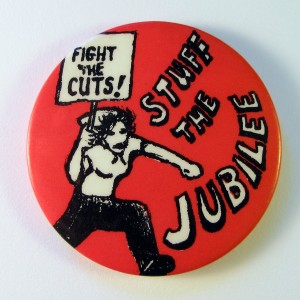
Unlike today, in 1977, there was a culture of opposition to the Jubilee and it was summed up by three words “Stuff the Jubilee”. Young people, in particular, who faced rising unemployment and public service cuts, headed the opposition to the royal nonsense. There were demos, gig ands, of course, the Sex Pistols and their single “God Save the Queen.”

Sherri Yanowitz produced the essential badge. “I designed it with Neil McFarlane. When I ordered 4000 badges from the Universal Button Company in Bethnal Green, they sort of laughed at me. The same company had the order for hundreds of thousands of pro-monarchy items. In the end we sold over 40,000 in less than three months.”.

So why is it in 2012 there is little opposition to the latest royal jamboree? Mike Luft, veteran anti-fascist and community campaigner, puts it down to a general political apathy in the country. “In the 70s and 80s there was a republican movement in this country. Nowadays people opposing the royalty are seen as extremists.” He believes that the media has successfully whitewashed the queen and the rest of the royals. “People are not aware of their wealth and privilege and what they did to get it. And it is an indicator of the low political consciousness of people.”

Louise Raw, historian and writer, agrees “Consensus seems to be, Oh bless her she’s an old woman/ her grandsons are lovely/ that Kate Middleton has some nice frocks. So it’s partly respect for her white hairs and partly that the Palace has finally won the media war it’s been desperately waging since ’97, to convince us all that the royals are hard-working, necessary – and ‘just like us’”

As a parent she has noticed how the whole jubilee farrago has been fed into the school system. “It’s interesting to see how it’s being forced down the kids’ throats in schools as well, even in Reception year (age 4 – 5).I don’t think it’s being taught in a nuanced or balanced way either. I had to dress my son (aged 5) in red white and blue for some jubilee party, and of course you can’t inflict your political views on them. So I had to do it with gritted teeth, and not give into my temptation to get a white t-shirt and stencil ‘Abdicate now (in favour of a democratic republic)’ or ‘Off with her head’ on it”.

Stephen Kingston editor of Salford Star, like many of his generation, were influenced by the Stuff the Jubilee events. “Unfortunately, I’m old enough to remember it and it was this anti-campaign that got me interested in politics, cos one of the papers called the anti-jubilee people “worms” and I thought I’m not a worm, I must find these people..and so a life on the left was born..the rest is misery.”

Living and working in Salford he says that there are plenty of anti-jubilee events. He thinks that in 1977 the media gave a bigger profile to the anti-campaign. “The Left were a lot stronger. The media just went hysterical in 1977 – particularly with the Sex Pistols. Maybe opposition to the monarchy doesn’t sell papers these days – the anti-Royal tunes are out there, there’s anti Jubilee badges and t-shirts – but no media reaction. Does that make the opposition different from ’77 .The Salford Star is certainly finding no shortage of alternative Jubilee stuff happening in Salford. The events aren’t angry, just ironic piss takes. The real anger is saved for the people doing the cuts”.

So, see you all in Salford! Here are some events to get down to…

Read the Salford Star

Buy from Campaign Badges

Relive the spirit of 77 – see the Sex Pistols on Youtube

Jubilee sick bags..I am not joking!.

If you have enjoyed this article and would like to support this blog by making a donation you can do using this button

Posted in anti-cuts, Socialism, TV drama | Tagged , , , , , | 1 Comment

Stop,Look,Listen! My weekly selection of favourite films, books and events to get you out of the house


WatchShoestring starring Trevor Eve as private “ear” Eddie Shoestring. He works on a Bristol based radio show and responds to the problems of his listeners. It was made in 1979 and has a very English style. Trevor Eve was fancied by all my girl friends when this first came out. He looked too much like my cousin to do anything for me, but he was a very likeable character and the scripts hold up today.

Read… Visitation by German author, Jenny Erpenbeck. A piece of German history tracing the life of a house and its inhabitants. Set in the Brandenburg forest we are taken through the history of the 19 and 20 century. Over seven decades we learn of a history of violence. A woman drowns and Jewish neighbours disappear, the Red Army takes over the house, a young man tries to swim to freedom in the West and so on. Jenny uses little dialogue, but creates a powerful story of loss; not just that of a house but of a country.

Go and seeThe Name of the Game by Bridgewater Theatre Company at the Nexus Art Café on 2 June at 8pm. Alfie has returned from the war in Afghanistan and is suffering from Post Traumatic Stress Disorder. Tickets £5 (£4 concessions) Tickets can be reserved for collection on the door at stevewaters17@gmail.com or by calling 07504635431. A collection for the military mental health charity ‘Combat Stress’ will be taken at the door on exit

Take to the streets
…to oppose work capability tests on the disabled and benefit cuts. Join the march on thursday 31 May at 12 from Albert Square in Manchester. Further details Manchester Coalition against the Cuts.

Look up…on 5 June, the Transit of Venus take place. Only four times every two centuries does the planet Venus pass between the Sun and the Earth. In 1639 Salfordian William Crabtree, self taught astronomer, was the first person to discover it. Due to the outbreak of the English Civil War his discovery was not recognised until sixty years later, long after he had died. Don’t worry if you miss the Transit because you can watch Eric Northey’s play of the same name in the 24/7 Theatre festival in July. Manchester Digital Lab is organising an event , more information here

Posted in anti-cuts, drama, novels, trade unions, TV drama | Tagged , , , , , , , | Leave a comment