Stop,Look,Listen…my weekly selection of favourite films, books and events to get you out of the house

WatchThe Master and Margarita(2006) Based on the book by Mikhail Bulgakov(1891-1940).Most of his work, including this book, was censured during his lifetime but it is now considered to be a masterpiece. This film adaptation is a literal depiction of the book. The director, Vladimir Bortko, used original 30s film in the film to give it authenticity, as well as amazing recreations of scenes from the book. Bulgakov was an exponent of the genre of magic realism and that is why having read the book I was amazed that anyone would try and recreate it. If you cannot get the film, read the book or see the Barbican’s production in december by theatre de complicite.
Tickets go on sale on 14 August.

Support your local…the Black Lion Salford was robbed last week and several people are doing fundraisers. On Friday 17 August, playwright Cathy Crabb and friends are donating a performance of the excellent play “The Bubbler” about the August riots of 2011. Starts 8pm at the Black Lion

Listen..Sailing to Byzantium (Trail Belle records 2012) by Christine Tobin.She takes the poetry of WB Yeats and writes the accompanying music. She has chosen some of his most beautiful poems and mostly it works well. One of them, “The Song of Wandering Aengus” has been covered much better by Christy Moore. Yeats was a bit strange around women and Christine also chose the poem he wrote about political activists Eva Gore Booth and Constance Markievicz which I think is a bit creepy. Most of the songs and music are excellent and she picked a winner when she got the lovely Gabriel Byrne to read three of the poems.

Celebrate...and commemorate the Peterloo massacre..there is a vigil on 15 August at 930PM in front of the G Mex/central Exhibition centre. A 15ft home made monument will be installed of an illuminated liberty cap, which was one of the icons targetted by the yeomen on the day. As well as bathing the pavement in the light of liberty, it will also feature the word LIBERTY in bright red letters.A candlelit vigil will follow until midnight. See

Manchester Trades Council are holding a social to commemorate Peterloo and raise funds for the TUC March in October. It will be held at the Radisson Hotel on 16 August at 730pm. The line-up will include singer Claire Mooney and comedian Dave Puller.see

Posted in anti-cuts, Communism, drama, films, human rights, labour history, Manchester, music, Salford, Socialism, trade unions, Uncategorized | Tagged , , , | Leave a comment

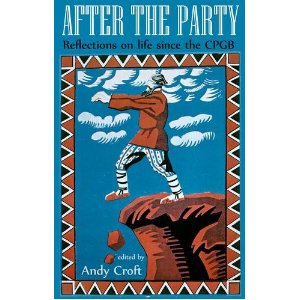
Book review; After the Party;reflections on life since the CPGB

After the Party, Reflections on life since the CPGB Edited by Andy Croft (Lawrence & Wishart) 2012  ISBN 978-1-907103-47-6

It is twenty years since the demise of the Communist Party, a party which the editor Andy Croft says, “was unlike any other in British politics. No other party enjoyed so much influence in the trade union movement, or in British intellectual and cultural life. At its peak the party had 60,000 members and during its life-time serveral hundred Communist councillors and 5 Members of Parliament were elected”.

In this book he, and seven other former communists, reflect on the reasons why they joined the party and how it changed their lives. It is a fascinating book, not just because it is interesting to see why some people become politically active and what it meant to be in the CP but also, now that the party is over, to learn where those people then chose to put their energies and commitment.

Mark Perryman, now of Philosophy Football, joined the CP in 1979. Like me he was at Hull University but, unlike me, chose the CP over the Trotskyists. He was particularly inspired by their political education at the annual summer Communist University of London. “One event I wil never forget was a debate between Eric Hobsbawn and miners leader Mick McGahey..it felt like the arguments and the people taking part really mattered….a recognition that the need to listen to each other was far more important than the issuing of the “line” for others to follow.” Academics like Hobsbawn are now few on the ground and it would be hard to find a trade union leader with the grit and intellectualism of McGahey, much less to get them to engage with the reality of peoples’ lives today.
Alistair Findley, who was involved in the Scottish CP, recalls one of the distinct features of the CP: putting the involvement of working class people at the heart of its politics. “In 1971-73 to hear Mick McGahey and Jimmy Reid’s brilliant oratory at mass public demos….eloquent,funny,pugnacious, intelligent, unkind to Tory governments. ..the public face of Scottish marxism….just working class auto-dictats, informed, combatative, no prisoners taken.”
Dave Cope echoes the lack of snobbery in the CP towards working class members. “Membership of the CP, with its encouragement of discussion,reading,debate and attention to cultural affairs was an education of a life-enhancing nature for many workingclass activists.”

Many of the contributors in the book comment on the internationalism of the party. When Lorna Reith joined she was offered the choice of either the roles of Morning Star organiser or Chile Solidarity campaign representative. After choosing the latter, she travelled to Chile in 1986. “Being part of an international movement was always part and parcel of being in the CP. Branch discussions would almost always include updates and views on what was happening elsewhere in the world”.

But by 1991 the Party was in decline and its membershiphad fallen to less than 7,000. Any hopes of a reformed communism were too late, as Mark Perryman explains; “With the Berlin Wall crashing around our Communist ears, the horrors of the Chinese Tiananmen Square massacre in the summer and ..the ousting of Rumania’s brutal Ceausescu.”
Dave Cope feels by that time the party was out of touch with politics on many levels. “The constitution had become unreal, its medium term programme utopian, class was no longer the sole defining function in politics,Lenin was seen as irrelevant and the party did not advocate any existing model of socialism.”

Since 1991 it is as if the CP never existed and their successes are ignored or deleted from the history of the 20th century. As Andy Croft comments “The 1936 Jarrow March is remembered but not the six much larger Hunger Marches organised by the CP-led National Union of Unemployed Workers.”

Some of the contributors who seem the most distressed by the end of the Party are now in the Labour Party, which rebranded as New Labour became the antithesis of what the CP stood for. Ironically Lorna Reith’s chaper is titled; We will rebuild our country ten times more beautiful. She is now the Deputy Leader of Haringey borough in London and is in the process of making Haringey a much uglier place by making millions of pounds of cuts.
I was never a member of the CP, but through my friendship with Ruth and Eddie Frow from 1981 I saw the uniqueness of its political culture and the value put upon its working class and international roots , while the genuine humanity of many of its comrades was impressive.

After the Party reflects the good and the bad in the CP and is an important contribution to the debate as to why its existence and history has been ignored or forgotten. It also asks important questions about why working class people are now so disengaged with the political process, and what we, as socialist activists,are going to do about it?

If you have enjoyed this article and would like to support this blog by making a donation you can do using this button

Posted in book review, Communism, human rights, labour history | Tagged , , , | Leave a comment

Stop,Look,Listen…my weekly selection of favourite films, books and events to get you out of the house

Watch. Salute..these days Olympic sportspeople are no different from celebrities and little is left of the ethos of the Olympic message. But in 1968 three men used the winning stand to express their opposition to racism and discrimination. The 1968 Olympics are now famous for the host country Mexico killing 2000 students in the city, whilst in the Olympic arena two American black athletes gave the black power salute. This film reminds us of the third man on the podium, Australian Peter Norman, who went along with the protest and, like the Tommie Smith and John Carlos, put his life at risk by doing so. In Australia at the time, like in America, Aborigines faced racism and discrimation, and there was a “white Australia Policy”. But a campaign raged in the country, waged by Aborigines, students and liberals, to demand equality for the original Australians. As the “white man” on the podium Norman represented all those people who opposed injustice across the world. After returning to Australia he was blacklisted by the sporting authorities and many people forgot about his role in the protest. His nephew, Matt Norman, made this film in 2006 which reminds us of the importance of standing up what is right and as Matt Norman says “ALWAYS STAND AGAINST INJUSTICE!” See

Look..Demon Drink, Temperance and the Working Class, an exhibition at the People’s History Museum in Manchester. We are used to health messages telling us that drinking is dangerous, whilst at the same time the government makes it easier and cheaper to buy and consume alcohol. I wonder why…something to do with the economic decline and keeping us quiet? This exhibition shows us that there is nothing new about people drinking excessively and other people trying to stop them. The north-west was the birthplace of the Temperance Movement in which people took the pledge not to drink alcohol although few people know of this history. In Demon Drink we can see why people were concerned about drinking and what the Temperance Movement did to promote abstinence including providing a culture and social activities based around enjoyment without alcohol, such as temperance beauty parades,lessons,games and sporting events. There were even trades unions such as the Dockworkers and Railwaymen that had temperance sections. It is a fascinating exhibition and, whilst you might think some of the ideology is based on middle class people stereotyping the working classes as the drinking classes, there are some interesting points made that are as relevant today as during the heyday of the Temperance Movement.see

Read..The Manchester Man by Mrs.G.Linnaeus Banks in 1876. One of my favourite books and I have bought this for many of my friends and visitors to the city. It is a book that is much loved by people in the north-west. It is a story of 18th Century Manchester, and of those who benefitted from the prosperity of the development of the city and those who gained little. It is a very moral story and a real adventure story. Some of the names are still familiar today eg Jabez Clegg, an orphan who becomes an apprentice, and then rises through society to become an important figure in the new commercial life of Manchester.

Know about..Shaker Aamer…he has been in Guantanamo for 10 years. He has been tortured,imprisoned and detained without trial. Although now cleared of any crime he is still stuck in Guanatanamo in a nightmare limbo. Spectacle have made a film about Shaker to promote his campaign see video on Shaker Aamer and sign the petition

Posted in art exhibition, book review, films, human rights, labour history, Manchester, novels, Uncategorized | Tagged , , , | Leave a comment

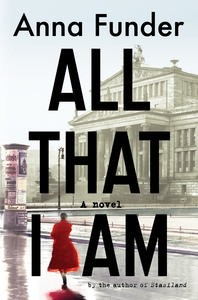
Book review; All That I Am by Anna Funder

For those of us who are active in anti-fascist struggles, whether in our community, in the workplace or on the street,  the spectre of the rise of the Nazis in Germany in the late 1920s is always there. It is the reason why many of us feel that opposing any aspect of fascism is important in our lives. Few of us can imagine what it must have felt like for  socialists, when Hitler did come to power in 1933.

In this fictionalised account, based on real people, Anna Funder has recreated the lives of the women and men who opposed Hitler, and,  most importantly,  were part of a movement that decided to fight  one of the most ruthless regimes in the 20th century. The novel  tells us about four close friends and comrades as they react to a politics that drives them first  underground,  and then out of their own country. The story is told through Ruth,  an elderly woman, living out her last days in Australia and through Ernest Toller,  who escapes to New York after five years in prison in Germany.

For me Funder’s recreation of the 20s and 30s Germany is fascinating, and in particular,  the role of Dora (based on the real activist Dora Fabian),  as she gets involved with the socialist movement. At 17 she is leafleting munition factories to oppose Germany’s involvement in the First World War. By  1925 Dora is speaking at a meeting to defend abortion rights. Through Toller we hear her words; “A law which turns eight hundred thousand women into criminals every year is no longer a law. …You are looking at the face of an outlaw.”

Dora, her cousin Ruth, Hans and Ernest Toller are members of the socialist movement which briefly took power in 1919. But as the right wing take back power they find that they are now the target. Toller says about Hitler; “He’s made a list and he is working through it.”

Ernest Toller  looks back at his life as he sits in a New York hotel in 1939. He recalls how in 1919, when  a  communist government is elected in Bavaria,  he saw Hitler watching them; “this man seethed at Germany’s defeat,denied the Kaiser’s responsibility for the war and its loss. Instead he blamed progressive Jews, pacifists and intellectuals for bringing Germany to her knees.”

Eventually all four comrades are forced to leave Germany and live the life of refugees in England. For middle class socialists it is a shock; ”We had all spent years talking about the working class,but as I looked around this little place with its low, plain ceilings and tiny rooms I realised that we hadn’t ever, really known how they lived.”

In the 30s several hundred German activists fled to England,  but were only allowed the right to stay on the basis they did not take part in politics. This  meant  they were not meant to raise  uncomfortable issues such as Hitlers’ persecution of opposition activists and his plans for war. Through the four characters we learn how they did in fact  carry  on this political work, although constantly  fearing deportation back to Germany and certain imprisonment and death. They become in effect  prisoners in their flat and eventually end up fearing each other as their flat is raided and they are hounded by Nazi supporters. Their friendships  fray as the political situation deteriorates.

In All that I Am Funder has reminded us of the tremendous struggle that German socialists put up against Hitler, both at home and abroad. It shows how cowardly the British government was in the face of Hitler’s plans to wage war,  and that far-seeing intellectuals such as Fenner Brockway were marginalised and derided in their attempts to tell the truth about what was happening in Germany. Although this book is written about a specific point in history,  it is a reminder to all of us of what the consequences can be if we allow our democratic rights to be destroyed.

If you have enjoyed this article and would like to support this blog by making a donation you can do using this button

Posted in book review, Communism, human rights, novels, Socialism, Socialist Feminism, women | Tagged , , | 3 Comments

Stop,Look,Listen…my weekly selection of favourite films, books and events to get you out of the house

Watch...A World Apart (1988) Written by Shawn Slovo, the daughter of S.African Communist activists Ruth First and Jo Slovo. Molly, a 13 year old living in Safrica in 1963 is the daughter of political activists who oppose the apatheid government. As the government closes down opposition parties she witnesses the effect it has on her home life. Her life closes down around her as her father flees the country and her mother is imprisoned. This is an important film because it explores the dilemmas for political activists who are also parents. It asks questions including should your children come second to your politics and through the main character in the film it shows the price that children play in the larger political story of causes such as the Anti-Apartheid Movement in Safrica. Of course the Slovos were privileged children and could escape to Britain but Ruth First who fled to Mozambique was assassinated by the S.African regime in 1982. In post-independance Safrica Joe Slovo, in 1994, became the Minister for Housing but died in 1995.See

Read..The Master and Margarita by Michael Bulgakov. He was born in Kiev in 1891.Trained as a doctor, he took part in the First World War and the civil war in Kiev and the Caucasus. These experiences had a profound effect on him and he became a writer and produced books and plays, many which were censored. Most of his work is satire and that is why, particularly during Stalins’ era he had little work published. This book was recently dramatised by Complicite theatre in London and singer Patti Smith was inspired to name her new album Banga after Pontius Pilate’s dog in the Master and Margarita
The novel is completely surreal. It is set in Moscow in the 1930s (so lots of references to the politics of the period) as the devil, disguised as a magician, enters the city with his talking cat and expert assassin. The action switches between Moscow and first century Jerusalem and the reader is introduced to many characters that confuse, surprise and make one smile. Bulgakov took eleven years and many drafts to complete the manuscript and it was not published in his lifetime. It is now considered one of the most important books of twentieth century Russian literature and has been translated into twenty languages further info

Look.. Harry Rutherford (1903-85) was an important artist in the Northern School which sought to depict the post industrial landscape of north-west England. He trained with Walter Sickert and later went on to become the first artist to have his own television programme. A new exhibition, at the Central Art Gallery in Ashton-u-Lyne, called Pocket Pictures shows drawings that have never been displayed publicly. Interesting to me is his insight into political events in the Tameside area including a sketch of a soup kitchen in Mossley in 1929 and a painting of a recreated scene of a Chartist Meeting in Hyde in the 1830s. The exhibition is fascinating and also revealing about events that have largely been forgotten. Further info

ListenThe War Symphonies..Symphony no 7 in c major Leningrad (Shostakovich) conducted by Valery Gergiev and the Kirov Orchestra.Shostakovich dedicated this symphony to the struggle against fascism and his home city of Leningrad. It became a worldwide symbol against the Nazi regime and today is a beacon of light to all political activists who seek to oppose fascism. Shostakovich understood the importance of politics to artists ”The Soviet artist will never stand aside from that historical confrontation taking place between reason and obscurantism, between culture and barbarity, between light and darkness.” A message for all activists in the 21 Century.

Posted in art exhibition, book review, Communism, drama, films, human rights, music, novels, Socialism, Tameside, Uncategorized | Tagged , , , , , , | Leave a comment

Book review; Behind the Lines by Michael Crowley

Behind the Lines; Creative Writing with Offenders and People at Risk – Michael Crowley Waterside Press
ISBN 978-1-904380-78-8

There is a treasure in the heart of every person if only you can find it (Winston Churchill)

Micheal Crowley has been working with young offenders and people at risk for 15 years. This book he says; “is a book about getting people to write and writing with them, and what that teaches us both.” Written for professionals who work with offenders and people at risk, it shows the process of oral and writing warm ups from writing exercises through to text and from rehearsal through to performance.

He has worked with teenagers in a variety of settings in the education service, the criminal justice system and as a writer. He was interested in writing drama and used some of the characters and scenarios he came across in his job as an education worker. It was when he became a youth offending officer that ; “I decided I wanted to use young peoples’ writing to get to know the individual under my supervision, and as ambitious as it might seem, as a basis for making the changes I was supposed to.” He is now a writer in residence at a Youth Offenders Institution which is funded through the Writers in Prison Network.

Mike explains how the book started. He was working with a girl from a violent background and her response to his role as a YOT officer was to present him with a poem. As he says; “Giving me the poem was the greater act of trust. So I decided to ask for more and from other youngsters.” This led to him producing four collections of young people’s writing at the YOT and “many of the pieces, the best pieces are monologues in the voices of imaginary and detailed characters, a gestation,a gender away”.

It is not just a practice book, running through it is a discourse about the prison system and the way in which this society criminalises, largely poor, largely working class young people from many backgrounds. Michael challenges the very negative stereotypes that domainate about these young people and in this book and through his work makes us, the person outside the criminal justice system, listen to their voices. “I will often begin a session by asking “Why are you in jail? Many will instinctively reach back years into their upbringing…The current swing away from social determinism towards individual responsibility does not have to be at the cost of insight…there can be little possibility of a different future without it”.

Michael is not unaware of his role in the prison system; “I am into my fifth year now and, like many of the young men I see come and go, I’m convinced it will definitely be my last stretch”. And the future for the valuable work he does is not certain as public spending cuts bite and there is less opportunity for working with individuals and small group work with offenders. Funding for the Writers in Prisons network has been cut and there is now a campaign to continue its work.

The riots of 2011 were not a surprise to many people working with young people. Michael believes that “working or living in a jail you require a sense of an ever increasing volume of young men habituated to crime, schooled in a dog eat dog Britain”.

In his work with the young people jailed for taking part in the riots he says that they are easier to work with and better educated. And their reason for being in the riots; “as a form of anarchic protest and went along out of fascination, to take photos or otherwise support some kind of inchoate rebellion.” He doesnt believe that their motives were purely politicial but that the riots could have happened under any government at any time over the last years.
.
Michael believes that his work can have many results. By encouraging young people to write it can “be a means to address not only literacy but therapeutic needs, moral reasoning,offence-focussed thinking and all at the same time.”
He feels that creative writing should be encouraged and built upon to address offending.

In Beyond the Lines he addresses some of the major problems affecting our society particularly as the government chooses to cut the public services and gets all of us to pay for the criminality of the bankers.

Read Michael’s new poetry book Close to Home published by prolebooks
Contact Michael via his website
His new play The Cell, catch at the 24/7 Theatre Festival on 27 July at 6pm  and it then goes to The Unity Theatre Liverpool for 4th and 5th September.

If you have enjoyed this article and would like to support this blog by making a donation you can do using this button

Posted in book review, drama, education, human rights, poetry, Socialism, young people | Tagged , , , | Leave a comment

Stop, Look,Listen…my weekly selection of favourite films, books and events to get you out of the house..

Watch...Nostalgia for the Light a new film by Chilean director Patricio Guzman. He contrasts the beauty of his home countrys’ Atacama desert and its hidden history of concentration camps and Pinochets’ regime. The desert has some of the most wonderful landscapes and the world’s largest telescopes but also women who are now in the 70s trying to locate the bodies of their families who were tortured, killed and buried somewhere under the ground. Guzman, who left Chile in the 70s, in the film shows us not just the terrible history of his country but how astronomy can, like the political prisoners in the desert, confirm our humanity against a political landscape of terror. See Guardian Chile through the Landscape

Read..Hannah Maria Mitchell;Radical Suffragist by Bill Johnson. Hannah was an extraordinary woman who was born in Derbyshire in 1871. Her education only lasted a week, she left a violent home in her mid-teens and worked in sweatshops most of her life. Her biography, now out of print, sums up her life “The Hard Way Up”. But she was a suffragist and rebel who took part in the campaign for the vote, was a socialist and member of the radical,grassroots organisation, the Independant Labour Party. Bill Johnson wrote this pamphlet because he could not get Hannah’s biography republished. Hannah’s secret ambition was to be a writer and here we can read some of her own stories and articles as well as look at photographs of where she was born and of her husband and son. The pamphlet is a bargain at only £4, available from Tameside Local Studies and Archive.

Listen...Nimissa(regrets) by Ba Cissoko. Ba is originally from Guinea but now lives in Marseilles. He uses the kora as a basis for his afro beat sound. His fourth album is a mixture of funk and groove, melodic and rhythmic. It tells us stories about his home, in Loumo of the weekly African market and in Politiki he lambasts Guinean politicians who are destroying the country.Ba is a skilled songwriter and in his latest album has produced a fascinating mixture of Mandingo tunes with salsa, rumba etc.etc.

Visit...the idiosyncratic Portico Library on Moseley St. in Manchester. Opened in 1806 it is a private, subscription based library but it is open to the public to view its 19 Century collection. There is a wide selection of travel literature. novels,biographies and history with a number of first editions. To celebrate Dickens year it has an exhibition called “Charles Dickens;Children and Childhood in His Life and Works”. It features a number of first editions of the author’s novels as well as illustrated children’s adaptation, graphic novels and translations. Its worth just going to look at the Library and a wonderful “oasis of calm in the heart of the city”.

Posted in human rights, interesting blog, labour history, Manchester, music, Socialism, Socialist Feminism, Tameside, trade unions, Uncategorized, women | Tagged , , , , | 1 Comment

Book review; Socialism with a Northern Accent……

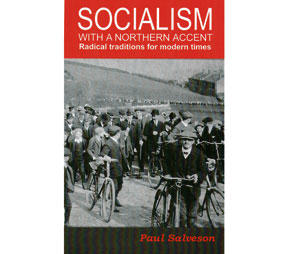
Socialism with a Northern Accent; Radical traditions for modern times by Paul Salveson

Lawrence & Wishart ISBN 978-1-907103-39-1
 
In 1998 at the Brit awards the anarcho punk band Chumbawamba attempted to throw a bucket of water over John Prescott and Cherie Blair/Booth. They said at the time: “If John Prescott has the nerve to turn up at events like the BRIT Awards in a vain attempt to make Labour seem cool and trendy, then he deserves all we can throw at him”. John Prescott (and Cherie B/B) epitomise the worst in terms of working class people who have gained money and power and then peddle a stereotyped view of what it means to be working class.

In his introduction Prescott,or rather Lord Prescott, plays on his long forgotten (and ditched)working class background to extol the virtues of the last Labour government, whilst forgetting to mention that many of the policies that the Con/Dem coalition are following were originally New Labour policies. He may hope that he can use the past to rescue the Labour Party at the next election, but the voters will not be so easily conned.

Paul Salveson, Labour party councillor and Member of the British Empire, is quite clear about his agenda for this book. “Socialists – be they Labour Party members,Greens or non-aligned radicals – should have an awareness of their heritage that can help inspire campaigning today”. He says the book “draws on examples of radical politics and culture in the North over the last two hundred years that are, to a greater or lesser degree,distinctive to the region, and have lessons for us today.”

Salveson concentrates on the north because, he argues, “Labour needs to cultivate a patchwork of regional and national identities, both political and cultural, as part of a wider “Britishness” celebrating a diverse,confident and progressive Britain of regions and nations.” For northern he means North West, Yorkshire and the Humber and the North East. And that word “socialism” again, only this time with a “northern accent”.

Salveson traces the struggle for democracy within movements such as Peterloo and Chartism and places it within the distinctive history of the north. He introduces characters such as Thomas Newbiggin, a radical Liberal and shows how in the 1880s there was a radical Liberal political culture. It’s hard to believe this when the present day Lib Dems find it easy to get into power with the Conservatives.

Salveson explores the growth of the trade unions and alongside it progressive organisations such as the Social Democratic Federation, the Independant Labour Party(ILP) and the Labour Party.

A large chunk of the book extols, quite rightly, the important role that the ILP played in improving the lives of workingclass people. It was founded in 1893 in Bradford and “the acheivements of scores of ILP councillors at the municipal level were considerable – free school milk,improved sanitation,municipal lighting,council run tramways,”fair wages’ clauses in council contracts and council housing”.

The ILP was not just a political party, it was a way of life with socialist education,journalism, music and art. However, by 1932 the Labour Party had changed from a community,grassroots organisation to an electoral machine and the ILP severed all links with the party.

It’s the template of the ILP that Salveson sees as the future for the Labour Party. “Can Labour recapture some of the radicalism and passion which informed the early years of the ILP and the Clarion Movement”. This book is essentially about how they, the Labour Party, can re-fashion itself for the next general election. However, he fails to address the reason why they lost 5 million voters between 1997 and 2010. One has only to look at the early days of the New Labour Government and their harsh treatment of single parents on benefits, the use of ASBOs against largely, poor working class young people, the privatisation of elderly social care…I could go on. It was not just that they looked down upon their own voters but that in power they flaunted their wealth and power with their celebrity mates.

This is very much a nostalgia fest as Salveson returns to Bradford and the ILP birthplace as a good model of a Labour council. Clearly , he did not really know what was going on there as shortly after he published this book George Galloway and the Respect Party swept the Labour party aside to grab power at a national and local level.

It is interesting that Salveson MBE and Lord Prescott still consider themselves to be socialists and belive that there are socialists still in the Labour Party. But it is clear that the people that he lauds in the book would be horrified if they saw what the Labour Party had done in their 13 years of government and would quite rightly line themselves up with everyone outside of the Labour Party.

One of the reasons that Labour face an uphill struggle to regain its working class roots is that people are so disengaged with the political process and in particular young voters. Many young people are active in social movements such as UKUncut and Occupy where there is no hierarchy of old men to tell them what to do. They have created their own communities, some of which have similarities to the radical culture of the ILP, but they see power in a completely different way from electoral politics. They are the ones, not the Labour Party, to quote the subtitle of this book, who truly have “radical traditions for modern times.”

If you have enjoyed this article and would like to support this blog by making a donation you can do using this button

Posted in book review, labour history, occupy, Socialism, Socialist Feminism, trade unions | Tagged , , , , , , , | 1 Comment

Stop, Look,Listen…my weekly selection of favourite films, books and events to get you out of the house..


Watch..new drama at 24/7 Theatre Festival in Manchester. 10 new plays by new writers. Topics vary from The Cell a collaboration with writer-in-residence, Mike Crowley at Lancaster Farms YOI and young offenders and prison warders to Eric Northey’s drama about the Transit of Venus in 1639. There are free events such as a script in hand reading of Ian Winterton’s play Sherica which won Manchester Theatre Awards 2011 as well as workshops with playwrights and actors. Further details.

Look....the radical response to the Jubilee. A new exhibition, Jubilee: the radical tradition, opens today at the Working Class Movement Library, curated by Jen Morgan. The exhibition uses the Library’s collections to trace the radical use of ‘jubilee’ alongside the royalist use of the term. It runs until September. See

Read... Goya by Robert Hughes. Hughes is one of the best art critics in the world and in this book he explains why Goya is one of his heroes. Goya was a pacifist and in some of his paintings he expresses all the horrors that come with war, not in a voyeuristic way but in a humane and compassionate style that firmly takes the side of the oppressed. Hughes says that Goya was the first modern visual reporter on warfare. See what you think, the book is fascinating, personal and thought provoking. See

Listen.Rumba Angelina by Radio Tarifa. A mixture of Arabic,Flamenco and medieval music with the wonderful voice of lead singer Benjamin Escoriza. Sadly he died on March 8 2012 at the age of 58. See

Celebrate. playwright,Lydia Besong and Bernard Batey’s success at getting leave to remain in this country after a national campaign to stop them being deported.Funds raised will go towards paying their legal costs. Event is on 26 July, 730pm at Unique, formerly Platt Chapel, Wilmslow Rd, Manchester. £5 entrance.Further info

Posted in art exhibition, book review, drama, Manchester, music, Salford, Uncategorized, women | Tagged , , , , | 1 Comment

Classic LPs; The Spirit of Freedom by Christy Moore

In the 1980s concerts by Christy Moore and the Wolfe Tones gave the Irish community somewhere to express their solidarity with the Republican movement. The venue was often the International club in Longsight (a largely Irish part of the city) which had seen better days but on those nights it was bursting with the Irish of all ages: my dad was in his 70s when he joined us one night to see the Wolfe Tones. People would decorate the balconies with Irish flags and there would always be the Irish anthem played at the end of the evening.

The Republican Hunger Strikes of 1980 and 1981 had enraged the Irish community across the world. In 1976 the Labour government tried to treat the situation in the North of Ireland as a security situation, rather than a political one and withdrew political status from republican prisoners. Previously they had been able to wear their own clothes, have free association, did not have to do prison work, could undertake educational activities and the prison authorities recognised their command structure. The men at Long Kesh (later the H-Blocks) and the women in Armagh Prison refused to wear prisoner’s clothes and sat in their cells in a blanket. Their visits from relatives were stopped and they lost remission. The action escalated as prison warders beat the prisoners who reacted by refusing to leave their cells and smeared their excrement on the walls. Tensions rose as publicity about brutality and torture by British forces was circulated, whilst the IRA started killing prison warders.

Outside the prison a national and international campaign began in 1979. It was led by the National H Block/Armagh Committee on which Bernadette Devlin was a leading member. On 27 October 1980 the men in the H-Blocks decided that a hunger strike was the only way to achieve their aims with Sinn Fein and the IRA reluctantly supporting them. Following negotiations with the Tory government the first hungerstrike was stopped, but there was no resolution. On 1 March 1981 Bobby Sands started a new hungerstrike followed by other men at regular intervals to pressurise the British government.

On 9 April, amongst enormous political tensions, Bobby Sands was elected as MP to the House of Commons for the constituency of Fermanagh and South Tyrone. The death of Bobby Sands on 5 May led to widespread rioting across Northern Ireland in which British soldiers killed people. Over 100,000 people attended his funeral in Belfast. Nine other men died by the end of September and, with no signs of political concessions from the Tories, parents and families intervened to stop other hunger strikers dying. The hunger strike was halted on 3 October after 217 days, the British government seemed to have won. Yet over the next years all the prisoners demands were quietly met and they gained a great deal of autonomy in the running of the prison. Ironically Loyalist prisoners gained the same rights. At the same time Sinn Fein began winning seats on local council and in 1983 Gerry Adams begame the MP for West Belfast.

In Britain the hungerstrikes politicised a new generation of Irish people, including myself. Whilst Thatcher and the Tory Government were supported by the Labour Party leadership an angry national and local campaign to support the hunger strikers was started. As well as rallies in Manchester,London and Birmingham every time a hungerstriker died we would meet outside Chelsea Girl in Piccadilly carrying black flags and give out leaflets. We often met with abuse.

In 1981 the Irish in Britain Representation Group was set up. It reflected the growing numbers of Irish people who were no longer prepared to remain silent about human rights abuses in Ireland and against the Irish community in Britain.

Christy Moore was born in Kildare in Ireland on 7 May 1945.He is hugely popular in the Irish community in Britain because his songs reflect our lives. He supported the republican H-Block protestors in the 1970s and 1980s with the album H-Block in 1978 and the launch was promptly raided by the Irish Special Branch.

In 1986 he brought out Spirit of Freedom. “This album came about as the result of a trip I made to H Blocks. I left the Falls Road in a van that was clapped out. It was used daily to ferry prisoners’ families to and from the camp. I got the idea to try and raise money for a new van and that was the purpose of this album” says Christy.

The album is the stories of the hungerstrikers and most poignant is Christy’s homage to Bobby Sands in “The People’s Own MP”. Also included is a song written by Bobby Sands called “Back Home in Derry”. It also links up Irish struggles with the experience of Mexican workers in the USA in Woody Guthrie’s “Deportee”.

Listening to the album in 2012 it is of its era, but shows how important music and songs are in documenting the history of a people’s struggle. In May this year people in Ireland commemorated Bobby Sands life and death. And today Christy is still out there singing and championing the rights of people whether it is in austerity Ireland or the Palestinian cause.

Check out what Christy is up to by visiting his website

Read Michael Herberts’ The Wearing of the Green for the history of the Irish in Manchester for more information visit his website

For information about Bobby Sands visit this website

If you have enjoyed this article and would like to support this blog by making a donation you can do using this button
Posted in human rights, Ireland, Irish second generation, Manchester, music, North of Ireland | Tagged , , , , , | Leave a comment