Stop,Look,Listen…my weekly selection of favourite films, books and events to get you out of the house

Watch….Berberian Sound Studio….a strange but haunting film with a homage to Italian horror giallo films. Set in the 70s,  Toby Jones plays Gilderoy,  an audio engineer who usually makes films about nature. Suddenly he is in Rome working on a cheap, sordid horror film. There is more drama going on in the studio than on the film and Gilderoy’s sense of reality and distance between the film and his own life disappears. The film is so strange that it is hard to work out what is happening and how it is going to end. The soundtrack is by Uk band Broadcast and during the film we are transported back to Gilderoys’ home, a pastoral scene, and the music of Vaughan Williams. It has got to be one of the most original films this year.

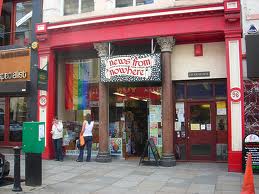
Read….The Milkman in the Night by Andrey Kurkov…set in Kiev where several residents are suffering from sleepwalking. We are in the world of post-Soviet gangsterism, where  alcohol is the solution to daily and nightly life. There are many nods to Michael Bulgakov’s Moscow as a cat plays the role of avenger against the gangsters. Absurdism runs riot as cases of strange drugs appear, wives refuse to bury their dead husbands and there is a trade in human milk which leads back to the local oligarchs. This is Kurkov’s seventh novel and he is also a journalist and commentator on Ukranian politics. Buy from News from Nowhere

Visit…3 Minute Theatre…..based in a shop unit in Affleck’s Palace in Manchester. The only non-public funded theatre in the city run by  genial hosts Gina and John, who say ” we are dedicated to the development of emerging local talent and premiering the best new work Manchester has to offer.” See website for next week’s productions.

Learn…….. about global warming in Library Theatre’s new production of the Heretic. this is a  a comedy about a scientist who goes public with her doubts about the science of global warming. It won  London’s Evening Standard award for best new play in 2011 and looks to be one of the more interesting and controversial plays that we will see in the established local theatres this year. It is on at the Lowry theatre from 27 Sept-13 October book here

Book for…….TUC demo on 20 October in London. Say no to the Government and its cuts agenda and book your transport at

Demonstrate….Action on Abortion demo on 29 September, the International Day for the Decriminalisation of Abortion. Sadly, once again in London , for more information see

Posted in anti-cuts, book review, Communism, drama, films, human rights, Manchester, music, Socialist Feminism, trade unions, Uncategorized, women | Tagged , , , | 2 Comments

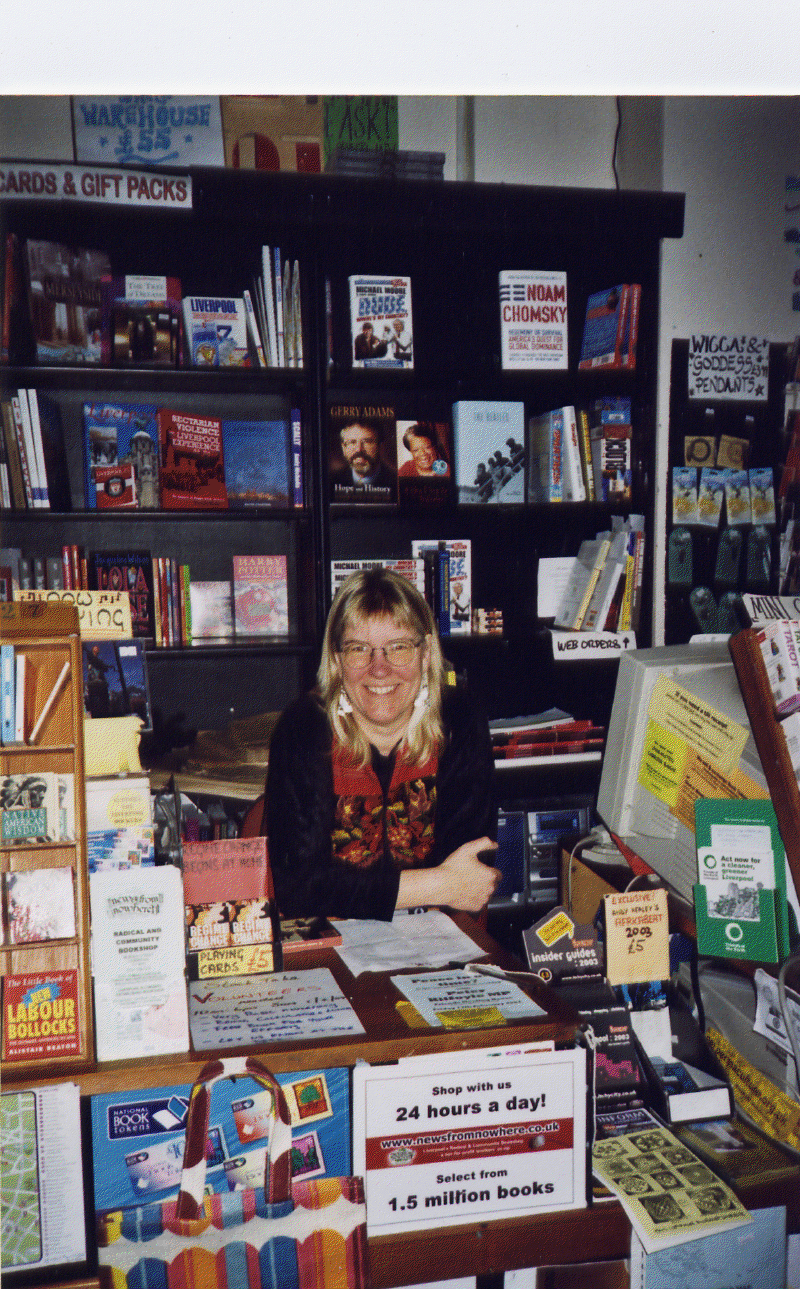
Political Women (2): Mandy Vere

Feminist, campaigner for social justice, mother of 2 grown up children, radical bookseller………..

Mandy Vere was born and grew up in Stockport. Her parents were Quakers and socialists, activists of the Labour Party:

I grew up in a Quaker household and it had a big influence on me and my sister. The community was all around me and their ideas of pacifism and social justice have stayed with me all my life.

Aged just 17, she went to Belfast to take part in a Quaker work camp. This was at the height of the conflict between Republicans and the British state:

I didn’t know anything about the politics of Northern Ireland. I learnt so much and my experiences there were very influential on my politics throughout my life.

On her return Mandy went to Liverpool University but dropped out in the first year, preferring to get involved in radical politics. Previously she had been involved with the Non Violent Direct Action Movement and she now joined the British Withdrawal from Northern Ireland Campaign

Supporters of the BWNIC leafleted soldiers giving them information on their rights to conscientious objection. At this time there were soldiers who were deserting the army rather than serve in Northern Ireland. The government charged14 BWNIC members with conspiracy to disaffection over their actions. A number of these were from Liverpool and Mandy became involved in their defence campaign. All 14 were eventually found not guilty:

It combined my interests in pacifism, non- violence and the Irish struggle. The defence campaign allowed us to raise lots of issues about the occupation of N. Ireland and militarism.

The 1970s was also the beginning of a new wave of the women’s movement and Mandy became very involved;

It hit me like a joyful barrage. It was so exciting and exhilarating to be involved at that time. There were lots of small groups discussing our experiences as women and out of that a movement grew. It showed us that as women we were repressed and that we could provide a body of evidence to prove this.

This level of discusions and conscious raising is something that Mandy feels is missing from the latest wave of feminism;

In those days we did discuss class and race and learn about other people’s experiences. I think that the latest feminist groups have grown out of universities and therefore tend to be quite middle class.

Mandy combined her interests in feminism and Ireland by taking part in some of the big campaigns of the early 80s:

I got involved with the Women and Ireland group and campaigned against stripsearching, the Prevention of Terrorism Act and organised delegations to Northern Ireland. It was a hard time because there was so much anti-Irish racism in England.

Underpinning Mandy’s politics has been her involvement in the radical bookshop News from Nowhere:

“ I started working in NFN in 76 and my politics have run parallel to my work in the shop. I had my kids in the 80s and that, with the bookshop, has meant that I haven’t had the time to put my energy into having a direct role in campaigns.”

Like many activists who have children Mandy had to make decisions about how and where she put her energies:

It was a big change for me becoming a Mum and I became more focussed on my child and my home life. But it also made me aware of how little power young people have. It is the last big liberation movement. Young people do not have a voice or any way of expressing themselves. Parenting is the most important job in the world in bringing up the next generation .

Mandy feels that the Occupy movement has given young people the opportunity to express their feelings and get together with other individuals and groups to campaign for change:

Occupy in Liverpool had lots of young people involved who were willing to be out in all weathers and be passionate about their politics. I went down to their base and brought them blankets and had this young lad teaching me about capitalism. It was great! I loved it and they were so brave

In 2012 Mandy is still involved with NFN and the bookshop gives her the opportunity to be involved in making connections with a diverse range of campaigns and community groups;

It allows me to combine cultural and political issues. As an independent bookshop we can react to local, national and global campaigns. Recently in response to the Pussy Riot trial in Russia we organised a dramatic rendition of their testimony at the shop. It was picked up by local radio and we were able to raise consciousness about feminism, freedom of speech and Putin’s Russia.

NFN is facing a major challenge from online retailers such as Amazon who dominate the bookselling world and can aggressively discount not just books but many other items. Mandy is calling on lefties to appreciate traditional bookshops such as theirs, who can offer an online service including accessing every book in print, browse recommended booklists and order online.

“If people on the left do not spend their money in our bookshop, then we will disappear. In other words shop with the real Amazons!”

And Mandy’s advice for young women today?

Be yourself. You can learn from older women and feminists but you will always do it differently. Don’t ever believe you are not having an effect. I really admire young women activists because there is lots of repression now. It is different, in the 70s the movement for change was much more mainstream and campaigns such as Greenham Common did get publicity and produced a debate. Nowadays the media has such a stranglehold . I think UKUncut are one of the best things that have happened recently, particularly in the way they have used the new media to organise themselves.”


“I am hopeful about the future. I look at my daughter, who doesn’t see herself as political, but she takes for granted all the things we fought for. She spoke out at work and organised against a bullying boss. There are lots of young people who are willing to speak out and there is much to be optimistic about in the new wave of feminism.

If you have enjoyed this article and would like to support this blog by making a donation you can do using this button

Posted in anti-cuts, human rights, Ireland, labour history, North of Ireland, occupy, political women, Socialism, Socialist Feminism, women, young people | Tagged , , , , | 1 Comment

Stop,Look,Listen…my weekly selection of favourite films, books and events to get you out of the house

WatchSalvador Allende a film made by Chilean director Patricio Guzman. The film documents the struggle within Chile to establish a left government, headed by Salvador Allende. His government strove to give the economy back to those people who created the wealth, which included an agrarian reform policy and the nationalisation of the major utilities. Allende was one of the first people to call for an opposition to the growing power of multinationals. In a coup, similar to that by Franco in 1936, the left were defeated and General Pinochet destroyed democracy in Chile for decades. The Manchester Film Coop and Manchester Zapatista Solidarity Group are organising the showing and it will be followed by a debate on ethics and politics. Its on at On the Eighth day Café on 11 September at 745pm. Entrance is free. More details http://www.manchesterfilm.coop/

Have a slice of….. Cake by Mike Heath. “A comedy about weddings, psychedelics and finally saying what you need to.” It is the new season at Salford Studio and they are starting with a play that was first performed at 24/7 Festival in 2007. Dates 10-16 September. Tickets; £7/5 Further details

Demonstrate…..support the Miami 5. They are Cuban political prisoners and it is now 14 years since they were wrongly imprisoned in the USA. Cuba Solidarity Campaign are having a stall and visual display at Piccadilly Gardens at 12 on Saturday 15 September. Further details

Go on...a walk and find out about Manchester’s trade union history. On Saturday 15 September 11am Meeting point: Manchester Mechanics Institute, Major Street, Manchester M1 6DD As the world’s first great industrial city, Manchester was one of the birthplaces of the trade union movement. This walk will visits sites connected with a number of key events including the foundation of the TUC in 1868, the 1913 Dublin lockout, the General Strike in 1926, the rise of women’s trade unionism and the 1842 mill-workers strike.
Fees per walk £6.00/£5.00 Advance booking for the walks is strongly recommended as a limited number of places are available. To book, please email: redflagwalks@gmail.com.

Posted in Communism, films, human rights, labour history, Manchester, Socialism, trade unions, Uncategorized | Tagged , , , , | 1 Comment

Political Women: (1) Christine Clark

This is the beginning of a series. My aim is to profile women who are active in left campaigns including the women’s movement, peace, trade unions and single issue campaigns. I want to explore their reasons for being politically active and the dilemmas for them as women, parents, carers and so on. I hope it will encourage other women, particularly  younger women,  to get involved in campaigns and I would welcome feedback on some of the issues that come up in the interviews.
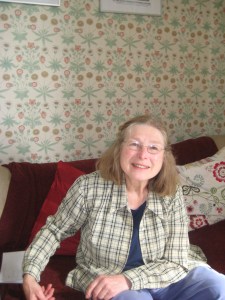
Christine Clark has been active in politics for over thirty years:

I wasn’t politically active until I was 37 and went to University as a mature student. I met so many people from different walks of life including feminists. There was a brilliant library, I read Mary Wollstencroft and Simone de Beauvoir. I had a friend called Claudette who was black, my first black friend, and she gave me an insight into a different world

Christine did not come from a political family. Her dad was a bus driver and had had little education due to the First World War, whilst her mum came from a farming background, left school at 14 and was apprenticed as a seamstress at 15. Luckily she was encouraged by a local doctor to return to education and eventually, her mother after completing a chemistry degree, became a pharmacist.

Christine was good at Art but had learning difficulties and found the exam system unbearable:

My mum helped me with my English and Maths and I did get on a degree course at Leeds College of Art. But I fell in love with my teacher and became pregnant at 18 and had to get married. I knew nothing about contraception and went onto to have another child by the time I was 20.

When Christine became pregnant again shortly after giving birth, she decided she could not cope with another child. This was 1964 and there were no legal abortions:

My mother had a friend who was a doctor and believed in women’s right to abortion so she arranged it for me. It cost £100 (equivalent of £1000 today!) and my husband, my mum and a friend helped me get the money together. One day I just got the train to the doctor’s, had the abortion and then got the train home. Next day I went on holiday with my husband and two children to Lewes, where I was taken very ill with contractions and bleeding. I just took the pain for granted, I suppose I should have taken it easier. I didn’t contact a doctor or a hospital.

Being a young mother in the 1960s was not easy:

It was the 60s and many of our friends were artists and they were so free, ready to talk about all sorts of issues. Women were doing everything and I was so resentful because I was young but had all this responsibility.

In 1973 Christine went to Wolverhampton College of Art to do an Art degree:

My husband looked after the children during the week and I came home at weekends. I started reading and thinking more. My friends challenged my assumptions about life and everything.

In the 80s she got involved in women’s  issues in Tameside:

I started listening to what was going on. Locally there was a group of women who started a WellWomens group. I went to the first meeting and so many women turned up that we didn’t have enough chairs.

On the 5th September 1981, the Welsh group “Women for Life on Earth” arrived on Greenham Common, Berkshire, England. They had marched from Cardiff with the intention of challenging, by debate, the decision to site 96 Cruise nuclear missiles there. On arrival they delivered a letter to the Base Commander which, among other things,  stated ‘We fear for the future of all our children and for the future of the living world which is the basis of all life’. This was ignored and so they set up a Peace Camp just outside the fence surrounding RAF Greenham Common Airbase. Their protest lasted  19 years.

women surrounding the Greenham common airbase

There was a call in 1982 for people to go to Greenham Common. I went and just felt the power of women. It was revolutionary and I hadn’t seen anything like it.

From there Christine got involved with the peace movement and the Wages for Housework Campaign. WFH    had been set up in 1972 by Selma James who said.” By demanding payment for housework we attack what is terrible about caring in our capitalist society, while protecting what is great about it, and what it could be. We refuse housework, because we think everyone should be doing it.”

Christine  did her own one woman action outside a Post Office in Tameside:

My placards said that women’s right to benefits is sharing in the wealth of the country.

At the same time she  moved out of the family home (which now included her 3 chidren, her parents and her brother):

I went to live by myself. I was becoming more politically aware and active. I became involved with the Labour Party and more formal politics. My involvement included raising issues such as Greenham Common and the new Child Support Act. I campaigned at every election, I didn’t vote for Tony Blair as leader and I opposed the abolition of Clause 4.

Her women’s politics have always been at the forefront of her activity:

In 1995 I went to the Beijing Womens Conference for three weeks. I also raised funds for women from the Developing World to join us.

By 1999 she had joined the Green Party:

I have always believed in respecting the land and animals, that we should not pollute the environment and I was always interested in growing things. I got this from my Mum and I think this was from her farming background.

Christine has been active in environmental campaigns, locally and nationally. She has stood as a Green Party candidate in local elections in Tameside:

The Green Party raises the issue of the cost that the Third World is paying for our wealth. We are dependant on each other and the environment.

In 2012 Christine is still active in the Green Party, in the Wages for Housework Campaign and the peace movement.She is also a grandmother

Looking back at her political life has made her think about the dilemmas that women face who are parents and political activists:

I have put so much emotional energy into changing things for everybody. Maybe I didn’t put enough into my children.

She is amazed how things have changed in the past 40 years:

So much was hidden from women in the 50s and 60s and nowadays my daughters and granddaughters are so educated. They are educating me! Its not one way though, it’s a different world, I want to join with them but it must be on human rights terms and it must be in encouraging all groups to work together and to make this a better world. In my opinion the Wages for Housework is a key campaign as it is addresses the fundamental issue of the economy. The economy relies on the unpaid work of people such as carers and the fact that this is unpaid and unrecognised affects everyone as it brings everyones’ wages down.

And her message to young women?

We should start from where they are. I have some interesting conversations with my granddaughter who is in her teens and is black. I try to be on her side and listen to what is important to her. As activists we must listen to them and what they are struggling with and give them support.

If you have enjoyed this article and would like to support this blog by making a donation you can do using this button

Posted in education, human rights, political women, Socialism, Socialist Feminism, Tameside, trade unions, women, young people | Tagged , , , | 2 Comments

Stop,Look,Listen…my weekly selection of favourite films, books and events to get you out of the house

Watch..Even the Rain (2011) Written by Paul Laverty,who has written most of Ken Loachs’ films, and immediately you know that you are going to learn something and be challenged about our understanding of history. A Spanish film company arrives in Bolivia to make a film about Columbus and his relationship with the indigenous people of the Americas. Like Columbus and the Spanish monarchy, they have chosen Bolivia because of its cheap and abundant labour. At the same time as the film company is shooting scenes showing the indigenous people fighting the invading Spanish we see a modern day battle start as the Government has privatised the water supply and the local people take to the streets. This really happened in Bolivia and eventually the Government fell and was replaced by socialist and trade union leader Evo Morales. At a time when Europe is facing economic meltdown it is good to see a film showing people winning victories against the State and multi-nationals. Laverty’s films also give us hope, that people can change and take the side of the oppressed, which is another aspect to this film. Because this was made by a Spanish company it was only given limited release in this country so it is over to the DVD rental shop/internet company if you want to get hold of it.

Go to…the 2nd Wigan Diggers Festival Sept 8. Gerrard Winstanley,leader of the Diggers or True Levellers was born in Wigan The Diggers were one of the first egalitarian political movements to represent the poor and those without property, and also argued for the equality of men and women.The Festival has been organised by a variety of groups on the Left plus the Labour Party. Lots of different activities including a digging re-enactment and tree planting ceremony, a showing of the 1975 film “Winstanley”, a parade around the town and a mass singsong.
See my article

Listen to…The World Turned Upside Down, written by Leon Rosselson, his anthem to the Diggers. Bettered, I have to say, by Billy Bragg’s version in 1985 but make your own mind up. You can watch Leon here and Billy here.

Explore…Salford’s Radical history on Saturday 8 September at 11am starting at the Black Lion, 63 Chapel Street, Salford. This walk will explore Salford’s radical history including the Flat Iron Market, the General Strike of 1842, vegetarian Christians, Votes for Women and the disturbances in Bexley Square in 1931.
Fee £6 (£5 concessions). Further details here

Starting next week my series on Political Women. I interview women who are active in left politics including feminism, trade unions, social movements etc. What made them become involved and what keeps them challenging the state? Why do they think younger women should follow in their footsteps?

Posted in films, human rights, Ken Loach, labour history, Manchester, music, Salford, Socialism, trade unions, Uncategorized, women | Tagged , , , , , , , , | Leave a comment

Disabled protestors brand Atos as “killers”

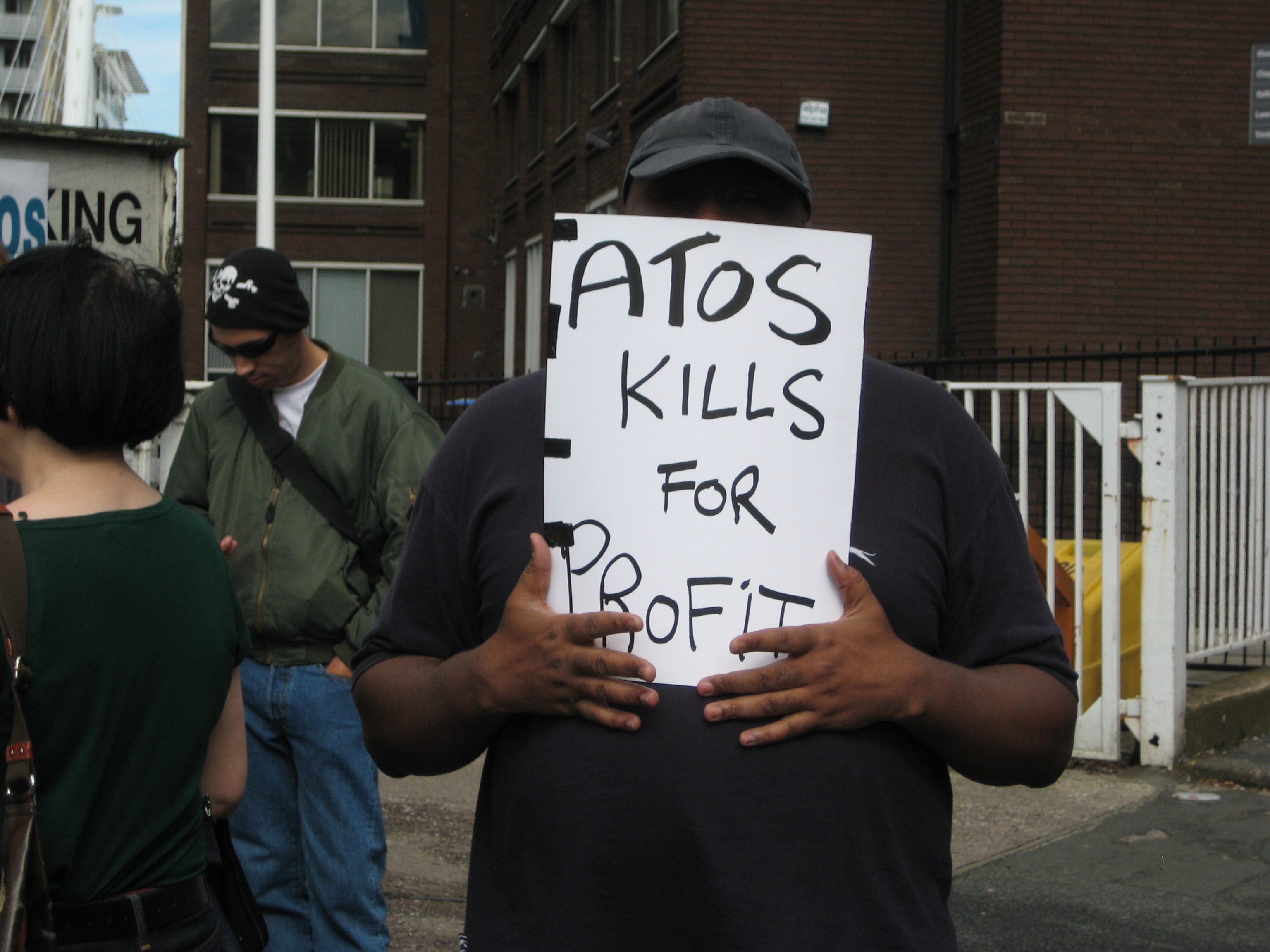
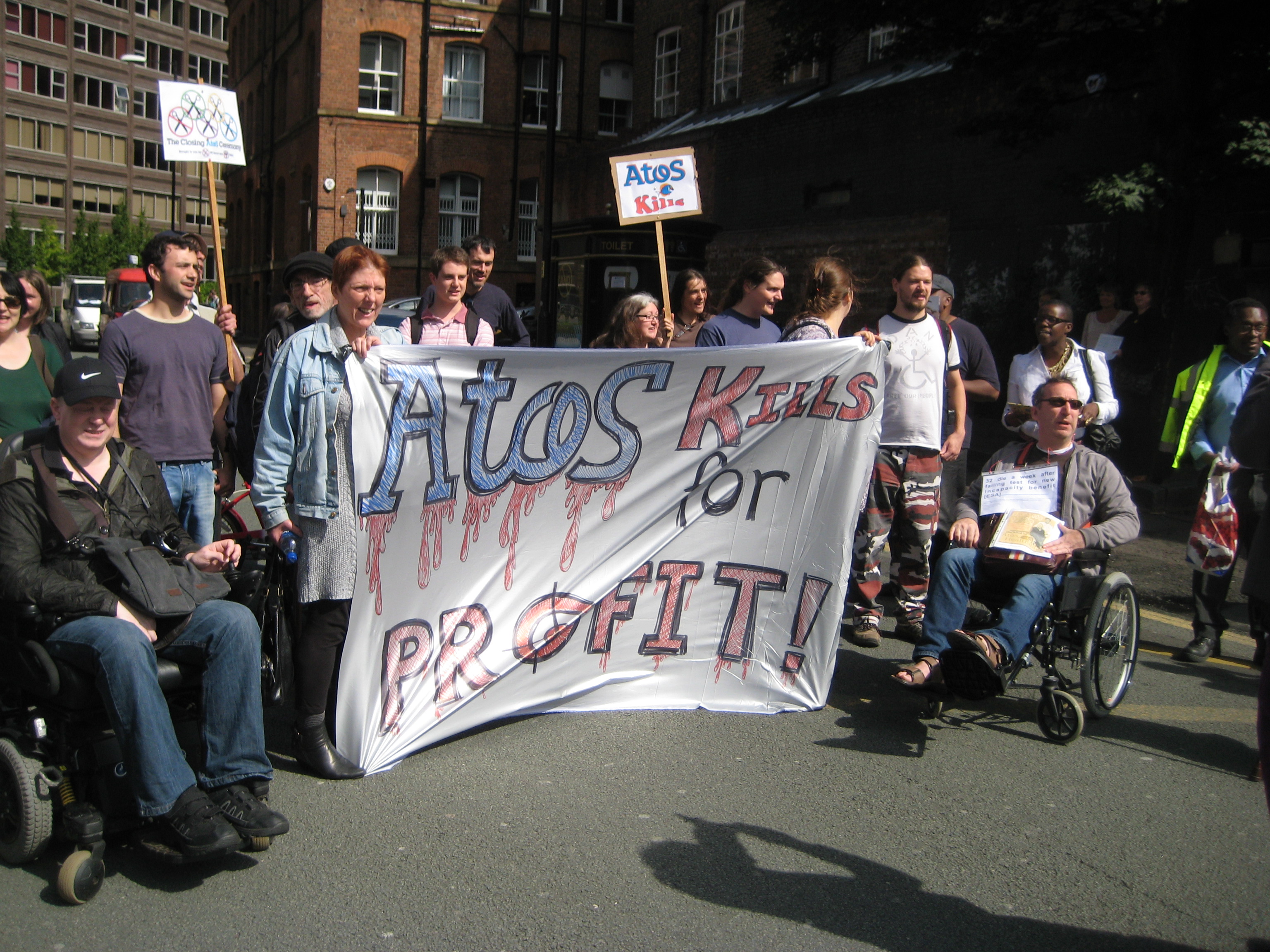
It is one of the sunniest days in Manchester and fifty noisy people are gathered outside the Atos centre at Albert Bridge House. Many people have walking sticks and a few are in wheelchairs and they have all gathered to tell Atos that they are not fit to sponsor the Paralympics. Atos is the organisation that the Government are using to kick 500,000 disabled people off their benefits.

After blocking the road the protesters then marched around the city centre chanting ‘David Cameron hear us shout, time to kick Atos out!

The Manchester demonstration is part of a week long activities organised by Disabled People Against the Cuts to highlight the contradictions of the Government accepting Atos as a sponsor for the Paralympics games. The media are also bombarding us with positive images of Paralympic athletes whilst the reality for most disabled people is that their lives and livelihood is being threatened by cuts in their benefits. DPAC have joined with the Manchester Coalition Against the Cuts to organise this and several other events.

Two of the protestors shared their stories with me. Reverend Paul walks with a stick because he has a spinal disease and has a terminal illness.
“They, Atos, have passed me fit for work twice. I have appealed twice and won. But whilst you are appealing you are only paid basic benefits, which means I got £33 per week for six months whilst waiting to get to my appeal. The second time I had to wait for 9 months. Even though, once you win your appeal, you get the backdated benefits, it means that during that period your bills are not getting paid and you are living on the breadline”.
Reverend Paul, unlike some other activists believes that the whole WCA system should be scrapped. “I don’t think it can be improved. Why don’t they believe the medical reports from our doctors and consultants.”

Colin (known as Criquaer on twitter) is in a wheelchair and his motivation to attend the demo was for his friends;
“I came here on behalf of friends who have been treated very badly by Atos assessors who don’t take into consideration the whole of our illnesses. I am petrified about that brown envelope coming in through the door from Atos calling me in for a “fit for work” assessment. I have had to go back on anxiety tablets because I am that worried. Its got everyone het up because of the stories you hear and the disrespectful way that they have treated people.”

Many of the speeches by disabled people echoed the comments of Paul and Colin. Not just the fear of being called in for assessment but also the reality that even if you win your appeal you can be then called back in again for another assessment. As DPAC says “Atos continues to devastate people’s lives. Many have committed suicide because of its testing programme, and over 1,000 people have died of their illnesses soon after being found ‘fit for work’”.
It was not just about disabled activists detailing horrendous experiences but also in showing how claimants could challenge and win their appeals. One of the speakers provided information on useful websites and strategies that claimants have used to challenge the system.

On previous demos the PCS who represent administrative staff have provided speakers but as Mark Krantz of MCAC explained; “These union members are under tremendous pressure and its difficult for them to speak out publicly. But it is important for claimants and union members to act together to oppose this barbaric system. “. Some union members did come out and sign the petition.

PCS, the main union, issued a statement in support of the action whilst at the same time expressing their own perspective .
“The members we represent in ATOS offices are not responsible for the failings of the government’s unfair welfare policy which victimises people who are not able to work through no fault of their own. They deserve your support, consideration and respect during what is a difficult time for any worker trying to deliver public services.”

Tuesday’s event is only one part of a series of activities being organised by DPAC and their supporters during the Paralympics. Please check their website for daily updates.See

If you have enjoyed this article and would like to support this blog by making a donation you can do using this button
Posted in anti-cuts, disabled people's campaigns, human rights, Manchester, trade unions | Tagged , , | 1 Comment

Stop,Look,Listen…my weekly selection of favourite films, books and events to get you out of the house

Watch Woman in a Dressing Gown, a film made in 1957 and set in London, it is the story of Amy and Jim. They live in a council flat, have been married for 20 years and have a teenage son, Brian. Amy is a housewife, spending most of her day in her dressing gown. Her world is the flat, trying to get to terms with keeping it tidy, making meals for her family and counselling a new wife and mother who is not so happy with the job description. Unbeknown to Amy, her husband is having an affair with his young secretary and is about to announce that he wants a divorce. Women’s lives have changed so much in the years since this film was made that it could be seen as archaic, but it’s the performance of Yvonne Mitchell as Amy that makes the film so interesting. Amy is like a hamster in a cage, going round and round on a wheel and never getting anywhere. She doesn’t even change from her dressing gown because she doesn’t leave the flat. Her life sums up the lives of many women of that era, a stultifying, small world where women lived for their husbands and children and were not expected to want or make their own choices. The film is a reminder of how much life has improved for women and by that change also allowed men to escape the repressive role that many of their fathers had to play.

LookGhosts; Disappearing Histories, an exhibition at the People’s History Museum . The exhibition is curated by Commonword and, according to them, “celebrates the Moss Side and Hulme nightclubs of the 1950s to the 1980s and the role they played in building and sustaining the community, from the early days of the Reno to the last days of the PSV.” It uses various artefacts to recreate this era; from clothes of the day to the recreation of a living room and a TV. I particularly liked the photographs, which included people in the clubs as well as scenes from the local streets and the annual Moss Side Carnival. Unfortunately many of the photos do not have the names or contexts of where the photos are taken. A key feature of many of the photos is the number of mixed race and white (Irish) people. Although the exhibition is mainly about the black community, I think few of the audience will realise the high numbers of black men who married/lived with white (predominantly Irish) women. This exhibition is a slice of the life of the area of Moss Side and Hulme and for those of who lived there at various times but it is just one aspect of a very vibrant and highly political community.

Listen,..Banga by Patti Smith. She is another Mikhail Bulgakov fan and her latest CD is named after Pontius Pilate’s dog in the novel,Master and Margarita. This is Patti’s 11th album and is as unique and one-off as she is. She is a performance poet, born out of the 60s, with all the weirdness that goes with that but her voice, songs and music are unique. This is an album that makes you want to listen to it over and over again. It doesn’t matter that you don’t know who Tarkovsky and Bulgakov are, it’s the songs that count..well, apart from the really bad rendition of Neil Young’s After the Goldrush. You can listen to an interview with her about Bulgakov here

Remember..each year the Red Cross commemorates those have disappeared in armed conflicts and gives support to their families. This year in Manchester they have organised a Community Arts Exhibition which includes artistic contributions from the community on the theme of “The Disappeared” or “The Missing”. It takes place Wednesday 29 and Thursday 30 August at Bridge 5 Mill, 22a Beswick Street, Ancoats, Manchester M1 7HR 9-5pm.

Join…the demo against Atos on Tuesday 28 August at noon at Albert Bridge House organised by Disabled People Against the Cuts.  Atos are the government’s agent to throw 500,000 disabled people off benefits. They are also a sponsor of the Paralympics – how ironic is that?? Personally I do not understand why people feel the need to prove that they can run faster, lift heavier weights and perform better than other people, particularly as nowadays it is about who can access the right training to do so. It is interesting that the Proms are on at the same time and, although they get lots of publicity on the BBC, it would make a change for all people to be encouraged to understand and enjoy classical music. Maybe that would be encouraging people to think? Cannot have that. Back to the Paralympics then. Join us on Tuesday to show that we oppose the government’s decision to destroy the lives and civil rights of some of the most vulnerable people in society.

Posted in anti-cuts, art exhibition, disabled people's campaigns, films, music, novels | Tagged , , | 1 Comment

Uniting to fight ATOS

Next week Disabled People Against Cuts (DPAC), are organising a week of action to coincide with the Paralympics, they are calling it “the Atos Games”. Atos is a sponsor of the Paralympics and is the main contractor for the government in its drive to cut disabled people’s benefits. Groups across the country are coming together to protest at Atos medical assessment centres. Locally it is the Manchester Coalition Against the Cuts( MCAC), who are backing DPAC at its protest on Tuesday 28 August at 12, outside Albert Bridge House.

Disabled people get a raw deal in our society. But the Paralympics being staged in this country has meant that the mass media coverage has produced some very positive images that get beyond the usual stereotype of what it means to be disabled.

But the reality for most disabled people is not so positive. The Con/Dems, in their pursuit of benefit cuts, have targeted one of the most vulnerable groups in society; the disabled. Openly they have pursued a policy of driving 500,000 disabled people off their benefits . The company Atos ,who conduct the Work Capability Assessments, have been exposed as the government’s accomplice in reducing the numbers of people claiming disability benefits. The government has admitted that the tests are “flawed” whilst the British Medical Association have demanded that they should “end immediately.”

The fighback against the cuts is being led by DPAC . It was set up after the 3 October 2011 mass demo against cuts in Birmingham. An action group called Disabled Peoples’ Protest led the protest, which was the first large scale opposition to the cuts and their effects on disabled people.

DPAC co-founders are the original Disabled Peoples’ Protest organisers. It believes;
“that disabled people should have full human rights and equality. It is for everyone that refuses to accept that any country can destroy the lives of people just because they are or become disabled or sick. It is for everyone against government austerity measures which target the poor, while leaving the wealthy unscathed. It is for everyone who refuses to stay silent about the injustices delivered by wealthy politicians on ordinary people and their lives”.
They have, through their campaigning , highlighted the devastating effects of Atos, and exposing the reality that people have taken their own lives rather the face the severe hardship and poverty that comes with being passed “fit-for-work” by Atos. More than 1,000 people have died of their illnesses shortly after being passed “fit for Work”. DPAC’s website is a forum where disabled people can exchange information, gain support and take part in activities.

Ironically, or maybe not, Atos, is one of the lead sponsors of the Paralympics. They have not just been given a lucrative sponsorship deal but Government has now rewarded them with a £400m contract to carry out assessments for Personal Independence Payments that will take over from Disability Living Allowance in 2013. DPAC say “Atos are unfit to sponsor our Sports”.

Mark Krantz of MCAC says, “we are calling on people to join us on Tuesday, because we want to expose the brutality of the system that Atos is operating. We also want to bring together claimants and the members of the PCS who are involved in the system”.

A spokesperson for PCS commented; “We wholeheartedly supports the campaign’s aim, which is to fight back against the unfair workplace capability assessments. The ‘fit-for-work’ tests have led to severely ill and disabled people being forced off the benefits system.”

“Any PCS members wanting to support the week of action are encouraged to do so. The members we represent in ATOS offices are not responsible for the failings of the government’s unfair welfare policy which victimises people who are not able to work through no fault of their own. They deserve your support, consideration and respect during what is a difficult time for any worker trying to deliver public service.”

See you outside ATOS Centre in Manchester at 12 Noon, Tuesday 28th August
Albert Bridge House, Bridge St. Manchester M60 9DA
Further details
DPAC see www.dpac.uk.net
MCAC see http://www.coalitionagainstcuts.org.uk/

If you have enjoyed this article and would like to support this blog by making a donation you can do using this button

Posted in anti-cuts, human rights, Manchester, trade unions | Tagged , , , , | Leave a comment

Stop,Look,Listen…my weekly selection of favourite films, books and events to get you out of the house

Watch…..Ai Weiwei: Never Sorry (2012)…we are not used to artists being politically active in this country. Weiwei is a superstar artist in his home country of China, at first  loved by the party apparatchiks, for whom he designed the Birds Nest in the Chinese Olympics. But Weiwei has proved to be more of a politician than an artist. He challenged the Chinese state and took the side of the victims of their corruption. He championed political prisoners such Liu Xiaobo

In this documentary we are shown how Weiwei has been increasingly harassed by the Chinese authorities as he uses all forms of the digital media to expose the increasing human rights abuses of the regime. His home is watched by government agents and a cctv camera is placed outside his front door. Weiwei responds by watching them watching him, so we see every move against him, leading to his detention in 2011 for 81 days. Bravely, he responds to this harassment, by continuing to oppose the regime. The Chinese authorities want him to shut up or leave the country. He is doing neither of these things. This documentary is a fierce rebuttal by him to a regime that is facing increasing opposition in the country.

The Echo of Pain of the Many..a film made in Manchester about human rights abuses in Guatemala. Showing at On The Eighth Day Thursday 30 August at 8pm. see a video clip

ReadCold Light by Jenn Ashworth. A northern writer, this book tells the story of three working class teenagers as they are on the edge of womanhood, their families and school life. It is hard being a teenager and the book recreates those feelings of loneliness, friendship, hatred and fear. It’s a brilliant evocation of how many young people feel, but this has a dark element of impending doom. It’s a scary, spooky book that will keep you firmly gripped as the lives of these young women go into freefall. Brilliantly written, my only criticism of the book is its lack of humour and hope. Life is tough for the working classes of all ages but they still have some sense of community, where people help each other and care about each other, which is harder to find in the more affluent areas of this country.

Eating…one of my favourite hobbies and no place better to do so than at the Topaz café at the Mind Centre in Ashton-u-Lyne. A hidden gem of vegetarian food in a pleasant and relaxing atmosphere. Topaz has won awards for its food, which is bought and grown locally.

Agitate……….Disabled People Against Cuts and UK Uncut are protesting against  Atos sponsoring the Paralympic games. Atos “test” sick and disabled people on behalf of the Government to drive them off welfare benefits. Some people have killed themselves because of the harassment. But DPAC and UK Uncut are going to expose this hypocrisy on Friday 31 August, they will be shutting down Atos’ London HQ for the Closing ATOS Ceremony. Please join them. Further details here

Posted in book review, films, human rights, novels, Uncategorized, young people | Tagged , , , , | Leave a comment

Mary Quaile; Manchester Irish Trade Unionist

Mary’s life and political activity shows us why unions are important for women and is an example of the role that Irish people have played in the British trade union movement in this country.

She was born in Dublin; her father was secretary of the Irish Brick and Stonemakers Union. In 1908 she came to Manchester and got a job at the Socialist Clarion Café in Market Street, Manchester. She organised a Café Workers’ Union in Manchester and became its secretary. This was the beginning of a lifetime career as a trade union activist.

In 1911 Mary was appointed as Assistant Organiser to support Mrs Aldridge at the Manchester and Salford Women’s Trades Council. The Council had been established in February 1895 at a meeting in Manchester Town Hall with a view to promoting trade unionism amongst women workers.

By 1914 Mary was the organising secretary for the Council as Mrs. Aldridge had left. She opposed the First World War and belonged to the No Conscription Fellowship. In April 1919 the two Manchester women’s trades councils merged with the Manchester and Salford Trades Council (with Sarah Dickenson appointed Women’s Organiser) and that same year Mary took up a new post as National Women’s Organiser for the Dock, Wharf and Riverside Workers’ Union, which eventually joined the Transport and General Workers Union in 1922. This was Britain’s largest union.

She quickly became prominent in her union, standing for election to the General Council of the Trades Union Congress in 1923 when she came third in the ballot behind Margaret Bondfield and Julia Varley. When Ramsay MacDonald appointed Margaret Bondfield to a job in the first Labour Cabinet as Minister for Employment in January 1924 she resigned from the General Council and Mary took her place as the runner-up, attending her first meeting in March.

Mary was a member of the TUC Women Workers Group, which was looking at the organisation of women in trade unions, following a resolution at the TUC the previous year. In May 1924 the TUC sent out a letter to all unions stating that in their opinion “much could be done to further the trade union organisation of women if all men Trade Unionists would do their utmost to get their wives and daughters to see the importance of becoming trade unionists themselves.”

In 1925 Mary led the Women’s Trade Union Delegation to Russia. She said that “The visit of six working women to Russia was a milestone on the road to international Trade Union unity”. This banner was presented to the British women by the Soviet trade unions.(TUC Archive)

Mary attended the TUC Women’s Conference, held on 20th March 1925, in Leicester, which discussed ways of recruiting more women workers and called on stronger trade unions to come to the aid of the weak, blaming past Executive Councils and union officials for not having made special efforts to organise women.

Later that year at Congress Mary spoke in the discussion on women’s organisation within the TUC, stating her belief that it was necessary to have a women’s group “because of the work that had been done not only in organising the women but in educating them in their responsibilities, and the part they had to take in their own trade union movement”. Mary was elected again in 1925 to the General Council. She was now one of the most prominent women trade unionists in Britain.

The Leicester conference resulted in the TUC launching a recruitment drive for women in the early months of 1926 with Manchester and Salford as its first target. Mary spoke alongside Margaret Bondfield and Walter Citrine, the new TUC General Secretary.

In May 1926 the TUC called the General Strike in support of the Miners’ Federation of Great Britain, whose members had been locked out by the coal-owners. The strike was very solid in Manchester and Mary spoke at a mass meeting in Platt Fields, attended by many thousands on Saturday 8th May. Despite the magnificent response of trade unionists across Britain the TUC called off the General Strike unilaterally after ten days without consulting the miners, leaving them to fight on alone until starvation forced them back on the owners’ terms in the autumn.

In September Mary attended the First Annual TUC Women’s Conference in Bournemouth. She did not stand for the General Council in 1926 and the following year returned to Manchester, living in Levenshulme, and again took office as secretary of the Women’s Group on the Trades Council. In 1935 she was elected Vice-President of the Trades Council, the first woman officer of the council, and from 1936 to 1958 she acted as Treasurer. In her later years she was awarded the TUC Silver Badge for Trades Council Officers at a reception at Belle Vue attended by some four thousand people.

Writer and socialist, Jim Allen, in his film Days of Hope, which described this period leading up to the General Strike of 1926, featured a woman, trade unionist called Mary. Given Jim’s in-depth knowledge of labour history I believe he was referring to Mary Quaile.

Sources

Michael Herbert – see

Warwick University

If you have enjoyed this article and would like to support this blog by making a donation you can do using this button
Posted in Communism, education, human rights, International Women's Day, labour history, Manchester, Socialism, Socialist Feminism, trade unions, women | Tagged , , , , | Leave a comment