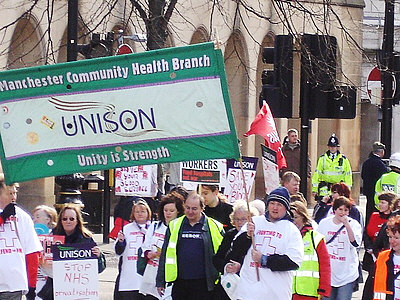
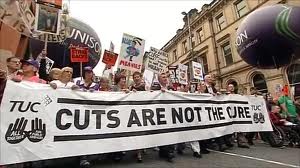
Political Women (8) Voices of Trade Union Women

Education has always been the escape route for working class children out of low paid work but in 2012 it is not just the demise of Education Maintenance Awards and the rise of student fees that are changing their lives, but the changing nature of the labour market which means that, even if you do get a degree (at a high financial cost), you may not get a better job.

I decided to do some research into the lives of women from similar backgrounds to me, but who did not stay in education, and instead went into traditional working class jobs. But, through their involvement in trade unions, they found another way of getting an education, and also developing their own self confidence, and went on to change their lives.

My research started with interviewing women who are active in trade unions. Historically trade unions have offered women opportunities to improve their wages and working conditions, to get an education, to become active in the union and take union jobs, as well as moving into the wider job market. The women I interviewed were Marilyn, Cath, Sharon and Julia. Their ages varied from early 40s to 60s.

Most of the women were not from trade union families, but had worked in industries that were unionised. All of them had left school at 15 or 16, none of them achieved any qualifications at school and all went into unskilled work:
Marilyn (who is in her 60s) said I left school in 5th year and was not encouraged to stay on. My job was to go out, get married and have babies. That was what women’s lives were then and therefore I got married at 17 and had a baby

Why did they join a trade union:

Cath; at 16 I went to work in “Cadburys factory” and it was unionised so I joined.
Marilyn; “I worked in factories that were unionised so if there was a union I would join it. I must have believed in it because I don’t follow like a sheep.”
Julia; “At 16 I went to work in KwikSave and it was unionised so I joined the union and the store.”
Sharon; “At 17 I went to work as a machinist at a factory and I joined the union. I was the youngest person in the union.”

How did this affect their lives?

Three out of the four women worked in factories which had track records of union organisation.
Cath worked on the Wirral in Cadburys factory from 1972-88: There were 2000 members, all in the TGWU, and it was a closed shop. But of the 50 shops stewards only 4 were women. She worked in the factory when single and then went back after her husband was made unemployed, working on the weekend shift as she now had 4 children. Cath became the shop steward and the female deputy convenor spotted her potential: She was my biggest inspiration and encouraged me to do courses. I went back into education and that made me realise I could do anything I wanted. Cath is now a tutor on trade union courses at a college.

Julia also left school at 16 and worked on a checkout at KwikSave. Usdaw recruited her at her induction. She came from a trade union family, her father had been a shop steward on the docks in Liverpool and took part in the Merseyside Dockers Campaign to try and save jobs and the industry. Julia went to Argos, got married and had 2 children, and whilst working on the dayshift became a shop steward. Through the union she has gone on many courses to improve her own qualifications and develop her role as a full time official in her trade union. For her the benefits are clear: Initially I did the learning to improve myself. People don’t realise how being part of a union and taking up educational opportunities can give you confidence in improving your own life and career.

Marilyn’s life changed when she went to work in the food manufacturing industry: In 1996 I went to work in a local bakery, well it’s a factory producing cakes, there are 2000 workers and 90% of them are in the union. For Marilyn joining the union changed her life; It had a massive effect on me, I went on every course and it meant for the first time I travelled by myself on trains and buses all over the country. She worked for the union for a year and wished she had got involved earlier: If I had got involved in the union thirty years ago my life would have gone in a different direction. I would have run for a fulltime officer post and be more active.

Sharon left school at 15 years without any qualifications, mainly because she was dyslexic and was not provided with the appropriate support. In the 1980s she trained as a machinist and joined GMB as the firm was unionised. She was the youngest person in the union. Sharon thinks attitudes to unions were better in the ‘80s: I think unions had a higher and better profile in those days and now they have been run down by the Government.
In 2004 Sharon moved to a large biscuit manufacturer and, as soon as her position was made permanent, she joined USDAW. In the factory there is a Union Learn Centre, a joint employer/union learning centre where staff can obtain qualifications. Sharon was encouraged by the union convenor to do so: He had faith in me, he kept saying you can do it and don’t give up. She has now become a Union Learning representative and says; I now feel able to talk to other people about learning and encourage them the way I was encouraged by the union.
It’s not just in learning that the union has helped Sharon. She has a back problem which affected her attendance at work and may have cost her her job. The union supported me when the company wanted to get rid of me. The union ensured that my condition has been recognised under the DDA and backed me all the way otherwise I would have just given in and given up my job. So being in a union has made a big difference to me and that’s why I say to people that they should join a union.

The key issue for these women was working in organisations that were unionised. It provided not just opportunities to access education, but also enabled them to take positions of authority in the union such as shop steward.
In 2012 unions still have a key role in providing free education. This is rarely recognised in the negative press which unions get in the media. It is clear from my interviews that union membership was a key event in changing the lives of these four women and many others who have taken up the opportunities available to them as union members.

At a time of increased cuts and privatisation of education and training the unions can offer a way out for some of the most disadvantaged groups in society. However the unions themselves have often underplayed their educational role. As Cath says; Unions don’t promote the value of what they do for women, including the confidence they can gain through being a member of a union and being active in it.

In 2012 the TUC has its first woman leader, Frances O’Grady, a single parent from a trade union background. France’s appointment reflects the important position that women hold in the trade unions, they make-up nearly half of all members, they are also taking the brunt of the ConDem cuts. It is an important step in the history of the trade union movement but one woman cannot change history but many women and men can do so and that has got to be the future.

If you have enjoyed this article and would like to support this blog by making a donation you can do using this button

Posted in anti-cuts, education, feminism, human rights, political women, Socialism, Socialist Feminism, trade unions, women | Tagged , , , | 1 Comment

Stop,Look,Listen…my weekly selection of favourite films, books and events to get you out of the house

Watch…..Manchester Film Co-op and Manchester Open Rights Group are screening The Real Social Network, a film about the new generation of protest. Between the first UK student protests in November 2010 and the global uprising in the spring of 2011, a new radicalism, fuelled by modern technology, has hit the streets. Can the Twitter generation build up alliances with all sections of society? Can a movement that has no basis in communities such as Ordsall and Openshaw in Salford and Manchester really be the next big challenge in this country? Join the debate on Tuesday 23rd of October @ 19:45pm.On The Eighth Day Cafe, 111 Oxford Road, Manchester, M1 7DU.Admission: £3 waged, £2 unwaged/student.
The Real Social Network captures the passion, the anger and the technology that has forever changed the game between those in power and us.
More info and trailer:

Listen…to one of my heroes Selma James who is on a book tour publicising her new anthology Sex, Race and Class – The Perspective of Winning. . She addresses the power relations within the working class movement, and how to organise despite and against these power relations, South and North – including drawing on the experience of Occupy in London and the US in which the Global Womens Strike has been active.
For more information see

Look... On Thursday 26 April 1986 the explosion at the Chernobyl nuclear power plant in the Soviet Union was one of the most significant reactor failures in the history of nuclear power. More than 200 people died or were seriously injured by radiation exposure immediately after the explosion. 161,000 people had to be evacuated from a 30 kilometer radius of the reactor and 25,000 square km of land were contaminated. As time went on millions of people suffered radiation related health problems such as leukemia and thyroid cancer and around 4,000 people have died as a result of the long-term effects of the accident.

Jane and Louise Wilson’s exhibition at the Whitworth Art Gallery  features their new film Toxic Camera, and photographs from the local town of Pripyat which was next to the Chernobyl reactor. Also showing is the Soviet filmmaker Vladimir Shevchenko’s film Chernobyl; A Chronicle of Difficult Weeks. He was given access to the nuclear reactor site just a few days after the explosion and the film is a fascinating insight to the devastation of the explosion but more importantly the heroism of the 500,000 people, mainly volunteers who over six months battled (and that is definitely the word) to stop a second explosion. Jane and Louise’s narrative includes the story of Vladimir’s camera which became so radioactive that it had to buried on the outskirts of Kiev. Vladimir and his editor also became victims of Chernobyl and died shortly after the film was made. For more details of the exhibition see

Support local book shops………. Books on the Park 749 Ecclesall Rd SHEFFIELD South Yorkshire S11 8TG map tel: 0114 266 6364 Open: Monday – Saturday 10.00 – 6.00, Sunday 11.00 – 4.00.

Books on the Park moved to new, larger, premises in February 2012. They have books on: art, design architecture, fiction, graphic novels, poetry, literary critism, philosophy, religion, mythology and lore, history and politics, transport, cookery, children’s, Folio Society , natural history, local, (including walking guides), languages, science, maths, psychology, sociology and cultural studies, education, music (inc. sheet music, CDs and vinyl), humour and antiquarian.


Oppose the victimisation
…….of trade union representatives at Manchester Metropolitan University. Christine Vie and now Ian Parker. Sign the petition here Messages of protest are being sent to the Vice-Chancellor John Brooks (john.brooks@mmu.ac.uk) These messages are being copied as messages of solidarity to the MMU UCU chair Pura Ariza (p.ariza@mmu.ac.uk) and vice-chair Christine Vié (c.vie@mmu.ac.uk). See .

Go to…… Liverpool Against The Cuts and Manchester Coalition Against The Cuts are jointly hosting a Conference to look at the Cuts agenda being pursued by the Coalition government. The Conference will be held in Liverpool on 10thNovember. The Conference plans to bring together many groups such as trade unions, various anti cuts groups, charities and other interested parties to look at the cuts and help form a cohesive response going forward.
There are many activists working hard and giving up a lot of their time within the resistance to cuts across the country. Their work is invaluable but to hold a Conference like this means one more thing – money!!! Funds are needed to cover the normal costs of a Conference such as travel, food, printing etc etc. Please send contributions to Michelle Smith c/o Unite The Union, Jack Jones House, Islington, L3 8EF (cheques to be made payable to Liverpool Against the Cuts). To reserve a seat at the conference: coalitionagainstcuts@gmail.com

Support local libraries……….A partnership between Bilbary and Kensal Rise Library is now active. This groundbreaking collaboration will promote and encourage reading by providing access to over 300,000 e-books available via e-readers, computers, tablets and smart phones. Bilbary is  an online e-book service,  set up  by Tim Coates, former MD of Waterstones,  (and respected library campaigner and advocate) is already running in the USA and will now operate through Kensal Rise Library in the UK. 50% of revenues raised through the website will go to the library. As an alternative to Amazon you can now buy their books through Bilbary and support libraries at the same time Just click on the e-books button or Bilbary.com logo on the website http://www.savekensalriselibrary.org/  to order your books.

Posted in anti-cuts, art exhibition, Communism, feminism, films, human rights, occupy, Salford, Socialism, Socialist Feminism, trade unions, women, young people | Tagged , , , , , | Leave a comment

Political Women (7) Ana Lucia Cuevas


Socialist, feminist……….

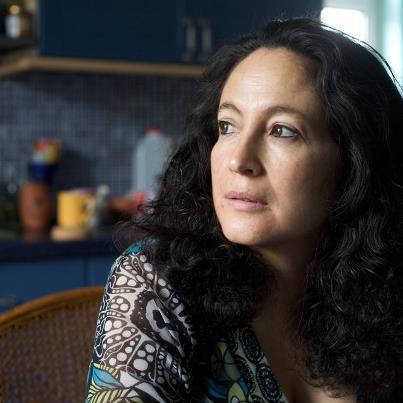
Lucia was born in Guatemala ,one of the poorest countries in Latin America, and one with a tragic history. Between 1944 and 1954 a democratic government tried to bring in basic human rights in education and labour, reforms which were labelled as “Communist” by the USA. The Eisenhower government supplied covert aid to the military to destabilise and overturn the legitimate government. Decades of repression followed.

Lucia and her family were part of a radical opposition to this longstanding military regime:
My father was Chancellor of the National University and was outspoken against the violations of human rights. My mother spoke out against injustice and inequality.

Her father died in exile in 1979:

My father made a big impression on my life. He would talk a lot to us. He gave us a political education.

As a student in the 1980s, alongside her brother, she opposed the civil war that had raged in the country, with the illegal kidnapping, torture and murder of opponents to the regime. It is believed that over 150,000 people died and 45,000 people were “disappeared.”

I joined the Communist Party aged 17 years and was part of a clandestine opposition movement of which the students were an important part. I was very political, no doubt due to time I was living through. I felt I had no choice.

By 1984 the situation had become so bad with the escalation of violence against Communist Party members that Lucia and her family were advised to leave. Her brother, who was a student leader, and his wife disappeared at this time. After spending a year with her mother and sister in Costa Rica, she went to Bulgaria to continue her studies:

I lived in Bulgaria for six years. The Communist government paid all my expenses. I started an Art degree and led a simple life. It gave me time to heal. It was a strange time, being in exile, but I had no contact with the West.

In 1991 Lucia came to England and completed a Masters Degree in Computer Graphics and then decided to focus on filmmaking:

Since leaving Guatemala I had always campaigned about the political situation in the country. In 1996 there were peace accords in Guatemala, so I went back, very quietly. I got in touch with the group that my sister-in-law had formed, and we asked the government to investigate my brother’s case.

Lucia discovered that her brother had been killed by the government:

In 1999, a chilling document was found: records of 183 people who had been taken. My brother was there, with all his details. There was a code – the number 300 – next to the name if the person had been executed. My brother had that code: he was executed three months after he was kidnapped. Until then, I’d thought he might still be alive.

Due to Lucia’s campaigning last year, the civilian president, Álvaro Colom, made a very public apology to her family and two others. But in January this year, a new president took power: Otto Pérez Molina. He was part of the military during the repression. To Lucia this is an ominous sign:

Under this military president things are being obstructed and he is finding ways to avoid processes.

Lucia has used her own filmmaking experience to tell her story, and that of her country in a film called The Echo of the Pain of the Many. Her film of that journey, documents not just one man’s disappeance and murder by government forces, but brings to light the history of the USA’s involvement in Latin America for over 36 years and the consequences for the people of Guatemala:

It comes from my heart, and the response to it in Guatemala has been overwhelming. My brother, Carlos, was my soulmate and losing him was a big hurt in my life. It was important for me to make the film, to challenge the amnesia that exists in Guatemala about that period of history, to find out who was responsible for my brother’s death, but also a chance to gather together pieces of a shattered past. Not just to relive my pain but the echo of the pain of the many.

In Guatemala many young people in schools and universities have seen the film and Lucia feels that it has made a difference to their lives:

I am full of hope, I have seen young peoples’ response to the film and they understand that there is a gap in their history of what happened during this time.

Lucia is very aware that. with the election of a military president, things are changing again in Guatemala:

It’s surreal: human rights are already going into reverse. Last week eight people in the countryside were killed as they took part in a demonstration.This new president is returning to old fashioned repressive techniques.

And her message for young women?

Life is very different if you are part of a movement that is doing something to change our reality. It is very rewarding and no words can describe how empowering that is. Especially for women whose lives can be so disempowered. You can feel a different person if you are part of a movement for change.

Contact Lucia

If you have enjoyed this article and would like to support this blog by making a donation you can do using this button
Posted in human rights, political women | 1 Comment

Stop,Look,Listen…my weekly selection of favourite films, books and events to get you out of the house

Watch……<a

WatchBarbara …it is 1980, in East Germany, and she is a doctor who has applied to leave the country to be with her West German lover. As a punishment she is sent to a rural town to work in a hospital dealing with young patients. Secretly she plans her escape as the local Stasi watch her every move and seek to intimidate her. The director effectively recreates the claustraphobic nature of East Germany and its repressive society. Barbara’s West German lover wants her to join him but to become a housewife which sums up the dilemma for people from the East who really wanted to stay in their own part of Germany but live a freer life. The personal is political…..

Listen….to Sarah Gillespie and her new album In the Current Climate. Sarah performed during the Manchester Peace History week in Manchester. Her songs are funny and heartfelt. On the night I saw her she echoed the anger that many of us feel about the injustice of the world. One of her songs was dedicated to Shaker Aamer, the last Londoner in Guatanamo detention camp. Sarah called on us to support him and his family in their call for freedom and justice. see Sarah’s article on Shaker at


Celebrate
Black History Month at the WCML with a talk on Wednesday 17 October at 2pm by Natalie Zacek, Frederick Douglass and Manchester: a ‘liberating sojourn’. Douglass is celebrated for his activities in the abolitionist movement in the United States, but his visit to Manchester in 1846 was a crucial moment in the evolution of his thought on slavery, race, economics, and politics. This talk describes the centrality of Manchester and the North West in this radical transatlantic movement.Natalie is Lecturer in History and American Studies at the University of Manchester.All welcome; admission free; light refreshments after.

Later at the WCML at 3pm listen to Andy Merrifield, author of Magical Marxism and intellectual biographies of John Berger and Guy Debord, who will speak about the Enigma of Revolt: Occupy and beyond. Joseph Maslen (Edge Hill), will speak about representations of ageing Communists in popular fiction. Further info see

Go for a walk……. Saturday 20 October 11.30amUp Then Brave Women: Manchester’s Radical Women. Meeting point: Robert Owen statue, Coop Bank, Corporation Street.This walk will include Chartism, women in the Coop movement , Socialist women, women writers on the Manchester Guardian, Mrs Gaskell, the Manchester Society of Women Artists and women at Peterloo. £6.00 /5.00. Advance booking recommended: redflagwalks@gmail.com

Posted in Uncategorized | 1 Comment

Political Women (6) Karen Reissmann

Socialist, nurse, woman, fighter against injustice………..

Karen has been involved in politics from the age of 16. She is a shop steward and member of Unison Executive. She was not from a political family but…

Neither of my parents were active politically. We did talk about the world we lived in. Mum was a steward in the Royal College of Nursing when it was changing from a professional organisation to a trade union. But she was strongly anti-striking as a principle. She had a sense of justice, that you should stand up and do something and not  turn a blind eye to injustice.

She started on her political life in 1975, aged  16,  when she joined the National Union of School Students:

It was a time  when there were cuts in education and we were fighting for students to have a voice in the school system.

Her parents were not happy about her activity:

They were worried about me being political and that  it would lead me into trouble

Karen moved to Manchester  to study mathematics at the University and became  involved in the students union. In 1979 she  joined the Labour Party as a result of Thatcher coming to power

 I felt that she had got to power because Labour were not electable and I wanted to change that. There was a huge left wing in the party then and the campaign for Tony Benn as deputy leader showed how close we were to making that change.

But Tony Benn failed to get elected by a whisker  and by the 1980s her local left wing Labour council was  voting  through a series of cuts.

I left the Labour Party because I didn’t campaign for leftwingers to push through cuts. I felt the Labour Party wasn’t prioritising working class people and their needs but their own electoral future.

Karen gave up her university course and trained as a nurse. Within six weeks of starting in the job as a student nurse she was elected a shop steward. Her career as a nurse runs alongside her own politics:

I do like being a nurse, being able to help people and for them to help themselves and see peoples’ lives improve. I find it hard to ignore the blocks that stop people being mentally well, including money. For me the ability to link what you do for a living and fight back against racism  and   sexism at work is part of fighting against injustice in society.”

She sees the link between patients’ rights and the rights of people generally. For Karen  it is not just a question of being a trade unionist, but being a political trade unionist. Her branch of Unison Mental Health Manchester has been at the forefront of working closely with service users;

There is a political edge to the branch. Unlike other branches, we have built links with the user and , had joint campaigns over issues such as free bus passes for patients. Some unions have fought on issues such as safeguarding staff,  rather than seeing the issue of safety as one for staff and patients.

In 1988 she joined the Socialist Workers Party and is still a member.

I have stayed in the SWP because I think it is hard to be an individual in a world that is pulling so much to the right. The SWP does have an analysis of what is happening in the world, and  it builds alliances to do things in an organised way.

Karen is aware that many people are disillusioned with the Left and that,  in particular,  many young people are not involved in any politics:

My response is to ask young people, are you happy with the world, and then discuss how things really change. Society changes when people stand up and fight for things. It is not about who you elect to Parliament. After the Second World War we got a welfare state, not because we elected a Labour Government, but  a product of the mood of the people, a response to the 30s and t the fact that people did want a better world. In 1951 the Tory Government came to power but  kept the NHS because they did not dare try and take it away. Now they think they can take it away

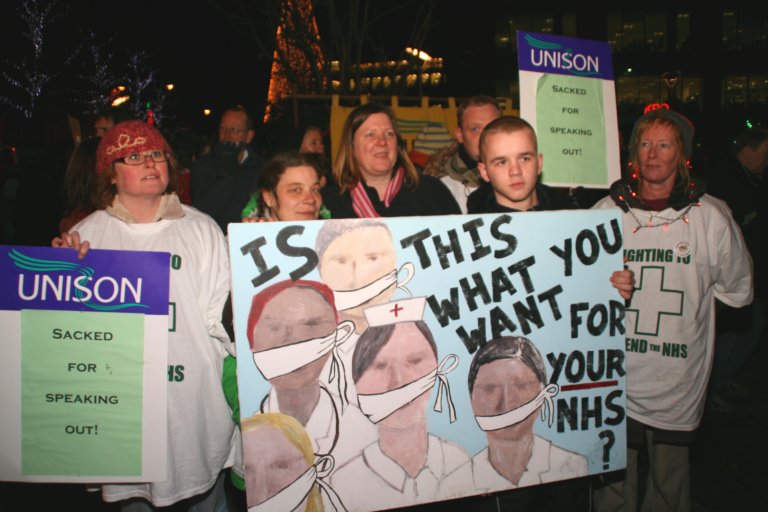
In 2007 Karen, who was then branch chair,  was sacked by Manchester Mental Health and Social Care Trust. This was because she spoke out against cuts and privatisation. Around 700 workers at the trust struck for 14 days in Karen’s defence, while 150 community mental health workers took several weeks of all-out strike action to demand that Karen  be reinstated to her job. Her campaign included union members and user groups. Karen’s  case went to Employment Tribunal and,  although she did not get her job back,   her campaign helped bring attacks on freedom of speech for trade unionists to national prominence.

Her belief in building alliances with union members, patients and the wider community is at the heart of Karen’s  politics.

Unions need to look outward. There are arguments within the unions about challenging the cuts agenda. Some centre around waiting for a Labour Government but there is a real difference between full time officer and ground level union activists. Fulltimers do not want to upset the capitalist system but the advantage of being political means that we can make alliances at a local level to challenge the cuts.

The Con Dem government are now trying to make £20 billion  cuts in the NHS. They want to reduce the number of hospitals in Greater Manchester from 12 to 5. Karen believes that the public will not accept this level of cuts;

We need a mixture of union and community campaigns. I believe the public will respond and be horrified at what is an unravelling of the NHS. The closure of hospitals and services at this level will mean that the service will be replaced by me and you.

Karen  is positive about the future,  although   scared about her own future as a health worker. Her politics give her hope for the future, though.  And her message  to young women?

The world is scary, but more so when we do not do anything. I have always tried to fight back and I don’t see any other way of getting a better world unless we do so. Fighting back, can change you, it can give you confidence and for me being in the SWP has meant that I feel I can make a difference.

If you have enjoyed this article and would like to support this blog by making a donation you can do using this button
Posted in anti-cuts, human rights, labour history, Manchester, NHS, political women, Socialism, trade unions, women, young people | Tagged , , , , | Leave a comment

Stop,Look,Listen…my weekly selection of favourite films, books and events to get you out of the house

Watch……Budrus (2009) a film about a Palestinian village which was threatened with having its land sequestrated by the Israeli government as it drove the building of a so-called security wall through Palestinian land. The documentary shows how the village people,  plus outside help from Israeli peace activists,  refuse to accept the destruction of their land. Even Fateh and Hamas, the usually opposing Palestinian parties, get together. Apart from the wonderfully inspiring story of people challenging a hegemonic force, I really liked the way the young Palestinian women took to the frontline, refuting stereotypes of domesticity and dependence, and put themselves sometimes literally in front of bulldozers. The film shows that even in the worst of times we can make a difference.

LookSnap! – my life in the Working Class Movement Library Mike Carter has been responsible for creating many of the exhibitions and leaflets that the WCML has produced. Now it is his turn to reflect on his own political life and the artefacts of the WCML. He has produced a stunning exhibition showing us many posters that are part of the collection, some that I knew and had seen before, but also a fantastic one of Black political activist, Angela Davis and one that was part of the campaign against Pinochet’s Chile and called for a boycott of their products. On show are the cartoons that Mike produces as a response to the nonsense of present day politics and his take on the game of Monopoly. It’s a brilliant exhibition and reflects not just his individual choice but that of someone who really loves the library and its collection.See

Listen…singer songwriter Claire Mooney (with Robin Sunflower) is at the Q Inn, Market St, Stalybridge SK14 2AL on Monday 8th October 8.30pm. All welcome. FREE!  See www.clairemooney.co.uk

Learn…about Sean McLoughlin On Saturday 13 October at 2pm Charlie McGuire will be coming to speak at the Library. His book Sean McLoughlin, Ireland’s Forgotten Revolutionary charts the remarkable story of a man who progressed from republican to socialist and communist politics and who not only played a major part in Ireland’s fight for freedom over several years but who also contributed to the struggle for revolutionary socialism in Britain in the early-mid 1920s .All welcome; admission free; light refreshments.

Support…. The Derby People’s History Group….Come and watch and discuss the film”The Plot to Kill Lloyd George” Alice Wheeldon: The Basic Story Thursday 11th Oct, 7. 45pm Friends Meeting House, Derby. And listen to top singer, Robb Johnson, perform his brand new song Alice Annie Wheeldon at Brunswick Inn on Saturday 27 October.

Remember….Marxist historian Eric Hobsbawn who died this week (1917-2012)…an outstanding intellectual who did not pretend to be objective. He understood what was meant by historical change and he had a major influence on historical research. Now we are left with Starkey, the Snows and the histories of the house…help!! See

Posted in art exhibition, Communism, films, human rights, Ireland, labour history, Palestine, Socialism, Uncategorized, women, young people | Tagged , , , | Leave a comment

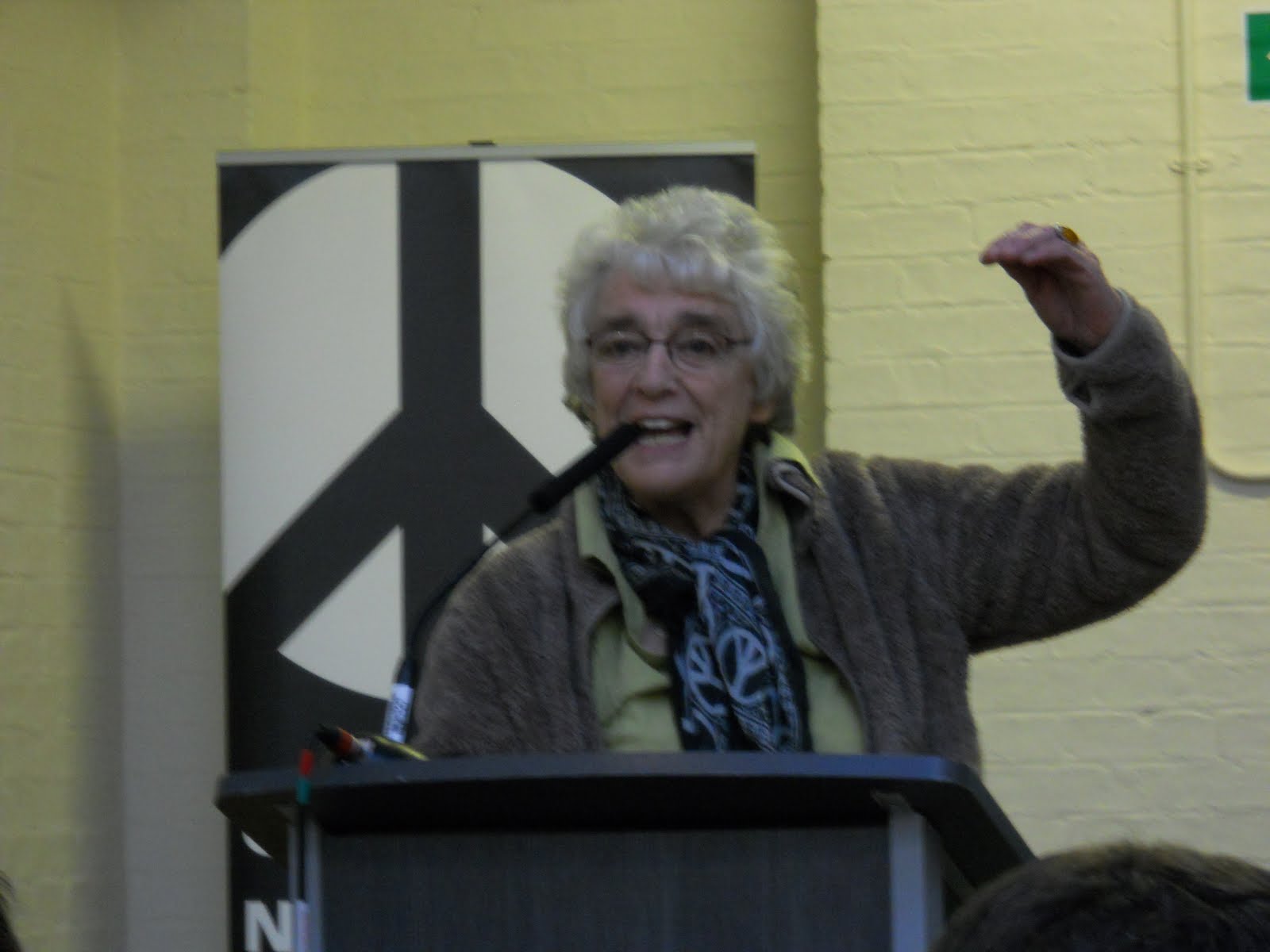
Political Women (5) Rae Street

Feminist, peace activist, environmentalist…..

Rae has been active in the peace movement for over 30 years. Born in Yorkshire, she didn’t come from a political family:

My mother was a working class conservative, due to growing up in dire poverty, where her earnings supported her family. From a Polish, Jewish immigrant family, she worked in a factory and she was desperate to become respectable”
Her father went at the age of 12 to work as a halftimer in the office of a local factory. His mother was widowed in 1918 and brought up him and his sister.

Rae benefitted from the post Second World War expansion of the education system:

I passed the 11+ and went to a High School. The teachers, who were mainly spinsters, did not like working class children entering the school. Luckily they had to draft in new teachers and I had a wonderful history teacher who taught us about socialism. The parents did not like it and complained to the head teacher!

She then got a place at Manchester University to study English but, unlike many of the students, she had to pay her way throughout her studies:

I felt like a fish out of water, with a Yorkshire accent and also I had to work every holiday to support myself at University. But I felt I learnt more from those jobs than I did in my studies.

Rae feels that there was a definite discrimination against her due to her accent and also her poverty:

I watched the Aldermaston March and, although I felt strongly about the issue, I felt I didn’t belong on the march because everyone seemed so posh.

After leaving University she turned down an opportunity to do research at Manchester because she didn’t know how she could fund herself through it and the Professor did not mention payment:

I just didn’t have the confidence to ask him about the money side so I gave up what could have been an interesting opportunity. But I returned to Leeds, completed a secretarial course, and eventually became a Publicity and Information Officer at what became Bradford University.

Her interest in peace work came out because of the times she was living in

I read the book Silent Spring by Rachel Carson which alerted people to the detrimental affects of chemicals in the environment. I also watched the film, Hiroshima Mon Amour, which woke me up to the tragedy of Hiroshima.

In the late 70s she joined the Labour Party, and became active locally. In 1981 Rae joined her local Peace group in Rochdale which was affiliated to the national Campaign for Nuclear Disarnment.

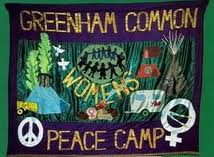
In 1981 the decision by the Tory Government to site Cruise Missiles at Greenham Common in Berkshire led to the establishment of the Greenham Common Women’s Peace Camp. It became the focus for peace activists, many of whom were women. In December 1982, 30,000 women joined hands around the base at the Embrace the Base event:


Greenham was a liberating influence for me and the campaign has had a long lasting effect. I went down to the Embrace the Base event. I took my youngest daughter, who was 8 years at the time, unfortunately she witnessed the police horses who were out of control, women were arrested and thrown in police vans. She was really upset by the violence and after that I decided I couldn’t leave her for long periods.

Rae’s activity grew with the peace movement. She became involved in the European Campaign for Nuclear Disarnment and in 1986 she took part in a lecture tour of the USA:

I spoke at many meetings, from large university halls to community and women’s group. It was a great success and for me personally it was a great success, they couldn’t hear my accent and there was no class bias

She has visited and spoken in Japan, particularly around the commemoration of Hiroshima:
The peace movement there is amazing. There are many young activists, their peace bulletin has over 1 million subscribers!

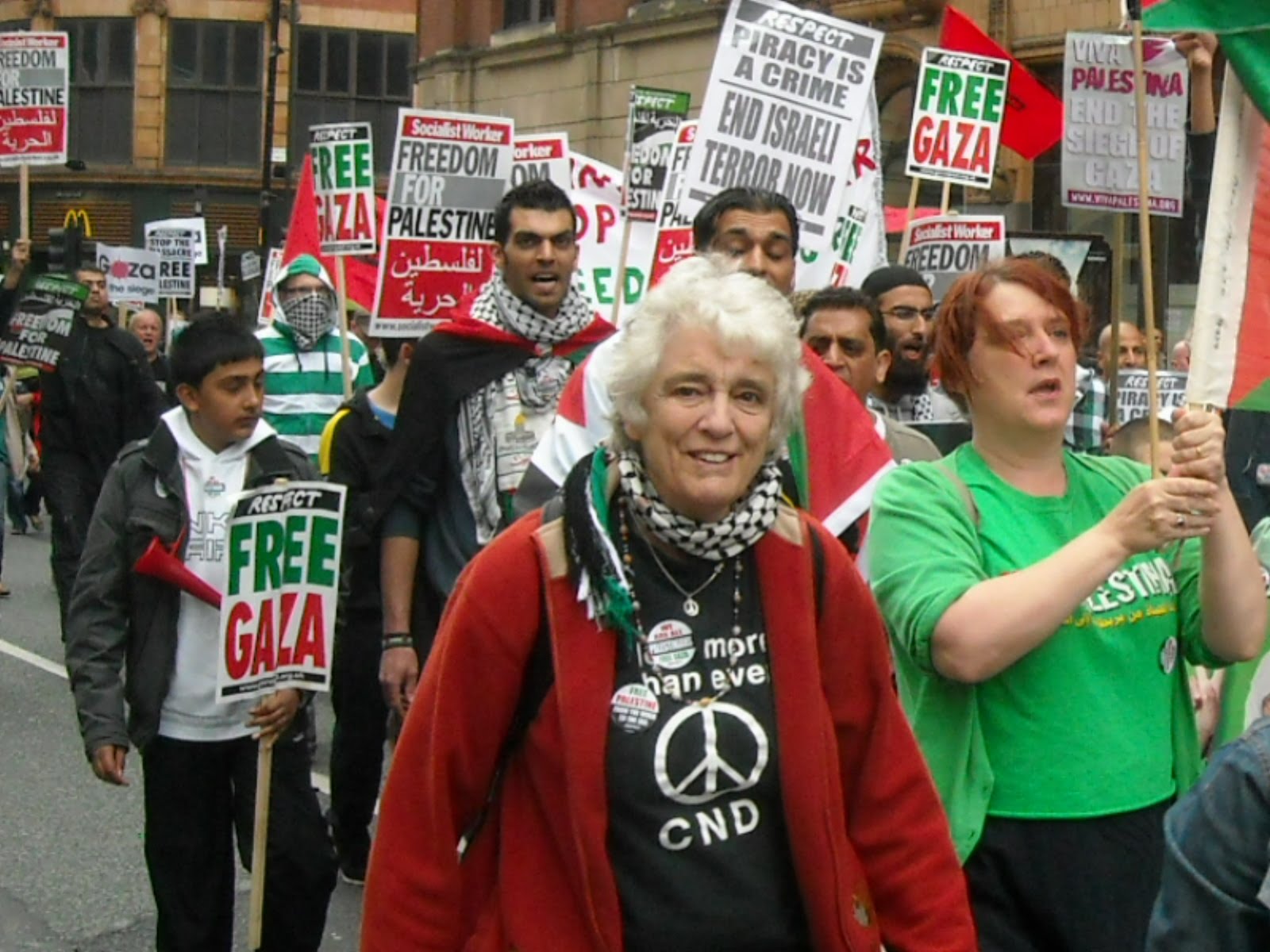
Over the years Rae has held many posts in local and national CND. Including chair of the Greater Manchester and District CND and Vice chair of national CND. She also founded the Campaign Against Depleted Uranium Weapons and is on the steering committee of the International Coalition to Ban Uranium Weapons.

I have taken part and ‘carried the banner’ over the years in many non-violent demonstrations, rallies, blockades, sit ins and just standing with placards. Locally I am a strong believer for campaigning in a visible presence: streets stalls and letters to the local press – and that I have done.

Rae has been able to be so active because her husband has been supportive. Her daughters have also been active in the peace movement. One of her daughters was arrested aged 16 at Greenham Common peace camp.

More recently Rae has been trying to bring more young people into the peace movement:

We have been trying to set up groups in Universities and looking at how we can encourage younger people into the movement. We have got a group of young people involved with the anti-Uranium weapons campaign. Through events such as our Peace festival we do try and get younger people to join us.

And her message for young women?

Get involved. It’s not a distant issue. Trident and anti-militarism are important issues. Never feel you cannot do something, whether it is in a local peace group or through your trade union. Don’t think that politics is for someone else, it is for everyone.

If you have enjoyed this article and would like to support this blog by making a donation you can do using this button

Posted in anti-cuts, biography, human rights, peace campaigns, political women, Socialism, women, young people | Tagged , , | 2 Comments

Stop,Look,Listen…my weekly selection of favourite films, books and events to get you out of the house

Watch..Big Flame by Jim Allen, Tony Garnett and Ken Loach. It was made in 1969 by the BBC when trade unions had some political as well as militant credibility. Jim was a Marxist and his politics reflect the subject matter and drive behind the script; that strike action for political ends is a legitimate democratic strategy. There are few images on tv or film that show working class people engaging in politics, particularly the politics of the workplace. That is only one of the reasons why this is such an important film. It gives back to working class people a belief that they can make change, that they have the power, and that collective action is the only way to achieve equality in society.

Read…Malkin Child by northern writer Livi Michael. Livi has written 12 books for children and 4 for adults. Many of her stories encompass the history of the north and her latest book is about the Pendle Witches. On the word of a nine year old, Jennet Device, her family and friends were arrested, put on “trial” and hung as witches in 1612. you can read my interview with Livi here

Celebrate…one of the most important events of the Second World War when Hitler was defeated at Stalingrad. This autumn  is the 70th anniversary of the Nazi onslaught on Stalingrad. The siege of the city and the eventual defeat of the Nazi war machine marked the beginning of the end for Hitler. An epic moment, the turning point of the war, a great anti-fascist victory that inspired millions all over Europe resisting the Nazi occupation. Philosophy Football have produced an anniversary range of teeshirts which are inspired by Anna Akhmatova’s poem the designs are based on a medal, a fuselage, a propaganda poster, a book title from the time and the slogan with which the Russian people greeted their eventual victory. Nobody is forgotten. Nothing is forgotten! Here is the poem

We know what’s at stake and how great the foe’s power,
And what is now coming to pass.
The hour of courage has struck on the clock
And our courage will hold to the last.
The bullets can kill us, but cannot deter;
Though our houses will fall, we shall remain.

Anna Akhmatova, 1942

Listen…to Sarah Gillespie at the Manchester Peace Festival. Finale concert with Sarah Gillespie
Saturday 6th October, the Night & Day Cafe, Oldham St, Manchester ‘Sarah Gillespie’s eclectic mix of Beat poetry with jazz, folk and Middle Eastern elements is a sonic reflection of the London street.’
Tickets cost £10 and £5 concessions more information here


Look
.Music & Liberation, an exhibition about Women’s Liberation Music Making in the UK (1970-1989) shows how feminists used music to entertain and empower women during the 1970s and 1980s. Featuring the work of Jam Today, the Northern Women’s Liberation Rock Band, Feminist Improvising Group, Ova, the Fabulous Dirt Sisters, Abandon Your Tutu, the Mistakes and many others, the exhibition brings together a diverse collection of women’s cultural heritage. Visit it from 1-14 October at Bureau ‘off-site’ Three Piccadilly Place Manchester M1 3BN

Get active
Monday 1 October Demonstration supporting Pussy Riot in London, , from 11 am till 1 pm, opposite the Russian Consulate at Bayswater Road.

Tuesday 2 October; Fighting Further Cuts…Manchester Coalition Against the Cuts. 7pm at NUJ. Further details;

On 4 October the trial begins in Turkey of 69 trade union leaders all of them women, from the public sector union on trumped-up charges of “terrorism”. See Labourstart. Please send a message of protest and support for the women.

Volunteer…for  Love arts festival in Leeds this month. The aim of the festival is to develop the role of the arts in health and social care, whilst enabling people who may feel excluded to take part in the rich cultural life of Leeds. Love Arts harnesses the power of the arts to explore mental health issues such as identity, stigma, social justice and even happiness! Further details contact fran.limbert@nhs.net and see website http://loveartsleeds.co.uk

Drop in…to Firebox in London..a new left wing café offering more than coffee and cakes. Launch party with Tony Benn on 6 October. Further details here

Posted in book review, films, human rights, Ken Loach, Manchester, music, novels, Socialist Feminism, trade unions, TV drama, women | Tagged , , , , , | Leave a comment

Political Women (4) Pia Feig

Retired active socialist feminist

Pia has been a political activist for over 40 years. She did not come from a political family but;

They were avowedly non-political, we did discuss politics at home but there was a real fear of getting involved because of being Jewish, of being immigrants, yet there was lots of discussion about it. Me and my sister would answer back to my father and that was the start of a protest position, right from the family dynamics.”

Her parents were both Jewish. Her mother was British and from an orthodox Jewish working class family. Pia’s father had fled Poland after his life there destroyed. He was grateful to Britain for asylum and for the right to be openly Jewish.

In 1970 Pia went to Oxford University and became active in university politics. It was three years later, when she took part on a demonstration about Britain’s role in Ireland, that she saw the big diference between student and street politics;

My very first demo which was about Ireland really frightened me. It was the large police prescence and the atmosphere was the opposite to all the student activity I had been involved in.

She identified as a feminist and became involved in the women’s movement:

The women’s group gave me fantastic support. It was very important in developing my thinking about being a woman, it was a source of emotional support, it encouraged me to have independent relationships. By this time I had moved to Glasgow and the women in the group were from a variety of ages and backgrounds.

Pia was now training to be a teacher and she joined NATFHE and the International Marxist Group, a small, hyper-active, Trotskyist group linked to the Fourth International:

Glasgow in the 70s was a highly political place. People understood their history and the May Day was a big event with people from all different parties taking part. I used to sell papers at factory gates and was treated with respect by the workers.

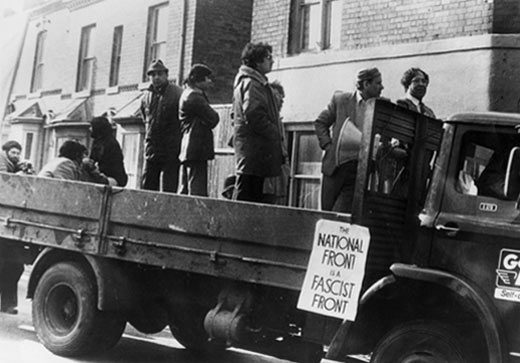
By the mid-70s race politics was a big issue for the left in Britain. The rise of the National Front and the increasing attacks on black people led to the rise of anti-racist activity. Pia moved to Wolverhampton, which at that time had had Enoch Powell as MP, and like many places in Britain at the time there was a lack of opposition to racism at all levels of society;

I lived in a mainly Sikh and Caribbean area of the city. I got involved with an anti-racist committee which included the Indian Workers Association. We campaigned against the (West Midlands) police harassment of black people and one thing we did was to convince the local Labour Party that the NF were fascists.

It was a time when to be involved in political activity was all encompassing;
I attended 5 meetings a week, plus paper selling and meetings at weekend. I felt connected with the world and part of a community, part of a struggle, part of a movement for change.

Although, like many people on the left at that time, she identified race as a key issue for herself to be involved in, she did not see her own ethnicity in the same way;

In my political development I lived in the here and now and looked at all the new possibilities for me. I didn’t integrate where I came from, as a person from a Jewish orthodox immigrant background, with my politics, at that time it didn’t seem as important. It does seem strange now, but it was partly because I was young but also because of the nature of the race politics at that time.

She did see the link between the harassment of black people and cases such as the Birmingham 6 and throughout her political life has been involved in many similar campaigns.

By the 80s Pia was no longer involved in a women’s group, but was still active as a union representative in her college:
I left the IMG because of political differences. I felt it was ineffective and was not relating to the political reality of the time.

She is still looking for a political organisation to become involved in but it would have to be one that reflected her political analysis;

It would have to reflect a class analysis of society, have an internationalist viewpoint and be anti-imperialist.”

In the mid-80s she joined the Labour Party, as a tactic, and became involved in Irish politics.

I have always seen the issue of Britain’s role in Ireland as crucial to politics generally. I was involved with the Labour Committee on Ireland which sought to influence the Labour policy on Ireland. During the Miners’ Strike I was involved with two delegations to the North of Ireland which included Miners’ Wives.

More recently Pia has been involved with the Palestinian Solidarity Campaign and out of that came her involvement with the Jews for Justice campaign:

It (JfJ) was a conscious raising group. I lived in Spain in the 90s and became more aware of my own identity. Being brought up Jewish had had an influence on me. It wasn’t about the religious aspect, but about the social and political context.

Pia was quite happy to use her Jewish identity to counter the way in which Zionists wanted to smear activists on the Palestinian issue as anti-semites.

She has been involved in her Unison health service branch for the last 8 years. She has seen the growth of the involvement of women in her union and she has been part of a radical union branch. But she feels that Unison has not reflected this level of female activity;
Unison is male dominated at an officer level. Nearly all the full timers are white and men.

This year Pia retired from work and is now starting to look at where she will put her energies:
Work has never been a substitute for my political activity. I will still be involved with the PSC. The issue of the Palestinians is very important to world politics. I am also still going to be involved with Unison, in organising a local retired members group.

And her message for young women?

I am not sure I have one! I have been impressed with the young women I have worked with in Unison. Some of them have told me that they have learnt from me and they admired my determination. I hope more women will come forward to take the leadership roles, not to end up as facilitators. That they will not be held back by gender or expectations of gender and will be involved in determining the direction of politics.

If you have enjoyed this article and would like to support this blog by making a donation you can do using this button
Posted in anti-cuts, Communism, human rights, Ireland, labour history, Middle East, NHS, North of Ireland, Palestine, political women, Socialism, Socialist Feminism, trade unions, women | Tagged , , , , , , | Leave a comment

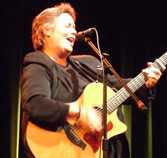
Political Women (3) Claire Mooney

Funny, as I meet the golden age

My life’s been one long story yet I have hardly filled a page

When (1997)

Claire was born and brought up in Manchester:

My parents were not really political but had a sense of social justice. I remember being told a story where a travelling family knocked on our door. Their son had fallen into a brook and wanted to use our bath and my parents agreed. They were very open and very generous.”

Her own politics have been driven by her experiences:

I have always been a leftie. I was involved with Socialist Unity when I was at University  in Birmingham and I have always been in a union. But Thatcher getting in was the biggest single event that pushed me into politics. It was horrendous and you just knew what was going to happen.

Working as a Housing Adviser during the Thatcher era made Claire aware of how things were changing for poor people and, rather than be involved in the system, she resigned and decided to become a full-time performer.

I started writing songs when I was 9 years old. At Uni I was involved in the Folk Clubs and I just thought,  I enjoy this but how can I make a living from it?

Her first professional gig was at the Haslingden Folk Club, run by radical folk singers Barry and Lyn Hardman:

They liked radical songs, unlke many folk clubs, who would hoik me off stage if I sang a leftwing song. It’s a lot better these days. To me, folk music is a chronicle of our times, that’s why I like it, the ballads are longlasting.

Claire has now been self-employed for 23 years. During that time she has worked on many community projects, run women’s music projects as well as developing her own singing and songwriting career:

It has been a fascinating time. In 1989 I got a record contract with Playtime, who launched Inspiral Carpets. It was a good experience but taught me that I didn’t want to be constrained by a contract and everything that went with it. So I set up my own record company in 1992

She was now in control of her career and also got on the rosta of Popular Productions. Run by comedian, Linda Smith and her partner, it gave Claire experience in working on radical gigs around the country with performers including Mark Steele and Mark Thomas.

Having my own record label meant  I could be in control of what I wanted to do and how I could do it. It was way ahead of its time, before Myspace. In 70s/80s there were a lot of women performers who then disappeared. Today there are more women singers but are they in control of what they do?

Claire’s songs reflect her politics and what she believes in. A big issue for her is domestic violence.  One of her most powerful  songs is Hitting Home which she wrote for a conference on domestic violence.

I have sung Hitting Home in pubs and had blokes come up to me and say “that was me”. Songwriting is such a phenomenal way of reaching out to people in so many different ways.

Music has become more accessible as technology means that people can produce their own songs in their own bedrooms. But for Claire, as the North of England representative for the Musicians Union, this has its drawbacks.

I do endless benefits and I am happy to do them. But music and performing is a profession and as such the expectation should be that performers get paid for their work.  Young people are vulnerable because they want to get gigs. But we are all being asked to do more for less.

And in the present austerity economy she believes it is women who are being most affected by public service cuts:

Last year I performed at the TUC women’s conferences and sang my new song “Rise Up” which addressed this issue. I believe women are the root of life and that is the reason why our lives are being affected by  the cuts.

As a lesbian she feels that, looking back over the last twenty years,  that life has changed for the gay movement:

Our rights have grown but we do not have equality. We have to be careful that we don’t get pushed back into the home. We are not to blame for the economic situation, it is the capitalists who are responsible for the mess. I worry about young people who think ‘we’ve got it’ but it is only temporary and our rights can be taken away.

Looking back over all the campaigns she has been involved with including Clause 28, Troops Out, Viraj Mendes and  many TUC demos,  she is positive about people’s capacity to defend their rights;

I do go on endless demos but I expect people to be there for me. If I am fighting for justice for the Anthony Grainger campaign and for trade unionists I expect them to be there for me as a lesbian fighting for my rights. We should all be working together.

And her message for young  women?

We should own ourselves. I think a lot of women are stopped, maybe we stop ourselves as we are thrown at things through the media. Women have to keep going, have our own voice and our own opinions. Women need to have songs that are about us, that we can relate to and they need to be out there.  But you have to follow what you believe in, that is essential.

To find out more about Claire or book her see


If you have enjoyed this article and would like to support this blog by making a donation you can do using this button
Posted in anti-cuts, human rights, Manchester, music, political women, Socialist Feminism, women, young people | Tagged , , , , | 2 Comments