Temperature rises in Greater Manchester campaign to save NHS!


If Nye Bevan’s famous statement the NHS will last as long as there are folk with the faith to fight for it is anything to go by, then the NHS is far from being finished in Greater Manchester.
Stephen Hall of GMATUC

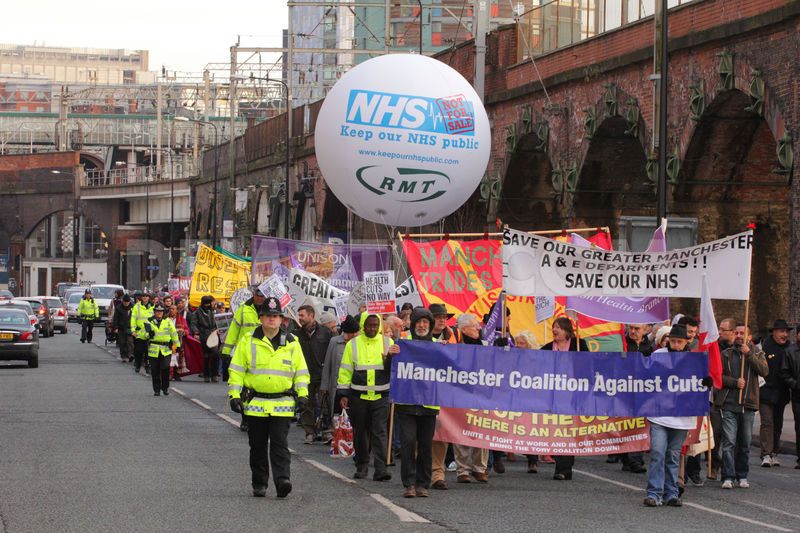
On Saturday 16 February more than a hundred activists gathered at the Friends Meeting House in Manchester to discuss the crisis facing the NHS. Although organised by the Greater Manchester Association of Trades Union Councils, it was much broader than the trade union movement in terms of the individuals and groups who turned up to the meeting. In her opening speech one of conference organisers, Pia Feig, outlined the scale of the health emergency; It is a wholesale assault on the welfare state. We need to organise a fightback against the cuts, at a local, regional and national level.

NHS save

Dr. John Lister of the Health Emergency Campaign stressed the importance of a united campaign and told the meeting about how thousands of people had demonstrated in Lewisham against the closure of their A&E. The campaign in London was broad-based including councils such as Ealing, as well as the trade unions. John said that; the priority is to keep services alive and to push every button to mobilise individuals and groups. He believed that the Tory Government was worse than Thatcher in its determination to tear up the legislation that had set up the NHS in 1946. He said: We have to defend services and make them fit for purpose.

Karen Reissman, of the Save Bolton A&E Campaign, explained how the cuts were affecting her hospital. Five hundred staff are at risk of losing their jobs. That means five hundred people not working in our hospital will seriously compromise the health of local people. In Bolton 30,000 people have signed a petition to oppose the cuts and had joined the healthworkers in the campaign to save the A&E. Karen told the meeting that in Mid-Yorkshire the healthworkers have gone on strike over the cuts and she encouraged people to send messages of support to the strikers. For further details on this strike see
save bolton a&e

In the workshops a variety of individuals and groups spoke about their own local activity. Jo Harding, of the Save Trafford Hospital Campaign, told participants how their campaign started with just two people and that regular street stalls and petitioning had galvanised the local community in a high profile and positive campaign. She said that the petition was the most powerful tool in raising public awareness and it was the first time that people found out about what was really happening. Every week campaign members went out to towns across the borough to do street stalls and challenge the blatant lies that the officials were putting out. They had put the petition on the internet and, whilst recognising that this was a good way of contacting some people, it did not have the impact that talking to people face to face had.
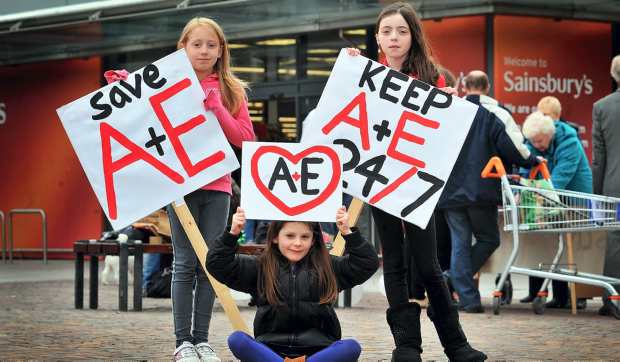
save trafford a&E

Some people had become organised through the internet based lobby group 38 Degrees. Speakers from Stockport, Bury and Salford explained how they had become active by signing petitions through 38 Degrees and were now involved in work on the local Clinical Commissioning Groups. A representative from Manchester University told the meeting how he had taken a one year sabbatical from his medical degree to run their campaign to Save the NHS.

Several members of Unison members were at the meeting and they spoke about the atmosphere within the hospitals and the difficulties of union activity when £20 billion worth of cuts were being demanded by the Tory government. They felt it was important to join with the public in order to build up a campaign to challenge both the cuts in jobs and defend the service.

The conference ended with a variety of activities being planned, including linking up with other campaigns for a week of action in May, helping other people to organise local campaigns across Greater Manchester, and building up contacts with other campaigns that are facing cuts, including the Fire Brigades Union.

Pia Feig summed up the day: I think the best thing that came out of the conference and it was timely, was that it brought together people who are organising in a small way and they could meet with people from their area and share resources, and create informal networks where people can decide what is the best thing to do in their locality. For the Unison members who attended I think it showed them that there are people outside the NHS who want to work with them and it will boost their confidence in defending the service from the inside.

Next meeting:
Thursday 28 Feb, 7pm,
room G1 at the Friends Meeting House,
6 Mount St., Manchester city centre
Room booked as “GMATUC / Keep Our NHS Public”.

Andy Burnham has agreed to speak at a public meeting on
Friday 8th March 6pm Bolton Town Hall.
The Staff Side Committee of Bolton Royal Infirmary have agreed to host the meeting (after meeting local MPs, who are all on board).

Further information on  Keeo our NHS Public see
See my article on NHS campaign

If you have enjoyed this article and would like to support this blog by making a donation you can do using this button

Posted in anti-cuts, human rights, labour history, Manchester, NHS, trade unions | Tagged , , , , | 3 Comments

Stop,Look,Listen…my weekly selection of favourite films, books and events to get you out of the house

Watch…..Modernity, municipalism and light: 100 years of Blackpool Illuminations
at Manchester City Art Gallery on 21 February at 6.30pm.
Sadly going to see the illuminations is one of the few reasons to visit Blackpool these days. Blackpool Illuminations, the seaside light show which is a unique autumn tourism event, was 100 years old last year. Blackpool has declined as a holiday tourism destination since its heyday between the war and a combination of council budget cuts and the rise of other forms of entertainment has massively affected its popularity. At this event you can watch three short films depicting pre and post-war Blackpool, featuring aspects of the Lancashire coast, holidaying and attractions in Blackpool and, of course, the Illuminations themselves.
Dr Steve Millington from Manchester Metropolitan University will introduce the films from the North West Film Archive. This event is organised by Manchester Modernist Society, North West Film Archive and Manchester Metropolitan University. Its free but booking is essential, book tickets at.

Celebrate………on 7 March…Derby Peoples History Group has invited historian Louise Raw to speak about her fascinating book on the Bryant & May matchwomen’s strike of 1888, Striking a Light . Not just the history of a struggle but a reminder of how women together can collectively improve their lives. To find out more about her book, see
Derby Peoples’ History next organising meeting is 21st February at Friends Meeting House. 7.30
Further info see

Oppose…fracking and find out more about it…..Greater Manchester Anti-Fracking & Climate Activists Meeting – Tuesday 19th Feb, Friends Meeting House, 7.00pm
With companies such as IGas looking to develop CBM extraction as well as fracking for shale gas as early as 2014 within the Greater Manchester area, and Davyhulme Sewage works potentially also to become the site for the processing of billions of gallons of toxic frack waste water from all over the North West, this meeting aims to begin a discussion amongst local anti-fracking and climate activists, as well as other environmental campaigners, on how we might best work together across the city region as well as regionally and nationally to stop it.
This meeting is organised by Wigan Green socialists. For more information see Wigan Green Socialists

Support….Central American Film and Food night on Friday 15th March, 6.30pm, at the Inspire Centre 747 Stockport Road Manchester M19 3AR

Freedom from Torture (FFT) has been working for 25 years to provide medical and psychological support to survivors of torture who arrive in the UK, as well as striving to protect and promote their rights. Since its inception, over 50,000 individuals have been referred for help. Many are referred to FFT’s centre in Manchester, who have come from countries as diverse as Iran, Afghanistan, Sri Lanka, Democratic Republic of Congo (DRC), Turkey, Pakistan, Sudan, Nigeria, Cameroon and Uganda. FFT relies on individual donations for about 3/4 of its funding.

Special screening of The Echo of Pain of the Many – a personal story of ‘the disappeared’ in Guatemala. Over four years, Ana Lucia Cuevas traced the involvement of her own government and foreign intelligence services in the abduction, torture and murder of her brother and his family. The film will be followed by a Q+A session with the the Director, Ana Lucia.

Tickets £15 including film and a delicious Guatemalan meal. All proceeds to Freedom from Torture.
To reserve/buy a ticket email cglend@hotmail.com or anicolay@freedomfromtorture.org; or text 07739 797027.

Go for a walk…during International Womens Week……
Sunday 3 March, 11.45am Women at Peterloo.

This walk will explore the role of women in the radical movement and
highlight their part in the events of Peterloo on 16 August 1819.
Meet at the Friends Meeting House, Mount Street. Please note that it
will include a walk up to Ancoats and back. Fee £6/£5. Advance
booking strongly advised.

Friday 8 March, 10. 45am. Up Then Brave Women; Manchester’s Radical Women.

On International Women’s Day, this walk explore the rich radical
history of Manchester and the role played by women. It will include
the Owenite feminists, the Clarion movement, women journalists on the
Manchester Guardian amd women artists. Meet at the Robert Owen
statue, outside the Co-op Bank, Corporation Street. The walk will
end at Three Minute Theatre on Oldham Street for tea and biscuits.
Fee £6/£5. Advance booking strongly advised.

Sunday 10 March 11.45am Votes For Women

This walk explore the history of the campaign for votes for women from
1868 to 1928 and the role played by Manchester women such as Lydia
Becker, Eva Gore-Booth, Esther Roper, Margaret Ashton and the
Pankhurst family. Meet at the Friends Meeting House, Mount Street.
Fee £6/£5.
Advance booking strongly advised.
The walks will be led by Michael Herbert, author of the recent book Up Then Brave Women Manchester’s radical women, 1819-1918.

More information and booking : redflagwalks@gmail.com.

Posted in feminism, films, human rights, International Women's Day, labour history, Manchester, political women, Socialism, Socialist Feminism, trade unions, Uncategorized, women | Tagged , , , | 1 Comment

Community Cohesion at its best : Oldham Unity Destitution Project

22 February is Destitution Awareness Day- what is the reality for people who are destitute and and do we have a responsibility towards helping them? This is an account of a day I spent at the Oldham Unity Destitution Project last summer……………

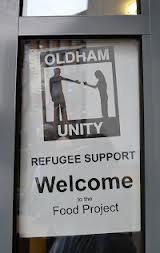
It is one of the sunniest days in Oldham and the Baptist Church is packed as the weekly Oldham Unity Destitution Project gets going. In the kitchen older local women from the church and two young, brightly dressed, Muslim women are serving hot food and drinks. In the main hall people from many different countries are sitting at tables, enjoying the food and, of course, cups of tea. In the creche the children are playing, whilst their parents are making their choice from the tables of food that stretch across three of the walls.

oldham unity

The Oldham Unity Destitution Project started after the riots nine years ago as a befriending project for asylum seekers , since when it has expanded to provide a vital service for the growing destitute community in the Oldham area. Every week without fail it provides a food parcel worth £6.50 to at least 50 destitute refugees. This consists of basics such as rice, lentils and tins of tomatoes.

Stewart Bailey, secretary of the group, tells me that: the project responds to a humanitarian need. Destitution means that people have fled conflict in countries including Iran, Iraq, Afghanistan and Palestine,just to mention a few. Many are traumatised and have to prove their refugee status. They often fail due to personal factors such as trauma and a lack of proof, as well as not being able to access legal support. Whilst in this process the government supports them with housing and a small amount of money. But, once they are deemed as not eligible as refugees, they have all their housing and money withdrawn and become destitute. Even if they want to appeal, it is difficult due to the changes in Legal Aid to get solicitors to take up the case, while dedicated services such as Oldham Law Centre has now closed.

Even for people who decide that they are prepared to go back to their home country it is not straightforward as Stewart explains: These people can apply for Section 4 funding which will provide financial support whilst they are waiting to return home. But not everyone is accepted and some countries such as Iran will not accept them back anyway.

The Red Cross attend the project each week and check people’s eligibility for destitution support. They are able to give limited financial help for the first year. After that the project, which is not a charity, has to meet the costs, raised by regular appeals.

The project is run entirely by volunteers. As Stewart says; People get involved because of their philosophical or political views. We range from Marxists to Methodists. Many local faith groups provide support, including the Baptist Church who provide a city centre venue. Other churches provide weekly food collections while the Pakistani community provide storage for our food. On the day I was there,during Ramadan, Islamic charities were providing bags of food including fresh meat, a rare treat for the recipients as the project has no cold storage facilities.

Ruth and Mike, volunteers, sort donations.

Ruth and Mike, volunteers, sort donations.

The project has built up good local links with NHS services Local medical and dental practices will register people and will accept the Baptist Church as an address, Stuart explains: Many of the refugees come from war torn countries and need counselling and so the project refers them to the Freedom from Torture service.

One of the people using the project when I visited was Ali, a Kurdish young man who had fled Iran due to his political activity. He told me his story: I came from Iran nine months ago and applied for asylum. They rejected my claim and now I have no housing or money. I come to the project for food and clothes. In Iran I was a football player and I want to get back into this. Mike Luft, one of the volunteers, has been helping Ali to link up with local team FC United.http://www.fc-utd.co.uk.

fc united

They have been very positive in supporting some of our young men. It’s not just about giving them food and clothing, its about helping them to join the society we are all part of. Mike and his wife Heather provided practical support by taking Ali to the sports training ground so that he can join the weekly training group.

Robin Pye, who co-ordinates the community and education work at FC United, told me of their work with asylum seekers and refugees: FC United want to benefit the community we serve so we provide support to groups that have differing needs. including unemployed young men as well as asylum seekers. We recognise their particular problems of loneliness and extreme poverty.We offer sports training as a way for them to integrate into life in Manchester. Football has an international language and can help these young people by getting involved in the sport and making friends.

Stewart says that: the project is Community cohesion at its best. We work from the basis that these people are homeless and hungry, and ask the question; what can we do about it?

If you have enjoyed this article and would like to support this blog by making a donation you can do using this button
Posted in human rights, young people | Tagged , , , | 1 Comment

Stop,Look,Listen…my weekly selection of favourite films, books and events to get you out of the house

Watch…..No(at Cornerhouse)..set in Chile in 1988, where the fascist dictator Pinochet is still in power and wants another 8 years. Under pressure from the international (read the USA) community to legitimize his regime he agrees to hold a referendum, to decide Yes or no. Gael Garcia Bernal plays Rene Saavedra, a young advertising executive who is seems to be living the modern, affluent Chilean lifestyle, who designs the No campaign. His decision to work for the left brings him into conflict not just with his partner in the advertising agency, and the left activists, who are suspicious of his marketing approach. The film reveals his own radical past. One of the undeveloped aspects of the film is his relationship with his ex-wife and mother of his child whom he looks after. She appears, generally at night, to see her son and then as Rene becomes more involved with the No campaign we see her being targeted by the police and brutally beaten and dragged off. In the end the regime loses the referendum and a democratic government was elected.
For many Chileans this was only the beginning of trying to find out the truth about the disappearance of their loved ones. No, shows how the left can triumph even after many years of fascism, dependant, of course, on those brave people who say yes to living in a truly democratic country.

Celebrate…it’s a hundred years since the birth of Rosa Parks aka The Mother of the Civil Rights Movement. On 1 December 1955 , in Montgomery, Alabama, Rosa refused to obey bus driver James F. Blake’s order that she give up her seat in the colored section to a white passenger, after the white section was filled. She wasn’t the first person to do so, but she was determined to challenge through the courts the Alabama segregation laws. Parks’ act of defiance and the Montgomery Bus Boycott became important symbols of the modern Civil Rights Movement. She became an international icon of resistance to racial segregation. She organized and collaborated with civil rights leaders, including Edgar Nixon, president of the local chapter of the NAACP; and Dr. Martin Luther King, Jr., a new minister in town, who gained national prominence in the civil rights movement.

On Monday 11 February at City Library, Elliot House, 151 Deansgate Manchester from 1-2pm Lou Kushnick will talk about Rosa’s life and why we should remember her.
Book free tickets at http://www.rosaparkscentenary.eventbrite.co.uk or call 0161 234 1317 for more information.

Learn about .Walter Tull, only the second black professional football player, and one of the few black officers in the British Army. He was a war hero during the First World War and in the play Tull at the Bolton Octagon this month we also find out about his relationship with suffragette, Annie Williams. Phil Vasili has written a biography Walter Tull, 1888-1918: Officer, Footballer and he has collaborated with the playwright David Thacker to develop the play. It looks to be one of the most interesting and relevant plays that are on in the northwest this season. Further details see

Eat……and make your views heard.….. , Salford based theatre company Quarantine are offering you a free lunch at Manchester curry house, the Kabana Café, if you talk to them for half an hour. It is refreshing that a theatre group want to listen to their customers and maybe other companies should follow when going to the theatre is a luxury item. For more info on the monthly curry and chats visit http://www.qtine.com or you can book your place by emailing info@qtine.com or calling 0161 830 7318.
Next date is Tuesday 19 February 2013
Time: Half hour slots between 12 noon – 2.30pm
Venue: Kabana Café
Address: 52 Back Turner Street, Northern Quarter, Manchester M4 1FP

Reclaim the Night…..in Manchester on Thursday 21st February. Organiser Tabz O’Brien says: it will be a lively, creative march filled with colour, light and sound. The event is open to the whole community, to demonstrate women’s right to walk the streets at night free from sexual violence, street harassment and assault. The march starts at Owens’ Park, Wilmslow Road, Fallowfield at 7pm, where a neon parade will head down Wilmslow Road towards Manchester Students’ Union. The march will be led by a women’s-only block, open to all self defining women, and followed by a mixed march open to all genders. The evening continues with the Reclaim the Night After Party, a festival of the finest women talent, with live comedy and music, arts and crafts, fun activities, community stalls and DJs from 9pm until late. Further see

Read about……. the northern spirit…a website exploring all aspects of what it means to be northern. The latest post is by talented writer Chrissy Brand and its about my favourite place in the northwest the WCML… This is just one of Chrissy’s posts, she also covers Manchester Town Hall, businesswoman Elizabeth Raffald, and gig-goer Dave Eckersley. It is her series of Manchester Movements and Manchester Moments exploring her love of this part of the northwest. See

And don’t forget… Emergency Summit on Future of NHS in Gtr Manchester …. 12 noon, Saturday February 16th, 2013 Friends Meeting House, Mount Street, Manchester. M2 5NS. See you there!

Posted in Uncategorized | Leave a comment

People Power Can Save Our NHS!

In the North West of England the threat of privatisation of the NHS is being opposed by a mixture of traditional, such as trade unions, and new organisations, such as 38 Degrees: a reflection of the fact that many people see this as their health service and an essential part of the fabric of this country.

In Greater Manchester up to five local Accident and Emergency units are facing closure or downgrading under the proposed “Healthier Together” Review. In Rochdale the A&E has already closed. In Trafford, the birthplace of the NHS, local people have campaigned to save the A&E and, although last month the NHS Greater Manchester approved its downgrading to an urgent care centre, the matter has been referred to Health Secretary, Jeremy Hunt, by Trafford Council’s Health Scrutiny committee. Other local NHS services have also been privatised or face the axe to achieve alleged “efficiency savings”; the further “rationalisation” of services and spending cuts.

Nye Bevan and Trafford Hospital

Nye Bevan and Trafford Hospital

In Trafford Steven Tennant-Smythe is typical of the people not previously active who have become involved in campaigning against NHS cuts through the internet lobbying organisation 38 Degrees: I am not an NHS worker, not in a trade union, not politically active and I have voted for all the political parties. He became involved with 38 Degrees by signing their petitions and it was almost accidental that he became involved in a group: 38 asked if anyone would organise the handing-in of the petition, I waited a few weeks hoping someone else would do it and when they didn’t come forward I agreed to do it. Together with 15 other 38 Degrees members from his area, he handed in the petition concerning the make up of the Clinical Commissioning Groups.

Since then Tennant-Smythe has regularly organised street stalls across the towns of Trafford to raise the issue of the increased marketization of the NHS, getting people to sign postcards against the use of private providers and then delivering the postcards to GP surgeries:

There are about thirty five people in our group and their ages vary from 20s to 70s.” He feels that the campaigning by 38 Degrees has had an important effect; “It has got all kinds of people involved and has been a resurgence of democracy in getting people interested in the issue.

1355006231-stop-the-cuts-and-save-the-nhs-protest-underway-manchester_1665055

Gary Parvin from Glossop in Derbyshire would echo those sentiments. He is a local Labour councillor, NHS worker and Unison member. He became a councillor in 2011 and was involved in setting up a local NHS Watch: 38 Degrees is a new way of organising politically. It has brought in new people to the NHS cuts campaign who have not been politically active before and has given them confidence in getting involved. But while online petitions have been useful, Gary feels that this doesn’t always then lead on to people coming to meetings and doing collective work: I am not sure whether it’s a question of time poverty, maybe the older people who turn up at the street stalls have more time to get involved.

In his local area, Glossop, he has been involved in doing street stalls to raise awareness of of the use of private providers by GPs and alerting people to the threat of the closeure of local A&E services: NHS Watch is a broad based campaign and we want to see as many people as possible get involved.

Stephen Hall of the Greater Manchester Association of Trades Union Councils sees the issue over the NHS cuts as a crucial one for organisations on the left; Greater Manchester is at the vanguard of the privatisation of the NHS. We need to step up to the plate and empower local people to organise their own campaign group.

Over the last few months he has been organising groups across Wigan to raise the issue of the closure of the local A&E and encouraging people to set up a local group: Most of the people who turn up have never been active in a campaign, but once we tell them about the threat to their local services they then understand how important it is to do something.

GMATU, is not just offering to help people set up a campaign but have also established a fighting fund so that people can afford to book rooms and speakers and pay for leaflets. As he says; It is not a question of GMATUC doing everything but empowering people at a local level to set up their own campaign. We cannot substitute ourselves for a mass campaign, which is what we need.

On Saturday 16 February at the Friends Meeting House in Manchester, GMATUC and a number of groups and individuals have called an emergency summit to bring together all those who want to do something about the NHS cuts. Amongst the speakers at the summit will be Dr John Lister, Information Director of the National Health Emergency campaign, and Dr David Wrigley, a local GP, who is a member of the Keep Our NHS Public campaign group (KONP0, as well local campaigns such as the Campaign against Manchester Ambulance Privatisation and NHS User Groups.

The conference will be an opportunity for people to meet together and plan a strategy for opposing the cuts. It will also allow individuals and groups to find out about what is happening locally and gain skills in how to set up local NHS campaign groups. Hall says:Local community campaigns have already started across the city region – we want to bring them together to share their experience, pool resources and make the strongest possible impact…The NHS belongs to local people – we urge them to come and join us in the fight to save vital life-saving services which we all value. The NHS is a much-loved public service. Now the public need to stand up to save it. People power can save our NHS.

Greater Manchester Health Emergency Open Conference Saturday 16 February 12-430pm Friends Meeting House, Mount Street, Manchester.
Further details email Stefan.cholewka@btinternet.com

If you have enjoyed this article and would like to support this blog by making a donation you can do using this button

Posted in anti-cuts, Manchester, NHS, trade unions | Tagged , , , , | Leave a comment

Stop,Look,Listen…my weekly selection of favourite films, books and events to get you out of the house

Watch…Lincoln (2013)…in the 1860s Manchester textile workers supported the economic blockade of the southern states of America, even though, as the supply of raw cotton dried up, many of them lost their jobs. Lincoln sent a letter of thanks to the people of Manchester and you can see a copy of it on the Lincoln statue in Brazennose Street in the city centre. This film deals with the last months of the American Civil War and Lincoln’s successful attempt, by any means necessary, to pass an amendment to the Constitution abolishing slavery in the USA. It is an anti-war film, graphically showing battlefields and injured soldiers. His own personal life is touched by the death of his young son, whilst his older son wants to join the war. Daniel Day Lewis plays Lincoln as a deeply humane person, whilst not underplaying his sharp politicking to get his anti-slavery legislation through the Congress.

See…The Trojan Women, a production by Salford City College. First performed in 415BC, this rewritten and reworked piece comments on modern warfare between the Middle East and West, and how wars in these countries have changed the role of women in their society, forever.
Tuesday 5 February – Friday 8 February 2013 at 7pm
Ben Kingsley Theatre Pendleton Sixth Form Centre Tickets can be purchased at the Ticket Office in the collge or by phoning 0161 631 5000.

Read…. Raised from the Ground by Jose Saramago (1922-2010). He was a Portuguese writer and Communist who wrote novels that reflected his politics, most notably in Raised from the Ground. A novel based own background (his parents were landless peasants) in which he describes the lives of the poor of Portugal. “What kind of world,” it asks, “divides into those who make a profession of idleness and those who want work but can’t get it”? . Buy it from

Support. Freedom Books,.one of the oldest and largest anarchist bookshops in the country. It doesn’t just sell books, but provides essential services such as drop-in sessions on Sundays for people seeking advice on prisoner support run by London Anarchist Black Cross and, on Fridays, advice on the law from Legal Defence and Monitoring Group. Last Friday they were firebombed and need donations to help replace stock and repair the shop. See

Don’t forget….LGBT month at the Working Class Movement Library on Saturday 9 February as they mark both National Libraries Day and LGBT History Month with a talk on Eva Gore-Booth and Esther Roper by Sonja Tiernan, who used the Library for her research. See my review of Sonja’s book at
The talk begins at 2pm, it’s free, and everyone is welcome. Further information see wcml.org

Help save the NHS….. Up to five local A&E units across Greater Manchester are under threat of closure or downgrading under the proposed “Healthier Together Review” of how local NHS services are provided and, or as a result of other cutbacks, or alleged efficiency savings or so-called improvements to NHS services. In order to help prevent this and to better co-ordinate fight to save ALL OUR Greater Manchester A&Es, hospitals, ambulance and other NHS services – GMATUC in conjunction with Greater Manchester Keep Our NHS Public are organising an Open Conference on 16th February in Manchester city centre .Speakers include: Dr. John Lister (Health Emergency Campaign) Dr. David Wrigley (NW GP – Keep Our NHS Public)
The organisers want to encourage all people who are concerned about the attacks on the NHS to attend the conference. It will give people the information and support in order to start their own local campaign. Further details see

Finally a song to cheer us all up…see

Posted in anti-cuts, book review, Communism, drama, films, human rights, labour history, Manchester, NHS, novels, political women, Salford, Socialist Feminism, trade unions, Uncategorized, women | Tagged , , , , , | 1 Comment

Celebrating the Manchester International Brigaders!

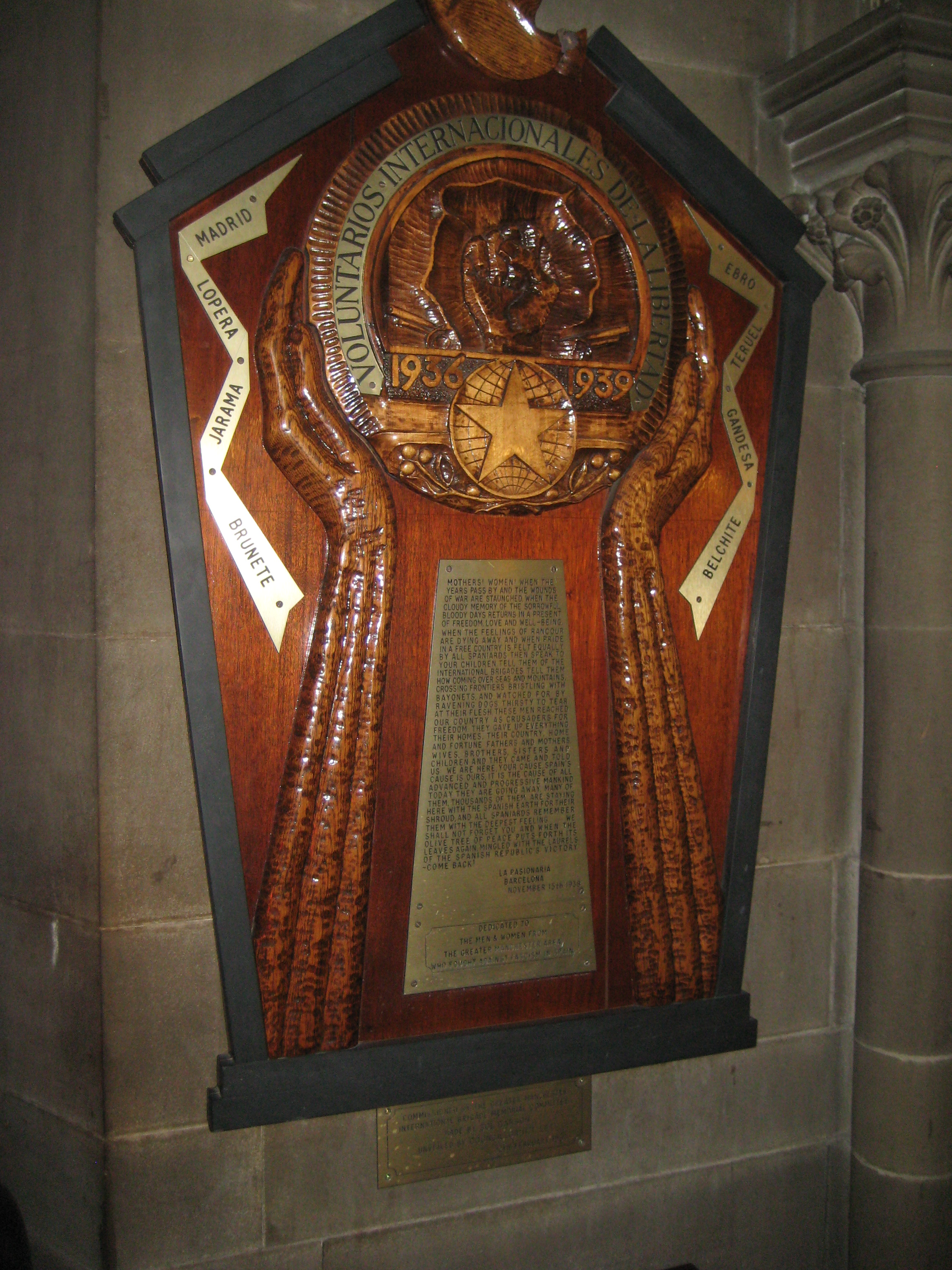
Squeezed between the cosy couches and afternoon teas in the Sculpture Hall of Manchester Town Hall is a plaque to those people who dedicated their lives to one of the most important struggles of the 20th Century, the fight against fascism in the Spanish Civil War. Why was Spain so important? And why did some many working-class young men and women from the Manchester area,make their way to the battlefields of Spain?.

IMG_2913

Benny Goodman, an International Brigader, explained in 1996 why he fought in Spain;

There were no financial inducements to go to fight in Spain. We weren’t mercenaries.We were idealists.

People like Benny grew up in an era when there was a rise in fascism across Europe. Hitler and Mussolini came to power on the backs of destroying democratic organisations and killing their members. In Britain, the Tory government (and Tory establishment) covertly supported the German and Italian regimes. The rise of Mosley and the British Union of Fascists showed that there was nothing foreign about fascism and its physical force mentality.

Across Britain people organised against Mosley and his armed gangs. On 29 September1934 he brought his Blackshirts to Belle Vue in Manchester. Local trade unionists and communists ignored a police ban on marches and held a protest meetin whilst , some people went into the meeting and shouted Mosley down.

Like today, in the 30s, there was a worldwide economic crisis, leading to mass unemployment and a level of social deprivation that is unheard of today. Walter Greenwood, in his novel Love on the Dole, showed how this poverty ground down every aspect of peoples’ lives. Greenwood knew what he was writing about, he came from Salford and was close to the communities he wrote about. For me the power of this book is the way he showed how people did fight back against the system and incorporated into the book is a real event when the local branch of the National Unemployed Workers Union took to the streets of Salford in October 1931 to protest against cuts in benefits.

The election of Popular Front governments in Spain and France in 1936 gave hope to socialists that there could be opposition to the rise of fascism. But as we now know, although it was Franco who led the revolt against republican Spain, he was supported by Hitler and Mussolini who were playing a bigger game in their plan to take over Europ
A number of countries signed a Non-Intervention agreement, which meant that they would not sell or send arms to Spain. These countries included Germany, Italy, the USSR, Britain and France. Germany and Italy, however, continued to support Franco with aeroplanes, tanks, and troops. Most importantly the American oil company, Standard Oil, with the backing of the US government, gave Franco the fuel to win the war.

In 21st Century Britain it is hard to explain why so many people were outraged at these events. But we are talking about a highly politicised working class who understood history and had been active themselves in many trade union and political struggles.

Organisations such as the Manchester and Salford Trades Council had throughout the 30s informed people about the rise of fascism globally. It now organised a series of events to educate and organise people to help Spain. Meetings were arranged to raise money for the National Council of Labour and the Spanish Appeal Fund. The film Defence of Madrid was shown and meetings and demonstrations were held across the city.

But some young people decided that they wanted to do more and that meant going to Spain and joining the armed forces. They left England, mostly in organised groups (although some people made their own way) and when the frontier between France and Spain was closed, they had to cross the Pyrenees, often at night. We still do not know how many people fought in the International Brigade as many used false names the British Government had passed legislation to stop people joining the Spanish republican forces.

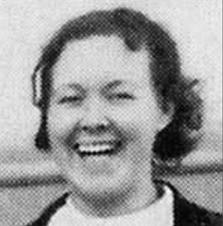
Many people from Manchester went to Spain to work in the medical services. This included 22 year old nurse, Lillian Urmston of Stalybridge in Tameside. Her work meant nursing the wounded in caves, dodging bombing to reach injured soldiers, and fleeing across the Pyrenees whilst still caring for the sick and wounded.

Lillian Urmston

Lillian Urmston

She later recounted;

On the way the Fascists were right behind us and the French didn’t want us so we were interned with the refugees in France.

Syd Booth left school at 14 and became a railway worker. He joined the Communist Party and became a leading trade union activist. As an activist in the anti-fascist struggles he saw the importance of the war in Spain and, like his mates and younger brother, he followed them and joined the International Brigade. He spent many months fighting in Spain until he was wounded and returned to England. Back home he was active in the International Brigade Association and he designed this sculpture which was dedicated to the Manchester Brigaders.

Sid Booth

Sid Booth

The sculpture came about because Councillor Mike Hynes felt there should be a permanent memorial to the Manchester men who fought in Spain in the XV Brigade. A Greater Manchester Spanish Civil War Memorial Committee was formed, including WorkingClass Movement Library founders Ruth and Eddie Frow. Financial support for a plaque was provided by Manchester Trades Council, Labour Party organisations, MPs and individuals.

On 12 February 1983, the 46th anniversary of the Battle of Jarama, it was unveiled by the Deputy Lord Mayor of Manchester City Council. The plaque includes the names of the battles where International Brigaders fought and the farewell speech to them by the famous Pasionaria.

For many years an annual commemoration took place in February each year to remember the XV Brigade. Next month on 10 February from 11.30-12. 30 there will be a re-dedication of the plaque. Hilary Jones, one of the organisers of the ceremony said:

We are commemorating the 76th anniversary of the Battle of Jarama -when the British Battalion of the International Brigades first went into action and succeeded in holding back the fascist attack on Madrid . Approximately 150 men went from Greater Manchester ..with 46 killed. We are also honouring the contribution of the men and women of Greater Manchester who helped the Republican cause in the Medical aid for Spain movement.


The event is organised by the IBMT, an organisation that was set up in 2002 which originally included veterans of the IB Association, the friends of the IBA and representatives of the Marx Memorial Library and historians who specialise in the history of the Spanish Civil War.

In March they have organised a conference in Manchester on the anniversary of the publication of George Orwell’s Homage to Catalonia.
For further information about the International Brigaders see Bernard Barry’s excellent From Manchester to Spain published by the WorkingClassMovement Library.

If you have enjoyed this article and would like to support this blog by making a donation you can do using this button

Posted in book review, Communism, human rights, labour history, Manchester, novels, political women, Salford, Socialism, Tameside, women, young people | Tagged , , , , , , | 1 Comment

Stop,Look,Listen…my weekly selection of favourite films, books and events to get you out of the house

Watch….William Kunstler: Disturbing the Universe(DVD) You may have heard of Chartist journalist and lawyer Ernest Jones who went to prison for his politics in the 19th Century or Gareth Pierce and Michael Mansfield who have taken a rigorous political view of their trade as lawyers. William Kunstler, In the United States in the 1960s, took an equally political view of his role as a lawyer. In this film made by his daughters they examine why he took a path that led to him and his family facing their own trial by the media and the public. Kunstler came from a respectable middle-class Jewish family, became a major in the American army during the Second World War and then followed the usual middle-class path of becoming a lawyer, marrying and having two children, and living in a wealthy suburb of New York state. By the 1960s, however, he had abandoned this life style and became a radical civil rights lawyer. He represented civil rights activists in the South of America, the Chicago 10, who were on trial for protesting against the Vietnam War, and prisoners in the notorious Attica Prison. The film-makers are the daughters from his second marriage, who were on the frontline of Kunstler’s life as he moved his legal practice to the basement of their family home in central New York. It is fascinating to see the mixture of home movies and family films interspersed with TV news of Kunstlers’ legal cases and the reaction of the media and politicians to his work. During the Chicago trial he was himself sentenced to prison for contempt (although it was overturned on appeal ). It is hard to imagine that today any lawyer would put themselves on the line for their politics in the same way. The New York Times is quoted about Kunstler as “the most hated and most loved lawyer in America.” Watch the DVD and you will understand why.

Read..…When The Sky Rained White With Fire by Musheir El-Farrar (Sheffield Palestine Solidarity Campaign, £8.99) Musheir is from Gaza and his book tells the true story of the 21 days of the Israeli Operation Cast Lead in 2008. Musheir interviewed 17 families who describe their horrific experience, an experience that makes you want to stop reading as the details are so awful. The launch of this important book is on Wednesday 30th January 2013 at 7.00pm in Friends Meeting House (behind Central Library) Manchester.

Listen to …some Lancashire dialect…From Tum Fowt to Windmill Land: Allen Clarke, Bolton’s literary champion of the working classes. Bolton Library and Museums Services are marking the 150th anniversary of the birth of local dialect author Allen Clarke with an event at Bolton Central Library on Saturday 23 February from 11am to 1pm. Speakers include Paul Salveson, MBE, author of a book on Clarke, and Clarke’s grand-daughter Shirley Matthews Clarke. Admission free.

Celebrate….. Lancashire Archives is hosting its celebration of LGBT History Month, Outing the Past 3!, on Saturday 2 February, from 11am to 4pm.The day will be free, including lunch. Speakers include Teresa Nixon, West Yorkshire Archives Service on the Diaries of Anne Lister; Robert Thompson, Lesbian and Gay Newsmedia Archive, on the press treatment of homosexuality in the 1950s and 1960s; and Kaye Mitchell, University of Manchester, on 1950s lesbian pulp fiction.
Further information from Kathryn Rooke, Lancashire Record Office, Bow Lane, Preston PR1 2RE; email record.office@lancashire.gov.uk; tel 01772 533032.

See a play………. for today…on Fri 25th, Sat 26th, Mon 28th & Wed 30th January, & Fri 1st February – Burjesta Theatre: The Pied Piper of Liverpool 7.30pm at The Casa, Hope Street, L1 9BQ – Sometime in the near future, Liverpool is a city in crisis. As the Mayor closes down hospitals, schools and libraries, a plague of rats overruns the city. Come from ‘afar’ the Pied Piper soon realises that all is not as it seems at the Town Hall. Look forward to seeing the dastardly ‘Lord Rug’, the villainous ‘Runcorn Local’, the seductive ‘Dame Hoodless’ and lovelorn Jennifer whose hearts pounds in vain for the Pied Piper. Will the noble Queen Rat rally ‘Ratkind’ to avoid a dreadful end? Will troubled 16 year-old Anthony come to the fore to save the day? And what does the Pied Piper’s Sparrow have to teach us about the meaning of life?
Not suitable for children! Tickets £5 – pay on the door or reserve on 07913 449 396

More info on Burjesta Theatre see

Look…….one of my favourite poets and artists William Blake is the subject of a new exhibition at John Rylands Library (a fascinating building) Burning Bright Focusing on his achievements in the art of books, this exhibition features designs and prints by the artist and poet William Blake, whilst also examining the creative impact of his works. You can visit the exhibition from 8 February until 23 June, but if you can’t wait until then, there is a programme launch event on Thursday 31 January at 6pm, where you are invited to celebrate forthcoming events and exhibitions over a glass of wine and nibbles.

Posted in art exhibition, biography, Communism, education, films, human rights, labour history, Manchester, Middle East, Palestine, poetry, Socialism, Uncategorized | Tagged , , , , | Leave a comment

Book review: Special Category; The IRA in English Prisons vol.1; 1968-78

Special Category: The IRA in English Prisons vol.1; 1968-1978 by Ruan O’Donnell
Irish Academic Press ISBN 978 0 7165 3141 8

ruan odonnell

It will come as a surprise to many people in this country that there have been political prisoners in English jails. In this book Ruan O’Donnell provides a comprehensive account of who they were, why they were there and what both the British government and the prisoners themselves felt about the situation.

We are, of course, talking about Irish prisoners who were in English jails from the late 1960s onwards because of Britain’s occupation of the Six Counties of Ireland (otherwise known as Northern Ireland) and the unresolved political situation which affected both sides of the Irish border and Britain, and also had an international dimension.

What is amazing about this book is the way in which Ruan has used an array of sources. He has interviewed many participants – including prisoners and their families – as well as using private collections of correspondence and papers, state archives, declassified documents and official records of parliamentary business. His attention to detail is incredible; in one chapter there are over 300 footnotes!

There have been Irish prisoners in British jails going back to the United Irishmen in the 1790s. In this book Ruan looks at a ten year period, beginning with the new phase of the Troubles in 1968. After this date the numbers of Irish Republicans jailed increased and the tactics of the British Government towards these prisoners changed. And, as the numbers of Republican prisoners in English jails grew, they organised against an increasingly harsh prison regime;
It was no coincidence that the first two fatal hunger strikes of the modern Troubles occurred in England and that events within the Dispersal System resonated, often powerfully,on Irish soil over three decades.

In the 1970s I went to a predominantly Irish secondary school in the heart of the Irish community in Manchester and, whilst the main agenda for the hierarchy of this Catholic school was to deliver law- abiding British children, there were Irish teachers who were Republican minded. I remember vividly one Irish nun telling us about the interned Irish prisoners in the Six Counties and their harsh conditions. And in that Irish area (like many parts of Britain in the 70s) houses were being raided by the police and Irish people were being dragged off to police stations. Many years later I would be involved in the various miscarriage of justice campaigns that had sprung up (driven by the relatives of the prisoners) to get justice for the well-known (such as the Birmingham 6) and the less well-known (such as Frank Johnson and Kate Magee).

One civil rights activist, a nun named Sister Sarah Clarke, played a significant role over twenty-five years in providing support to Irish prisoners and their families. She worked in London and, in her autobiography, explained how the effects of the war in Ireland affected the Irish in Britain:

sister_sarah_clarke_image001

The Irish population in British cities found themselves under attack by formerly friendly neighbours and an increasingly repressive and sophisticated police force.

The Irish community in Britain has always played a significant role in opposing Britain’s occupation of Ireland but, as the war intensified and the IRA brought its actions to England, it was the community which took the backlash. The British Government rushed through the Prevention of Terrorism Act in 1974 after the Birmingham pub bombings which, whilst not stopping IRA activity, did severely curtail democratic debate in this country about the war going on in Northern Ireland. From 1974 to the early 1980s very few Irish people, and even less English people, wanted to be seen to be taking part in any public opposition to the eroding of civil and human rights of Irish people on both sides of the Irish Sea.

Ruan puts this into context and weaves together some of the campaigning work done by outstanding people such as Sister Sarah on behalf of prisoners and their families. She had been active from the 1960s but, after 1973, was barred from visiting prisoners. She only found out in 1985 that she had been stopped from being an approved visitor on the grounds of “security”. In her biography, No Faith In The System (1995), she outlines her reasons for her tireless work for Irish prisoners.

Whilst IRA prisoners in English jails asserted their Republican political views, for those individuals such as the Birmingham 6, Guildford 4, Maguire 7 and others who were victims of miscarriages of justice, in effect convicted of being Irish in the wrong place at the wrong time, it is heartbreaking to read the accounts of their unjust treatment by all levels of the police, courts and prison system. As Ruan says about the Maguire family;

Their case was arguably the single worst incidence of judicial abuse perpetrated under the Prevention of Terrorism Act and indicated that any Irish person, regardless of age, gender or political orientation, was liable to face imprisonment if elements of the British Establishment so desired.

Patrick, the youngest of the Maguire family, was only 13 when he was arrested with his family. Using later discredited forensic tests the police said the family had handled the explosive nitroglycerine. Patrick served four years, mainly in adult prisons. He was refused parole because he continued to assert his innocence. In 1991 all the convictions of the Maguire 7 were quashed as the evidence was ruled as unsafe.

pat maguire

Patrick is now a talented artist, while his biography My Father’s Watch has been turned into a play. Probably most importantly he, like Paddy Hill of the Birmingham 6, has gone on to help other prisoners who have been unjustly jailed in the organisation The Miscarriages of Justice Organisation

As the number of Irish Republican prisoners in English jails increased, they took part in a variety of strategies to seek their freedom. This included escapes, riots and legal challenges. They became very important in the Republican strategy for resolving the political situation in the Six Counties and, as we saw in the negotiations in the 1990s leading to the Good Friday Agreement, the prisoners had a major influence in the settlement. Ruan’s book covers the first part of this story up to 1978. It is a fascinating and important history of the Irish struggle, and makes one look forward to the next volume.

If you have enjoyed this article and would like to support this blog by making a donation you can do using this button

Posted in biography, book review, human rights, Ireland, Irish second generation, North of Ireland, political women | Tagged , , , , | Leave a comment

Stop,Look,Listen…my weekly selection of favourite films, books and events to get you out of the house

Watch…….films about Iceland and hear some short stories from author Agust Borgpor Sverrisson. Agust has worked as a journalist, copywriter and translator and is a well-known blogger and commentator in Iceland on literature and politics.
He is an acclaimed Icelandic author and the two films are based on short stories by Jon Atli Jonasson and Agust’s own short story Disappearing into the World. See them on 24 January at 7-9pm at Madlab. Further info see

Look…….new exhibition by Maurice Carlin First… Next… Then… Finally... Castlefield Gallery solo show, Preview 6 – 8pm on Thur 7th February. The show continues until 17th February. Maurice says….This is my first solo exhibition in Manchester. I’ll be showing a series of new work consisting of print, performance and film works plus a specially commissioned essay by Philip Auslander. More info about the exhibition is available on Castlefield gallerys website. I’m really excited about this show, it would be great if you can make it along!

Read…. about the history of the cooperative movement in a fabulous graphic novel The Co-operative Revolution. The movement started in Rochdale in 1844 and has now spread across the world making a real difference in countries such as Argentina during their economic crisis in the 90s. People took over bankrupted businesses and ran them as co-ops. An important lesson for us at the present time. The story in the book continues and takes us to Rochdale in 2044 where co-ops are now an important part of the economy of the country. The illustrations by Polyp are beautiful and engaging and certainly turn an important story to an inspiring one.

Join the campaign to sack Nick Griffin…….In 2009 Griffin won his seat in the European Parliament by a whisker – under 5,000 votes. Hope Not Hate want to ensure that in 2014 Griffin and the BNP in the north-west are ejected from the parliament once and for all. They say Sack Nick Griffin will be a positive and exciting campaign spread across the region. It will bring together a broad progressive coalition of trade unionists, faith and community groups and individuals all with the one aim of unseating Nick Griffin. Also, with the BNP in major financial trouble and Griffin funnelling money to the party from his post in the EU, when we take him out in 2014 we remove one of the BNP’s last major sources of income. This could be the campaign to bankrupt the BNP. Now that’s worth signing up for! See

Sign the petition…to get Amazon to pay their taxes…independent booksellers Frances and Keith of Kenilworth & Warwick Bookshops are asking people to sign the petition: In our book, that is not a level playing field and leaves independent retailers like us struggling to compete just because we do the right thing. And that is why we’ve started a petition see a petition on Change.org calling on Amazon to pay their corporation tax in the UK. Click here to join us. see

Celebrate…. LGBT month at the Working Class Movement Library on Saturday 9 February as they mark both National Libraries Day and LGBT History Month with a talk on Eva Gore-Booth and Esther Roper by Sonja Tiernan, who used the Library for her research. See my review of Sonja’s book The talk begins at 2pm, it’s free, and everyone is welcome. Further details see

Challenge the cuts….Greater Manchester Community Union have organised a meeting on THE CUTS, HOW THEY AFFECT YOU AND WHAT YOU CAN DO ABOUT IT
Tuesday 12th Feb Tuesday, 7.30pm, Friends Meeting House, Manchester.

Posted in anti-cuts, art exhibition, book review, Communism, feminism, films, human rights, interesting blog, Ireland, labour history, Manchester, novels, political women, Salford, Socialist Feminism, trade unions, Uncategorized, women | Tagged , , , , , | Leave a comment