Stop,Look,Listen…my weekly selection of favourite films, books and events to get you out of the house

Watch…. Food, Inc….another engaging collaboration between Manchester Film Cooperative, Trauma at MMU and FoodCycle Manchester. This film, set in America, exposes the links between a small number of corporations and the food chain, sanctioned by the agencies that should be protecting consumers; the regulatory agencies. In Food, Inc, filmmaker Robert Kenner shows how profit comes before consumer health, how farmers and workers are exploited and our environment pays the biggest price:
Featuring interviews with such experts as Eric Schlosser (Fast Food Nation), Michael Pollan (The Omnivore’s Dilemma, In Defense of Food: An Eater’s Manifesto) along with forward thinking social entrepreneurs like Stonyfield’s Gary Hirshberg and Polyface Farms’ Joel Salatin, Food, Inc. reveals surprising—and often shocking truths—about what we eat, how it’s produced, who we have become as a nation and where we are going from here.
Date: Tuesday, 18th of June.
Time: Doors open at 6.30pm, the film starts at 7pm.
Admission: £3 waged, £2 unwaged/student.
Venue: New Business School G.36 – Lecture Theatre 3 (All Saints Campus).
Optional RSVP: Facebook.

Support ….The Northen Grove Publishing Project, a not for profit organisation. It publishes the works of writers interested in the history of the working people of Britain and Ireland, both fictional and historical. From the 28th September 2012 all profits from paperback books and eBooks will be paid directly to the Working Class Movement Library.
The website is an education in itself with information about the history of working class people, as well as news items and links to campaigns see

Get invoved…..Left Unity are holding a meeting next Wednesday, 12th June, between all the groups in Manchester to discuss how they can start the process of building the party manifesto from the roots up. It’s at Green Fish Resource Centre on Oldham St, Manchester 6-8:30pm
Further info see

JoinQuarantine Theatre to eat, act, and make a change…they have several projects running over the next few months and are looking for people to get involved….meet with them on their regular free curry lunches to find out more…
Further info see

Celebrate…. Refugee Week, women from Greater Manchester’s refugee and migrant communities take you to the heart of their lives in this production and tell stories that are significant to them and to their communities, these women invite you to share their dreams – and nightmares. IF YOU HAD TO RUN FOR YOUR LIFE TODAY, WHAT WOULD YOU TAKE WITH YOU?
Heart’s Core (6.30pm)
15th June 2013
6:30 pm – 7:30 pm For further information:
Tel: 0161 234 2975 or see

Donate to take Health Minister Jeremy Hunt to court….our A&;E Depts are under threat of closure and a campaign to take Hunt to court to stop this has been started in Lewisham, South London, where local campaigners want to take the government to court over plans to slash their A&E and maternity services. If they win their court case, it would be a huge boost for battles to protect A&E services up and down the country. They need money for the court case and have launched an appeal through 38 degrees see

Organise,picket and oppose the Bedroom Tax…. new group starts this week in Tameside…organiser Steve Starlord says:
I have organised a Tameside Against The Bedroom Tax at the Church of the Nazarene on Stamford Street Ashton this coming Thursday 13th June 2013. I’ve kindly been offered the use of a room that seats 10+ people during one of their coffee mornings/afternoons that run from from 10am to 3pm. The entry fee is 1 cup of coffee circa 70pence. I hope we can all afford that! I shall be there myself at 12noon. Arrival therefore from 12noon to 12pm30 when we shall start a meeting lasting as long as it takes, perhaps a couple of hours?

Also..tenants to lobby Housing Conference with ‘don’t evict us from our homes’ plea. 12.30pm Tues 25th June, Manchester Central Convention Centre Protest as Tory Minister Lord Feud who will speak at Housing Conference 2013 9am Thursday 27th June, Manchester Central Convention Centre Bedroom tax tenants, supporters, trade unionists and other campaigners from across the country will flock to the city at the end of June to demonstrate and lobby at the biggest corporate event in the social housing calendar.
Further info see

Posted in anti-cuts, drama, feminism, films, human rights, labour history, Manchester, NHS, political women, Uncategorized, women | Tagged , , | Leave a comment

Stop,Look,Listen…my weekly selection of favourite films, books and events to get you out of the house

Watch…… Multi Media Ska / 2 – Tone Music Event ..Saturday 8 June, 3pm to 11pm, a day of films and music at the Miners Community Arts and Music Centre in Moston. They say, and we can well believe, “An event, the Likes of which has not taken place in Manchester Before”, with film, DJ’s, and a live band, The Uplifters,
Further details see
For Tickets click on link also from the venue and Dr.Hermans opposite Afflecks Palace, Manchester .

And to help buy some much needed heating for the Miners-last time I was there I had a blanket to keep warm!!…
Go to ..their social with Stuart Maconie, Jessa Hoop and Mike Joyce (ex-Smiths) on 13 June 6:30 pm – 11:45 pm…further details see

Join…the campaign to Keep Our National Health Service Public(KONP)…Tameside branch have a street stall in Ashton-u-Lyne on Saturday 8 June from 11-1pm. Sign a postcard to your GP demanding s/he prioritises NHS services. See you there or contact TamesideKONP@gmail.com

Find out… about William Blake and his fascination with the Gothic, “inspired by the neo-Gothic architecture of The John Rylands Library in which the exhibition ‘Burning Bright’ is set. It offers participants another perspective on selected items in the exhibition and will be an opportunity to other see items from the collection in a close up encounter. This will include work by Blake himself and by others interested in various aspects of the Gothic, weaving a narrative between Blake and the library building”.
Collection Encounter:
William Blake
Wednesday 12 & Saturday 15 June
12-1pm, Free.
Booking essential, please contact the Customer Services Team on 0161 306 0555 or jrl.events@manchester.ac.uk

Remember…Dave Hann, an anti-fascist activist from Manchester. On Monday 17 June at 6.30pm the Working Class Movement Library is hosting a free launch event with Louise Purbrick for Dave Hann’s book Physical Resistance: Or, A Hundred Years of Anti-Fascism.Physical Resistance is an activist’s history of anti-fascism in Britain from the early twentieth to the twenty-first century. It is based on over twenty interviews with anti-fascists from the 1930s to today and presents insights into how everyday life and street politics are entwined, weaving together life histories with detailed archival research.
Dave Hann died in 2009. A plasterer and political activist, he left little except a manuscript of over 100,000 words and trunk full of anti-fascist leaflets. His partner Louise Purbrick completed the book, saw it through to publication and, in so doing, reflected upon the writing and activism of the person with whom she had lived.
Physical Resistance is published by Zero Books see

Discuss….. “Sex sells: promoting images of women”. Anna Percy, Nina Powell and Emily Pitts will introduce a discussion on the promotional imagery of women. Organised by the Manchester Salon and hosted at the popular salon at 3 Minute Theatre, on 18 June. Food including salads, cake and coffee can be bought in the theatre’s own cafe. The discussion starts at 6:45pm and goes on until 8:30pm. Tickets are (£5/£3), and as seating space is limited, they should be booked in advance online, or by emailing events@manchestersalon.org.uk .

Learn how to….make suffragette sashes on Saturday 26 June at Bolton Socialist Club, to wear on 6 July at a Women’s Suffrage Centenary Celebration at 1.30pm outside Bolton Town Hall. Speakers Eileen Murphy and Hilary Eastham will be joined by singers from Kadenza and Bolton Clarion Choir. There will be a picnic at Rivington in the Liverpool Castle Folly at 4pm, with On the Go theatre group performing their play; Saint or Sinner. The event will commemorate the life of suffragette Edith Rigby. Further details see

Posted in anti-cuts, book review, drama, education, feminism, films, human rights, labour history, NHS, political women, Socialist Feminism, Tameside, Uncategorized, women | Tagged , , , , | Leave a comment

The Last Pit in the Valley – the Irwell Valley Mining Project

For the last twenty years former miner Paul Kelly has been placing flowers at the entrance to what was Agecroft Colliery in Salford.

Paul at the site of Agecroft Colliery

Paul at the site of Agecroft Colliery

I did it as a memorial to those people who worked and died in the pit. In 1990 the pit closed and was replaced by an industrial centre and 128 years of coalmining history was wiped out

Paul hasn’t just left flowers, together with other local people he has been involved in a project to remind other generations, including local children, about the importance that coal once played in their history and can have in their future.

Paul is Chair of Irwell Valley Mining Project, which is being supported by the Heritage Lottery Fund. They were one of the first groups in the country to receive funding for the All Our Stories project. For a small community project it is undertaking a vast amount of work, including a memorial at the site of Agecroft colliery, a book, a film, a leaflet, an exhibition, a website and an educational pack.

Central to the project is a book written by Kelly called The Last Pit in the Valley, which is semi-autobiographical as it tells the story of several generations of his family and their lives working in the mining industry.
It is about commemorating our lives but is also an introduction to the coalmining industry with a map showing the location of pits. It will also show how it was a political decision to wipe out the industry.

Alice Searle, who is the Secretary of the project, and an ex-teacher emphasises how important it has been to get local children involved in the work:

Children do not know the history of this industry and the importance it played in the community. We have got a local school, St. Augustine’s involved in helping make tiles for the monument and the students from Salford College are actually going to build the monument.

Searle was involved with the project to get a monument to the Chartists at Kersal Moor in Salford and she wrote a book about the Chartist movement:

I have sold over 1000 copies of what is a small local story but it showed how people are interested in their history.

Members of the project have been going out collecting interviews from ex-miners and have uncovered unpublished photographs of Agecroft colliery to use in the exhibition.

Agecroft Colliery before closure

Agecroft Colliery before closure

Together with the priest at St. Augustine’s Church, which was called the Miners’ Cathedral, they have sought to remind people of a mining disaster in 1885 when 178 men and boys were killed in a local pit and were buried in unmarked graves in the churchyard. The exhibition will be launched in the church as a commemoration of the dead and a reminder of the price paid by working class people in the mining of coal.

Kelly has been going out filming the sites of long gone pits in order to produce a visual history of where the pits were and what has happened to the sites. The films have been uploaded to Youtube to allow people to track the development of the project. See

Searle and Kelly met when they were both involved with the Stop the War Campaign and their project does have a political edge as Kelly comments:

Coal is important. We don’t need to fight wars in Iraq and Afghanistan for resources, its all there under out feet. Young local men should not have to put on a uniform and fight for fuel when they could be working down the pits and producing our own energy.

Alice Searle and Paul Kelly

Alice Searle and Paul Kelly

For further information contact aosearle@gmail.com

If you have enjoyed this article and would like to support this blog by making a donation you can do using this button

Posted in anti-cuts, art exhibition, book review, labour history, Salford, trade unions, young people | Tagged , , , , | 1 Comment

Stop,Look,Listen…my weekly selection of favourite films, books and events to get you out of the house

WatchWe Live in Two Worlds ..a number of films about a flawed but important public service facing privatisation, the Post Office which in the 1930s had its own film unit, the GPO Film Unit. On Thursday 30 May, 6.30-8.30pm, the Manchester City Art Gallery are showing a selection of films made between 1936 and 1938, including the experimental animations of Len Lye and Norman McLaren, as well some well-loved classics and less well-known films. The screenings will be followed by a discussion.

The evening is free, but advance booking is advised. Book tickets at

Listen…to a footballer who has something to say. Mahmoud Sarsak is a talented midfielder for the Palestinian national football team whose career was destroyed by three years detention without charge or trial in an Israeli jail .
His incarceration only ended in July 2012 after a three month hunger strike and an international outcry on his behalf by individuals and organisations, including former French international and Manchester United star Eric Cantona, FIFA President Sepp Blatter and the international professional footballers’ federation FIFPro.
In April-June this year the sportsman and former detainee is touring Europe to thanks those who campaigned for his release and to highlight the experience of Palestinian prisoners and of Palestinians dealing with discrimination in sport and in other areas of their working and personal lives.

Join him on Monday 27th May 5.30pm onwards at the Saffron Restaurant , 107, Cheetham Hill Road, Manchester M8 8PY. This has been organised by the Manchester Palestine Solidarity Campaign
For more information contact Norma 07903668500

Find out moreWorlds within worlds: punk ladies, riot grrrls and fanzine culture.
Cazz Blaise, writer on women and punk, will be giving a talk on Wednesday 29 May at 2pm at the Working Class Movement Library in Salford. She will discuss the role women played in the UK punk scene and the UK incarnation of the female focused, female dominated Riot grrrl scene. Further info see

Discover ..the wonderful music of Finnish composer, Jean Sibelius, played by the BBC Philharmonic next month. His work not only redefined what was central to the character of the symphony, but was also part of the nationalist movement in Finland. Sibelius was heavily inspired by Nordic folk legends, basing a fair amount of his tone poems on old stories and literature. When Russia invaded Finland during the Second World War he refused to leave the country. Further details see

Go to….Brian Clarke: Born Oldham 1953. Brian was born and educated in Oldham and is the world’s best-known stained glass and architectural artist. Look up when you are shopping in Oldham Spindles shopping centre and see his work celebrating another Oldhamite, William Walton. Visit Gallery Oldham to see another aspect to Brian’s art; his drawings. He is 60 this year and the work looks back on his life in his hometown, particularly celebrating his love of cotton mills. You can meet Brian on 5 June at 2pm when he will be giving an illustrated talk on his work. There is no charge but booking is essential – phone 0161 770 4653 to reserve a place. Further details see

Celebrate…. the life and ideas of Wigan born and bred Gerrard Winstanley (1609-1676) and the 17th Century Diggers movement he became the inspirational theorist and spokesperson of. The third annual Wigan Diggers festival takes place on 7 September. Enjoy poetry, music, film and song and its all free!
This year they have established an annual award bearing the name of Gerrard Winstanley and will present it, ideally at the festival each year, to an individual or a group, in recognition of their outstanding contribution to the cause of making the Earth a common treasury for all, in the spirit of the Great Wiganer. This year the award is being presented to veteran left-winger and former Labour MP Tony Benn, someone who has himself described the Diggers as the first “true Socialists”.
Further details see

Posted in anti-cuts, art exhibition, Communism, education, feminism, films, human rights, labour history, music, Palestine, political women, Uncategorized, women | Tagged , , , , | Leave a comment

Building a Socialist Library (2) “Striking a Light: The Bryant and May Matchwomen and their place in Labour History” by Louise Raw

Striking a Light: The Bryant and May Matchwomen and their place in Labour History, Louise Raw Continuum Press ISBN 978-1-4411-1426-6 Buy it from

striking a light 2

Louise Raw’s book is not only a fascinating history of the strike of 1400 women and girls at the Bryant and May factory in 1888, but also an expose of how little real research has been done into what was in fact a key episode in British trade union history. Louise argues that it has been underplayed both in terms of their actions and the significance of the strike.

I hope this book will go some way towards restoring to these women and their workmates their own voice and agency,serving both as a rewriting of the very beginnings of modern British labour history and as a tribute to the women..

Louise starts off with the best of credentials for writing this political history as she has worked In the East End with local people and has herself been on strike with them. Her research on the Matchwomen provides us with a new story about the women who have been ignored by more famous and lauded historians. Her book is the first proper history of this group of women workers taking industrial action.

matchwomen

She had to write a history in the absence of any autobiographies written by the individual women, and with all the participants long dead. Her account of how she did this is fascinating. She spent several years laboriously tracing the women through local papers and history talks and eventually succeeded in interviewing and speaking to the grandchildren of those whom she now believed were the true leaders of the strike.

The rich and valuable testimony of these three matchwomen’s grandchildren allows us to see the women growing up and becoming mothers,wives and grandmothers.Far from being downtrodden, all were figures of some standing in their communities, and well respected despite not conforming to popular notions of female “respectability”.

One of the key myths of the strike is that Annie Besant (a middle class journalist and Fabian) actually led the strike. Louise demonstrates that in reality Besant was fundamentally opposed to the kind of action that the women instigated, in fact she wanted a more middle class compromise ie a boycott of the Bryant and May products.

This is an important book on many levels but particularly in giving back to these women and their descendants the true history of their lives. Too often in histories the independent actions and motivations of working class people are ignored or underplayed. This book conveys to us an understanding of who these women were and why they decided to go on strike. It also puts into context the vibrant political community they came from, largely Irish, a community that has through the years played a significant role in British trade union history. As Louise says:

Certainly there is good evidence that the working-class Irish community in the Victorian East End was a politicized one. The London Irish brought with them traditions of passive mass defiance, street violence and armed rebellion.

In this book Louise shows that the Matchwomen’s strike was an important element in the lead up to the wave of strikes, including the Great Dock Strike of 1889, which led to the birth of the trade union movement in this country and the creation eventually of the Independent Labour Party.

In 2013 as we are going through a major attack on public services in this country it is important that we look back and learn from past experiences. The Matchwomen are part of the fabric of the trade union movement in this country and as such quite rightly deserve their place in our history.

And what is the message from this book for women in 2013? Louise comments:

125 years on, women are suffering disproportionately under the Government’s austerity programme. The poor are once again divided into ‘deserving’ and ‘undeserving’ by both politicians and sections of the media. Migrant workers are demonised, and Michael Gove wants to drag school history back to the Victorian classroom.

If the truth about the matchwomen’s victory had always been acknowledged, and taught in schools rather than ‘buried’ by history, they could have offered powerful role models to generations of young children. The self-esteem of girls given positive historical and cultural role models has been shown to be measurably higher.
I believe we need to reclaim our history, and the fearless spirit of workers like these, as we face the challenges of today.

Louise has organised a festival to celebrate the Matchwomen see

matchwomens festival 2013

If you have enjoyed this article and would like to support this blog by making a donation you can do using this button

Posted in anti-cuts, book review, feminism, human rights, labour history, political women, Socialist Feminism, trade unions, women | Tagged , , , | 1 Comment

Stop,Look,Listen…my weekly selection of favourite films, books and events to get you out of the house

Watch…..Tsar to Lenin (Cornerhouse 27 May) Released in 1937, this ranks among the twentieth century’s greatest film documentaries. It presents an extraordinary cinematic account of the Russian Revolution; from the mass uprising which overthrew the centuries-old Tsarist regime in February 191, to the Bolshevik-led insurrection eight months later which established the first socialist workers’ state and final victory in 1921 of the new Soviet regime over counter-revolutionary forces after a three-year-long civil war. It’s great that Cornerhouse are screening such an inconic film but only for one night…further details see

Celebrate…..the fiftieth anniversary of the publication of E.P. Thompson’s The Making of the English Working Class. Edward and his wife Dorothy, a respected historian in her own right, were good friends of Ruth and Eddie Frow. This exhibition at the Working Class Movement Library celebrates the book, and that friendship, and is a fascinating introduction to one of the most influential history books of the twentieth century. See

Support the Working Class Movement Library …..on Sunday 3 June at 3pm at Islington Mill a benefit in aid of the WCML will take place. Will Kaufman will be presenting . “All you Jim Crow fascists!” – Woody Guthrie’s freedom songs, the story of Guthrie’s transformation from a youthful Oklahoma racist to the ardent anti-racist champion who, along with many others, risked his life holding the line against American fascism during the Peekskill riots of 1949. Last time Will performed we had to turn away the punters so get there early if you want to see what will be more than just a singer and his songs. Tickets on the door at £10 venue; Islington Mill, James Street, Salford M3 5HW.

Enjoy….the art and music of the Netherlands on Thursday 23 May from 7-9pm at Manchester City Art Gallery as they launch a new exhibition; Home, Land and Sea Art in the Netherlands 1600-1800.
From 7pm see evocative paintings of everyday life, stormy seas, calm, peaceful landscapes and still lifes of luxury goods that have been redisplayed to reveal the Netherlands’ great artistic heritage. At 7.30pm enjoy an historic music performance by Accordes, who will play music by the 17th century Dutch composer and poet Constanijn Huygens (1596-1687) and his circle. The performance includes a lute, theorbo and Baroque guitar. Accordes is a sub group of the larger ensemble Partita. Further details see

Find out about….Ken Loach’s new party Left Unity as it holds its inaugural meeting for the folk of Tameside at 730-9pm in the Stalybridge Buffet Bar Thursday night, 23rd May. The meeting is a joint north and east Left Unity Manchester meeting. One of the speakers is from the Bedroom Tax campaign group in Gorton. Further details see

Check out mookychick.…..a feminist website that features fashion and feminist opinion, its funny…see

See…. a new play by award winning Shred Productions, SOUTH, set in Antarctica, 1962: “when ‘going south’ meant 12 months cut off from the world. Discovering upon arrival that the fiancée he left back home is pregnant, biologist Daniel puts ambition above his religious belief and stays. Seeking solace in his work, he uncovers disturbing evidence of the environmental disaster mankind may yet bring about. Teetering on the edge of depression, Daniel’s life is forever changed by his friendship with young dog-sledger, Jim. Then, when news of the Cuban Missile Crisis reaches the base, total destruction looms.”.
SOUTH plays at The Lowry, Salford Quays. Date/Time: May 29th, 30th & 31st – 8pm start • Tickets: £10 see

Go to a talk….about Votes for Women, 1868 – 1928 on Tuesday 21 May, 7:30pm at Chorlton Library. Socialist historian, Michael Herbert will tell the story of women’s long and difficult campaign for the right to vote in which Manchester played a key role with activists such as Lydia Becker, Esther Roper, Hannah Mitchell, Eva Gore-Booth, Teresa Billington, Mary Gawthorpe and the Pankhurst family. Free. Chorlton Library, Manchester Road Library 21 9PN. Further details see


Worth listening to
….PJ Harvey singing the Ballad of the soldier’s wife – music by Kurt Weill and lyrics by Bertolt Brecht. Originally called the “Ballad of the Nazi Soldier’s Wife” and Intended for broadcast to Germany as part of the US war effort, the song chronicles the progress of the Nazi war machine through the gifts sent to the proud wife at home by her man at the front: furs from Oslo, a silk dress from Paris etc., until finally, from Russia, she receives her widow’s veil…………see

Posted in anti-cuts, art exhibition, drama, feminism, films, human rights, Ken Loach, labour history, Manchester, political women, Socialism, Socialist Feminism, Tameside, Uncategorized, women | Leave a comment

Book Review; Militant Liverpool, A City On the Edge by Diane Frost and Peter North (Liverpool University press)

book review

In 1982 I moved to Liverpool to take up a job as a careers adviser, working in an office on a council estate in the north of the city. Two questions were asked of me as I started my first day at work; How did a Manc get a job in Liverpool and what football team (Everton or Liverpool) did I support? I was only 30 miles down the motorway from my hometown of Manchester but it seemed like I had entered a completely different world.

In this book Diane Frost and Peter North mark the 30th anniversary of the election of a Labour Council in Liverpool;
The actions of the council in the years 1983-85 mark the time that the city began to turn the tide. Far from putting off or delaying the regeneration of the city, the council’s actions represented a shout of anger and pain against years of poor leadership and private sector disinvestment, the economic and social policies of national government, and the global changes in the economy that at the time only dimly understood.

In 1983, alongside other cities such as Manchester and Sheffield, they decided to refuse to make the cuts. But, unlike the other cities, Liverpool was in a much worse position in terms of its infrastructure and economy:

Liverpool in the early 80s was, then, a city in crisis. For some, it was tragic that throughout the 1970s the city suffered from a triple crisis; an economic crisis in common with the rest of the country that saw manufacturing and port employment decimated; a geographical crisis that left a largely derelict city marooned on the wrong side of the country; and a political crisis as the city’s leaders failed to rise to these challenges.

In national politics in 1983 Margaret Thatcher was at her most popular, winning the General Election with a majority of 144 seats, but in Liverpool there was a wave of militancy across the city, not just in a highly politicised Labour Party but also in local communities and in the trade unions. After years of Tory or Liberal administrations Labour gained 46% of the vote and now had 51 seats in comparison to the Tories and Liberals, who together had 48 seats. Dubbed a “Militant council”, in fact only 9 of the 51 new councillors were paid up members of the Militant tendency. But, as Derek Hatton explains, all Labour councillors agreed that they going to take a very different path to past administrations:

We established that principle from the very word go that we were not going to put the Tory cuts on the backs of ordinary people because we had hammered the Liberals in the past for doing it, so we were not going to do that.

Unlike other histories of this period, Frost and North have used the oral testimonies of many of the key characters to explore the events of that period and to put into context an era that outside Liverpool has been erroneously written off as a time when a small gang of political extremists hijacked the city.

Working in Liverpool between 1982 and 84 I was shocked by the poverty that I saw around me, and the crippling cycle of unemployment which affected whole generations of families. What was heartening, and quite different to Manchester, was the highly politicised working class that I came across and a sense of pride in being Liverpudlian. This was translated into large demonstrations that took place in the city during the years I lived there and also to the high levels of activity in the trade unions, particularly my own, Nalgo.

Nalgo members demonstrate on budget day

Nalgo members demonstrate on budget day

In 1983 Liverpool Council told the Conservative Government that it would not make cuts. Indeed they created more jobs as they believed that only the public sector could produce an economic recovery. The Labour councillors took the campaign to the people through meetings, mass canvassing and leaflets. Other Councils, including Manchester and Sheffield, took the same stance but eventually they did deals with the government.

The result for Liverpool was that the government did offer them more money, which was interpreted as a victory for the city against the government. But the following year another confrontation led to the bankruptcy and disqualification from office of the 47 Labour councillors and the expulsion of both Militant and non-Militant members from the Labour Party.

In 2013 Labour is once again in power in Liverpool and facing a series of harsh cuts to its budget which will once again hit the poor the hardest. But the present administration, like others in Manchester and Sheffield, do not see the 1980s experience as one that should be followed today. As Derek Hatton says:

There are people out there who still take the line that we should do what we did in the 80s, but the danger of that is assuming the conditions are same as in the 80s. The fact is, they are not.

This is an important book not just because of its analysis of the politics of Liverpool but also because it asks questions about the nature of socialist politics . People and history may scorn the role of left wing activists in groups such as Militant but how is it that they spoke to the needs and hearts of working class people in the 1980s? Why is it the Labour Party commands so little respect from working class people? And at a time when the term working class gets thrown around in the media why is it they have so little involvement in left wing organisations?

If you have enjoyed this article and would like to support this blog by making a donation you can do using this button

Posted in anti-cuts, book review, human rights, Socialism, trade unions | Tagged , , | Leave a comment

Stop,Look,Listen…my weekly selection of favourite films, books and events to get you out of the house

WatchManchester Film Co-operative – in association with the IF Campaign –have put together two films about the real economic crisis. It’s a double billing of We’re Not Broke and the award-winning Secret City.
6.30pm – 8.pm: We’re Not Broke, the story of how American corporations have been able to hide over a trillion dollars from Uncle Sam, and how seven fed-up Americans from across the country, take their frustration to the streets and vow to make the corporations pay their fair share. And at 8.30pm Secret City, not London but the finance sector in the City of London. This award-winning film exposes the Corporation‘s anti-democratic constitution, the ancient laws which allow it function as a state within a state, and what happens to those who oppose it. It’s followed at 10pm: Q&A session with Secret City director Lee Salter.
Date: Tuesday, 14th of May.

Time: Doors open at 6pm, the event will finish by around 11pm.

Admission: £5 waged, £4 unwaged for the double bill (or £3 waged, £2 unwaged for single film).

Look at….The exhibition Burning Bright: William Blake and Art of the Book which runs at The John Rylands Library from 8 February 8 – 23 June. Admission is free. Blake ( 1757 – 1827) was a poet, painter, and engraver. Ignored during his lifetime, and seen as mad by some people, he produced what are now seen as iconic images in his drawings and poetry. In this exhibition there are thirty of Blakes’ etchings and engravings as well as works by artists and designers who were influenced by him. What makes this exhibition unique is seeing so many of his engravings in one place and in the wonderful setting of the John Rylands Library. Further details see

CelebrateThe Smiths On Screen. Screen Stockport Film Festival is declaring Monday 13th May 2013 officially #SmithsDay in Stockport. It’s exactly thirty years to the day since The Smiths released their debut single Hand in Glove, which was recorded at Strawberry Studios in Stockport. There will be speakers discussing the cultural influence of the Smiths, as well as a showing of the film A Taste of Honey written by Morrisey’s favourite playwright Sheila Delaney. See

Get involved…..Derby Peoples History Group are organising a Peace and Justice Festival on 14 September. They have a planning meeting on Thursday 16 May and are looking for people to get involved. See

Join….. Greater Manchester Keep the NHS Public and be inspired by the dedication of people to challenge the privatisation of the NHS. …next organising meeting on Wed 15th May 7pm, Lounge Room, Methodist Central Hall, 1 Central Buildings Oldham Street Manchester M1 1 JQ. The room room is booked as Keep Our NHS Public. See

Listen to…. The making of a protest album (in 5 easy steps) by Quiet Loner who made a protest album called Greedy Magicians in 2012. He made it on one evening in a Salford Church and the artwork was created using 19 Century machines. On 18 May from 3-5pm he will be playing songs from the CD and explaining why he wanted to make a protest album. Free. Further info see

Posted in anti-cuts, art exhibition, films, human rights, labour history, Manchester, NHS, poetry, Uncategorized, women | Tagged , , | Leave a comment

Save the Salford Cranes!

I heard a siren from the dock
Saw a train set the night on fire
Smelled the spring on the sulfured wind
Dirty old town, whoa-oh, dirty old town

Ewan McColl Dirty Old Town

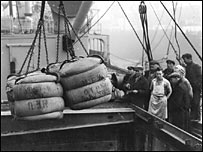
In the 1970s I was taken by my school to visit the docks at Manchester. We went on a boat which weaved between the ships that were scattered throughout the docks, which in those days were seen as an important part of the economy of the city, one which children should know about and value.

Many Manchester families had links with the docks, in my case my uncle worked there, taking his docker’s hook home at night. Like many dockers he was Irish , for the dock community included people from many ethnic backgrounds, including African. Billy Johnson, for instance, father of boxer and Communist Len Johnson, had worked there in the early 1900s as a pilot escorting the boats into the docks, having come from Sierra Leone.

Manchester and Salford docks were opened in 1894 by Queen Victoria. They were part of the newly completed Manchester Ship Canal, which meant that large ships could now navigate through the waterways to Ordsall.

Looking around Salford Quays to-day it is hard imagine how the docks once gave employment to thousands of people across Salford, Manchester and Trafford, from the era when dock work was casual and men lined up to be picked for a day’s work, to the heyday of the 1970s when the Transport and General Workers Union had negotiated good employment terms and conditions for its workers.

The docks were the third busiest port in Britain with merchant ships of 12,500 tons in weight bringing in a variety of goods to feed the local and national community. Thousands of people worked in the ports, not just dockers and labourers but the crews from the various liners and merchant ships that were constantly visiting the port as well as customs officials, office staff, canteen workers and cleaners.

In 1982, due to the increasing use of containers and an increased trade with the European Common Market, the docks were closed down. In the 1990s the docks became the Salford Quays. This represented the massive change in our economy: from a manufacturing one to a service based one.

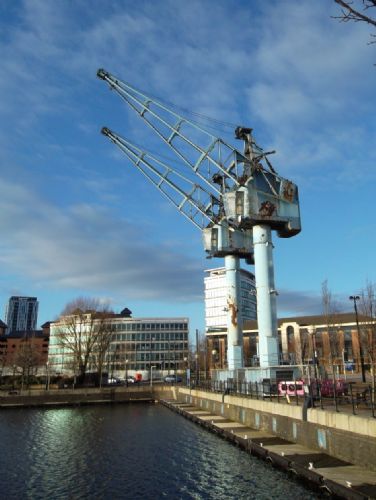
Cleansed of a thriving dock community, the area to-day has almost a Stepford Wives aura. There are many flats, from which hardly anyone seems moves in or out of, sitting amongst the prestigious Lowry Theatre and Imperial War Museum. The only signs left of the past are the art deco dock office and two large cranes. The cranes were erected on south dock 6 (now known as Merchants Quay and Clippers Quay) in 1966, but were decommissioned in 1988 when they were moved to their present home.

They have taken on a new life as Alice Darlington, has run a one woman campaign to save them from demolition. She says:
It was a great industry, and these cranes are a landmark of that era. Once these cranes have been demolished it will be hard for young people to remember what the docks were all about and how important Salford was as a trading post. The cranes are enormous and represent how important the docks were to the economic health of the nation.

Alice Darlington

Alice Darlington

Cranes were an essential part of the docks, used to load and unloaded goods. There were over 200 at the height of the working life of the docks. The remaining two cranes are iconic and are a landmark in the area, made by Stothert and Pittand specifically designed with one single column leg for Dock 6.

Docks 1905

Docks 1905

Alice Darlington tried to get the cranes listed by English Heritage, due to their uniqueness, but they refused to do so, and this has been rubberstamped by the Secretary of State.
Darlington says she cannot understand a Labour Mayor Ian Stewart’s refusal to support the campaign to keep the cranes:
I don’t understand why a Labour representative is so against the working class heritage of Salford. If he keeps the cranes it could offer jobs to local people to maintain them.

As Salford Council make massive cuts to their frontline services they have responded to the campaign over the cranes by citing financial reasons. Labour Mayor Ian Stewart:
It would be wrong to spend £1million on preserving two rusting and dangerous cranes, when the people of Salford are struggling to make ends meet

Darlington and other local cranes campaigners, including the Salford Star, challenge the figures and believe that the money for refurbishment has been ringfenced and that they would only need to raise £22,500 from private sources to make up the shortfall from the Council.

The spotlight is now on Salford Council to see if they will demolish the cranes. Darlington is continuing with her e-petition and is gathering support from the local community as she takes her paper petitions around the local area.

We are getting lots of support from all parts of the community and the press. The cranes are part of a rich heritage for Salford people and it is important to remember that it was one of the greatest inland ports of the world.

salford cranes

Sign the petition at http://epetitions.direct.gov.uk/petitions/45202

If you have enjoyed this article and would like to support this blog by making a donation you can do using this button

Posted in anti-cuts, labour history, Manchester, political women, Salford, trade unions | Tagged , , | Leave a comment

Stop,Look,Listen…my weekly selection of favourite films, books and events to get you out of the house

Watch….a mini film festival at the Working Class Movement Library…including on Wednesday 15 May at 2pm they are showing a locally made film The Condition of the Working Classes, an up-to-date take on Engels’ classic of the same name. And on 17 May at 7pm a film by Luke Fowler The Poor Stockinger, the Luddite Cropper and the Deluded Followers of Joanna Southcott, a curious mixture of archive footage and newly shot material reflecting on the life of critic, historian and activist EP Thompson:.. It captures a moment of optimism, in which Thompson’s ideas for progressive education came together with political resistance and activism. For further info see

Go and see…two plays about the condition of women…the Royal Exchange are doing Ibsen’s A Doll’s House, his insightful and emotional story of a woman’s struggle to be liberated. Written in 1879, it still has an inner truth about the lives of women, maybe not so much in the west.
And at 3Minute Theatre you can see Female Transport, written 40 years ago, which again looks at the lives of women, those who were deported to Australia for petty crimes in 19th century Britain. Their lives on the ship mirrors societys’ treatment of women and the journey becomes one of political education and liberation. Further info see

Sign a petition.The Shrewsbury 24 Campaign aims to overturn the unjust prosecution of 24 building workers who were charged following the first ever national building workers strike in 1972. They picketed building sites in Shrewsbury during the dispute and were prosecuted in Shrewsbury Crown Court in 1973. They became known as the Shrewsbury 24. Six of the pickets were imprisoned. Their crime was to be part of a trade union campaign to get a decent rate of pay and safer working conditions for all building workers. For more information, see the campaign website
The campaign needs more signatures for their petition calling for full disclosure of all Government documents relating to the 1972 building workers strike and the conspiracy trials at Shrewsbury. Government files relating to the strike have been withheld from the National Archives even though more than 30 years have passed. please sign.

Look at..the photography of Eric Latham…he is from Beswick in East Manchester and in his book On Class Street he looks at the lives of people, mainly men, in an area that went from being a vibrant community to a wasteland when unemployment hit in the 80s. It is Eric’s story as well and it made me want to cry when he tells the story of how his father’s health was ruined by his working conditions in a local factory which led to his early death. The photographs compliment the stories and it was part of a wider project which toured local schools. Further details

Laugh with…. the latest chapter of the Artist Taxi Driver’s attack on the privatisation of the NHS….he pushes a plastic pig to parliament see

Go to…CAMP FRACK 2 SAYS NO TO FRACKING – YES TO ONE MILLION CLIMATE JOBS Mere Brow – 10th, 11th, 12th May. Organised by a broad coalition of local residents groups, environmental activists and trades unionists from across Britain. Camp Frack 2 aims: to be the largest unified symbol of resistance to the threat of extreme energy developments, such as hydraulic fracturing or ‘fracking’, that the UK has seen so far! See

Posted in anti-cuts, book review, drama, education, feminism, films, human rights, labour history, Manchester, trade unions, Uncategorized, women | Tagged , | Leave a comment