Remember, remember the 5 November…..

5 November-a day of action against the austerity agenda

5 November-a day of action against the austerity agenda

In the news this week the Department for Work and Pensions announced that more than 400,000 people have lost Jobseekers Allowance under new government sanctions. Employment Minister Esther McVey said that people were paid Jobseeker’s Allowance only if they were doing all they could to look for a job. She said these sanctions were only used against those who were “wilfully rejecting support for no good reason”.

On Tuesday I stood outside the Ashton-under-Lyne Jobcentre with members of the Tameside against the Cuts campaign and heard a different story. We were leafletting to show solidarity with the thousands of people who have had their benefit cut for no reason and those who are being pushed into working for employers whilst only receiving their benefits.

Several young men came up to me as I was leafletting and were very angry and bitter about the way they had been treated by the Jobcentre staff.

One young man, in his 20s, said;”I have done everything they have asked me to do. I have attended every interview and they suspended my claim. I went to the CAB and appealed but its going to take another month for it to be sorted. It’s not fair and now I am in debt for no reason.”

Another older man joined us and said; “They, the Jobcentre staff, are making a lot of people very angry. And when you complain, they just ban you from the premises.”
Steve Starlord from Tameside Unemployed Workers Alliance said that they had organised the picket “to stop state sponsored slavery and opposing working for your dole. If there is a job out there then people should be paid the rate for the job.”

TUWA are just one group that took part in the action yesterday. members of the Green Party and the anti-Bedroom Tax Campaign are also part of the Tameside against the Cuts group. Each week they meet and offer support to people who are unfairly having their benefits sanctioned, being made poorer by legislation such as the Bedroom Tax and the increasing numbers of people who are being taken to court over Council Tax arrears.

Tameside against the Cuts campaigners

Tameside against the Cuts campaigners


It is not just the unemployed who are facing hardship, as on the same day in Ashton and across the country, staff in Probation Offices were on strike against the privatisation of their service. Privatisation only means one thing: massive cuts in wages and benefits such as pensions. From the Jobcentre TAC moved to show solidarity with striking Probation workers.

Across the northwest pickets and demo took place on Tuesday to highlight the affect of the Government’s austerity agenda. They were organised by the People’s Assembly with the support of groups including Greater Manchester Keep our NHS Public, the Green Party and the various Bedroom Tax and anti-cuts campaigns.

Stockport NHS Watch picketed Stepping Hill Hospital, giving out 2, 000 leaflets to show how the NHS is being privatised and facing £20m worth of cuts.

Stockport NHS Watch at Stepping Hill Hospital

Stockport NHS Watch at Stepping Hill Hospital

In Bolton and Salford, where the mental health service is facing cuts, supporters took part in rallies outside the hospitals where the mental health wards are under threat.

Later that day, as it rained and got darker, over 60 people marched around Manchester city centre and stood outside banks and employers who had not paid their taxes. From Barclays to Starbucks people are asking why is it that the poor are being told that they have to pay for the economic downturn whilst the rich can get away without paying their taxes.

And it is not just the unemployed who are feeling the lash of the austerity agenda. People in work, whether the public or private sector, are earning wages that are not keeping up with constant rise in prices for everything from food to energy bills, and are faced with the threat of losing their jobs, or at the very least being expected to take on more work as cuts are made.

This was just one slice of the activity going on across the country but you might not know it was happening because it did not get any publicity in the north west media nor in the national news.

Manchester; Queen Victoria is amused!

Manchester; Queen Victoria is amused!


Long time campaigner and Green Party member Christine Clarke summed up the Bonfire of Austerity day:
“We are here to show our support for the unemployed and to show them that they are not alone. For us in the Green Party it is about human rights and social justice. Unemployed people should be offered real jobs and a living wage so that they can have a decent life.”

If you have enjoyed this article and would like to support this blog by making a donation you can do using this button

Posted in anti-cuts, human rights, Manchester, NHS, Salford, Tameside, trade unions | Tagged , , | Leave a comment

Stop,Look,Listen…my weekly selection of favourite films, books and events to get you out of the house

Watch.. The Happy Lands (2012) Set in Fife in Scotland in 1926,  it uses a combination of dramatic scenes, archive film and local people as actors  to tell the story of the miners’ strike which lasted from May to November. Fife was a strong hold of the Communist Party, it returned a Communist MP for many years, and in this film you really understand why working class people did believe that a revolution was the only answer to the poverty, hardship and discrimination that they were  experiencing. Like today, in 1926 it was  the miners and their families who were  told by the government that they would  have to work longer and for less money as the fat cats of the private mining industry raked off the profits. The mining community refused to be treated as slaves and the film documents the tremendous battle that takes place as the country is taken to the edge of revolution. The film reminds me of Jim Allen’s Days of Hope because of its no holds barred and partisan approach to left wing history. Watch and be inspired.

More about the miners…in 1992 the Tory government announced even more pit closures, but this time it was the Women against Pit Closures who led the campaign and occupied six pits to highlight how important coal was to the country and that it was sheer vandalism to destroy jobs and communities. I visited the Trentham colliery in Stoke in May 1993 when three women from the North Staffordshire Miners Wives Action Group had chained themselves to railings by the two mile deep No 1 pit shaft and stayed there for three days and four nights.From this a play was devised called Nice Girls which toured the country. It’s good that this history is being remembered at a time when we are learning once again how important coal is and was for our country. A new play written by Maxine Peake about Anne Scargill and the occupation of Parkside Colliery, Newton-le-Willows called Queens of the Coal Age will be broadcast at 2.15pm on Radio 4 on Monday 4 November.
Further info see

Remember Remember the 5 November…the Bonfire of Austerity takes place across the country in a national day of disobediance across towns, cities and villages, people will be marching, occupying and showing their opposition to austerity. Here are some of the events;
Bolton – various activities going on across the borough…further info see
Salford – join a protest against the closure of mental health wards at 2pm onwards, on Stott Lane by Meadowbrook and Salford Royal hospitals
Tameside – occupy a public space -meet 12.30 Gold Medal Cafe, Old St. Ashton-u-Lyne and 6pm at Ashton Moss Allotments enjoy a socal with refreshments. Further info Nigel – 07709056079
Manchester – join a torch lit procession – starts 5pm at Albert Bridge House, Bridge St. Manchester M60 9AT – further details see

Find out about..feminist activity across the country at Storm in a Teacup – a feminist arts collective based in London – which has included the North West Labour Women’s History Conference.

Look at…Grayson Perry’s exhibition; The Vanity of Small Differences at Manchester City Art Gallery. He created six tapestries whilst making the documentary All in the Best Possible Taste. His inspiration was Hogarth’s A Rake’s Progress, the tale of a young man who squanders his inherited fortune and dies in an asylum. He says “the tapestries tell the story of class mobility”. Whilst recognising the creative beauty of the tapestries, and Perry’s insight into modern culture,  I have to say I found the content depressing and once again rolling out all the usual stereotypes of working class people. No-one is reading a book, has compassion for their neighbours or communities or is active in any kind of political campaign. Not everyone defines themself by consumerism and working class people are much more complex than this exhibition would admit to. I think he needs to watch Happy Lands

Posted in anti-cuts, art exhibition, drama, feminism, films, labour history, Manchester, NHS, political women, radio drama, Socialist Feminism, Tameside, Uncategorized, women | Tagged , , | 1 Comment

Stop,Look,Listen…my weekly selection of favourite films, books and events to get you out of the house

WatchGASLAND 2 by Josh Fox and Matthew Sanchez – the frightening story of what fracking is doing to people’s lives in the USA. Over there its called a fracking frenzy as companies are drilling thousands of wells in major rivers and destroying whole communities and their way of life. Unbelievably fracking has been excluded from the Safe Water Drinking Act so it is down to these communities to show that their source of water has been polluted. The film shows people are fighting back and it has become a major issue in the USA. In this country there is also a growing campaign and you can get involved. Join Gayzer Frackman as he walks from Astley to Barton Moss Drill site. Gayzer is undertaking a 252 mile walk over 12 days to Downing Street from his home town of Lytham. His aim; …to raise greater public awareness of the huge threat posed by fracking to public health and the wider environment, including to areas such as the North West, and to …inspire people to take steps to stop it!. Further details contact stevechik@talktalk.net

Join..the anti-fracking campaign…there is a public meeting about the proposed fracking at Barton Moss on 30 October..full details see

Support Curzon cinema workers..they work at an upmarket and arty cinema chain in London but are selling tickets that cost more than their hourly rate. Together they have joined the trade union BECTU and have asked their employer for their union to be recognised and for them to be paid a living wage. Curzon refuse to recognise the union, even though 108 out of 150 workers are members. The workers need your support- sign the petition at . Please email Curzon’s CEO Philip Knatchbull (philip.knatchbull@curzon.com) and explain why you care about Curzon staff receiving fair pay and having the right to be represented by a union if they choose to. Further details of the campaign see

Find out...about women’s history..the North West Labour History Society have organised a conference on Saturday 23 November from 10.30-5pm at the 3Minute Theatre in Manchester. Trying to get beyond the usual stuffy and smug academic world of conferences they have got together an interesting mix of historians and activists. The conference themes reflect important threads in our lives including music, what does political activism mean, and finishing with a debate on the relationship between class and gender, socialism and feminism. £10/£5.00. It is going to be popular… more information at

Go and see Macbeth by William Shakespeare, produced by Conor Mckee Productions: “Blood will have blood.””The country’s freshest physical theatre performers take you on a roller-coaster ride through Macbeth. Punctuated by thrilling stage combat, this electrifying production strips bare the text and takes you to the heart of Shakespeare’s bloodiest tragedy.” Directed by the MEN award winning Wyllie Longmore, and with original live music by Michael Cretu. See it at a variety of venues across the northwest including on Friday 8th and Saturday 9th November – Salford Arts Theatre, Salford. Further details see

Look at... Booth Hall Children’s Hospital by Reel MCR …an exhibition of photographs gathered from ex-staff and patients from the now closed Booth Hall Hospital in North Manchester. The hospital was once the heart of the community, the land was given to the sick and poor of North Manchester in 1909 by Sir Humphrey Booth, whose family once lived in the original Booth Hall. The hospital was renowned worldwide and delivered ground breaking treatment to local people and beyond. The people who worked at the hospital said ‘they were like family’. The last remaining block of the hospital was demolished in September 2013 and all that is left is the memories and photographs. Further info see
And maybe think about joining the campaign to stop more hospitals being closed…….see

Posted in anti-cuts, art exhibition, drama, feminism, films, human rights, labour history, Manchester, NHS, political women, Salford, Socialist Feminism, trade unions, Uncategorized, women, young people | Tagged , , | Leave a comment

Book review; Black Star Britain’s Asian Youth Communities

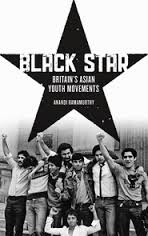
Black Star; Britain’s Asian Youth Movements by Anandi Ramamurthy (2013) Pluto Press £17.50

Black Star Britain's Asian Youth Movements

South Asian communities have a respected place in the history of the left in this country, a tradition that includes Shapurji Saklatvala, born in Bombay, who was elected as a Communist party MP in 1922 and Rajani Palme Dutt, born in Cambridge of Indian and Swedish parents, who became the leading theoretician of the Communist party.

In her new book, Black Star: Britain’s Asian Youth Movements, Anandi Ramamurthy traces this thread of history and activism and shows its importance in political life today. She says:
“I wrote this book because in 2003 I found that the discourse around South Asians was so dominated by faith. Neither I, nor my family or friends could identify with this, even on a cultural basis. I felt it was really important to recall a history where we defined ourselves on the basis of our politics and South Asians have had a long involvement in British political life.”

Black Star puts into context the history of black and Asian working class communities in the anti-racist campaigns in the 1970s and 1980s. These were campaigns that sprang from an anti-imperialist and left wing tradition which the South Asian community brought with them from countries such as India.

Ramamurthy explains how, after the 1962 Commonwealth Immigration Act, migrants, who were previously males, were forced to bring their wives and children to this country, fearing quite rightly, that the new legislation would lead to the forced division of their families. From the 1960s the enviroment for migrants, of all colours and including groups such as the Irish, worsened :
“Racist violence was also not simply perpetrated by gangs on the street but also by the police and state institutions.”

It was the children of the post war immigrants who, in the late 70s made up the activists in organisations such as the Asian Youth Movement which grew up in large cities such as London, Manchester and Birmingham as well as in Bradford, Bolton and Burnley. Many of the largely male organisations were made up of people as young as 15 years and others who were in their 20s and had had experience of being politically active in their college and workplace:
“They took up issues that impacted on their communities as a whole to respond to the climate of racism, which young people and their families experienced in a period of rising unemployment caused by an economic downturn that led to the decline of the manufacturing sector in Britain.”

Key to these organisations was notions of self-organisation, defending their communities, and building solidarity with other anti-imperialist groups to challenge the conditions of their lives and circumstances.

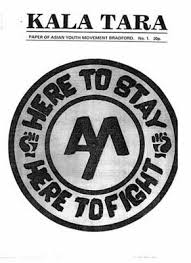
The AYMs used the term “Asian” as an inclusive one, and by the use of localities such as Bradford in their name they invited other groups such as the Afro-Caribbeans to join them. It was also open to all cultural and religious outlooks including members from all the major faiths in South Asia. And, unlike their parents, they saw Britain as their home and their struggle in terms of “Here to Stay and Here to fight”.

Here to stay here to fight

Ramamurthy shows how the Bradford Asian Youth Movement was one of the largest, best organised and influential of the groups and how it was at the forefront of defending its community:
“The case of the Bradford 12 (in 1981) was pivotal in challenging the state’s attempt to criminalise communities.”

1981 was a year when unrest spread across the country and when young people in Bradford made petrol bombs in case they had to defend their community against fascists. A dozen young men were arrested on charges including “conspiracy to make explosions… for unlawful purposes”.

bradford 12

One of the Bradford 12 , Tariq Mehmood, commented after their acquittal:
“The police made a mountain out of a molehill and in so doing made a monument to our beliefs; the right to self defence by a community under attack.”

Ramamurthy shows how solidarity was a key characteristic of the work of AYMs as in the Bradford 12 case. The defence committees were made up of the local community, as well as activists in groups including the Socialist Workers Party, lesbian and gay and Irish groups. Immigration cases dominated the political landscape of the late 70s and in particular the case of Anwar Ditta, who fought for years to get her children to join her in Britain.
“In building solidarity, the campaign liaised with trade unions, left organisations,religious organisations and celebrities.”
The support was not just national but international including a poem written by Bobby Sands for Anwar. In the end she succeeded in being re-united with her children.

Anwar Ditta

Anwar Ditta

From the late 1980s this broad based black identity based on class and anti-imperialist perspectives changed to a more softly focussed identity and cultural politics. As Ramamurthy comments;
“The promotion of faith based organisations by the state ensured the privileging of conservative voices through the formation of religious based councils amongst Hindus, Muslims and Sikhs. This fragmented the previous socialist voice that found expression in organisations such as the Asian Youth movements”.

From the 90s the problems of young Asians have been defined as ones around ethnicity and culture, rather than as that of institutionalised racism, street racism and poverty. The post 9/11 enviroment which has created growing Islamaphobia has left many Muslims isolated without the links to anti-racist groups and organisations which were a characteristic of these movements in the 70s and 80s.

In writing this book Ramamurthy feels that there are many lessons that present day campaigns have learnt from the Bradford 12 case, including the Stephen Lawrence campaign and climate campaign activists.

In conclusion she quotes Tariq Mehmood and Amrit Wilson;
“We believed a better world was possible…there was a feeling..that we could fight and win.”

Black Star is an important book in reminding us that the Asian community has played an important role in the history of the Left in Britain and the principles of solidarity and self determination are key to creating organisations that will undermine the sense of hopelessness that is endemic in society today.

If you have enjoyed this article and would like to support this blog by making a donation you can do using this button
Posted in anti-cuts, book review, Communism, feminism, human rights, labour history, political women | Tagged , , , , , | Leave a comment

Stop,Look,Listen…my weekly selection of favourite films, books and events to get you out of the house

WatchThe Pervert’s Guide to Ideology(DVD) a film made by cuddly philosopher Slavoj Žižek. I love films that try and to educate us about big ideas and Zizek is the opposite (!!) of the usual squeaky clean presenter. The film exposes how cinema, as the art of dreams, reveals much about the form and status of the ideologies that underpin modern society. Zizek examines the way in which ideology dominates our lives even if we do not notice it. To get his message across he uses clips from films ranging from The Sound of Music to Taxi Driver. The film is a bit longwinded at over two hours and, although entertaining, does become a bit repetitious towards the end. But it is good to see a film that encourages you to think about the world we live in….now just have to do something about it…………..

Join… the campaign to sack Nick Griffin as Northwest MEP. Hope not Hate are holding a northwest conference on 27 October at the Unison offices in Manchester. You can find out about the campaign and meet up with other activists from across the northwest. Further details see

Listen.. Reem Kelani in concert. She is a fantastic performer with a distinctive voice. At this concert she is accompanied by Bruno Heinen (piano)and Antonio Fusco (percussion) at 7.30pm Saturday 26th October at the Ted Hughes Theatre, Calder High School, Brier Hey Lane, Mytholmroyd, HX7 5QN. Advance tickets – £10, Concessions – £8, Children under 12 – £4 available from Jenny on 07801 275674 or by emailing hillyfletcher@btinternet.com

Find out aboutHidden between the pages: British socialist fiction, 1884-1914.The last talk in the WCML’s current Invisible Histories series takes place on Wednesday 23 October at 2pm. Deborah Mutch’s talk will uncover some of the many forms of fiction used by activists in their desire to create a socialist society. Further details see

Remember... the miners of Bradford Pit…Bradford, as in East Manchester, and nowadays the home of Manchester City FC. My father and uncle worked there and it was the main workplace for many local men. For many years three men who worked at Bradford have been trying to raise money to establish a monument to the pit. On Saturday 26 October from 7.30pm a fundraiser will be held at the Moston Miners. Only £3.50 on the door. There will be live bands, a DJ, guest speakers and films. Further details see

Posted in Communism, films, human rights, Middle East, music, Palestine, Salford, Socialism, Socialist Feminism, trade unions, Uncategorized | Tagged , , , | 1 Comment

Stop,Look,Listen…my weekly selection of favourite films, books and events to get you out of the house

Watch..the Battle of Algiers (1965) Like the North of Ireland to people in Britain in the 70s, so Algeria was to many French people in the 50s and 60s. An unknown part of the empire that few people visited or cared about. Algeria was as controversial a subject in French society, and this film shocked people out of their ignorance and lack of interest. It dramatizes the war that the Algerian people in the Front de Libération Nationale (FLN) waged against their French colonialists. The director, Gillo Pontecorvo, shows all sides of the story, as well as incorporating real and fictionalised characters in the drama. One of the most shocking episodes is when three Algerian women discard their veils and traditional dress for European garb so that they can get through checkpoints to plant bombs in French bars. It was a real incident and, like the Irish struggle, many Algerian women took part in the war. And, as you can imagine, the film was banned in France for many years and, even when it was shown over here and in the US, some of its scenes showing the French using electric shocks and water tortures against the Algerians were cut. It is a disturbing film and fifty years later in places such as Iraq and Afghanistan we see the so-called Western democracies impose the same human rights abuses. Its being shown by the Manchester Film Cooperative. For further details see

How far would you go for justice.. Desperate Measures.. the first production of the Manchester Shakespeare Company, adapted from the bard’s Measure for Measure is a story of comedy, power and lust set in present day fictional Mancia. John Topliff (founder of Three Minute Theatre) and Hannah Ellis are the directors. From October 23rd – 26th, 2013 at 730pm. You can book tickets at

Look at…one of my favourite artists, since he recreated the Battle of Orgreave, Jeremy Deller who has a new exhibition at the Manchester Art Gallery: All That Is Solid Melts Into Air. The exhibition is a mishmash of historical and pop icons, from pictures of industrial women workers to Noddy Holder’s family tree. Is it art or is it history?. Make your own mind up, I need to see it again Further details see

Also see

The personal is political… Alice Nutter’s play My Generation, which is set in Leeds over the last forty years, is about my generation, those of us who were involved in what is dubbed an alternative culture ie feminism and political activity. It revists a time when there was a lot of hope , particularly by young people and the working classes, and the highs and lows of the Miners Strike, the drug culture of the 90s and our present day austere and austerity society. We need more plays alongside political activity to remind us that we can win and give hope to the many generations of people who are despairing about the future. Further details see
Read my interview with Alice…see

Go to a meeting about dronesGround the Drones at the Friends Meeting House, 6 Mount Street, Manchester, M2 5NS. 7pm, Thursday 17th October 2013 Over the past five years there has been a massive rise in the use of armed unmanned drones, often controlled from thousands of miles away, to launch deadly airstrikes. While supporters of drones say they are a ‘precise’ and ‘pinpoint’ accurate weapons, in Pakistan, Gaza , Afghanistan and Yemen, hundreds, perhaps thousands of innocent civilians have been killed. Come and learn more about drones, how they are being used and what is planned for the future. Together we can Ground the Drones! Listen to Chris Cole who is a researcher and activist. He is co-author of Convenient Killing: Armed Drones and the Playstation Mentality, secretary of the UK Drones Campaign Network and maintains the respected Drone Wars UK website (www.dronewars.net).

Hosing down the establishment….see what Belgian firefighters did in response to the government attacking their pensions…see

Posted in anti-cuts, art exhibition, drama, feminism, films, human rights, Ireland, labour history, Manchester, Middle East, Palestine, political women, trade unions, Uncategorized | Tagged , , , , | Leave a comment

Remaking Picasso’s Guernica; a response to fascism

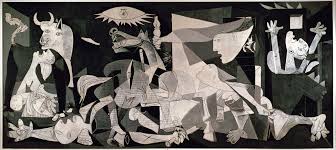
Picasso’s response to the bombing of Guernica in 1937, the painting Guernica, has been an inspiration to anti-fascists across the years and across the world. As the English Defence League threaten to march in Liverpool this weekend, and Tommy Robinson founder and now ex-leader of the EDL says he is leaving due to “extremists in the organisation”, the remaking of Guernica project arrives in Salford.
picasso's Guernica

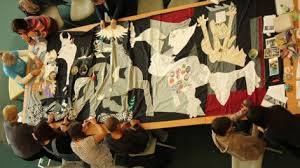
A group of artists and activists in Brighton have used Picasso’s painting, Guernica, to create a unique collaborative project as part of their protest at the rise of fascism. They are re-making the painting in a banner, as Maude Casey, one of the artists, explains;
We are increasingly concerned about the frequency of the EDL marching in Brighton and other places, with their message of hate. Historically, in times of austerity, fascism has targeted people instead of identifying the underlying economic causes. I was intrigued by the idea of collaboratively remaking Picasso’s Guernica as a protest against fascism.

Casey, like many other people in the collective, has a history of taking part in anti-fascist activity. Other members have been active in making banners for Greenham Common, or in anti-Guantanamo campaign work.

All of us have taken part in political actions where the creation of a banner, or a placard, or items of clothing or badges have been part of that action, dramatically enacting or expressing it while also inviting engagement and dialogue.

Central to the project is the collaborative nature of the sewing process which takes place in public spaces, such as public libraries, galleries and community centres:
Our public libraries are precious: they give the opportunity for diverse groups of people to meet and gather, to find information and spend time together.

During these sessions, the banner participants sit down with anyone who is interested in taking part in the sewing and people are given the opportunity to talk about their own experiences of war:
It has been very moving as people have spoken about their life histories and shared their experiences which have ranged from the bombing of Brighton and evacuation from London during the Second World War, the experience of the Basque children’s evacuation by boat to England in 193, to people who have recently fled war and torture in their home countries.
Remaking Picasso's Guernica

Casey feels that this sharing process is central to the project. She believes that, at this time in this country, people need to come together to support each other:
Doing anything together is empowering, to feel less isolated particularly because of the battering that many people are experiencing at this time. It is very positive to make banners, to do something practical that puts people in touch with their own creativity and imagination.

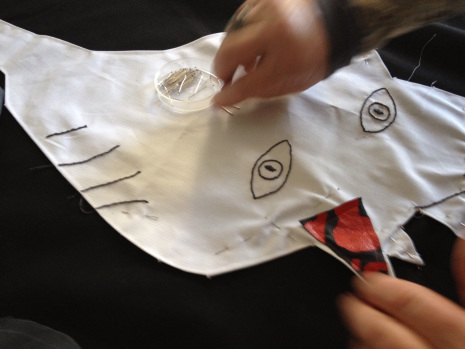
Being able to sew is not a prerequisite of taking part in the banner making. There has been a diverse group of people turning up at their sessions, including many men who are keen to learn how to sew, as well as men who have shared their experiences of growing up in cultures where they sewed with their grandmothers. Casey sees the act of sewing as a powerful symbol of resistance:
It is powerful to do something apparently small and modest, such as making some stitches in a textile. The banner says we are resisting, we have always resisted and we will continue to resist.
guernica_sew_2
The artists see the project in the spirit of Guernica, remembering the past horrors of war and its effects, particularly upon civilians:
We all see the collaborative process of making as a powerful antidote to the destructive powers of war and violent political systems.

Central to the project is the Women’s International League for Peace and Freedom; Casey feels that women bear a particular burden during wars:
Women have a different experience of war: we produce sons; we most frequently experience rape as a weapon of war; we are victims of trafficking – and we campaign for organisations to bring about an end to this.

Picasso said about his art:
No, painting is not done to decorate apartments. It is an instrument of war for attack and defence against the enemy.

The new Guernica banner also has a dual purpose:
It is a piece of art and will hang in galleries but it has been made big enough for 12 people to carry it on our protests in our continuing resistance of fascism.

Join Maude at the Working Class Movement Library on Saturday 12 October 2-5pm to take part in the sew-in.Further info see

Further details about the project see

If you have enjoyed this article and would like to support this blog by making a donation you can do using this button
Posted in anti-cuts, art exhibition, Communism, feminism, human rights, labour history, political women, Salford, women | Tagged , , , , | 1 Comment

Stop,Look,Listen…my weekly selection of favourite films, books and events to get you out of the house

Watch….the Miners Hymns (2012) by Bill Morrison at the Small Cinema in Moston.. A fascinating film made about the coal industry in the north east of England. Woven into the film is rare footage from the British Film Institute, the BBC and other archives. It tells the real story of the hardship of mining, the role of the National Union of Mineworkers to wrest dignity and a living wage from the Government and the social context of mining, including the Durham Miners Gala. And to give it a local focus ex-miner Paul Kelly and local filmmaker Richard Searle will show some of their film footage of the history of the miners in North Manchester as well as a film of the 2013 Durham Miners Gala.
Further details see

Take part…On Saturday 12 October from 2-5pm at the Working Class Movement Library join activist artists from Brighton who are re-making Picasso’s sombre anti-war masterpiece, Guernica, by gently sewing the famous shapes into a huge banner. Pop in any time during the afternoon to contribute a bit of stitching (no previous sewing skills necessary), take part in conversation, or just to have a brew and watch collective creativity at work. The artists/activists are inspired by Picasso’s view of art: No, painting is not done to decorate apartments. It is an instrument of war for attack and defense against the enemy. Their aim is to encourage people to get involved not just in the art of sewing but to sew and share recollections and reflections on their histories of struggle. See

Find out about…
Cuts can be beaten! how mental health service users took on Salford Council and won….read this inspiring story of how some of the most vulnerable users of the NHS challenged the relentless policy of cuts by Salford Labour Council. Salford is a poor city and over the last 3 years the Council has meekly carried out £80 million cuts imposed by the Tory government. This group of people alongside Salford Unison and Salford Against Cuts were not prepared to see their services destroyed. Read the full story in this booklet which can be bought for £2! Contact pgerrard2001@yahoo.co.uk or on 07999 951869. Also available from Salford UNISON HQ in Swinton.

Debate class…
.
and punk with David Wilkinson “I read Nietzsche at fifteen”: The Fall’s Mark E. Smith and other working class autodidacts on the Manchester post-punk scene at the WCML…on 9 October at 2pm. Was punk that influential? Strange combination of words; working class and autodidacts….in other words people who studied at the University of Life…hopefully the talk is not just another PHD view of the punk phenomena but someone who was there when it happened as on the TUC NHS march……

You had to be there
……..
on Sunday 29 September in Manchester and the NHS march. See the footage of the Artist Taxi Driver and his film of the event…see

Posted in anti-cuts, drama, education, films, human rights, labour history, Salford, trade unions, Uncategorized | Tagged , , , , , , , | Leave a comment

Stop,Look,Listen…my weekly selection of favourite films, books and events to get you out of the house

Watch…..Hannah Arendt, (14 October 1906 – 4 December 1975)   a  fictionalised account of the life of Hannah Arendt by acclaimed German filmmaker Margarethe von Trotta. Hannah was a philosopher and political theorist who reported on the war crimes trial of Nazi Adolf Eichmann for the New Yorker magazine. She was of German Jewish background who fled Germany during the Second World War. She was probably ahead of her time in her reporting of the Eichmann trial and in recognising as she described it “the banality of evil”, criticising the authority of the court and of some Jewish leaders who collaborated with the Nazis. This did not go down well in 1961 and her articles and books were attacked by the establishment.  To get the full story it is probably better to read her book Eichmann in Jerusalem: A Report on the Banality of Evil. Von Trotta should be commended for trying to dramatise the life of a complex character who should be better known.See


Go and see… an exhibition in Leeds 1st October to 30th November. 100 Years of Activism – Women in Science and Technology. It has been put together by Feminist Archive North. The exhibition features a rich collection of fascinating materials from campaigns and initiatives from the Women’s Engineering Society (established in 1918) through the WISE campaign of 1984 to the Bradford based UK Resource Centre (1991).

Who was Caroline Herschel? Jane C Wright? Rosalind Franklin? Should we know who they were? As 18th century astronomer, physician and pioneer chemotherapist, and unsung biophysicist colleague of double helix discoverers Crick and Watson, they are but three of the many women high achievers but unacknowledged in the field of science and technology for centuries up to the present.

http://www.feministarchivenorth.org.uk/index.htm

Location:
The Brotherton Room
Special Collections
1st Floor, Brotherton Library
Parkinson Building
University of Leeds

 Celebrate…Black History Month and attend one of the few political events. Author and historian Marika Sherwood comes to Salford on Friday 4 October at 2pm to give a Black History Month talk at the Working class Movement Lbrary on “Struggles in Manchester before and after the 1945 Pan African Congress”.Africans have lived in the Manchester area at least since the late 18th century and have struggled against racism and for freedom and independence for their countries of origin for at least the past 100 years – perhaps culminating in the Pan-African Congress of October 1945, which was held in Manchester.The Congress scarcely got a mention in the British press at the time but history has shown it to be a crucial occasion which inspired many to action, and gave ‘a voice to the voiceless’. Marika Sherwood’s book Manchester & the 1945 Pan-African Congress has been reprinted and will be available for  purchase. 

For details of other events see http://www.blackhistorymonth.org.uk/manchester-black-history-month/4567385511


Go toDerby Peoples History Group on Wednesday 16th October at 730pm: Open Organising Meeting at Friends Meeting House. Their future events include

Saturday 12th October Derby Coop with Tanya Moon, Derby Museum 11am.

 Tuesday 26th November A Cruel Silence: The Silk Mill and sabotage

Tuesday 14th January 2014  Heritage Lottery Funding/War and Peace Group

Thursday 1st May Rededication of Blue Plaque

Saturday 21st June: Derby Procession of Conscientious Objectors and Suffragettes

http://www.derbypeopleshistory.co.uk/


Find out about scripwriting….Tuesday evening, 6.30-8.30 pm 1st October 2013 at the WFA, Manchester.

Storytelling for Starters– a p2p masterclass with Faisal A Qureshi

At this peer-to-peer masterclass, editor, director and award winningscript writer Faisal A Qureshi will  present an introduction to script writing – including the basics of story telling, character and narrative development, creating outlines and layouts, the essential do’s and don’ts.

There is no charge for  BECTU members or individuals on the BECTU ‘student register’ who attend.

Non members are invited as well and will be charged £10.00.(Concessions) £5.00

Book here http://storytelling4starters.eventbrite.co.uk/


Buy Hovis again….one of the smallest union, the Bakery and Food Allied Workers Union has won in a dispute at Premier Foods (Hovis) in Wigan. The management had tried to bring in zero hours contracts which would push down wages and increase insecurity amongst workers. After 2 weeks of strike action, supported by mass pickets at 2am each strike day and the support of local people in Wigan, the management and union have agreed a deal which will mean  that future production will be covered from overtime and “banked hours” by members of the full-time 400-strong workforce. BFAWU regional organising secretary, Pauline Nazir, said “The sense of solidarity among the workers has been absolutely brilliant. “It makes you see why you’re a member of a trade union and why our parents told us to join a union.”

A lesson for everyone on a zero hour contract….something like 5 million workers!!!!!

Posted in anti-cuts, art exhibition, feminism, films, human rights, labour history, Manchester, Salford, trade unions, Uncategorized, women | Tagged , , , | Leave a comment

“Even the pigeons have black feet”; coal and community in Salford

Salford in Greater Manchester is one of those places that still boasts a lively community  hell bent on reminding all the rest of us of what it means to be working class. The Irwell Valley Mining Project, run by local activists, epitomises that spirit of refusal to accept any negative labels about what being working class means and is determined to pass on to young people the crucial role that coalmining once played in the community.

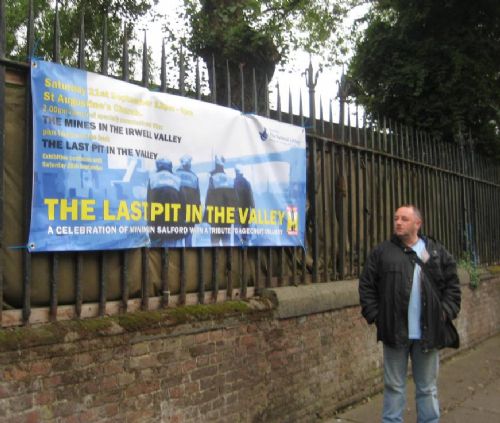
Funded by the Heritage Lottery Fund several aspects of the project were launched on 21 September at St.Augustine’s Church in Pendlebury, Salford.

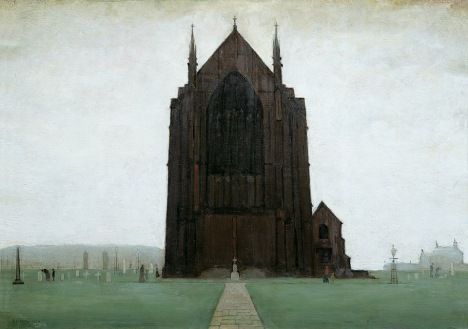
St.Augustine’s is a Grade 1 listed building, constructed between 1871 and 1874. Known locally as the “Miners Cathedral”, it was the focal point of the local mining community. Within its grounds is a memorial to the 178 men and boys killed in the Clifton Hall Colliery explosion in 1885. It was chosen by the IVMP to as the appropriate venue to offer local people the opportunity to see the culmination of the project’s work. This included an exhibition, a film and former miner Paul Kelly’s personal history of the Agecroft Colliery in Salford.

St. Augustine's as painted by LS Lowry

St. Augustine’s as painted by LS Lowry

Alice Searle, one of the Project workers, explained the significance of the Project:

It is very important for the community in Salford and particulary to pass on that history to the children. It is not saying that coalmining was good, because it was disastrous for many people, but it did play a significant role in the economic and social life of the community.

The project has worked with local children from St.Augustine’s Primary School which has included drama, creative writing and artwork. Many of the children did not know how coal used to play a crucial role in heating homes, as well as providing work. At the launch two of the children, Kelsey Gowland and Jai Bolton, both 10 years old, were dressed in 1950s outfits and role-played a couple getting a coalfire started. Kelsey’s great, great, great grandfather died in the 1885 colliery disaster.
IMG_3135

She said;
That is why they chose me to take part in the drama. People didn’t have central heating and used to sit around the fire, like we do around the tv.

Another young man, Mikey Kingston, aged 13 , explained how, after former miners and others had told their stories to the project workers, he was involved in making these accessible to other people:
I edited the sound files so that people can listen to them. There is also a booklet called “Even the Pigeons have Black Feet” which includes photos and the stories of miners and people in the community.

Agecroft colliery closed in 1991 and Lorraine McHugh, local artist and niece of miner Ken Chandler, managed to get into the colliery grounds as the pit was being dismantled. Her large black and white photographs are a reminder of how the physical prescence of Agecroft dominated the area. The pictures of the miners on those last days give a sense of the shock and disbelief that an industry with over 250 years history in Salford was going to be closed down.

Photo courtesy of Lorraine McHugh

Photo courtesy of Lorraine McHugh

Central to the project has been ex-miner Paul Kelly whose personal memoir of Agecroft Colliery was launched at the event. The Last Pit in the Valley is Kelly’s memorial to all the people who worked and lived in Agecroft colliery and the surrounding area:

Paul Kelly photo courtesy of Salford Star

Paul Kelly photo courtesy of Salford Star

This book is dedicated to all the men, women and boys who worked to get the coal that gave us light and warmth, and to all those who have been associated with our mining industry. This way of life has gone but our memories live on.

Kelly’s book is a history of the role that coal played in the economy not just of Salford but of the whole country. In words and pictures he skilfully recreates what it means to be a miner with the details of the daily life of the miner. And of course it includes a chapter on the 1984-5 Miners Strike of which he says:
The strike was not about money but about the survival of the coal industry and the safeguarding of the nation’s energy needs for the future.

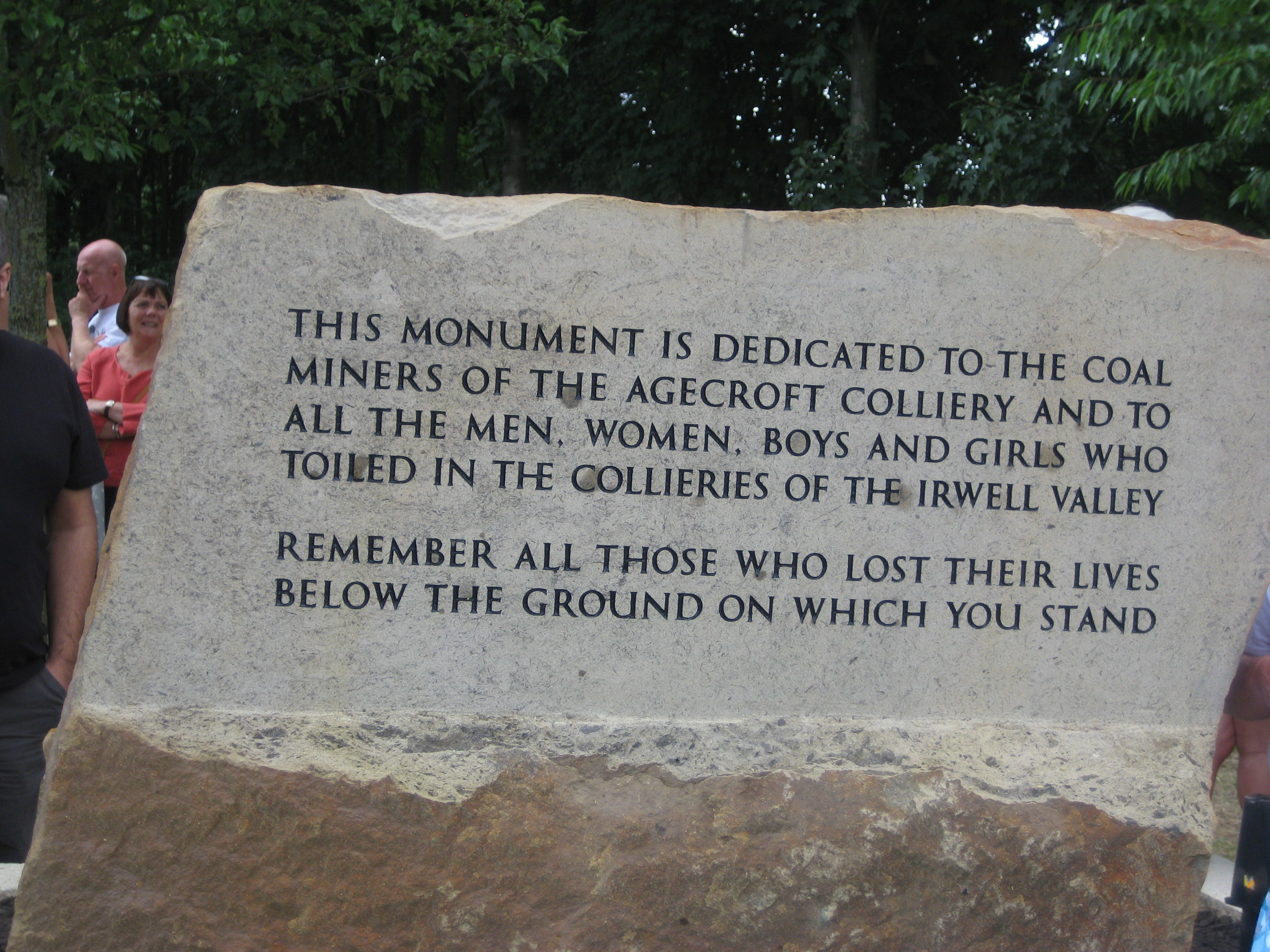
Kelly now gives talks in local schools on the history and uses of coal to a generation of children who do not know what coal is. In September 2013 a monument to Agecroft colliery was unveiled where the colliery used to stand. It is a flower garden, built by the construction students of Salford College and decorated with ceramic tiles made by the children of St.Augustine’s Primary School.
IMG_3109
Kelly believes that the case for reopening the pits has never been stronger;
I believe we should reopen the coal mines, rebuild the power stations with clean coal technology. If this was done under a nationalised energy service, the results would benefit all, old, young and especially the vulnerable.

The Irwell Valley Mining Project will launch its website in the next week. You can see some of their films on Youtube eg “Agecroft Colliery the Last Pit in the Valley”.

If you have enjoyed this article and would like to support this blog by making a donation you can do using this button

Posted in art exhibition, biography, education, labour history, Salford, trade unions, young people | Tagged , , , , , , | 1 Comment