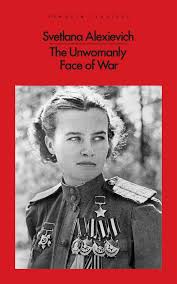
It is only recently that women in the UK have been able to take up frontline roles in the armed forces but in liberation struggles across the world from Northern Ireland to present day Northern Iraq there are plenty of women who have taken up guns to defend their country.
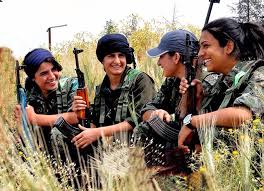
YPG women in N.Iraq
In this newly published book, it came out in the Soviet Union in 1985 but was heavily censored, The Unwomanly Face of War, we learn about the motivations of women during the Great Patriotic War ( aka Second World War) who decided that they wanted to fight for their country and way of life.
The author, Svetlana Alexievich, has a track record in producing books that challenge the orthodoxy of the Soviet Union and present day Russia. In previous books she has covered the war in Afghanistan and the disaster of Chernobyl.
But her books are not just exposes of state criminality but they start from the point of view of the individuals concerned. They are oral histories of how women, men and children felt about the circumstances of their times. She was born into the Soviet Union in 1948 and much of her analysis is about the massive changes that have taken place in the post Soviet Union era and how it has affected individuals.
This is a deeply personal book. Svetlana is not one for objectivity nor laboured intellectual analysis. The book begins with her challenging herself about the times she grew up in and the way in which the Soviet involvement in the Great Patriotic War (1941-45) was a constant theme of her childhood and youth.
“The war was remembered all the time: at school and at home, at weddings and christenings, at celebrations and wakes.” Not surprising when you consider that half of the country was occupied by the Nazis and 20 million people died over 4 years. As she says; “We were the children of Victory.”
Challenging this orthodoxy, particularly the role of Soviet women, was not easy and in this new edition she includes the conversations she had with the Soviet censor. When Svetlana exposes the barbarism of war, the fear of the women, she is told; “Who will go to fight after such books? You humiliate women with a primitive naturalism. Heroic women. You dethrone them.”

The power of this book is the testimonies of the 200 individual women and the way in which they lay bare their joy, fear, hatred and despair in their individual stories- told only in a way that women do expose their lives to other women. “We’ll eat pies. I’ve been fussing about since morning…. the hostess greets me cheerfully on the threshold. “We can talk later. And weep our fill…”
For Svetlana her research took over her life. “With it began a search that went on for seven years, seven extraordinary and tormenting years, during which I was to discover for myself the world of war, a world the meaning of which we cannot fully fathom.”
A million women took part in the Great Patriotic War. From doctors and engineers to snipers and partisans. Many of them were very young; some as young as fourteen. One young woman commented that her preparations to go to the front included packing a suitcase full of candy and her class picture.
Many of them went with a determination to defend their motherland and that is a constant theme in their stories. Even children of political prisoners and victims of Stalin, wanted to go to war. One young woman said; “The grown-ups wept, but we weren’t afraid; we assured each other that within a month we’d “beat the fascists’ brains out.”

Women snipers
For some women the war came to them as the Nazis occupied their villages. Women joined the underground, one had a small baby. “I used to go on missions with her. The commissar would send me off, and weep himself.”

women partisans in the Ukraine
Running alongside all these harrowing stories is Svetlana’s personal response to them and how the women’s stories did not fit in with the story of victory that the government had promoted. She did not want the story of what happens in a war but she did want to know; “What happened to human beings? What did human beings see and understand there? About life and death in general? About themselves?…. I am writing a history of the soul…the history of small human beings, thrown out of ordinary life into the epic depths of an enormous event. Into great History.”
This is not just a great history book but is a template for future oral histories of women and working class lives. War has not gone away and the experiences of women in this book can be mirrored in many conflicts across the world today.
Buy it from












 lipstick socialist