Working Class Life: written by working class activists. Read “A Bolton Childhood” by Alice Foley

a bolton childhood

In this occasional series I want to rediscover the autobiographies of working class people that have been forgotten or marginalised. They are important in understanding how and why people become activists. They are important in asking questions as to why today there is such a lack of working class people who are active in all kinds of political organisations from political parties to trade unions.

Alice Foley (1891-1974) wrote a biography of her early life called A Bolton Childhood, which was published in 1973 and re-issued by Bolton Libraries and Arts in co-operation with the Bolton Branch of the Workers’ Educational Association in 1990. It covered her life until 1918.

At the start of  A Bolton Childhood  we are immediately thrown into the realities of the life of the working classes in the 1890s. “I was born on a scurvy, inhospitable day, in late November, 1891, a premature victim of nature and the hazards of “moonlight flit”.

Life for the Foley’s was harsh, partly because her father who was Irish, was involved with the campaign for Home Rule,  and would disappear for weeks as he agitated around the country. The family was left to live off her mother’s earnings as a washerwoman. “During these years mother plodded gamely on, battling with a feckless husband whom she neither loved nor understood, and succouring her six children who she never really wanted.”

The Foleys did have access to a local library and it was Alice’s job to be the “chief book borrower”. The books were dished out to brothers and sister,  but as Alice’s mother could not read it was up to her to become her reader. As she says;” almost every day when I returned from school she would say coaxingly “Let’s have a chapthur.”

Alice’s life at school was dogged by her awareness of her poverty,  and also that she came from a mixed family ie her father was Catholic and her mother  a Protestant. This did not go down well in a Catholic school run by nuns.

Her father’s politics did not win them any friends either,  particularly, when he took the side of the Boers against the British. “This brought us into conflict with the prevailing patriotism of the day and I remember we youngsters endured some good “hidings” when engaged in mock street battles, for the English side invariably out-fought us numerically if not in courage.”

Alice grew up at a time when militancy in trade unions, particularly in the local textile trade, was growing. Her sister Cissie  was involved in the textile trade union and had “Tenaciously elbowed her way into the male precincts of that executive. She was also allied with the Suffragettes and more disturbing still, a zestful member of the local Labour Church.”

Alice left school at 12 and,  after failing as a shop assistant,  she found work in a mill. Many years late she had not forgotten this first experience of factory work. “I still sharply remember the agony of fatigue endured by standing on one’s feet from early morning to late evening, so exhausted that I frequently fell asleep over tea or supper, too tired event to eat.”

Alice lived in a time of militancy when workers were taking on employers who saw mechanisation as a way of cutting wage rates. She mentions the 1905 Daubhill mill strike of which she says,  “In retrospect, however, it could be seen as a first shot in the human struggle to retain traditional methods of production against those fierce on-coming thrusts of technocracy and automation which were to harass and bedevil the cotton industry for the next half-century.”

By the age of fifteen she was representing  her fellow workers.”Pushed forward by my workmates I began to stammer out the substance of our complaint, but the manager, now too bad tempered and irritable to listen or argue, let forth a volley of abuse and ended by peremptorily ordering us back to work under penalty of immediate dismissal.”
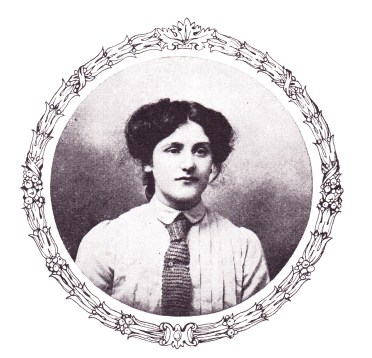
Alice Foley, 16

Alice aged 16.

This did not stop Alice’s trade union activities and she went on to commit  her life to  working in the trade union movement. One of the joys of this book is her discovery of another world; that of music and culture. One chapter is devoted to that:  it’s called; “Moments of Magic”

She says; “But these subservient days were occasionally shot through with moments of magic when the spirit of freedom and joy broke through. Such a moment became enshrined in my first visit to the operas of Gilbert and Sullivan at the Theatre Royal,  Churchgate.”

And through organisations such as the Labour Church  and the Socialist Sunday school she gained a political education, hearing lectures and speeches by local left wing orators including Victor Grayson.  Alice met other working class people who wanted to escape the drudgery of the factory system and explore poetry, music and a different way of life.

Alice comments about that era; “Life was ever meaningful, even if something of a battlefield, and we had abiding faith in the ultimate achievement of the human race.”  Frustratingly her  autobiography finishes in 1918:  she never completed it and today it is out of print.

In 2018 there are still women like Alice and Cissie out there,  discovering politics and activism,  but  unfortunately few of them write up their lives or will get the opportunity to publish them. There is a massive gap in radical history, one that the Frows tried to fill when they created the Working Class Movement Library.  The Mary Quaile Club was set up to promote Mary and also to draw links with working class women today. We would love to work with women who want to write up their history of activism. Please  contact us at maryquaileclub@gmail.com

Find out more about Alice at the WCML see
Posted in biography, book review, Catholicism, Communism, education, feminism, human rights, labour history, political women, Socialism, Socialist Feminism, trade unions, Uncategorized, women, working class history, young people | Tagged , , , | 3 Comments

Following in Sylvia’s footsteps; from 1918 to 2018. Meet Charlotte, Josephine, Eden and Lauren.

sylvia 1

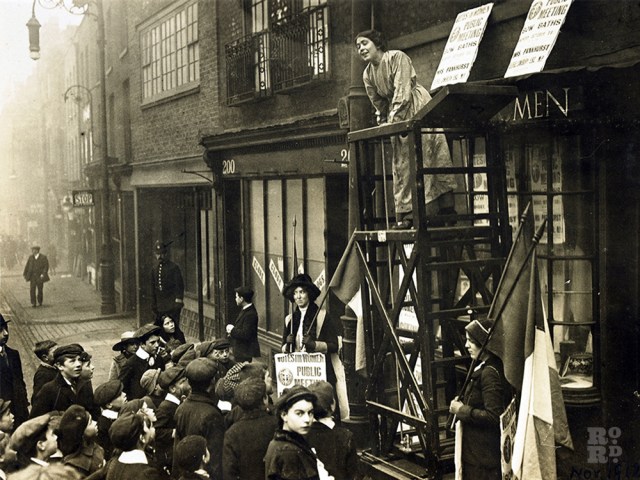
Sylvia speaking in the East End of London

Sylvia Pankhurst’s  response to the 1918 Representation of the People Act reflected her politics. She had opposed the First World War from the start and  spent the war years defending the rights of poor women and children in the East End of London who had  become economic  victims of that war. Sylvia believed that a partial suffrage victory was no victory at all, particularly when it left most poor women still without the vote. Her words could be echoed today by the inheritors of her philosophy and activity. Uncompromising, and offended by the legislation, she responded;

“Saddened and oppressed by the great world tragedy, by the multiplying graves of men, and the broken hearts of women, we hold aloof from such rejoicings; they stride with a hollow and unreal sound upon our consciousness.”

1918, and  the years following,  were a bad time for women in this country. The 1918 Act rewarded the homecoming soldiers by giving all men the vote,   whilst as the  war industries wound down tens of thousands of women who had been working  in traditionally male industries were bundled out of the way for men:  a miserable  reward for keeping the wartime economy going.

Female unemployment rose rapidly. By March 1919  at least half a million women were registered as unemployed, but it was probably higher as the Labour Exchanges were encouraged to refuse to register women as not genuinely seeking work. Just like in 2018. Also they could be refused benefit if they turned down work,  no matter how unsuited to their skills or how badly paid. Just like in  2018.  Many women were forced to return to domestic service – or rather “domestic slavery” as many  women called it.

In 2018 suffrage history has been sanitised. On 6  February, for instance,   Theresa May was welcomed by  Helen Pankhurst, Emmeline’s grand-daughter, to the Pankhurst Centre in Manchester (the home of the Pankhurst family until 1907) to kick off their celebrations of 1918.

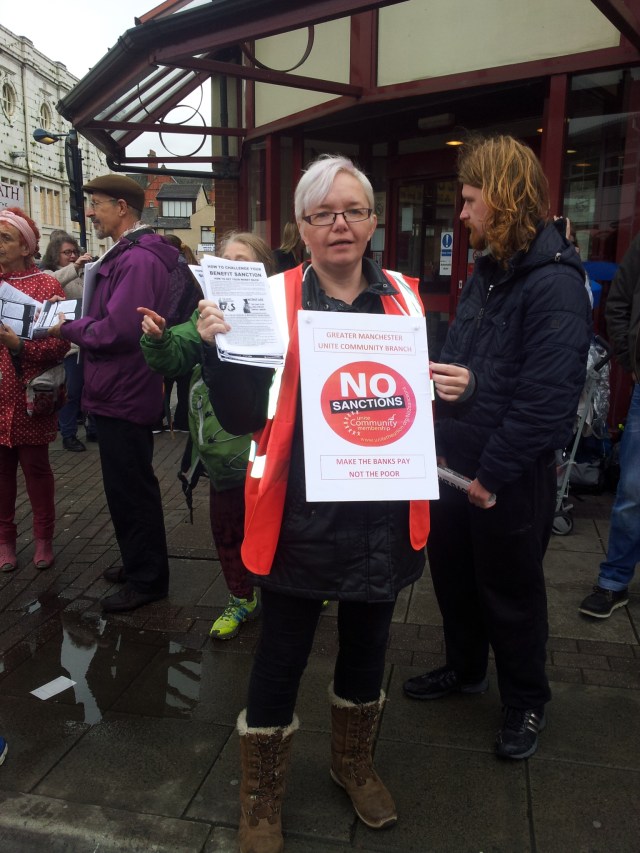
Charlotte Hughes, anti-austerity campaigner and writer was not invited to this event, of course. She blasts; “In my opinion it is abhorrent that Theresa May is celebrating a 100 years of some women getting the vote. Since Theresa May and the Conservative party have been in office, women have been victim to what appears like endless cuts to their income, their right to stay at home to look after children, while the cuts to legal aid and women’s aid services and refuges have forced women and children to live with an abusive partner.”

charlotte 2018

Charlotte on the picket line at Ashton-u-Lyne Job Centre

The #Vote100    events symbolise the massive gap there is between the well off women who can turn up at these events and promote their books, their businesses and brand  as “feminists”.  Absent from these events are the young women who are today’s Sylvia Pankhursts:  the true inheritors of suffragism and radical politics.

Life for young women in 2018 has improved dramatically over the last 100 years. Young women today have a personal and economic independence only dreamed of by women in 1918.

But life is still hard. I spoke to Josephine Clark, aged 23, a parent and student nurse. She is one of the lucky student nurses as she started her training when there were still  bursaries, but even with her partner working full time they, like most people, are  just one pay cheque away from economic meltdown.

Josie Clark

Josephine

She has been politicised by her grandmother, Christine Clark, a Green Party and feminist activist. “Everything I know about politics I have learnt from my Gran,” she says.   “I have voted since I turned  18 and always for the Green Party.” But working in the NHS has made her change her views. “I really like Corbyn, and being worried about the state of the NHS,  I decided to vote Labour at the last election.”

Josephine sees herself as a feminist. She cares about inequalities,  and feels that even in 2018 they are still there. “I do feel equal to my partner,  but I think that there needs to be improvements in the way women and ethnic minorities are treated.”

Student Eden Lewis, aged 19, is confident about being a feminist and holding her own against the men on her sports journalist course. “My generation is not going to let people keep us down, we won’t stand for it.” As a young woman she was involved in the “Girls Against” group which challenged sexual harassment at pop concerts. She voted for the first time at the last General Election and reluctantly voted Labour. “The Labour MP, Helen Goodman, does nothing for the area and the only other choice was Tory or UKIP.”

Eden at polling station

Eden

Eden’s mother is Lisa Turnbull, one of the most inspiring women activists of the Durham Teaching Assistants Campaign. Eden supported her Mum, not just in keeping her morale high, but wrote a leaflet for the campaign and took part in their actions. “Taking part in their campaign made me more vocal and more politically aware.”

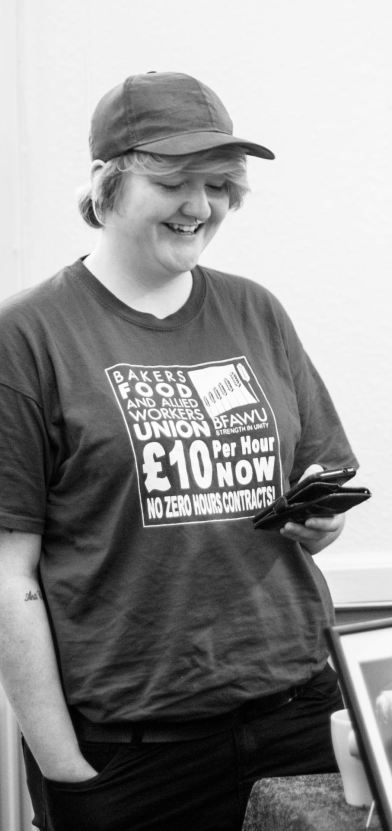
Lauren McCourt, aged 23, is a feminist and  a prominent activist in her union, the BFAWU.  She has chosen to challenge the everyday oppression meted out to young people in her workplace, some of which has parallels with 1918. “We have zero hour contracts, low pay, and bullying managers. Unions are important to protect people against these issues.” And just as in 1918 the response from women was to get organised.  “Being in a union for a woman shows the management that women will fight back against issues such as sexual harassment.”

lauren 3

Lauren (Photo Steve Speed)

In 2018 some feminists are trying to turn Sylvia into a kind of celebrity feminist as shown by the campaign to get her a statue which literally means turning her Marxist politics into stone. What women need is her anger and actions to make real her socialist view of the world. The true inheritors of that philosophy is found in the words and actions of women such as Charlotte, Josephine, Eden and Lauren.

Come and hear Lauren McCourt speak on 10th  March at 2pm at a joint event between the Mary Quaile Club and the Working Class Movement in Salford. Book tickets at trustees@wcml.org.uk


Posted in anti-cuts, Communism, education, feminism, human rights, International Women's Day, labour history, political women, Socialist Feminism, Tameside, trade unions, Uncategorized, women, working class history, young people | Tagged , , , , | 1 Comment

Beyond #MeToo? Broadening a campaign to a movement by Jane Latour

beyond me too

Jane Latour is a freelance writer and author of Sisters in the Brotherhoods Working Women Organizing for Equality in New York City. She lives in New York.

 Humpty Dumpty

Sat on a wall,

Humpty Dumpty

Had a great fall.

All the King’s horses,

And all the King’s men

Couldn’t put Humpty

Together again.

British Nursery Rhyme

Currently, men in high places are taking a great fall. In what is almost a daily occurrence, both the UK and the United States are experiencing widespread and highly publicized stories exposing egregious examples of sexual harassment.  We see women finally coming forward to share their experiences of being assaulted, degraded and sexually exploited in their work places. In the U.S  the phenomenon, now with a power and force all its own, began with Hollywood actresses speaking out about their abuse by the mogul Harvey Weinstein.

Labeled as #MeToo, the movement keeps spreading, and now includes a wide range of industries. Recent disclosures just dislodged Steve Wynn, a billionaire casino magnate, and prominent supporter of President Trump, who fell from his perch after the Wall Street Journal reported allegations about decades of predatory behavior toward his female employees in great and sordid detail. The resistance to President Trump is providing fuel for this moment.

Not since 1991, when Anita Hill testified before the Senate Judiciary Committee about the workplace behavior of her former boss and then nominee for the U.S. Supreme Court, Clarence Thomas, has the topic of sexual harassment so informed the public discourse.  So many of the types of questions that beguiled the public and members of the Committee back then are now being dissected and hashed out. Why didn’t Professor Hill come forward before that moment? Why on earth did she maintain her ties to Thomas? And how on earth did this happen at the Equal Employment Opportunity Commission (EEOC), the nation’s top federal enforcement agency overseeing sexual harassment cases.

Women speaking out about Weinstein, Wynn and numerous other serial harassers, are doing so at a moment when it feels safe to do so. This time, their stories are credible, there’s comfort and strength in numbers, and consequences are being leveled—not, as usually occurs, against the victims, but against the perpetrators.

Despite critics (Fox News right-wing pundit Laura Ingraham calls this “the War Against Men” etc.), the real problem is that, like the children’s game from long ago, Monkeys in a Barrel, all of the issues revealed by the #MeToo moment are intertwined. Pulling up on one connects to the next, and the next, in a sequence ultimately connected to power and the patriarchy.

The disproportionate hold on power in every sphere of society keeps the disturbing status quo in place for one-half of humanity. This power flows from the patriarchal arrangement of society and government whereby men hold the power and women are largely excluded from it.  The root of the word “patriarchy” derives from the Greek term for “ruling father.” Way back in 1970, when the women’s movement was creating upheavals in social relations, radical feminist and scholar Kate Millet shared this insight: “It is interesting that many women do not recognize themselves as discriminated against; no better proof could be found of the totality of their conditioning.” (Sexual Politics)

women unite

The early women’s movement began as a collective effort to upend these arrangements.  A robust and humanistic brand of feminism was practiced by many adherents, including the National Organization for Women (NOW) at that early stage. This path is evident in the breadth of their demands and the inclusive vision for changing society and oppressive corporate practices as documented in their archival records.  Witness, one small sample: a memo written by sociologist and NOW activist Sally Hacker in 1972, which reads in part: “These jobs (a reference to Bell Telephone employees) should be reorganized more humanely, and workers at all levels should have more control over their working conditions. If we are truly working toward a feminist-humanist society, let’s begin to change—not merely get into—some of these powerful and oppressive institutions.

As the historian Alice Kessler-Harris notes, “The #MeToo movement and, indeed, the women’s marches, both recall that bit of the 1960s-1970s feminism that emphasized collective and shared responsibility for each other, rather than the individual achievement of women, which later became identified as feminist. Perhaps we are getting back to that earlier place, and Trump has helped to push us there.”

Labor-rights-activists-de-010

What would make the old slogan, “Sisterhood is Powerful,” a reality, and the #MeToo moment a movement is the full-throated inclusion of working-class women in every aspect. If the deeply felt commitment to feminism was shared by women from all ranks of society—STEM professionals, doctors, lawyers, Indian chiefs, factory workers, clericals, blue-collar, pink collar and white-collar women, workers of every stripe—in a cross-class, cross-generational, multi-racial embrace of the cause of gender equity.

The “third wave” of feminism failed to reach deep into the ranks of working-class women. Today we have an opportunity to try, try again. Let us not falter. We have only to remember the old, working-class slogan of solidarity: “An injury to one is an injury to all.”

Posted in anti-cuts, feminism, human rights, labour history, political women, Socialist Feminism, trade unions, Uncategorized, women, working class history | Tagged , , , , | 1 Comment

My review of “The Caseroom” by Kate Hunter


the caseroom

This is a unique novel; how many are written by female  trade union activists about the history of women’s roles in trade unions and the struggle for equality at work?

The Caseroom is set during a dynamic period of women’s organising; 1891-1910. Iza Ross is a thirteen year old girl who, against all odds, is taken on as an apprentice  compositor in the Edinburgh print industry.  The opposition to women working in the print industry is spelled out by her older brother Rab who stops her one morning as she  leaves for work. “Ah’m a man at the frame, doing a man’s work. And you? You mean to be a frock at the frame? Better you’d never been born.”

women compositors

Rab and the other printers oppose the use by their employers of women as cheap labour.  As a female apprentice Iza gets only three  years training, unlike the men who get five  years, while  she is paid only half their wages. Employers are exploiting women but the men –  instead of bringing women into the union and fighting for equality for all  – try to exclude women from the workplace.

This is a theme running through the history of the trade union movement during this period and this  is why,  for example,  in the northwest of England we see the creation of the Manchester and Salford Women’s Trades Union Council in 1895.

manchester women

Iza is a feisty girl and, bolstered by her father who was blacklisted after the print strikes in the 1870s, she steps up to the challenge of becoming a skilled worker and against all the odds (which personally and politically are high) she continues to work through pregnancy and marriage.

In this well researched book Kate recreates the highly militant era of the 1890s in Edinburgh.  Iza becomes involved with an activist Roddy Mac who takes her to a meeting with the real life trade unionist and socialist James Connolly. Connolly,  noticing that Iza is becoming bored with their conversation,  asks her about her life. She explains how the male Typographical Union will not allow women compositors to join,  but he reminds her of the importance of being in a union. “There’s much wrong in this world, the thing is to make it right, and to make it right working folk must be organised.” 

Iza then decides that she will join the unskilled workers union,  The Warehousemen and Cutters Union.  Running through the book is the poverty existence of Iza, her family and community. Her father is disabled and each week, alongside her siblings, Iza must handover her earnings. And as a girl she is expected to make meals, and be available to care for her parents and younger brother.

But times are changing, if slowly,  for women. Iza is one of 800 women compositors in an industry that dominates Edinburgh.  Iza’s friend Margaret, also a compositor, will not go along with being forced to join the unskilled workers union and becomes involved with the campaign to set up a women’s section of the Typographical Union, the “We Women” movement to oppose the men. Margaret writes a letter to Iza saying “Amelia McLean, a compositor at Skinners, reported that 300 women had joined the We Women movement, set up with the aim of keeping the trade open to women and that they planned to set up a union of Edinburgh women compositors, readers and monotype operators.” Margaret urges Iza to sign the We Women statement; “Have you seen it? You must.”

Kate Hunter’s grandmother was a compositor, when it was really unusual for  a woman  at that time, the Victorian era, to get into the highly skilled trade of hand setting, and  that inspired her to write this novel. It is impeccably researched and took her  seven years! It is much more than one woman’s story of her life; it is an important history of how poor  women did change their lives,  and in that period led the way for other women to challenge out-dated stereotypes about women’s role at work and in the family.

I loved this novel because it is so unusual to find novels or history books about women in trade unions. This period of history, 1890s- 1910, was  a dynamic time for women organising as I found out when researching the MSWTUC.  In that archive there are many fantastic stories of individual women that would make great novels  just like Iza’s story in The Caseroom. We need these histories and these novels to inspire women today as we face major attacks on our lives at work, at home and in the world.

The Caseroom costs £9.99 buy it here

Posted in anti-cuts, book review, feminism, labour history, novels, political women, Socialist Feminism, trade unions, Uncategorized, women, working class history, young people | Tagged , , | 4 Comments

My Review of “The Night Brother” by Rosie Garland


the night brother

As the debate around gender recognition in the C21st rages on Rosie Garland’s new novel The Night Brother is a fantastical story of identity and belonging: of sexuality and gender.  Set in late  C19th and  early C20th Manchester  this is the story of Edie and Gnome, angry siblings trying to sort out their lives, whilst at the same time the suffragettes are taking to the streets and demanding the vote.

The story begins in 1894 in a pub in Manchester. “My night brother is here. Halfway between yesterday and tomorrow morning, he shakes my shoulder.”

Edie and Gnome take us on  their adventures through night time Manchester. I love the way in which Rosie catches the cheeky, challenging attitude of working class people.

Gnome gets them into Belle Vue Zoo by pretending to be a tea boy for the workers in the lion house. As they sail for free into the zoo Gnome tells Edie; “Here’s the thing. If you act confidently, folk believe what they see and hear. Act nervous, like you don’t belong in a place, and you’ll stand out like a sore thumb.”

The story is set in a vibrant time for working class women,  1894-1910. In 1895 the Manchester and Salford Women’s TUC sets up to help organise the oppressed women in industries from tin box to weavers to laundry workers and running alongside this is the campaign for the vote.  Rosie captures the excitement held out to women to finally escape Victorian female stereotypes and the strength to become visible on the streets and in demonstrations.

Edie is growing up and trying to discover her true self. She gets a job, moves into rented rooms and makes new friends. Gnome and her family try to hold her back but she educates herself through the local library, the art gallery and by meeting middle class suffragette Miss Abigail Hargreaves.

Edie comes across the suffragettes as they demonstrate in All Saints,  Manchester. Edie says; “Here are the women that Ma rails against; the scourge of society, on a mission to drag it to its knees. Ma would be terribly disappointed. From what I can see, everything is proceeding with the utmost decorum.”

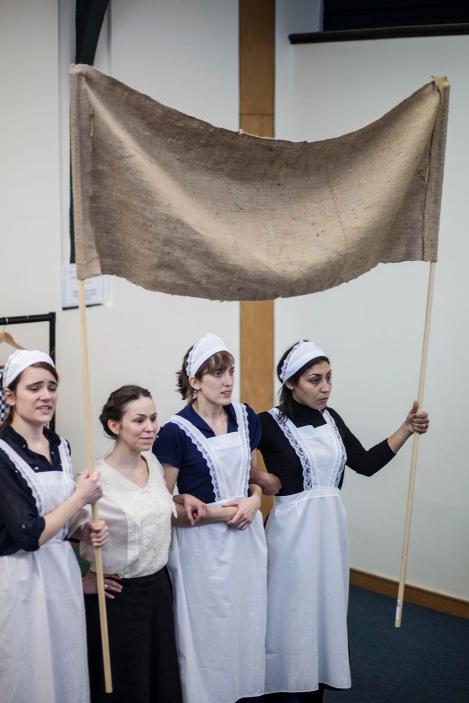
For me, this is where the novel loses its excitement. It might have been better if Edie met Mary Quaile who at this time was also on a journey from being a domestic to setting up a cafe workers union in central Manchester. It was not just the suffragettes who were demonstrating in Manchester at this time; many working class women were taking to the streets, they were angry  and demanded better pay and conditions.

play waitresses and banner

Scene from play “Dare to Be Free” about Mary Quaile. Photo by Steve Speed

And although other working class women appear in the book, apart from Edie, I feel they are caricatured as downtrodden.

Running through the book is the conflict between Edie and Gnome,  and as they grow up  it becomes more vicious. Gnome resents  Edie’s friendship with Abigail and  inveigles himself into supporting  a  suffrage demonstration in Ashton-under-Lyne. But reluctantly he realises that he has fallen for Abigail, who is only interested in Edie. Sounds like a familiar story? It is not. There is a deeper narrative going on at the heart of the book,  but you will have to read it to find out.

“The Night Brother” is a fascinating story made real by Rosie’s knowledge of Manchester during this period. “Manchester music rings in my ears: the squeal of trams and shouts of wagon-drivers; the slamming of doors and clash of plates from the cafes; the roar of newspaper-sellers; the percussion of clogs sparking stars from the pavement; the halloas and hail-fellows of a thousand folk at the beginning of the day’s labour, still brand spanking new.”

The Night Brother costs £16.99.  Buy it from or like me, borrow it from your local library – if you still have one.


Posted in book review, feminism, human rights, labour history, Manchester, political women, trade unions, Uncategorized, women, working class history, young people | Tagged , , , | 2 Comments

My review of “Freedom Song” by Mary King (1987)

FS 2

In 1962 white, preacher’s daughter, Mary King, graduated from college, and decided to give up her cosy middle class lifestyle and head south to work for the Student Nonviolent Co-ordinating Committee (SNCC).

This memoir is the story of her four years in one of the most dynamic, civil rights organisations. The SNCC was an organisation of young people; mainly black and male. Even at its height only 20% were white. It was a grassroots organisation which was set up to work in the southern states of the USA ,and alongside the black community, to  challenge their oppression .

SNCC logo

Mary’s first job with the organisation was to travel with another young  woman, who was black,  across the cities of the south  and assess the extent of academic freedom  in southern colleges. In the 1960s in the south this was a head-on conflict with the system of legalised segregation. As Mary explains; “The machinery that kept this system in place operated through the overt, legal channels of segregated education, healthcare and transportation; denial of voting rights: and infringement of the constitutional rights of free speech and assembly. But it was also maintained through extralegal, covert means-unlawful detention, police tyranny, terror, firebombing of homes and killing.”

Mary went onto to play a key role in the SNCC as its Communications Worker, a commitment that brought her face to face with her own possible death. She says; “I was willing to take on the possibility of being killed – as many known and unknown civil rights activists were.” But working for the movement was “everything I might have hoped for”.

Racism, then and today, is one of the key issues affecting American democracy. The SNCC was a radical organisation, unlike some of the other more prominent civil rights groups, which  challenged some of the big, moral issues of the 1960s. This included the relationship between black and white people and between women and men, non violence versus violence, grassroots versus top down leadership and reform versus revolution.

Mary  says of the SNCC; “Its enduring significance is that, within the American context, we raised these quandaries, projecting them into contemporary political debate, in some ways contributing to the terms of the discussion that continues to this day.”

sncc poster

The strength of this book is that it is the firsthand account of a young woman at the heart of the movement and alongside it traces her own personal development.  During the day she was working for the SNCC, going back to an apartment in the black projects (which was very unusual for white women in the 60s) which she shared with fellow worker Casey,  and spending their spare time educating themselves by reading the works of Simone de Beauvoir and Doris Lessing.

Mary and Casey used their experience in the civil rights movement to raise issues about the role of women within the organisation  – issues at the time were seen as groundbreaking.  One aspect of the book which I really like is the way in which Mary promotes other women; telling their story and giving them back their place in  civil rights history.

This is not an easy book to read because the history of the civil rights movement is a brutal one. Each chapter of the book opens with a song about freedom because as Mary explains: “The freedom songs uplifted us, bound us together, exalted us, and pointed the way, and in a real sense, freed us from the shackles of psychological bondage.”

“Freedom Song”, written in 1987,  is as  relevant in  2018. Its relevant to people in the UK is that it  shows that it is grassroots organisations with the oppressed at the centre that will really change their lives. Its relevant to the USA in 2018 as recent research shows that in the ex-Confederate southern states that there are still 4 million unregistered black voters. Then as now, the reality is that these southern states and their black populations, are key to the liberation of the USA. As Mary commented in 1987; “The best gauge of the success of our democracy and the true measure of justice in the USA is still the status of America’s black community.”

Posted in biography, book review, education, feminism, human rights, political women, Uncategorized, women, working class history, young people | Tagged , , | 2 Comments

My review of “Gender is Not an Identity;It is a Tool of Patriarchy” by Green Goude

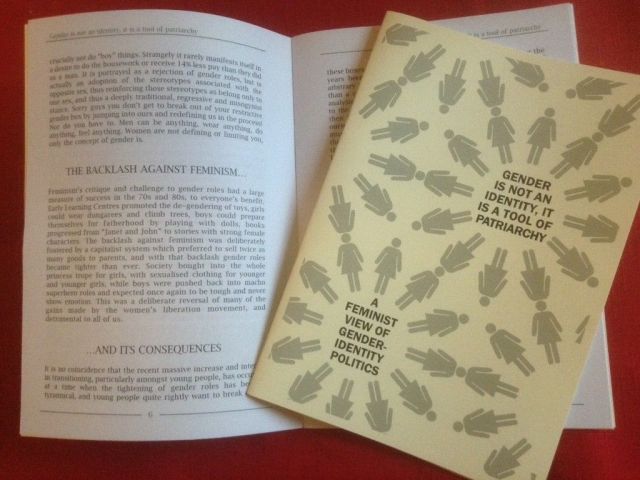
gender is not an identity

There is something wrong when respected members of the Left feel the need to adopt pseudonyms to write  a pamphlet about gender identity politics. But if you read the Morning Star, or were at the London Anarchist Bookfair, or go on Twitter you will know that there is an intense and sometimes violent debate going on over gender identity.

This pamphlet – in a considered and rational way – tries to calm down the anger and open up the debate.  The author, Green Goude, begins by reminding us that “Men are fine, women are fine. Every body is fine, every body is perfect”. She argues that  it is the society we live in,  and the nature of patriarchy,  which has created the oppression of women by men as a class.

Goude, a veteran of the socialist feminist movement, sees the backlash against feminism by capitalism and the reversal of the gains made by the feminist  movement as the background to the growth of interest in transitioning by young people.

She  challenges the notion that transitioning can  transfer someone into the opposite sex. And that, whilst respecting and supporting the rights of individuals’ to do so,   that for male to trans people (MTTs) who have been raised as a  male with all the privileges over women is “an ideology with no basis in fact, which is not believed or adhered to by many MTTs.

Goude calls for a more respectful debate of the issues of gender, supporting individual’s right to play around with issues of identity,  but being aware that this is a key issue when for example collecting statistics or on  policies on prisons, sports and in challenging ingrained discrimination against women in public.

The answer, as Goude rightly acknowledges,  is for there to be more debate and discussion around  these issues whilst recognising that,  although people have every right to identify however they like,  this cannot mean allowing personal preference and the expression of personality to  be given the same status, rights  and recognition as biological sex.  Otherwise, as she comments, “we undo in one fell swoop all the gains women have made and still need to make in our male-dominated society.”

Goude’s pamphlet is a challenge to the silencing of feminists who have questioned challenged trans ideology.  As Goude counsels “Any silencing only benefits a misogynist, homophobic and patriarchal society, and we will all be the losers.


Buy the pamphlet (only £2.50 free p&p in UK) and follow the debate here

Posted in book review, education, feminism, human rights, interesting blog, political women, Socialist Feminism, Uncategorized, women, working class history | Tagged , | 1 Comment

My review of “Revolutionary Women”

a-f-anarchist-federation-revolutionary-women-1

Clara Gilbert Cole


I love this pamphlet. It is a fascinating subject; 13 unknown revolutionary women, their story of how they not only fought for their own emancipation but led other revolutionary struggles.

Revolutionary Women was produced by the Anarchist Federation who not only want to prove that anarchism and women’s liberation are two sides of a coin,  but that very often, and not just in the anarchist movement, women have had to fight their own male comrades to achieve equality.

I was fascinated to find out about Mancunian, Clara Gilbert Cole, (1868-1956) .  She worked as a postal worker and married  artist Herbert Cole. Clara and Herbert were involved with suffragism and he went onto become staff artist at the Women’s Social and Political Union.

Clara took part in some of the most important campaigns of her age. She opposed the First World War, founded  a League against War and Conscription in 1915 and was imprisoned for five months for distributing anti-war leaflets.

In the 1920s she was involved with the unemployed movement and  was arrested again. Clara became an anarchist, supporting the Spanish Civil war. Throughout her life she wrote poems, anti-war articles and was fervently anti-religion.

Maria Roda was born in Como in the Lombardy region of Italy in 1877. Her father was an anarchist and she went to work in the local mills as a teenager.

maria roda

At the age of 15 years old along  with comrade Ernesta Quartirola aged 14,  she organised a strike in a mill for which she was imprisoned for three months.  It was not the first nor last time she was imprisoned for her actions and beliefs. Eventually, with her father and sister, she moved to the USA and was involved with organising textile workers in Paterson and wrote for their newspaper “La Questione Sociale”. Maria founded an anarchist women’s group called Gruppo Emancipazione della Donna (Women’s Emancipation Group) in 1897.

The group linked up with other women’s groups in the USA and internationally discussing issues about how women could be equal comrades whilst taking part in the workers and anarchist movement. And, if that was not enough,  Maria lived with comrade Pedro Esteve, had eight children, and continued to work in the silk mills and was an activist all her life.

Reading this pamphlet reminds me of the phrase: “ordinary women leading extraordinary lives”. One of the most unusual stories is about Japanese woman, Ita Noe (1895-1923). She was born into the landed aristocracy , but ran away after being forced into an arranged marriage.

Ito_Noe

Ito moved to the more progressive Tokyo and at age 18 joined the Seitosha (Blue Stocking Society) and went onto become an editor of their magazine. Ito spoke several languages, and translated the articles of anarchist Emma Goldman about women’s struggles.

She chose to live in an open relationship with anarchist Osugi Sakae which led to the couple being attacked by the media and  to divisions amongst their comrades.

Ito went onto found the socialist women’s group Sekirankai in 1921. A prolific writer,  she produced articles,  as well translating the work of European anarchists and writing several autobiographical novels.

But after the birth of her seventh child in 1923  an earthquake hit Japan and killed thousands of people. The authorities used the situation to blame the anarchists for the chaos and murdered anarchist and socialist militants. Ito and her partner Osugi and his six year old nephew were beaten and strangled by the secret police in September 1923. They were not alone as being an anarchist in Japan at that time meant the chances of being killed by the state were high.

Revolutionary Women is an inspiring read. Not just because of the fascinating history of anarchist women but also because  it’s well written and presented. If we are to convince people that grassroots politics is for them,  and not just for a political class,  then pamphlets like this are crucial to convincing people that they can make the changes to create a fairer society. And at £2 a copy it is accessible to everyone!

Buy it from

Posted in book review, Communism, education, feminism, human rights, labour history, political women, Socialist Feminism, trade unions, Uncategorized, women, working class history, young people | Tagged , , , , | 3 Comments

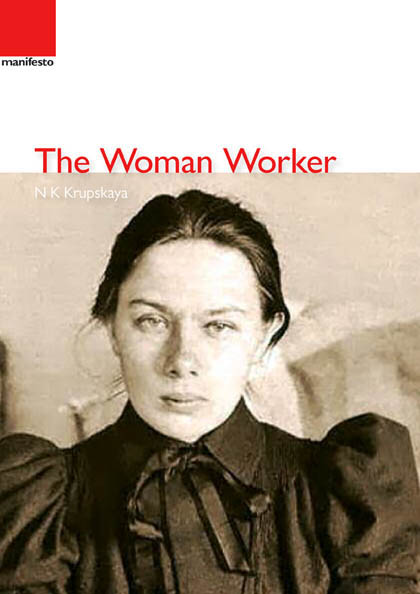
My review of “The Woman Worker” by N. K. Krupskaya

PIIGS 2

Reading this pamphlet reminded me of the report written by Mary Quaile following the TUC Women’s Delegation to the Soviet Union in 1925.  Commenting on the welcome they received Mary said; “Women were there in hundreds, many of them with bunches of wild flowers to give to their British sisters, all of them wanting to shake our hands, some with tears in their eyes, not of sorrow, but of joy at our meeting.”

We do not know for sure, but one of the women that Mary and her comrades may have met  on their visit was Nadezhda Konstantinovna Krupskaya (1869-1939).  She was an important revolutionary in her own right,  but has often been marginalised because of her status as “Lenin’s wife”.  But alongside Lenin she was arrested in 1896 and sentenced to three years internal exile. She then followed Lenin to Munich in 1901 and  on to  London in 1902.

She wrote The Woman Worker in 1899 using the pseudonym “Sablina”. It was published and distributed in 1905, but was banned after the suppression of the 1905 revolution,  and it was not until 1925 that it was republished.

Nadezhda was a lifelong activist, taking part in the October socialist revolution of 1917, and playing a key role in the government as Minister for Education from 1929 until her death in 1939 .

In the celebrations of 100 years since the Russian Revolution it is great to see The Woman Worker” being reprinted. I particularly enjoyed reading Nadezhda’s introduction,  and I cannot imagine many male writers confessing that; “As it was my first booklet I felt very nervous about whether I could manage it.” 

Nadezhda wrote the booklet to expose the horrendous lives of women in Tsarist Russia and to show how a socialist system could deliver emancipation for women and men. Reading it you can understand why the Tsarist government wanted it banned. She believed that women needed their economic independence in order to lead free and equal lives with men in society.

She runs through what seem very familiar arguments, even today, about why men need to include women in political struggle. “Stopping women joining in the struggle is the same as leaving half of the workers’ army unorganised.”

Nadezhda et shows how even in the bad times of Tsarist Russia women went out on strike because of low pay and that women were being forced into prostitution.

In 1899 women workers from a jute mill struck and marched to the factory’s offices. They were stopped on the way and locked into a park until  male workers from another factory forcibly freed the women. The governor responded by calling out the army who, for five days, fired on the workers who responded with stones, smashing windows and setting fire to buildings. Unfortunately, the workers then went on to to set fire to local brothels. The women  were angered by the owners who cynically told them that if the pay was not enough they could get additional income working as  prostitutes.

But as Nadezhda states; “Who can blame a poverty stricken woman for selling herself, for preferring the only readily available extra earnings to beggarly existence, hunger and sometimes a hungry death?”

Reading this pamphlet shows why a socialist revolution was inevitable in Russia. It was also the first Marxist analysis of the lives of women in Russia. In 2017, although some of the language sounds dated and there is little discussion of the role of men in the family under socialism,   the message about the importance of women being independent people alongside being part of a trade union is still relevant. I love her statement; “Only when struggling arm in arm for the workers’ cause can women find the keys to “the joyful happiness of freedom.”

The pamphlet was produced by the Marx Memorial Library and Workers School and you can  buy it here   It’s a bargain at  £3.50 plus postage.

Posted in book review, Communism, feminism, labour history, political women, Socialism, Socialist Feminism, trade unions, Uncategorized, women, working class history, young people | Tagged , , | 1 Comment

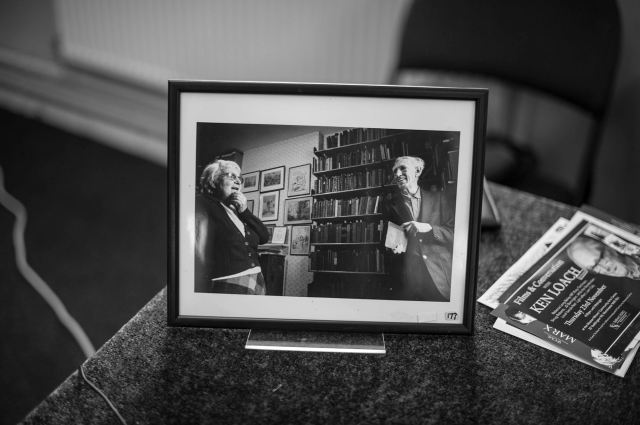
“…the point is to change it”: Remembering Ruth and Eddie Frow and the WCML

frows 11 nov


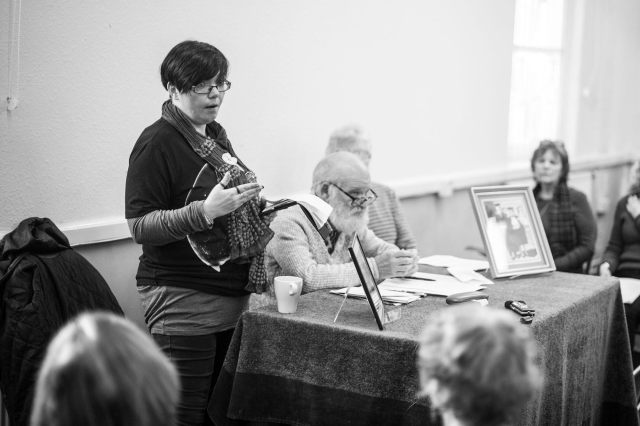
Last Saturday’s event commemorated the lives of the  Frows,  showing  how their belief in communism was about grassroots activity which included the creation of the Working Class Movement Library in the 1950s. They wanted  to encourage  future generations to understand  the importance of  working class history to political activity.

Mike Luft, communist and anti-fascist organiser, opened the event with a reminder of the importance of communism at a time when celebrations of the 1917 revolution were being airbrushed, obscuring  its inspiring message of hope for making the world a more just and equitable place.  He said the Frows were part of that history and had, with many other people, committed their life to communism and political activity.

mike luft 1

Actor, Joan McGee then read Bertolt Brecht’s poem Questions From a Worker Who Reads (1935),  a reminder that it is the people at the bottom who really make history.

joan mcgee

Radical historian Michael Herbert spoke  of Eddie Frow’s involvement in the National Union of Unemployed Workers and how that  had spurred him on to commit his lifetime to communist politics.

mike herbert 1

Charlotte Hughes   of Tameside against the Cuts made the link with today and how life for poor people had deteriorated under the weight of austerity and the  attacks on benefits. But she talked about the work that she was doing  in Ashton-under-Lyne and the campaign against Universal Credit.

charlotte 11 nov

Dorothy Winard spoke about the life of Ruth Frow who had shaken free from her stultifying background of middle class propriety  by joining the WRAF in 1939, becoming a communist in 1945, and  entering into  50 years of partnership with Eddie.

dorothy 11 nov

Hilary Jones of the IBMT then read the Leon Rosselson song  “The Song of the Old Communist”  a eulogy to the thousands of people who took part in communist politics in this country over the years – a message even more important in 2017.

hilary 1

Contributions from the floor included  Royston Futter, a library Trustee, who spoke about how the WCML was brought to Salford in 1987 and Maggie Cohen, chair of the Trustees,  who was friend and comrade with Ruth and Eddie for  over sixty years. I spoke about the generosity of Ruth and Eddie to Irish political prisoner John O’Dowd and a message was read from Alex Ritman about the kindness of Ruth to him when he had to wait for his parents when they were at Communist party meetings.

maggie

Mike Luft spoke about how young people in a largely Jewish area of Manchester, Cheetham Hill,  joined  the Young Communist League and played a crucial role in local and national politics.  Not just in local street politics opposing Mosley’s Blackshirts but in organisations that today have been cleansed of that communist background ie. Benny Rothman  leading role in  the Mass Trespass at Kinder Scout in 1932.

In 2017 one of the organisations which is encouraging young peoples’ activity is the Bakers, Food and Allied Workers Union and Lauren McCourt explained about how she had  became involved in trade union activity at work. Lauren gave an inspiring speech about how the recent first ever strike at McDonalds in the UK had encouraged many young workers to join the union. She said it was about organising workers including migrants and  supporting people across the world to take on exploitative employers. Her speech showed how the message of communism; about how liberating one person can lead to the liberation of everyone is as relevant today as in the 1930s.

lauren 2


Balladress Jennifer Reid and actor Joan McGee ended the day with a series of songs and poems that reflected the lives of the Frows and their many comrades locally, nationally and internationally.  This included a poem called “Freedom” written by author and anti-fascist activist Ethel Carnie  and  “Parkside Occupation” a song about the Miners’ Wives in the 1984-5 Miners Strike.

jennifer


Thanks for  photos by Steve Speed contact him at slspeed@hotmail.co.uk

Posted in anti-cuts, Communism, drama, education, feminism, human rights, labour history, music, political women, Salford, Socialism, trade unions, Uncategorized, women, working class history, young people | Tagged , , , , , , | 1 Comment