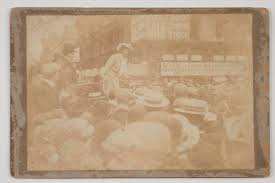
I recently came across this photograph of Hannah Mitchell, Manchester radical suffragist and socialist. She is speaking at an out-of-doors meeting campaigning for the vote for women.
Hannah (1871-1956) was unique in many ways. She was a working-class woman who took part in militant activity as a suffragist; she also campaigned in the Independent Labour Party for a better world for all; she became a Justice of the Peace, a councillor and a writer; and, most uniquely, wrote her autobiography.
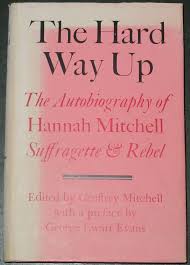
Her early life was not unusual for many working- class girls, she had only two weeks formal education and then worked in low waged and exploitative employment. But she was a woman with dreams and hopes for a better future for herself and her class.
She was living at a time when women were demanding the right to vote, while the working class was getting organised in trade unions and political parties for a better deal for their class.
In 2001 left-wing playwright Eileen Murphy brought Hannah to life in a play called Hannah which was performed at the Peoples History Museum.
It is Hannah’s autobiography that takes us into her mind and story as we walk alongside her through her life from 1871 to 1946 (she died in 1956) The book is divided into chapters: child, woman, wife, suffragette and so on
Hannah was born in a remote area of the Derbyshire moorlands. The environment and her mother pressed down on her until one day she gathered her belongings and took the seven-mile trek to Glossop: “somewhere on the moorland road I left my childhood behind for ever”.
Working as a maid she kept her self-respect “I wore an apron at work of course but absolutely refused to don the muslin badge of servitude”.
Hannah moved onto working as a skilled seamstress but still exploited she and her sisters attended a meeting to demand a weekly half day holiday for all shop workers.
In her description of her marriage and becoming a mother, Hannah shows how it is the kindness of friends that got her and her husband through these difficult times. Moving to a colliery village in Burton-on-Trent gave them the opportunity to meet socialists and join the Independent Labour Party.
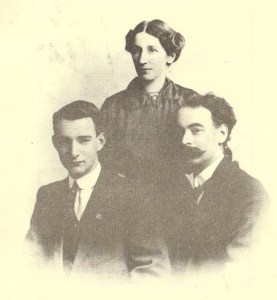
Hannah Mitchell and family
But her politics was tempered by the fact that as a woman she could not vote. As she put it “a real grievance in my mind.”. It was her male comrades, though, that encouraged Hannah to assume positions of responsibility and to take part in the rough and tumble of speaking in public.
Moving to Ashton-under-Lyne Hannah became more involved in the ILP and the Labour Church as Lecture Secretary. She chaired meetings with speakers from the labour movement and spoke at public meetings. In 1904 she became a Poor Law Guardian: her campaign was supported by Mrs Pankhurst which led to her offering Hannah a paid job as an organiser for the Women’s Social and Political Union. Without this wage Hannah could not have taken part, and it is to the credit of Mrs. Pankhurst that she recognised the importance of paying working class women such as Hannah.
But at home Hannah still had to do all the cleaning and cooking and look after her son who was now 10 years old. In her autobiography she thanks her neighbour Mary who would cook the evening meal for the family.
Her dedication to the suffrage cause was not daunted by her experiences. In reflection Hannah wrote in her autobiography: “It seems to me now, looking back, that all my previous life had been a preparation for this great experience.” She became an important activist in the suffrage campaign, speaking and organising meetings across the country.
What is shocking is the level of violence meted out to her and the other women. At one meeting in Boggart Hole Clough as Hannah and her sisters were speaking from a lorry a group of men took hold of it and tried to roll it down a slope. The women were terrified, but Hannah laid into the men with her umbrella.
In 1906 Hannah was arrested with her comrades at a Liberal rally at Belle Vue in Manchester: they were given three days in prison as they refused to pay their fines. But Gibbon, her husband, went and paid her fine, much to her disgust, and she was released. Her response was bitter: “Most of us who were married found ‘ Votes for Women’ were of less interest to our husbands than their own dinners.”
Her work took her across the country organising campaigns as well as speaking. It took its toll and eventually brought about a breakdown in her health. She says, “For week I wandered mentally in a strange world, all sorts of delusions passing through my disordered mind.” Hannah says she recovered due to her doctor and the “devotion and tenderness of my women friends”. Comrades in the suffrage movement sent her money to eat better and to take a holiday at the seaside.
Hannah was bitter at the lack of support from the Pankhursts who never contacted her. She says, “I felt that it would be impossible to work with them again.” The WSPU split during this time and Hannah joined the new, more democratic organisation “The Women’s Freedom League”.
Hannah continued her work with the WFL in Scotland and took her son, Frank, with her. She was active in the ILP and in 1914 was sent as a delegate to the “Coming of Age” conference in Bradford. There she challenged the socialists for their lack of support for the campaign for the vote.
Hannah and her husband Gibbon had always been pacifists. The First World War reinforced their views, and they joined the Non-Conscription Fellowship. Their son followed in their footsteps and registered as a conscientious objector and faced a tribunal.
After the war Hannah threw herself into work for the ILP. In 1924 she was elected as a councillor for the seat of Newton Heath in Manchester. In this work she worked had to improve the lives of working- class women. She served on the public health, baths, libraries and pension committees.
From her own experience Hannah knew what working-class women needed to improve their lives. She was involved in the building of a washhouse which was a major improvement for the women and children who had no bathrooms or washing facilities in their terraced houses.
In her work on the Library Committee Hannah established “young peoples” reading rooms providing a place where they could read in comfort.
Hannah had always wanted to write and after the First World War she joined the Lancashire Authors’ Association and started writing dialect sketches which were published in Labour’s Northern Voice.
She worked on writing her own memoir during the years of the Second World War. Hannah was no longer a councillor, although she was invited to speaking at the Cooperative Women’s Guild and women’s organisations.
In 1939, on the twenty-first anniversary of women’s enfranchisement, a young woman reporter visited Hannah and asked her opinion of young women today. She was scathing about them. “You’ve worked hard all day, and you think your nights should be spent at tennis or dancing. We suffragettes fought for political freedom. We got it. It is up to you to fight for economic freedom now. You are doing the same jobs as men as efficiently as they do them for about a third of their wages.”
Hannah’s autobiography was not published in her lifetime. It was not until 1968 that it was published by faber and faber. In 1980 it was republished by Virago and gained a new audience of socialist feminists.
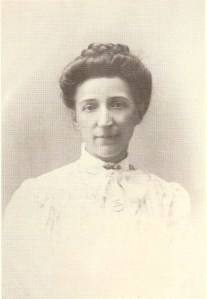
Sadly, today it is out of print. If International Women’s Day means anything it should be about promoting the lives of working-class women including Hannah Mitchell.
Secondhand copies of “The Hard Way Up” are available on the internet.
Greater Manchester Libraries have copies that can be borrowed.

 lipstick socialist
Only just seen your message re Hannah Mitchell book How can we get it back in print ? Still having treatment for my diabetes- nurses and carers but can do things like that. Love sanndy