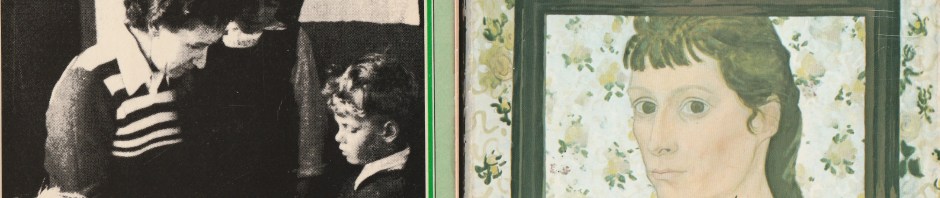
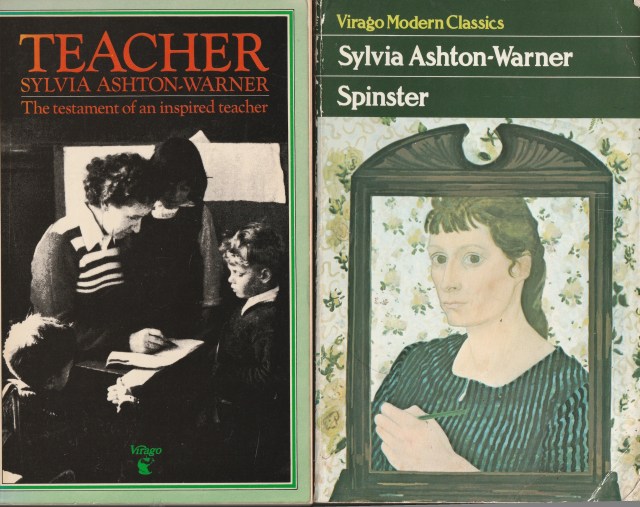
In 1973 Virago Press, a women-run publishing house was set up. At that time publishing was dominated by men promoting books by men. Driven by a new wave of feminism Virago spoke to those of us who wanted to read books by and for women, from the past as well as the present. Its name reflected this; virago meaning strong, heroic women. The use of green as the background to the books and beautiful artwork used on the covers made them stand out on the shelves and make you want to buy them.
These two books by Sylvia Ashton-Warner (1908-84) show how important Virago was in publishing international authors and (in this case) promoting a woman who created a new way of teaching children.
Sylvia was born in New Zealand in 1908. She was one of ten children, her father was disabled and her mother, a teacher, used to take the children to school with her every day. Like many working- class girls teaching became a career that she ended up in, rather than chose.
She married a teacher and they went to work in the Māori areas of New Zealand. It was when she was working with these children that she devised her own way of “organic teaching” that is using the children’s own experience to help them to read and write. But there is much more in this book.
In “Teacher the testament of an inspired teacher” published by Virago in 1980 Sylvia explains how she works with the children. There are photographs, her teaching diaries and her teaching scheme. What is inspiring in the book is Sylvia’s respect for the culture of the children whilst recognising that they needed to educate themselves to live in New Zealand society.
I love the way she called the children “the Little Ones”. She started the day and drew the attention of the children by playing on the piano the first eight note of the Beethoven’s Fifth Symphony. Sylvia was a talented pianist and artist, and she took these skills into the classroom and used them to give the children an education broader than what was expected of the curriculum in New Zealand.
Her children were involved with making things, knitting and sewing, washing and ironing, singing and dancing, playing basketball, drawing, painting, playing the piano and so on. Her aim was not just about children learning to read it was about bringing out the naturally peaceful nature of them and to become happy adults.
She says, “My concern is the rearing of the creative disposition, for creativity in this creche of living where people can still be changed must in the end defy, if not defeat the capacity for destruction.”
Sylvia’s Creative Teaching Scheme was (eventually) taken up in New Zealand and it became a worldwide text for schools.
Her novel “Spinster” (first published in 1958) is the story of a teacher living in a remote New Zealand town and her relationship with her Little Ones. It was her first novel which she used to promote her teaching scheme because she could not get a publisher for it.
Anna is the main character, who is struggling to live her as a spinster/teacher in a small town. Life is not easy and she needs a tumbler of brandy before working with the seventy small children that she teaches. She gains sustenance by her relationship with nature. She speaks to the flowers in her garden and sees herself in these flowers.
“I am a flower reaching beyond the restraining grasses. I am a Little One piling up a tall tower in the doorway. I am a teacher cleaving a track through the undergrowth.”
The reader is taken up, like one of her Little Ones, in her struggle to find the key to unlock freedom for herself and the people around her. We follow her journey through a surrealistic lens into her mind and world.
Her novel was rejected by New Zealand publishers but two years later was taken up by a London publisher. It became an instant best seller and was filmed. She published four more novels as well as educational work and her autobiography.
Both books are now out of print, and I bought them on https://www.abebooks.co.uk
I found out about Sylvia and the books through the Virago Classics
Facebook page.

 lipstick socialist