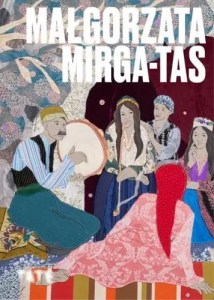
What is your image of a Romani woman? A woman selling the Big Issue? A group of young women wearing brightly coloured long dresses with babies begging on the street?
Artist and activist Malgorzata Mirga-Tas in this exhibition at the Whitworth Art Gallery in Manchester challenges western stereotypes of what it means to come from the Romani culture.
Raised in the community of Bergitka Roma in Czarna Gora near Zakopane in the Tatra Mountains of Poland she studied sculpture in the Academy of Fine Arts in Krakow.
Returning home (and where she still lives today) Malgorzata worked on a project with local Roma children. They collected clothes and then used them to make textile portraits of famous Romani people. She says “Through art, I was able to teach them about the Roma’s story.”
She has chosen to work within her community and particularly with children to inform and educate them about their history and in “creating a new generation with different ideals.”
She produces textiles art which tell the story of her community but specifically promoting the lives of women. She comes from a family of strong women and that is reflected in the subjects she chooses to work on. She works collectively with women and her artwork is big, brightly coloured and although some of the stories are heartbreaking there is a lot of joy (and fun) in the work.
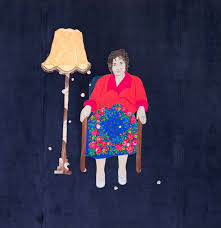
Recounting the often-hidden history of the persecution of Romani people is central to her work. Some of the most stunning works in this exhibition are her 2022 portraits Siukar Manusia (meaning “wonderful people”) which depicts first generation Romani inhabitants of the Nowa Juta district in eastern Krakow. I loved the one of Holocaust survivor and activist Krystyna Gil. Depicted sat in her living room, in traditional dress, she sits looking out at the viewer: proud and strong. It was not until 1982 that it was recognised by German Chancellor Helmut Schmidt that 500,000 Roma people were murdered in the Second World War.
Malgorzata’s work has been recognised through many exhibitions and awards and unlike many artists she has chosen to stay in her community. In 2015 she set up a Foundation to encourage a new generation of Romani artists and activists and to preserve and promote Romani culture and identity. Proudly, she says “We have our own voice and they cannot marginalise us.”
Find out more about the exhibition here https://www.whitworth.manchester.ac.uk/whats-on/exhibitions/ma%C5%82gorzartamirga-tas/
Read about Malgorzata in this new book. You can borrow it from Manchester Libraries or it costs £12
Artists Series: Małgorzata Mirga-Tas

 lipstick socialist