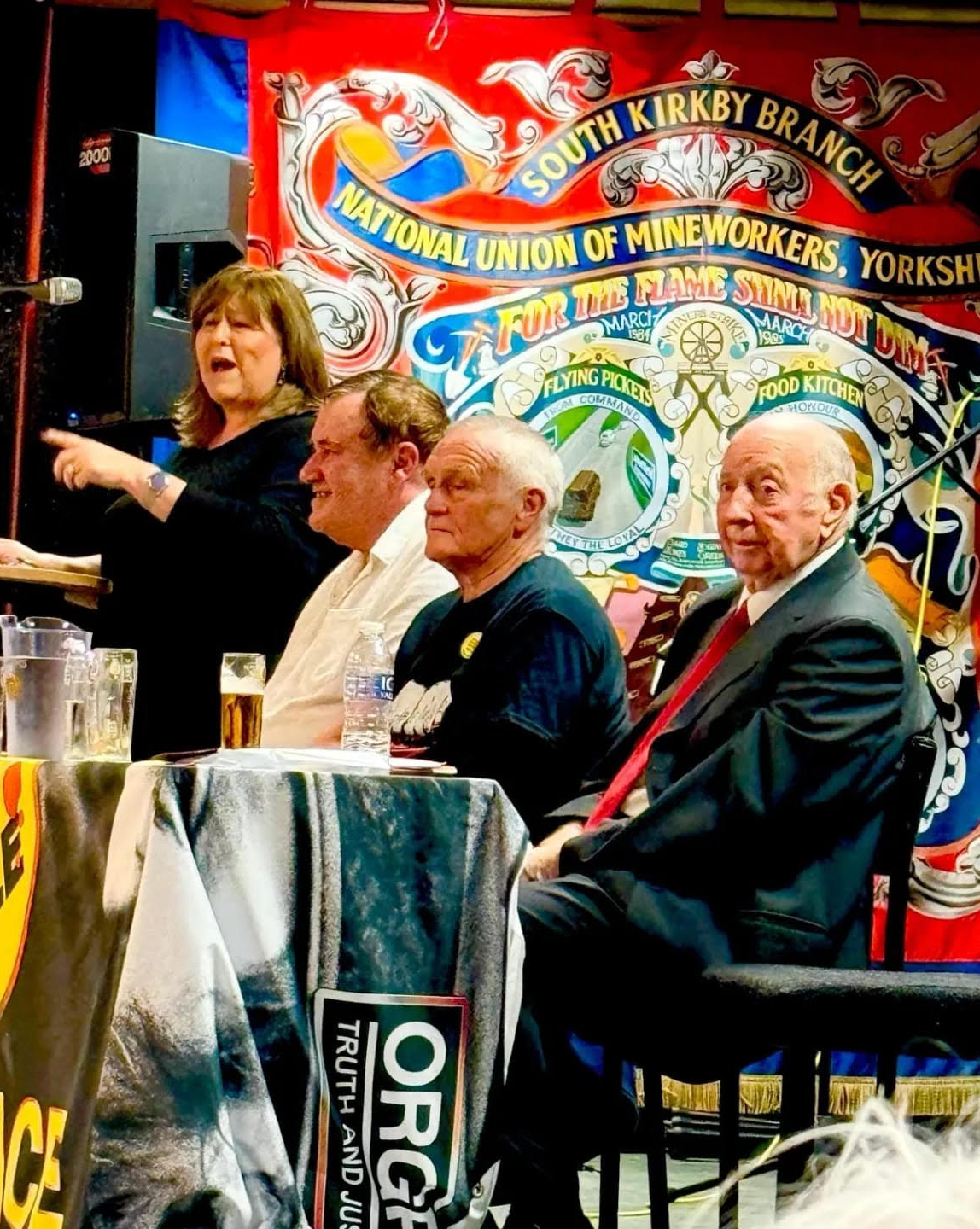
Rose speaking March 2024 40 Anniversary of Miners Strike.
After the end of the Miners’ Strike in 1985 Rose Hunter says: “Men lost their freedom; the women gained theirs.” Rose and her sisters in the North Staffs Miners Wives Action Group then embarked on forty years of raising issues about jobs and communities and making links with other progressive strikes and organisations.
Rose comes from a mining family. Her father, Denzil, was Indian who went to Scotland and became a miner. Her mother, Mary, is from a Scots Irish background. The family moved to the Potteries for her father’s work in the mine and Rose was born in 1960.
She grew up in the mining village of Biddulph where the pit was 12 miles away. Her father was active in the miners’ strikes in the 1970s. According Rose the miners from Scotland were more militant than the Stoke miners.
Rose’s first job was in a local hospital training to be a nurse: she was a member of the National Union of Public Employees. When the nurses went on strike in the 1970s in Stoke the miners were the first group of workers to join their picket line.
In 1979 she married Dave, another Scots miner living and working in the mines in the Potteries. When the strike broke out in 1984 Dave went out picketing while Rose looked after their two children. They had a third child during the strike.
Biddulph was a divided village. “Most people were scabs. It was a lot higher in North Staffs than in Nottinghamshire.” Rose was not happy about accepting food parcels. “I said I am not queuing up for food. It was mortifying.” Never mind that once the miners brought the food parcels back to the village there was no place to store and hand them out. “The local priest, Father Ryan offered us the church. He had been a missionary and understood the situation. But he got flak for doing it.”
They had massive support from family and friends during the strike although “we had no telephone and no car. We sent the television back – which was on hire – and did not even have a radio to listen to the news.” She used to go to her mother’s house to find out what was going on. “I could not believe what was going on, particularly Orgreave. It was like World War Three.”
“I wasn’t what you’d called political – but as a family we had strong views of what we thought was right and wrong – work hard, get an education, support each other and people in our community. So when we went on strike it was to save jobs and fight for our communities – build a better future for our children and grandchildren.”
One woman stood out in Stoke: Brenda Proctor. Their husbands worked at the same pit. “Brenda was travelling the country speaking at rallies and in Stoke she stood on the same platform as Arthur Scargill – his equal – talking about the strike, she was awesome.”
Rose did go to a big meeting about the strike in Digbeth, Birmingham in November 1984.There was a coach going and Dave said “it is men only” but she went anyway. The meeting changed her life: all the top miner’s leaders were there – Arthur Scargill, Mick McGahey, and Peter Heathfield. Rose remembers :“The atmosphere was electrifying. It was the first time I heard Arthur speak. It blew my mind. There was also a miner’s wife on the platform, she was so nervous – she wore a blue jumper and I think her name was Karen – she spoke for us all when she said the fight would go on.”
It was after this that Rose got involved in strike activity , going to a women’s event at the local Polytechnic about the strike and Ireland. Her husband’s cousin, Lorna, encouraged her to go. “I did go, in my high heels and skirt. I didn’t have anything else to wear. I got two buses down there and it was freezing.”
Rose noticed Brenda there and introduced herself, explaining that their husbands worked at the same pit. ”Brenda’s response was ‘where have you been?’ I thought she was going to kill me!”
After explaining that she had been pregnant Brenda invited her to join them: she won the raffle and shared it amongst the women. She also met Bridget (Bell) and thought she was a stereotypical feminist; dungarees, short hair, and Doc Martins. “I was completely wrong. It was right out of my comfort zone but I never felt so welcome with a group of women all experiencing the same thing – the miners strike .”
From then on Rose became involved in the North Staffs Miners’ Wives Action Group. The following day, Sunday, instead of Rose cooking Sunday dinner as usual, Bridget and Brenda picked her up in the Women’s Refuge van and she went to her first Women Against Pit Closure meeting.
After the strike ended the group still met every Monday, determined to continue supporting the miners who were sacked or in prison. Their friends at Banner Theatre suggested they start a choir which Rose says “lifted our spirits.” They started performing and got gigs around the country.
The women continued to make links with other struggles; Wapping and the print workers strike, Viraj Mendis in Manchester, Asian strikers in Birmingham. They saw a similar picture of a besieged community in the north of Ireland in Belfast and Derry, visiting Irish political prisoners in Belfast as well as Irish women political prisoners in jail in Durham. They stood on picket lines with fire fighters and opposed the war in Iraq.
In 1992 the huge mines closure programme was announced which the women were not prepared to let it happen without opposition. The WAPC agreed a plan of pit camps similar to those set up by the Greenham Women.
The North Staffs women set up a caravan for six months outside the Trentham Colliery, the last local deep pit in North Staffordshire, to save it from closure. Brenda, Bridget, and Gina (Earl) occupied the pit for three days with Rose coordinating activities from the caravan.
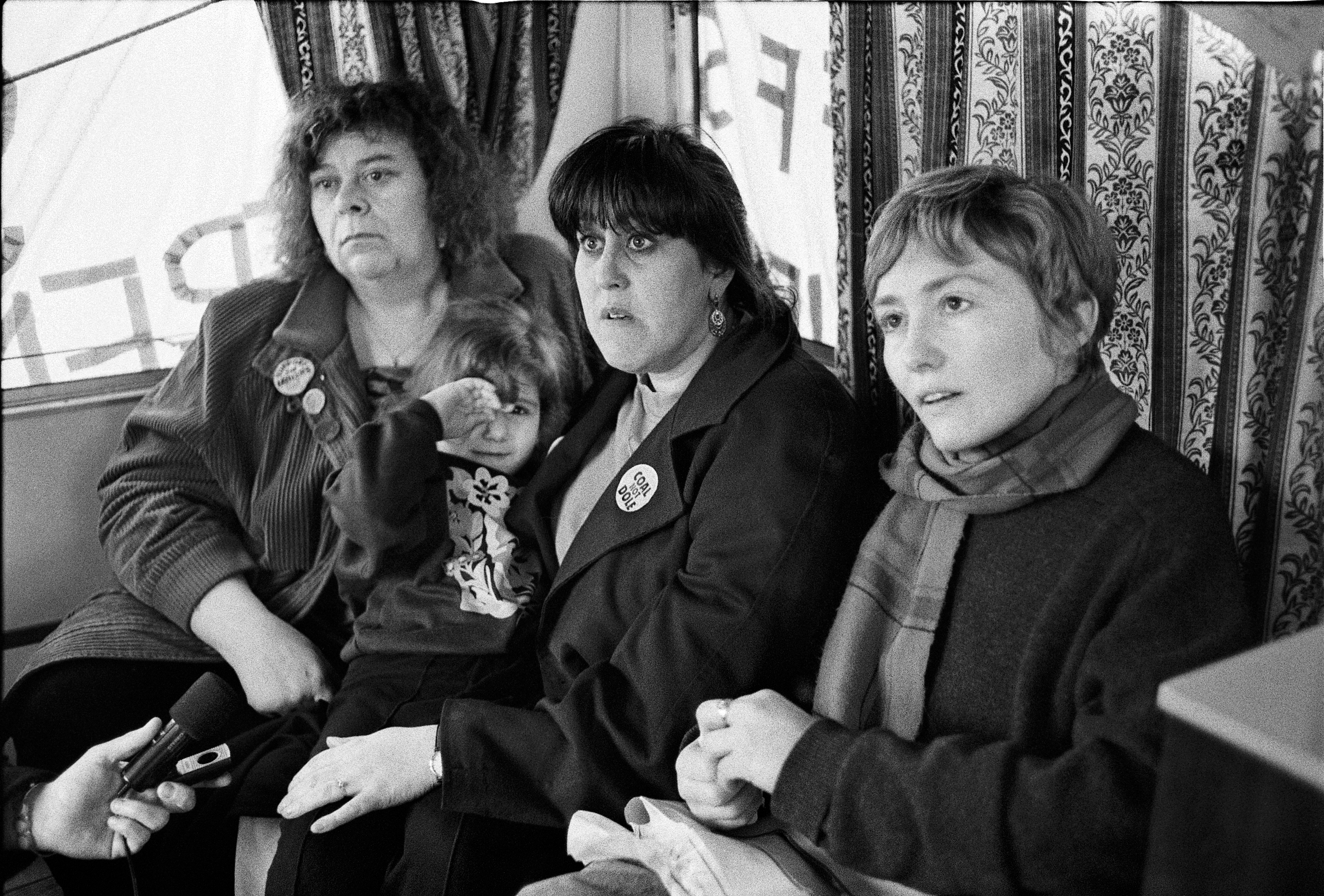
NSMWAG, Pit Camp 1993 L-R Brenda Proctor, Rose Hunter and Bridget Bell Photo: Kevin Hayes
The women left the pits with their heads held high, met by Arthur Scargill and members of the press. The local theatre in Stoke, New Vic, turned the occupation into a play called “Nice Girls.”
The following year they made a one-hour documentary “We Are Not Defeated, ” charting the history of the miner’s struggle against pit closures in Stoke-on-Trent. They have recorded songs to raise money for sacked miners, and commissioned a sculpture commemorating the miners killed in the strike.
Rose’s husband died in 1990. She now has four children and seven grandchildren. She worked as a driver and then a worker in a dementia unit for 25 years until she was made redundant. Over the years the women were active in the Socialist Labour Party, the Labour Party, and their unions.
2024 is the fortieth year since the strike. Although three key members of the group – Brenda, Bridget and Hilary – are now dead, Rose says: “We are holding a series of events over the year to remember them. It is not a sentimental journey, but to remember how we worked as a group and how this continues today. I was the youngest and they were the biggest influence on me.”
This year the events have been chosen to remind people of the links that the NSMWAG have made, and continue to make, with other people in struggle.
The events planned include a new play called “ The Miner Birds,”; a social bringing together the former Burnsall Asian strikers and local groups in Stoke; a showing of the film “Pride” to remember the support the gay and lesbian movement made to the Miner’s Strike. There is a new exhibition called “No Going Back” to mark the 40th anniversary at the Potteries Museum, where he archive of the NSMWAG is housed.
The NSMWAG are one of the few groups that have reminded people of the links that were made with Republican communities in the North of Ireland during the Miner’s strike. When Rose went there she said “It felt like I had come home.” They have continued over the years visiting Ireland and intend to mark this mutual support in 2025.
The women of the NSMWAG made the links between grassroots-based community and the wider issues of defending jobs and services and making this a better world to live in.
For Rose it was the Miners’ Strike of 84/5 that led her into the NSMWAG and a lifetime of political struggle. “This year is about the legacy of Bridget and Brenda. When I speak, I speak for them.”
But it is not about just looking back. She has been inspired by the young people interested in Orgreave while one of their recent events included a young woman active on Palestine. “Our activity has got to be relevant to now and the struggles that young people face. It is up to us to give them a platform.”
Contact the NSMWAG on Facebook
Visit their exhibition here https://www.stokemuseums.org.uk/pmag/whats-on/events/no-going-back/
All photos are by Kevin Hayes https://progressdigital.photoshelter.com/index
Rose will be speaking in Manchester on 1 February at a Mary Quaile Club meeting with socialist feminist Sheila Rowbotham

 lipstick socialist
Thanks for this. May I post it
Yes you can. Bernadette Hyland aka LipstickSocialist http:// lipsticksocialist.wordpress.com Freelance Writer Mobile no. 0757 9964 305 @lippysocialist
Thanks.Sent from my iPhone
Brilliant piece, Bernadette. Such a good woman. Very best,Gill