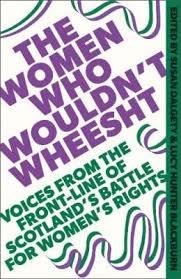
Wheesht (Scots) (wi:ft): a plea or demand for silence(exclamation);to silence(a person,etc.) or to be silent (verb)
On 21 March 2015 the Mary Quaile Club (of which I was a co-founder) organised what we called a “real International Women’s Day event!”.( https://maryquaileclub.wordpress.com/2015/03/23/a-real-international-womens-day-event/) Our event celebrated the true meaning of IWD and its socialist feminist origins. It reminded participants of the life of trade unionist Mary Quaile and sought to make links with present day activists.
One of those women was Sue Lyons of the Scottish Women’s Independence Movement. She spoke about how it had galvanised women into a powerful grassroots movement.
That was 2015 but in the years since the dream has turned into a nightmare. This book tells the story of the events that led to the downfall of SNP leader Nicola Sturgeon and the uprising by Scottish women to stop a profound assault on women’s rights.
It shows “a grassroots movement that took on the Scottish political establishment and its supporters in civil society, breaking down barriers between political opponents, and uniting novice campaigners, experienced activists, and professional politicians in new ways.” It is the story of activism at its best: “the story of women who were willing to risk jobs, reputations, friendships, to make their voice heard.”
The book concentrates on the five years from 2018-2023, beginning with the events of 14 February 2018 where a hundred women met to discuss plans to reform the Gender Recognition Act (GRA) in Scotland. Groups taking part included the organisers Women’s Spaces in Scotland (WSiS) and London-based Women’s Place UK (WPUK), a newly formed and volunteer-run organisation, established by three women trade union activists in parallel developments.
The book documents how Scotland became home to a powerful trans movement, throwing under the bus women’s sex -based rights, and instead pushing the agenda of a demand for self-declaration (self-id) which meant by a simple administration process that anyone over sixteen years old could obtain legal recognition as a member of the opposite sex.
As a socialist feminist reading about the way in which progressive organisations such as the trade unions were captured by this ideology is soul destroying. But perhaps not that surprising, given the way trade unions in my experience have over the years moved away from representing its members to a corporate mentality which has alienated those people it is supposed to represent.
Class is key to equality: working-class women experience a double burden of discrimination: promoting gender over sex leaves working class women most vulnerable. They are ones most likely to end up in rape crisis centres, refuges, prisons etc. They are the ones most likely to be preyed on by male abusers in places where they need to be safe.
Johann Lamont in her chapter tells her story of spending a lifetime in the trade union movement and the Labour Party working for changes which would promote equality and understanding the barriers faced by women.
She was then shocked to find how the debate was moved from changing women’s lives to ones about what women are. She says: “I am forced to watch as the reality of women’s lives is stripped out of our language, our health care, our personal safety.”
But this book is not a depressing read, it is an account of how women fought back against the annihilation of sex -based rights. Relying on old and new methods of organising the women refused to accept being silenced and galvanised thousands of other women to join them in their fight. They take their inspiration from the suffragettes who faced similar opposition; not just verbal and institutional but physical and life-threatening.

The costs of speaking out can be harsh. As Professor Sarah Pederson says: “Mockery and attacks in the mainstream media, violent crowds in universities trying to prevent women from speaking, women journalists threatened with the sack, worries about speaking out and losing family and friends.”
Social media has revolutionised the gender critical movement. The cretinous nature of the mainstream media in the debate, and the dismissal of women who spoke out has led to a movement that has used social media as a way of communicating, promoting, and unifying with women across the country – and indeed the world. As Professor Sarah Pederson says: “Scottish women have come together organically, reaching over the barriers of party politics to identify the issues that connect sister to sister, and making themselves a very visible force to be reckoned with.”
This is a Scottish story, but it is relevant to women across the UK and the world. It is an important chapter in the history of women fighting for our rights. It points to the need for a much wider discussion about what kind of society do we want to live in and how are we going to get there. As the editors, Susan, and Lucy, in their final comments say: “Grassroots campaigning is a vital part of the democratic process, but it should never be the whole story. If the Parliament and its executive, are to rediscover their democratic purpose and values, they must, once again learn to make politics work for all the people they represent. And they can start by listening.”
Buy it from women’s cooperative bookshop “News from Nowhere” https://www.newsfromnowhere.org.uk/ or if you live in Greater Manchester, it is available to loan from Manchester and Tameside libraries.

 lipstick socialist
Dear Bernadette, You’ve written a brilliant and important piece. I shall buy this book. Best,Gill