
This book is about Liverpool, about dockers, about their families and communities. It is also about democracy, trade unions and the Labour Party. It is about the past and the present.
Mike Carden was one of the key players in the Liverpool dock strike of 1995 and in this new, inspiring, and at times very depressing book he has a lot to say about the state of democracy in this country today and how we got to such a situation.
In 1995 I was one of the people inspired by the Liverpool dock strike. From a working class Irish background with dockers in my family I was part of that working class tradition that believed and saw trade unions (not the Labour Party) as the way in which would deliver (and did deliver) a better standard of living, a better society for me, my family and my class.
Unfortunately by 1995 all this was unravelling as the public services where I worked were being rapidly privatised by a Tory Government , with little opposition from my union Unison and helped along by my Labour Council.
The Liverpool dockers strike was like a clarion cry from another era. In the introduction Mike takes us back to the beginnings of the trade union movement in this country and the role that the Great Dock Strike of 1889 played in the beginnings of trade union history.
Without undermining totally his thesis: women did play a central if often marginalised role in that history. Women did work on the docks and crucially the Match women, who were part of the East End dock Irish family, are an important part of the history of the birth of the trade union movement.
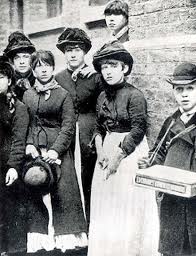
The Match Women
In over 700 densely packed pages Mike explains how dock work “impacted on how dockers related to trade unionism, they were not going to be shackled or controlled by membership”. Indeed they “had major trust issues; their response was to fall back on their independent organisation where it always existed, on the ships, quays, sheds, pens and hiring halls of the major ports.”
1989 was a crucial year for the dockers, the failure of a national strike led to every UK port bringing back casual labour in the ports and replacing dismissed ex-registered dockers. Liverpool was the exception. “Opposition brought the dock shops stewards into another period of prolonged and open conflict with the Merseyside Docks and Harbour Company and the leadership of the Transport and General Workers Union at both national and local levels.”
This would come to its head in on Monday 25 September 1995 as Mike recalls. “a small vessel berthed at Canada Dock, M.V. Sygna, was about to set in motion a chain of events that would trigger a conflict lasting two years and four months; it resulted in 500 Liverpool dockers being sacked for refusing to cross a picket line.”
In their newspaper the Dockers Charter they called on the whole of the labour movement to support them. “We cannot allow the scars of casual labour, inhumane working environments and the absence of democratic rights of representation to destroy the dignity of our waterfront.”
From the outset the wives and partners of the dockworkers supported their men. The chapter on “Women of the Waterfront!” records the important role they played in the dispute both locally, nationally and internationally. The children of the dockers took part in many meetings, speaking on behalf of their families and community.
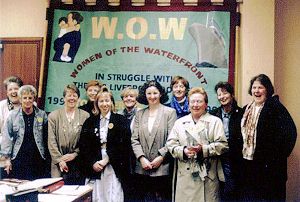
Sue Mitchell, one of the WOW, reflected on her activism “Working class women have been more politicised in Liverpool, mainly because they have always had to work hard and fight for any gains.”
Apart from the usual left wing response to the strike it also attracted a new generation of activists in the Reclaim the Streets group who saw the dockers strike as their fight.
Support came from across the world and the dockers were the first group of workers to use new digital communications to organise the first online rank and file international trade union e-conference on Saturday 17 February 1996.
But support from their own union and in particular Bill Morris (General Secretary) was lacking. Financial support was provided to the Hardship Fund but with dockers only receiving a fraction of official strike pay.
Bill Morris’s attitude was summed up by left wing band Chumbawamba where they dubbed him Pontius Pilate in their song “One by One”.
Pontius Pilate came to our town
Up to the dockyards to see the
picket line
We asked him to help but he just
turned around
He’s the leader of the union now
Leader of the union
All of our questions he ignored
He washed his hands and he
dreamed of his reward
A seat in the House of Lords
On 26 January 1998, the dockers accepted a settlement and continuity of pensions but without job reinstatement, although only about two-thirds of the dockers were included.
Addressing a mass meeting Mike Carden said, “This not a defeat. You have nothing to be ashamed of. We have exhausted every avenue to defeat the Dock Company, and you have earned the respect of everyone. You have defended the principles of the trade union movement.”
But it was not Morris alone who betrayed the Liverpool dockers as Mike points out; “but an organisational culture underpinned by a well-oiled bureaucracy of local and national paid officials who, in turn were supported by the decisions of the senior-lay member committee of the union, its General Executive Council”
Mike Carden has produced a unique in-depth personal and political analysis of the Liverpool dock strike. An inspiring book on many levels it reflects on the massive changes have taken place in the labour market and the failure of many unions to respond. The Liverpool dockers did, and we should take inspiration from their history and principled fight.

Mike Carden
Many of us are heartened by the role of new unions such as the United Voices of the World which are, not linked to the Labour Party, more democratic, represent some of the poorest workers in the economy, and most importantly winning their disputes.
Sharon Graham, the new General Secretary of Unite, is not from any Labour Party left faction, and is pioneering a strategy of putting members first and re-energising the union. Whether she can reinstate democracy into the workings of the union is yet to be seen.
Mike Carden died on 9.12.21. “Liverpool Dockers” is a fitting tribute to the man, his family and class.
In 1938 Bertolt Brecht was in exile but he still wrote one of the most relevant poems for our time/ any time
In the dark times
Will there also be singing?
Yes, there will also be singing
About the dark times
Svendborg Poems
You can buy the book, cost £20, from Liverpool’s radical cooperative News from Nowhere.
I ordered a copy from Manchester Libraries. Hopefully this will mean it will reach out to many readers looking for hope and inspiration in these dark times.

 lipstick socialist
Thanks.
Brilliant.
Reblogged this on Anarchy in the Sticks!.