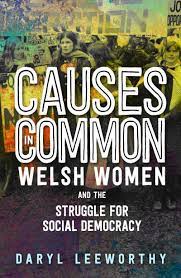
In this new history book about the role of Welsh working class women Daryl says his aim is to highlight women who “were active in the trade unions and their adjunct organisations; who were involved in the cooperative movement or in Chartist activity; who read feminist literature in the miners institute libraries and other working class libraries; or who were visible in the women’s sections of the Communist and Labour parties.”
In 227 pages he rips through 150 years of Welsh women’s history and digs deep to tell the story of working class women who have often been marginalised or written out of mainstream histories.
Daryl argues that the Welsh women’s movement was built on ideas of social democracy and that the women were driven by a determination to improve their lives and those of their community. He records that contribution; documenting who these women were and what they did, and puts it within a context of modern Wales.
He shies away from the dominant thread of suffragism in women’s history, showing that Welsh women were active long before Votes for Women in campaigns as diverse as the Anti-Corn Law League, Chartism and anti-slavery.
Working class women had to struggle two fold, not just to fight for a role in the growing but male dominated socialist movement, but also to fend off more confident middle class women taking their place.
The Rhondda Socialist of December 1912 argued that “what is needed is one or more women of the working class, whose interest is not the result of pity from a distance, but the effect of life’s contact with working class conditions.” Sadly, the same could be said for today’s politics.
In the following chapters Daryl tells the stories of some inspirational working class women who were important in changing themselves and society. He shows that there were many working class women who were important players in the history of the socialist and labour movement in Wales.
There are so many fascinating women – most of whom never wrote their own biography – and have not been included in main stream histories.
Grace Scholefeld, nee Metcalf, was born in Halifax, West Yorkshire in 1863. Aged eleven , like many working class children, she went to work in a cigar factory. Following marriage and children the family moved to Keighley where Grace and Nathan joined the fledgling Independent Labour Party. By 1904 they had moved to Cardiff .
Grace went on to become of the first women to be elected to the national executive of the ILP and was at the forefront of women’s labour movement activism in Wales. She was involved with organising the national annual ILP conference, and also chaired meetings of the Women’s Social and Political Union and the ILP.
Alongside her was Mary Keating –Hill, born into an Irish working class family, who was also a member of the WSPU and one of the founders of the Cardiff branch of the Women’s Freedom League in 1909. She was one of the first to be imprisoned in Wales for her suffrage campaigning in 1906.
One of the most fascinating chapters in the book is about the role of women in the Communist Party. Whilst Labour women were increasingly becoming part of the establishment Communist women continued to challenge the state.
Many women from the Communist and Labour Party were inspired by the radical changes taking place in the Soviet Union which improved the lives of working class women. Labour Party activist Martha Herman was one of those women. She said “real peace and progress for the workers in this country can only be achieved by international working class solidarity.”
But it was Communist women who took direct action to combat poverty, unemployment and take on the fascists. But they were then judged and found guilty by their Labour sisters in the magistrates courts.
As Daryl says “In their view the fight was not only against a state which harangued them but also against a Labour Party which had turned coat and sided with the capitalists.”
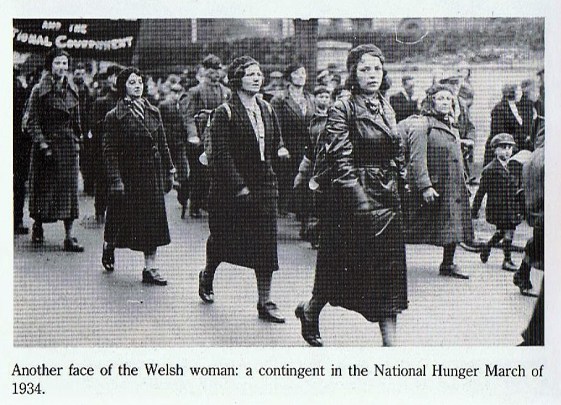
One of these heroic women was Ceridwen Brown. On 4 February 1935 she walked to Merythr Tydfil and led a crowd of 3,000 other angry, starving women and men who smashed up the offices of the Unemployment Assistance Board.
Ceridwen was an active communist who had visited Moscow and was under police surveillance. She could easily be picked out on the hunger and women’s marches of the 1930s in her trademark trench coat and red beret.
Excluded from the mainstream labour movement she worked hard to create other networks and a far left women’s movement through the working women’s guilds.
Causes in Common is an important history book for all women today. Not only does it show how working class women played an important role in creating the modern Welsh state it gives a name and history to those individuals. They are no longer hidden from history. Daryl should be commended for his use of new resources and for completing the book during covid.
He rightly points out the need for more research. In her groundbreaking book “Hidden from History” Sheila Rowbotham wrote that she was “turning up the topsoil in the hope that others will dig deeper.”As a member of the Mary Quaile Club I think that it is vital that groups of women and men outside the academic world should undertake this research. We need to bring in working class women to excavate and bring this history into daylight. It is their history. They are their sisters.
Buy it, great price of £11.99, from the radical and community bookshop News from Nowhere
Watch “Mam” (1988) a film made about the role of the mother in Welsh society from the beginning of the industrial age to the 1980s here

 lipstick socialist
Reblogged this on Anarchy in the Sticks!.