
Jean Donovan, Ita Ford, Dorothy Kazel and Maura Clarke
Guest post by Geoff Cobb.
I am a high school history teacher and author of books on Brooklyn history I also write for Irish American magazine, The Irish Echo newspaper and the New York Irish History round table journal. My research on Irish painter John Mulvany was featured in the NY Times
Why did I write about Sr. Maura I had to stop and think because it was an unconscious choice. Those murders horrified the New York Irish Catholic community because we had such reverence for nuns and for the first time many people wondered aloud about our role in Central America if we were supporting people capable of such barbarity and cruelness. The victims were our own people and beloved in the community.
Forty years ago, on December 3, 1980, the world was shocked to learn of the brutal rape and murder of three Maryknoll nuns and a lay missionary. Their bodies were found in a shallow grave near the town of Santiago Nonualco, El Salvador. They had been beaten, raped and their bodies mutilated. One of the murdered nuns was Sr. Maura Clarke of Belle Harbor Queens. The others were Ita Ford, Dorothy Kazel, and lay missionary Jean Donovan.
Americans learned in horror that Clarke and the other women had been assassinated at the orders of the Salvadoran government. In El Salvador at this time, the Catholic Church was “the object of governmental wrath and Clarke and the other women were seen as dangerous, subversives.

Ita and Maura.
Sr. Maura Clarke, a widely loved figure in Salvador, died serving the poor and oppressed people of Central America and her murder caused raised many troubling questions about American foreign policy in Central America.
Clarke was the daughter of Irish immigrants raised in “ The Irish Riviera,” The Rockaways. Her mother Mary, originally from County Antrim, while studying nursing in Dublin, met her future husband John from Sligo who was fighting for the IRA. In 1922, John brought a wounded comrade to a convalescent home where Mary was the nurse. They fell in love and left for New York. They married in 1930 and had three children, Maura, Buddy and Judy. In 1934, the Clarkes moved to Rockaway, where Maura attended St. Camillus, St. Frances de Sales (SFDS) and Stella Maris High School.
Clarke decided to become a Maryknoll nun, stimulated by a deep desire “to become closer to God and to serve him.” She joined the sisters in 1950, making her first vows in 1953 with the intention of becoming a teacher.
When Sr. Maura entered the order, novices lived by a strict code of individual and corporate prayer. Full habits were worn and visits from family were severely limited. When she had completed her two and a half years as a novice, Clarke was sent to teach school in a poor neighborhood in the Bronx and soon was loved for her warmth and deep empathy with the schoolchildren.
In 1959, Clarke was assigned abroad to Nicaragua. Her first assignment was in a booming, but impoverished gold mining town in the jungle called Siuna, where her attitude towards the role of the Church slowly began to evolve.
Sr. Maura was profoundly affected by the changes brought about by the Second Vatican Council. Clarke changed from seeing herself as ministering to people’s souls to tending to their social and economic concerns, believing that when the fathers of families “were digging gold and their children were starving,” the solution was not for them to attend church more often.

Sr. Maura at work.
Clarke became one of the earliest examples of lived liberation theology, believing, “the Catholic Church ought not only to be concerned with souls, but also with engaging ordinary Catholics in building a world of justice and fairness … to bring specifically Catholic answers to social problems.” Clarke and the other nuns now did not seek to be figures of authority as much as facilitators who entered people’s homes, talked with them, and helped them deal with the struggles of their personal lives.
After the huge earthquake in Nicaragua in December 1972, Sr. Maura chose to live with victims of the earthquake in refugee camps, sharing hardships with the people. She saw that the poverty in which most Nicaraguans lived resulted from the unequal distribution of wealth to a few closely connected to the regime of Anastasio Somoza.
She also learned that the aid coming from the U.S. never reached those in real need. The center of Managua, left flattened after the quake, was not rebuilt because American aid was used instead to buy weapons for the government to fight the leftist rebellion. Sr. Clarke helped the people to rebuild their homes, but also to establish truly Christian communities.
In 1977, Maura returned to the Center to serve on a Maryknoll Sisters World Awareness Team, working primarily along the East Coast of the United States. She explained her view of this work to a fellow nun, “I see in this work a channel for awakening real concern for the victims of injustice in today’s world.”
When her term with the World Awareness Team ended early in 1980, Maura made a period of spiritual renewal and mission updating. It was not easy for her to make up her mind to return to Central America, but Nicaragua needed her, so she went freely, gladly. She wrote, “My dream is that, with each of you, in Jesus our source of hope and joy, we may continue to give ourselves to bring about the new Kingdom of love, justice, and peace.”
She decided to take the place of a Maryknoll sister in El Salvador of a nun who had drowned in an accident. Clarke knew it was a dangerous posting. By the time of her assassination Sr. Maura was fully living the ideas of service and ministering that she had begun to develop in Nicaragua, which hearkened back to her Irish Catholic roots, where having a Catholic identity meant opposition to the British state.
Eventually, Sr. Maura and the others she worked with were actively helping guerilla fighters and others targeted by the Salvadoran government. She had moved out of institutions into ever more authentic encounters with people striving for social, political and economic equity. In the end, despite the danger, she chose to help the oppressed and ultimately lost her life.

Stained glass window in St. Francis de Sales church Bronx New York.
Today Maura Clarke is still a hero in Nicaragua and El Salvador. In Brooklyn, she and a fellow Maryknoll nun are memorialized by the Maura Clarke-Ita Ford Center, a social/educational institution for immigrant women. Writer Eileen Markey recently published a book about Sr. Maura (A Radical Faith: The Assassination of Sister Maura Clarke) which has led to calls for her canonization.
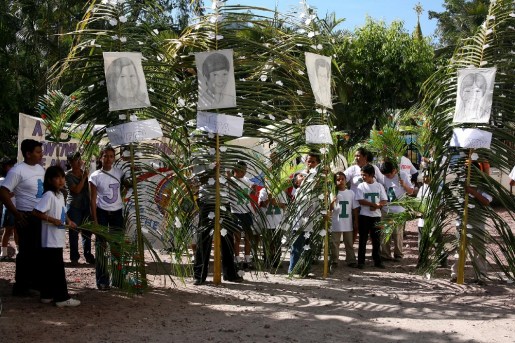
Mass for four women in San Salvador Cathedral 2005
Read more about the case here “Killed in El Salvador:An American Story”. Retro Report “The New York Times” here

 lipstick socialist
Reblogged this on Anarchy in the Sticks!.