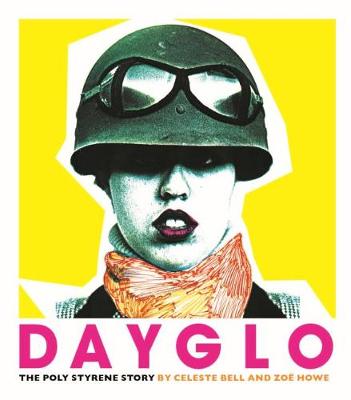
Poly Styrene (3 July 1957 – 25 April 2011), (real name Marianne Joan Elliott-Said) was one of the most unique performers who came out of the punk era. Watch this video here
In this affectionate and revealing biography written by Poly’s daughter Celeste Bell and writer Zoe Howe , we get an insight into her life as told by those were closest to her, including her sister, ex-husband, friends and many others who were part of her life.
Her mother was white, her father from Somalia. As her sister Hazel says life was difficult for her Mum Joan. “It was bad enough being a single mother. Being a single mother with half-black children, the whole community shunned her.” They grew up in Brixton and big sister Poly (or Mari as she was known then) looked after her younger sister and brother whilst their mother worked. Her sister tells some lovely stories about how they she would write poetry and Mari would write songs.
But life for Mari was not so straightforward as a young woman with what we now know as a bi-polar condition. However, it did open up her mind to a creative force which she poured into her songs and music, but, although a bright young woman, she could not cope in the school system.
Being mixed race in 1970s Brixton was not easy; such children were often called “half-caste”. Her friends were white and she used to pretend to be white. Even today if a person identifies more with the white part of their parentage it is seen as if they have a problem with their identity.
Life changed for Mari when at the age of 15 she met Falcon Stuart who was twice her age. He was a photographer and filmmaker and by 1976 they were living together. Through him she started writing and recording songs – and then punk happened in London with bands like the Sex Pistols, the Clash and The Damned being formed.
Punk gave Mari, who saw herself as an outsider, somewhere to belong. Fellow black performers, Pauline Black and Rhoda Dakar sum it up. “The attitude was you weren’t ever really black enough and you weren’t light-skinned enough –you know, you were obviously not white, but you weren’t black enough to be part of the black community.”
Mari set up a market stall and started selling the plastic jewellery and bags that were to become her identity as Poly Styrene. But the punk uniform of black clothes was not her style. She mixed and matched plastic and shiny materials, using colours such as lime green and orange. She was the princess of plastic – giving an impression she was a sweet young thing but in reality she was highly intelligent and a sharp character.
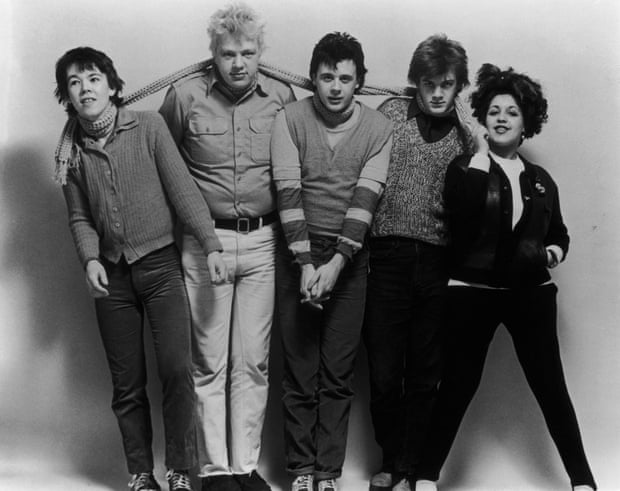
March 1976 was the first gig for X-Ray Spex with Poly as the singer backed by a talented band which included one other woman Lora Logic on the saxophone, Jak Airport and Paul Dean on guitars. Poly stood out as this charismatic, strong woman – very different from the usual women performers on programmes such as Top of the Pops. Immediately she gained lots of attention from the media.
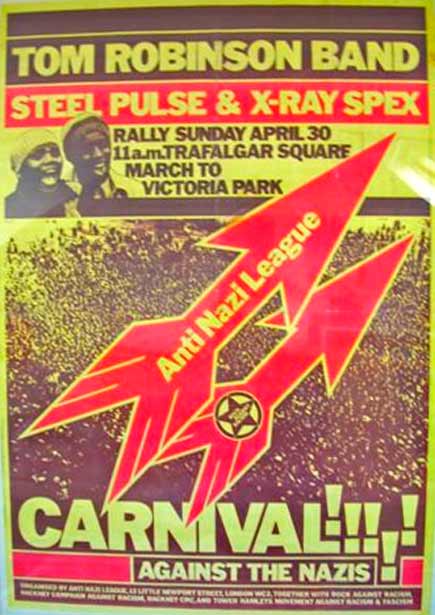
Punk was partly a reaction against the growth of racism and in the mid 1970s the rise of the skinhead movement which took its hatred out to the streets of London, Birmingham and Manchester. The Rock Against Racism movement started by Red Saunders and others gave two fingers to the fascists, uniting young and older people with a message of love and unity through music.
In the book Paul Dean of X-Ray Spex speaks about his own experience. RAR was important to him because his dad was a Polish immigrant, a real minority at that time, who had had a hard time settling in this country. Paul says, “Consequently I was quite political. I agreed with the aims of RAR, I agreed with the aims of the Anti-Nazi League.” X-Ray Spex took part in major RAR events such as the Carnival against the Nazis in London on 30 April 1978.
Poly’s songs and the brilliance of the band in playing them gave a voice to many issues from identity and being young to ones that we all talk about today including genetic engineering and being part of a throwaway society. Watch this Arena programme from 1979 where Poly talks about her songs here
But the pressures of media attention and live performances led to Poly having a mental breakdown. Few people realised how ill she was: it was a time when the mental health services focussed on labelling black (and ethnic minority people) as schizophrenia rather than listening to their stories and experiences of racism.
After leaving the band Poly was able to concentrate on developing her music beyond punk, but her personal life became more complicated. She married, had a child and then went to live in a commune of the Hari Krishna cult. Relations with the band deteriorated as she took all the royalties from the songs while she tried to stop her husband from having access to Celeste.
Mother/daughter relations are fraught – as all women know – but Celeste has produced a beautiful biography revealing the complex life of her mother. The photographs in the book are a wonderful compliment to the text and the book itself is a history of an exciting era in this country.
Most importantly it reminds us of Poly and her relevance to C21st women. She fought being commodified and put in a box as a woman performer. She said “Beauty and glamour are still such a big thing. I think about the female artists who have had success in recent years..they all look beautiful, everything is so glamourised, it’s a huge pressure on women. And will anyone remember the music?”
You can buy this book here

 lipstick socialist
Thank you for the review, I look forward to reading the book. This was my youth and my politics. Cheers.
Reblogged this on Wessex Solidarity.
Reblogged this on Anarchy in the Sticks!.