
KATE Hunter, a working class writer and political activist, recognises the massive barriers facing any person from her background who wants to write. At the age of nine she won a National Essay prize, but there was no encouragement from her teacher to take it further. So she left school at 15 and worked in jobs as diverse as care worker to trade union tutor. In later life she returned to education and gained a degree as a mature student. It is only now that she has been free to write.
Kate says: “It has taken me most of my life to believe I can do it. Because people from my background don’t write books. I didn’t manage to do it until I retired and had a pension. You need the free time and working class people don’t have that.”
Kate is from Edinburgh but lives in Milton Keynes. Her second novel, Common Cause is about to be published which continues the story of Iza Ross – now Iza Orr – a woman compositor from Edinburgh. Her first novel The Caseroom (which was shortlisted for the Saltire Prize) introduced Orr who starts work as a compositor, aged just 13, at the end of the C19th. Set at a time when unskilled workers were becoming unionised, the story of Orr and her fellow women workers fight at their workplace for equality and justice is pitched against a background of political and industrial struggles in Edinburgh with James Connolly among others appearing in the novel.
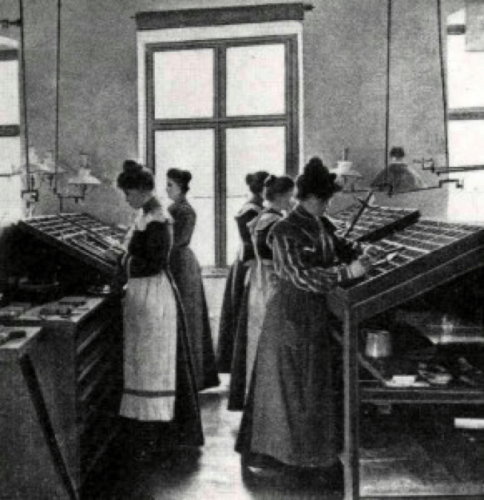
Common Cause is a radical retelling of the First World War and the way in which it affected the working class community of Edinburgh. Kate’s research is personal. Through the 1911 Census she discovered that her own grandmother was one of the few women compositors. Both her novels tell the story of how this group of women fought for recognition as skilled workers against the hostility of the male Typographical Union and the machinations of the employers who wanted to use them as cheap labour.
Kate ’s novels are informed by her own experience in the printing industry as a worker and trade unionist. Her research showed her how it was that a 13 year old had the literary skills to typeset the Encyclopaedia Britannica – backwards. “It was because Scotland had 100% literacy long before the rest of the UK. “
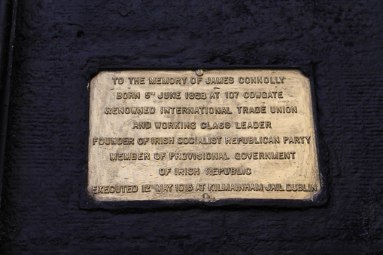
Common Cause draws a picture of a young woman and her growing political consciousness.Kate reflects: “She is a woman in the thick of events, struggling with her own life, her own ideas, but with not a lot of time or opportunity. Like most people political consciousness is a slow process of learning….I wanted the socialist and trade unionist James Connolly to be in the story. He is a hero of mine. My family lived in that area of Edinburgh.”
The novel portrays an Edinburgh mired in poverty which explains its radical history. When Orr is sacked as a compositor the family have to take in a lodger – who shares a bed with her husband. As Hunter says: “This is how people lived – if anything I probably gave them more space in terms of their housing than really existed!”
She also brings in the Women’s Freedom League who set up food banks in Edinburgh in 1915 for the wives and mothers of soldiers. But Hunter shows their lack of sensitivity to working class women. “I wanted to show the invisibility of working class women in the suffragette movement and I suppose get some revenge on the snobbery of some of the women.”
Her novel refutes the recent repackaging of the First World War as a celebratory event. Iza Orr’s husband returns from the war mentally disturbed and is locked up in the asylum, like one of Kate’s grandfathers. “They were not in Craiglockhart Hospital with the officers, but put in the asylum and forgotten. We didn’t even know he existed.”
Orr, now with a disabled husband, does get her job back as a compositor. Only because printers were not allowed reserved occupation status. “It seems the country needs starched cloth-lappers and lunatic asylum attendants, but it does not need learning and intellectual stimulation.”
Common Cause reflects Kate’s own politics from working in the printing industry and being an activist in trade unions, the SWP and the Bedroom Tax Campaign. It is grounded in her research including Sian Reynold’s “Britannica’s Typesetters: Women Compositors in Edwardian Britain.” which documents the history of Edinburgh’s female compositors and is where Kate found a picture of her grandmother.
Throughout her own life Kate has seen massive changes take place and her novels show the victories and defeats as experienced by activists in the 19th and 20th Century. And although today the trade union and labour movement has experienced many defeats she says “The struggle is always there”.
Common Cause is published by Fledgling Press and is being launched in Manchester by the Mary Quaile Club on 13 July at 2.30pm at the Friends Meeting House on Mount Street. The event is free. Book a place at maryquaileclub@gmail.com

 lipstick socialist
Reblogged this on Anarchy in the Sticks!.