
Elaine Mokhtefi was a key person for the Black Panther movement in Algiers, but her own story, added to the end of this book, is as important as it sheds light on how a young Jewish woman from small town America went on to became a militant anti-imperialist, journalist and translator.
Born Elaine Klein in 1928 she was the only daughter of dry store goods retailers. Her family survived the Depression because of the support of family and friends. When her parents moved to a small town in Ridgefield Connecticut Elaine witnessed the prejudice against black children and also her own exclusion from activities as the “little Jewish girl”. Elaine learnt from her mother about not just being an antiracist but the importance of standing up for her principles. During the war their shop was daubed with “JEW” on their front window while the local German barber had “NAZI” scrawled on his.
College meant Georgia in the racist Bible Belt of the South. Elaine was 16 years old and had ended up there because she knew nothing about going to college and had no-one to advise her. She describes the South “not only racist but underdeveloped economically and inbred culturally.” At the end of her first year she was told by the Dean not to come back. Her response; “I have no intention of coming back. I’ve had enough of this place!”
Elaine moved to New York, met up with radicals – including refugees from Republican Spain – and enrolled on a Spanish translation course. She became director of the Student Division of the United World Federalists (UWF) and toured schools and universities promoting an agenda of peace and and end to war.
In 1951, aged 23, she arrived in post-war Paris and got work at the French section of the UWF. She soon realised that the image of the French state as one of liberty, equality and fraternity did not include its large North African community who lived in a shantytown, outside of the city and outside the gaze of the average Parisian.
Elaine became a translator and interpreter for student and youth conferences, travelling to Europe, Africa and India. She went on to organise conferences in newly independent African countries but it was Algeria that became the defining issue of the 1950s in Europe. She says: “I became involved, marching in anti-war demonstrations, attending international meetings and discussions, introducing resolutions, denouncing torture.”
In 1960 she returned to the USA and began work at the Algerian Office which handled relations with the United Nations and with the UN delegations for the Provisional Government of the Algerian Government. Opposition to French colonial rule had been going on in Algeria from the 1920s, but in 1954 a new chapter opened in the war. The National Liberation Front (FLN) launched a series of attacks against French colonial targets across Algeria, beginning an eight year war that led to the liberation of Algeria but at a terrible cost for the indigenous people. Out of a population of nine million it is estimated that between 300,000 to 500,000 people were killed. Over two million men, women and children were herded into French concentration camps and their villages, herds and crops destroyed.
Elaine moved to post-liberation Algiers in 1962. The country was devastated by the war. “Algeria was an overwhelmingly rural society of poor people, over 90% illiterate, who had accomplished the awesome feat of bringing the fourth-greatest military power in the world to its knees.” But thousands of foreigners, supporters of an independent Algeria, flooded into the country to bring their skills and idealism to create a new country and a new world.
By 1969 Elaine was involved with bringing members of the Black Panthers Party (BPP), including Eldridge and Kathleen Cleaver, from the USA to the safety of Algeria. As Elaine says, they were not alone in being welcomed. “Algeria adopted an open-door policy of aid to the oppressed, an invitation to liberation and opposition movements and personalities from around the world.”
The BPP were singled out and given formal recognition and privileged treatment by the Algerian government. They became the superstars of the liberation movements and had a lifestyle very different from the average Algerian. Elaine was the liaison for the BPP to the Algerian establishment as she spoke and wrote French and had many contacts. I loved the photos in the book of this small Jewish woman surrounded by these charismatic Panthers.

Eldridge Cleaver and Elaine 1969
Hounded out of the USA the BPP gained an international status, but over the years they became detached from their people and organisation. It is a disturbing story, central to which is the role of Eldridge Cleaver, his misogyny and destructive behaviour.
By 1972 Cleaver was determined to leave Algeria and move to France and away from a revolutionary life.
The turbulent politics within Algeria led to Elaine’s exclusion from the country in 1974 which was only revoked recently. What she did have was a relationship with Mokhtar, FLN soldier and writer, whom she went on to to marry and to spend the rest of her life with until his death in 2015.
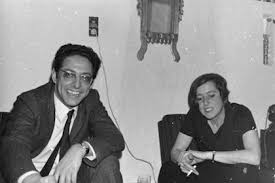
Moktar and Elaine 1972
Algiers, Third World Capital is an amazing insight into how the Algerian independence movement reclaimed their country from the French empire. And Elaine’s story shows how a young Jewish woman could change her life, become involved in worldwide revolutionary movements, and have a happy personal life. Not many women revolutionaries can say that!
My only criticism of the book is that Elaine wrote it without reference to diaries or notebooks, but living through these turbulent events it is not surprising that she chose not to record them at the time.
For Elaine Algeria is still in her heart; “In every gathering, I seek them out, Algerians young and old: they are people with a sense of the past, and I go back with them, and remember. I am young again.”
Buy it, at £16.99, here

 lipstick socialist
Reblogged this on Anarchy by the Sea!.