
IBRG Logo
Today most of us involved in our trade union or community organisation use the internet, including FB and twitter to communicate with our members. In the period of this archive there was no internet and contact with members was made by sending letters, while minutes of a meeting were written in books. There was a great deal of paper as leaflets and posters were produced to publicise events.
IBRG Manchester existed from 1984 to 2002 but there are gaps in the minutes. There are no minutes for the organisation before 1986, although the branch did exist because it produced the defining document “A New Deal for the Irish Community in Manchester” in October 1984. As is often the case people take or misplace files.
1986 is an important year for Manchester IBRG as the branch was revived with new people, particularly women, who joined and changed the profile of the organisation. One of the documents, handwritten by me as secretary of the branch, sums up a year’s organising, so it must be March 1987. I may have written it for the branch AGM or a national meeting as it also refers to the other northern branches.
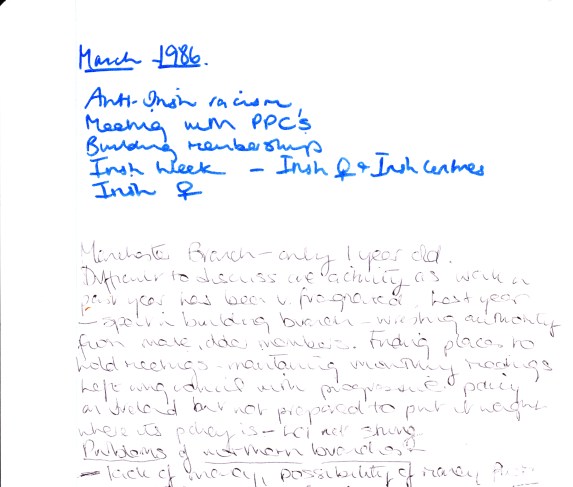
The notes sum up some of the problems of restarting the branch including “wresting authority from older members.” When I came back to Manchester in 1986 the Manchester IBRG meetings were held in Our Lady’s Catholic Centre in Moss Side. To me, and other second generation Irish ( particularly women), it was anathema to have anything to do with the Catholic church. Also, the branch was more of a drinking club for some quite reactionary men.
Taking the meetings away from this inaccessible venue was crucial to bringing in new members, which was not easy as the Irish community was scattered across the city. In the minutes the branch meetings take place in various venues from Manchester Polytechnic to Manchester Town Hall to St.Brendan’s Irish Centre in Old Trafford. Traditional Irish centres , except for St. Brendan’s, were wary of what they saw as a “political group” using their premises. This was not surprising given the police activity at the time which intensely surveilled the Irish community. It also reflected the views of some of the older generation, who were quite happy living in what I termed a “Celtic twilight” ignoring the bigger political issues facing the Irish in Britain and on the island of Ireland.

New members
This change in the profile of the branch is shown in some of the earlier minutes when it votes to donate £15 to a Bolton IBRG member, Margaret Mullarkey, so that she can go on the annual Women’s Delegation to Ireland (ie the North of Ireland). Another issue taken on by the branch is highlighting the use of strip searching of Republican women in prisons in Ireland by holding a meeting to publicise a national campaign.
In the 1980s Manchester had a left wing Council run by Graham Stringer which had a progressive policy on Ireland, due to the influence of an internal Labour grouping: the Labour Committee on Ireland. There was also a local Troops Out Movement as well as remnants of older republican groups such as Sinn Fein.
IBRG was not a party political group, but lobbied the Council to ensure that the Irish were given a proportionate say in their policies for ethnic groups in the City and to try and reflect the reality that the Irish were the largest ethnic minority whose needs had often been marginalised.
The Council had a Race Unit and a Race Committee which sought to represent communities in the city. In the mid 1980s the representatives from the Irish community included Ann Hilferty, a respected member of the community and who joined IBRG. The other representative was an Irish Catholic priest, John Ahearne. This reflected the nature of the established Irish community at that time ie largely Catholic and conservative.
IBRG took up issues around anti-Irish racism that lit a spark within the larger Irish community. In London in 1984 the left wing Greater London Council sponsored a new book on anti-Irish racism written by Liz Curtis called “Nothing But the Same Old Story: The Roots of Anti-Irish Racism showing that it was as old as Britain’s colonial involvement in Ireland.

At a national level IBRG produced policies on anti-Irish racism which led to our branch being involved in activity on this issue eg one of our members stood in a bookshop and read out the Irish jokes to challenge the management. But anti-Irish racism could be found in all parts of the establishment. One of our big campaigns was against the racist stereotyping of Irish men in an educational booklet produced by the Equal Opportunities Commission. We encouraged local Irish people to pass on their examples of racism to the Council’s Race Unit, who would also write letters to the offending organisation.
Challenging anti-Irish racism and discrimination was part of establishing a positive Irish identity, particularly for new generations of Irish children. It drew the links between the Irish who lived in Britain and those on the island of Ireland. IBRG nationally called for a political settlement in the North of Ireland: one that would take into account the view of those on the island of Ireland as well as those in the diasporas of Britain and abroad.
When the Labour Council invited representatives from Sinn Fein to visit the city in 1986 we took part. IBRG’s policy on the conflict in the North of Ireland was about encouraging all parties to get involved in the political process. Over the years IBRG was one of the few Irish community organisations that encouraged the inclusion of Sinn Fein into the process and the right of the Irish in Britain to have a say in any long term settlement.
But, whilst this activity found support within certain sections of the Irish community, those Irish people who were happy to use their Irish identity to gain jobs or positions of power in the establishment, were not so happy. This would surface in conflict over various issues including the Radio Manchester Irish radio programme Irish Line which was taken away from Manchester IBRG and handed over to Irish acceptable to the BBC and became the twee Come Into the Parlour. There was further division over the first Irish Week in 1988 when traditional Irish organisations tried to exclude IBRG events on women, the North of Ireland etc.

 lipstick socialist
Reblogged this on Anarchy by the Sea!.
That was great Bernadette but I dont seem to have received the first one. Can you please resend. You look so pretty at that age(and still do!) C U later xx
Reblogged this on Wessex Solidarity.