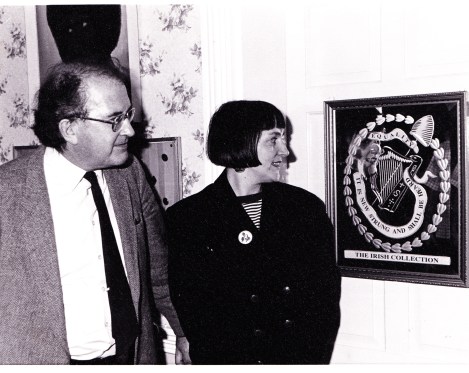
Opening of Irish Collection 1990. Tony Coughlan Executor of Greaves Collection and me, secretary of Manchester IBRG
Over the centuries the Irish have played a key role in the labour and trade union movement in this country. The Working Class Movement Library has some of the most important archives which document this activity and show the continuous thread between generations of Irish and British activists.
In the Irish Collection are the archives of Tommy Jackson and Desmond Greaves. Tommy Jackson (Thomas Alfred “Tommy” Jackson 1879-1955) was a founding member of the Socialist Party of Great Britain, and later the Communist Party of Great Britain. He was a leading communist activist, newspaper editor and a freelance lecturer.
Desmond Greaves (C.Desmond Greaves, 1913-1988), was a political activist and labour historian. He joined the Communist Party of Great Britain in 1934 and in 1941 joined the Connolly Association. The Connolly Association worked to organise Irish workers into trade unions and campaigned for a united Ireland within the Labour movement. In 1948 he became the editor of the Connolly Association’s newspaper the “Irish Democrat” and remained so until his death.
My friendship with Ruth and Eddie Frow and their comrades in the Communist Party and the trade unions showed me the important link that there was and still is between the Irish and radical history in Britain. In the WCML they ensured that this history was collected, they wrote articles and pamphlets to promote this history and always encouraged other people to research and write up that history. They showed the continuous link there is and was between generations, from the United Irishmen to their contemporaries such as Tommy Jackson and Desmond Greaves, while local activists such as Mary Quaile had made a tremendous contribution to labour and trade union politics.
In 1981 a new wave of Irish activists became involved in not just the campaign for a united Ireland but also civil rights and equality for the Irish in Britain. The early 80s were critical times during the conflict in the North of Ireland, it was a time of the hunger strikes when 10 young men died for their right to political status. The 80s was a time when 40,000 Irish people each year were making the journey across the Irish Sea to Britain. It was a time when a new generation of second and third generation Irish people became active in a variety of organisations from the Troops Out Movement to the Irish Abortion Support Group and the Irish in Britain Representation Group. It was a time when there was an active group of people in the Labour Party who fought for a progressive policy on the North of Ireland, supported the rights of the Irish in this country and most importantly, prepared to fund groups such as IBRG.

IBRG Haringay 1980s
Set up in 1981 the IBRG was a community based organisation with branches across the country. There were several in London plus Birmingham, Cardiff, Coventry, Manchester, Bolton, N.E.Lancs, Leeds and Merseyside. Over the years branches flourished and declined by turn, reflecting the problems of organising events and activities and finding activists and funds to keep going.
This new archive will link up with the Jackson and Greaves archives in telling the story of IBRG from 1981-2002. It has much material on the Manchester branch but there are Minute Books from other northwest branches as well national documents, minutes of meetings, leaflets, reports, photographs, videos and ephemerae.
I hope the archive will show what inspired people like me to get involved in IBRG, but also why, as a working class women, it made sense for me not just to be a member of my trade union but also to follow in the footsteps of many other Irish people to campaign for equality for the Irish in this country and a united Ireland.
I am now cataloguing the IBRG archive and will be posting about it as I work through the material.

 lipstick socialist
Reblogged this on Anarchy by the Sea!.
Really looking forward to this. I was in Lewisham IBRG founded in 1986, which was very active and also for a number of years, like yourself on the Ard-Choiste (England-wide Executive).