
In this new book Workers’ Play Time seven scripts written about the struggle for workers and trade union rights are published. The editor Doug Nicholls reminds us of the importance of culture to the struggle for trade union freedom. “Cultural work is central to and an essential part of our struggle; if you ignore it, you blunt your campaign, deaden your organisation, dull your education programme.”
Reading the plays is a history lesson in itself. From Neil Duffield’s play, Bolton Rising, set in 1812 during the Luddite rising to Jane McNulty’s Dare to Be Free, which links the early C20th and the struggle for cafe workers rights to the C21st and fast food workers.
Unlike most of mainstream theatre, the plays remind us of the importance of the ordinary person’s desire for justice, and how this really fuels political activity and change in society.
One of the most interesting chapters is Neil Gore’s explanation of how he researched We Will Be Free! about the Tolpuddle Martyrs. He drew on poems, songs, historical documents and previous productions. It is fascinating, and revealing about the creative process.

James Kenworth’s play A Splotch of Red shows how major historical figures such as Keir Hardie, and less well known activist Will Thorne, can bring to life local politics and remind people about their important radical history.
Eileen Murphy’s play Hannah about north west suffragette and socialist Hannah Mitchell is one of my favourite dramas. Through the use of a monologue Eileen captures the highs and lows of being a working class activist, as well as mother and wife.

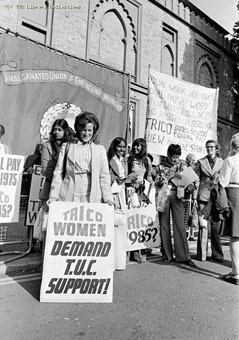
Workers’ Play Time reminds us of a golden era in playwriting and producing, as shown in the introduction to Out! on the Costa del Trico. In the 1970s the Women’s Theatre group worked as a collective with the women sharing the acting and directorial role. They concentrated on taking their work out to the excluded, including girls in youth clubs, schools and working class women factory workers. But this production about a six month strike by women for equal pay at a US-owned factory Trico in 1976 was not without controversy, particularly using white women actors to portray Asian workers and the criticism of the theatre company by some women union members.
Our play, Dare to Be Free, was a much more limited production. As a small group of volunteers we had to raise funding from individuals and trade unions and were lucky to get a playwright, Jane McNulty, and director, Bill Hopkinson, who took us through the whole process of getting a play out into the world.
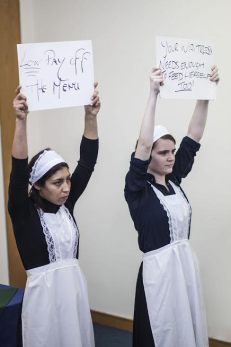
Our aim was not just to remember Mary, a tremendous fighter for equality for women at work, but also to link it up her activity with fast food workers today. The play took the audience from 1908 to 2016. This led to important links with trade unions including Mary’s own union Unite, as well as the Hotel Workers Unite in London, and the GFTU – for whom Mary also worked – and the BFAWU locally.
Worker’s Play Time showcases some powerful productions, but also reminds us that the issues highlighted in the plays have not gone away, including justice and equality at work. The Chambermaids, which was written in 1987, could be set today in the hotels across the country, and shows how the bread and butter issues of working conditions are still to be fought for by unions such as Unite Hotel Workers branch.
The GFTU and Doug Nicholls are to be applauded for getting this anthology out into the public arena. It is a reminder of the power of political theatre and how we are all diminished by its scarcity in 2017. Jim Allen, one of my favourite writers said about drama that it should make you angry, angry enough to want to go and do something. I hope this collection will inspire and stir up workers out there…
Buy it here

 lipstick socialist
Reblogged this on Wessex Solidarity.
Looks great Bernadette but no time to read it! x
On 12 October 2017 at 10:04, lipstick socialist wrote:
> lipstick socialist posted: ” In this new book Workers’ Play Time seven > scripts written about the struggle for workers and trade union rights are > published. The editor Doug Nicholls reminds us of the importance of > culture to the struggle for trade union freedom. “Cultural work is ” >