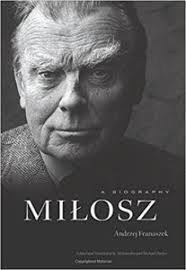
Andrzej Franaszek’s biography of the great Polish poet Czeslaw Milosz is more than the story of one man’s life: it is a compelling history of Eastern Europe in the twentieth century. Milosz was born in 1911 in Lithuania but during his lifetime the whole geography of his homeland was redrawn. Reading this book, it feels as if one is travelling with Milosz as he navigates the First World War, the Russian Revolution, the Nazi invasion and occupation of his homeland, and the new world order post-1945 when Poland became part of the Soviet sphere.
The narrative runs alongside the numerous poems and prose writings through which Milosz tried to make sense of his constantly changing world. In his poetry he tried to explain his experiences as he lived through different kinds of exile, until he finally defected from Poland to the West in 1951.
Milosz might have physically left his homeland, but he always wrote his poetry in Polish. His words reflected his life, his unrelenting hope for the future, and later on, his more spiritual view of the world.
In his speech accepting the Nobel Prize for Literature in 1980 he reflected on his life; “It is good to be born in a small country where Nature was on a human scale, where various languages and religions cohabited for centuries. I have in mind Lithuania, a country of myths and poetry. My family already in the sixteenth century spoke Polish, just as many families in Finland spoke Swedish and in Ireland, English: so I am a Polish, not a Lithuanian poet.”
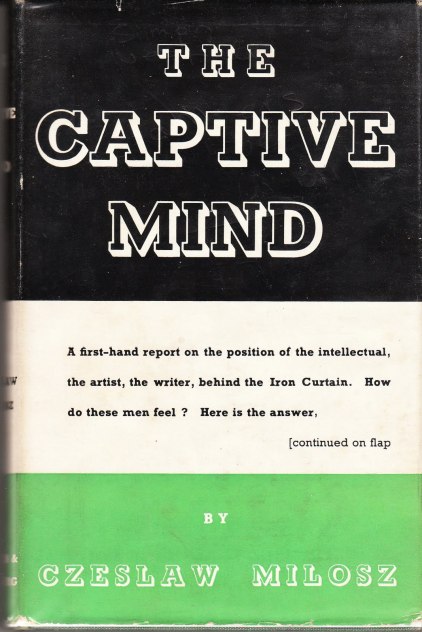
In 1953 his essay “The Captive Mind” he explained why he was not prepared to play first violin in Stalin’s orchestra of Socialist Realism. For him this was anathema to his whole existence. “”Socialist Realism” is much more than a matter of taste…It is concerned with the beliefs which lie at the foundation of human existence. In the field of literature it forbids what has in every age been the writer’s essential task – to look at the world from his own independent viewpoint, to tell the truth as he sees it, and so to keep watch and ward in the interest of society as a whole.”
In 1960 Milosz went to live in the USA, a secular and materialist culture that reinforced his Polish identity as a poet who worked in his own language for a Polish audience. In twenty years he wrote five volumes of poetry. He did not seek a public audience, but worked closely with his students and was generous in promoting other Polish poets. His audience in the USA was small, but unknown to Milosz, as Franaszek reveals, his works were being avidly read in Poland.
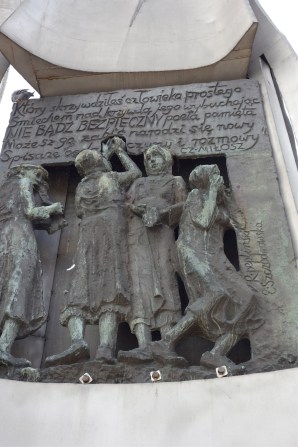
Changing events in Poland, including the emergence of the independent trade union Solidarity, led to a growing interest in Milosz and other Polish writers.When Solidarity finally won recognition as an independent, self governing trade union in 1980 one of the first things the union did was to construct a monument to commemorate those killed during strikes in Gdansk ten years earlier. Lines from one of Milosz’s poems “You Who Wronged” were inscribed on the monument’s plinth.
In 1980 he was awarded the Nobel Prize for Literature, and, typically, after a press conference was quickly organised at his university, he cut it short to return to his lecturing.
In 1999 he was welcomed back to Poland and lived there until his death five years later.
Franaszek’s biography is a masterpiece. It is readable, thought provoking and a fitting tribute to one of Europe’s finest poets. Probably best to order from your library as it is quite expensive at £24.

 lipstick socialist
Reblogged this on Anarchy by the Sea!.
Thanks for bringing this book to our attention. Fortunately, it’s available less expensively in the US. Perhaps we should also credit the translators, Aleksandra and Michael Parker.