
This is my fourth post about the Manchester and Salford Women’s Trade Union Council, and covers the years 1903-1905.
By 1903 the Council was an established organisation which individuals and organisations contacted, not just for help with organising women into trade unions, but was also contacted by national and local organisations to gain information and support.
Organising Secretary Eva Gore Booth became a representative on the Manchester City Council Education Committee which gave the Council the opportunity to lobby on behalf of women. An example of this is in May 1903 they protested against girls being excluded from scholarships for the Municipal School of Technology.
Women contacted them about getting help to form unions from as far away as dressmakers in Sligo in Ireland to the women Chain Makers in Cradley Heath in Birmingham. Eva was asked by the Hanley Trades Council to speak at their Labour Day to encourage women to get organised into trade unions.
New groups of women including cafe workers, were contacting the Council, highlighting issues of long hours, low pay and unhealthy work conditions. Messrs. Roberts Cafe was mentioned by an anonymous worker – possibly Mary Quaile – who later on in 1911 joined the Council as an Assistant Secretary.
Council meetings were now to be held alternately in the afternoon and the evenings so the women secretaries could attend.
The Council also stepped in when women could not access union funds. In April 1904 a fire in a local mill meant that 80 to 90 women lost their jobs. Their Union, the Winders, could only provide financial help after 5 weeks. The Council issued a circular on behalf of the women asking for financial help from other trade societies. The Weavers’ Union, a large and relatively well-off union, lent £20. Financially independent women on the Council – including Margaret Ashton, Miss Gaskell and Mrs. Schwann -gave £5 each.
But the question of the vote for women was to rock the Council in the autumn of 1904. Leading activists Eva Gore Booth, Sarah Dickenson and Christabel Pankhurst felt that the Council should, alongside other trade union and progressive organisations, support the suffrage campaign. In a motion Christabel Pankhurst urged the Council; “That it is now time that the Council should bring their policy into line with that of the Unions with which they are connected by taking active part in the effort to gain political power for the women workers.”
But other members of the Council objected, saying that it was down to individual trade unions to support the campaign, and it would alienate their subscribers and friends. Christabel’s motion was defeated and she, plus Eva and Sarah, resigned from the Council. Affiliated unions such as the Salford Weavers with 800 members followed them, as well as six other trade unions. They went on to form a new organisation, which in its name reflected the politics of the day; the Manchester and Salford Women’s Trades and Labour Council.
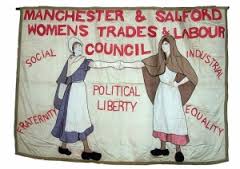
This spilt damaged the Council and in 1905 its work declined. The number of meetings they held annually went from 14 to 11.They now employed only a single Secretary Olive Aldridge, and concentrated on helping to organise smaller unions including; Sewing Machinists, India Rubber Workers, the Bakers and Confectioners, Fancy Leather Workers and Telephone Operators.
The Sewing Machinists and Bakers and Confectioners now became represented on the Council.
The Council continued to step in over cases of victimisation of trade union women. In October 1905 two women from the Leather Workers Union were dismissed from their jobs supposedly because of a lack of work. Mrs. Aldridge visited the firm and discovered it was because of their trade union activity. Unfortunately neither she nor the Union could get the women their jobs back but the Council gave a grant of 6/- a week to the women until they got work or the Union was able to support them financially.
Over the next few years the Council had to rebuild its organisation and obtain funding from new trade union organisations as well as relying on their wealthier subscribers.
To read about the MSWTUC Transcription Project see
Donations are welcome to continue this project – there are 23 years of Minutes- please contact maryquaileclub@gmail.com

 lipstick socialist